
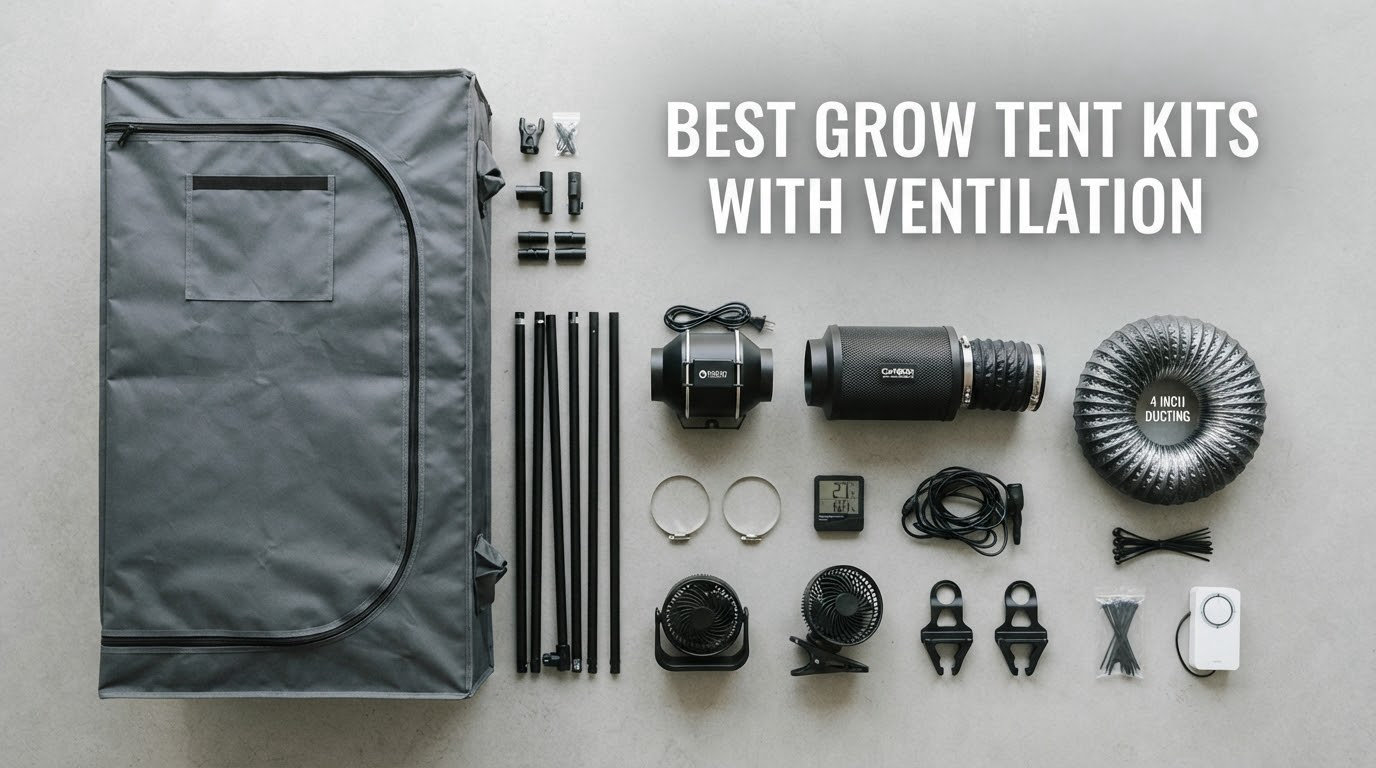
Most people searching for the best grow tent kit with ventilation picture a box that opens into a finished grow room. The reality is messier: some bundles arrive with a proper inline duct fan, an activated carbon filter and matched ducting, while others include a tent, a light and a clip fan and leave the actual air handling to you. We spent weeks comparing the ventilation hardware that comes in the box with what you end up buying later, because that single difference decides whether a kit saves you time or quietly costs you money.
A grow tent kit with ventilation means five specific things: an inline duct fan that pulls air through the tent, an activated carbon filter that traps odor molecules, flexible ducting to move the air, at least one intake opening so fresh air can enter, and a clip fan to stir the air across your plants. A clip fan alone is not ventilation in that sense. It moves air inside the chamber but does nothing about heat, humidity or smell leaving the tent, which is exactly what an exhaust system solves.
That distinction matters more than any other spec in this roundup. Grow lights dump heat into an enclosed space, plant transpiration pushes humidity up, and any odor-producing crop will announce itself to the rest of the house unless air exits through a filter. If you are still choosing a lighting setup, our guide to the best grow light systems for indoor plants covers wattage coverage, but light choice and air handling are two separate decisions.
We reviewed 12 complete grow tent kits, checking what each one actually includes for air handling, how much duct capacity the included fan offers, whether the included light can carry the footprint, and what reviewers consistently complain about. The short version: the best complete grow tent kit for most people includes a real 4-inch inline fan and carbon filter sized for a 2×2 or 2×4 space, and the most common disappointment is a bundle that includes a light too small for the tent it came with.
Below is every kit we evaluated, followed by a ventilation-first buying guide covering airflow math, intake versus exhaust setup, carbon filter replacement, and when it makes more sense to skip the kit entirely and build a system from parts.
Table of Contents
Top 3 Best Grow Tent Kits With Ventilation for October
These three kits are the strongest combinations of proven review history, correct chamber sizing and build quality. Two of them include a properly matched inline fan and carbon filter, and the third is a tent built to take serious air handling. So the decision comes down to footprint and how much you want to spend growing beyond the first cycle.

VIVOSUN P448 4×4 PRO Grow Tent
- 2000D Oxford canvas
- 22mm steel poles
- 400 lb load capacity
- 4 CFM support poles included

IPOW 2×2 Complete Grow…
- 4 inch 190 CFM inline fan
- carbon filter and ducting included
- 100W dimmable LED
- 600D oxford frame

G HYDRO 3×3 WiFi App Contro…
- 1680D Oxford canvas
- 54 cubic foot chamber
- WiFi app scheduling
- integrated controller
The VIVOSUN P448 takes the top spot on evidence rather than hype. It carries 630 reviews at a 4.5 star average, the largest feedback base in the group, and it is the only tent here built specifically to be braced against a powerful extraction fan, with four extra support poles included for exactly that purpose. It is an enclosure only, so you choose and size the ventilation hardware yourself.
The IPOW 2×2 is the best value pick because it is the rare bundle where the air handling matches the footprint. A 4-inch 190 CFM inline fan, a carbon filter, 8 feet of ducting, clamps and a 100W dimmable LED all arrive together, which is a working 2×2 system on day one.
The G HYDRO 3×3 is the pick for anyone who wants remote control. It is the only kit in this roundup with an integrated controller and WiFi app scheduling built into the enclosure, wrapped in 1680D Oxford canvas with a reflective lining. Reviewers do note that a 54 cubic foot chamber may want more airflow than the default setup delivers, so plan an upgrade for the hot months.
All 12 Grow Tent Kits With Ventilation Compared in 2026
The table below covers every kit in the roundup with the ventilation hardware and chamber details that decide whether it works out of the box. The feature column reflects what each bundle actually includes, not what the listing implies.
| Product | Specs | Action |
|---|---|---|
| VIVOSUN P448 4×4 PRO Grow Tent with High CFM Kit |
|
Check Latest Price |
| IPOW 2×2 Complete Grow Tent Kit |
|
Check Latest Price |
 TopoGrow 2×2 S1000 Complete Grow Kit TopoGrow 2×2 S1000 Complete Grow Kit |
|
Check Latest Price |
 SUPERGROWER 4x2x6 Complete Grow Tent Kit SUPERGROWER 4x2x6 Complete Grow Tent Kit |
|
Check Latest Price |
| G HYDRO 3×3 WiFi App Control Grow Tent Kit |
|
Check Latest Price |
 TopoGrow 32x32x63 APE600 Grow Tent Kit TopoGrow 32x32x63 APE600 Grow Tent Kit |
|
Check Latest Price |
 MELONFARM 2×2 Kit With 100W LED and 190 CFM Fan MELONFARM 2×2 Kit With 100W LED and 190 CFM Fan |
|
Check Latest Price |
 MELONFARM 2×2 Kit With 70W LED and 190 CFM Fan MELONFARM 2×2 Kit With 70W LED and 190 CFM Fan |
|
Check Latest Price |
 iMeshbean 2×2 Kit With Fan Speed Controller iMeshbean 2×2 Kit With Fan Speed Controller |
|
Check Latest Price |
 iMeshbean 32x32x63 Kit With Fan Filter and Hydro Parts iMeshbean 32x32x63 Kit With Fan Filter and Hydro Parts |
|
Check Latest Price |
 THEBUDGROWER 24x24x60 Kit With Dual 300W Light THEBUDGROWER 24x24x60 Kit With Dual 300W Light |
|
Check Latest Price |
| iMeshbean 48x24x80 Kit With 80 Inch Height |
|
Check Latest Price |
1. VIVOSUN P448 4×4 PRO Grow Tent with High CFM Support Kit
VIVOSUN P448 4×4 PRO Grow Tent with High CFM Kit, 48″x48″x 80″
48x48x80 tent
2000D Oxford canvas
22mm poles
400 lb load capacity
Fan and filter sold separately
Pros
- Largest review base in the group at 630 reviews
- Three-layer 2000D Oxford canvas with reflective Mylar lining
- 22mm steel poles with four hanging bars
- CFM support poles brace the frame against extraction fan vibration
Cons
- No light
- fan or carbon filter in the box
- Some owners report minor zipper light leaks
- Vent openings described as small for humidity control
We chose the VIVOSUN P448 as our best all-around pick because it is the only enclosure in this roundup engineered around the fact that a strong extraction fan will shake a tent apart. It includes four dedicated CFM support poles, four hanging bars, and a frame rated to 400 pounds, which is exactly the load profile a filtration setup creates when ducting, fans and hanging lights all load the top bars at once.
The canvas is the thickest in this group at 2000D Oxford, with a plant-friendly PE inner layer and a 100% reflective Mylar lining. That matters more than most buyers expect: the Mylar is what pushes light back down onto the canopy instead of soaking it into the walls, and the PE layer is what stops the interior from becoming a sticky, humid surface that grows mildew.
This is the caution we would repeat to anyone buying it. Despite the name and the CFM support poles, no fan, no carbon filter and no light are in the box. You are buying the best tent in the roundup and assembling the rest of the system yourself, which is a fair trade at this quality level but not what a first-time buyer expecting a complete kit has in mind.
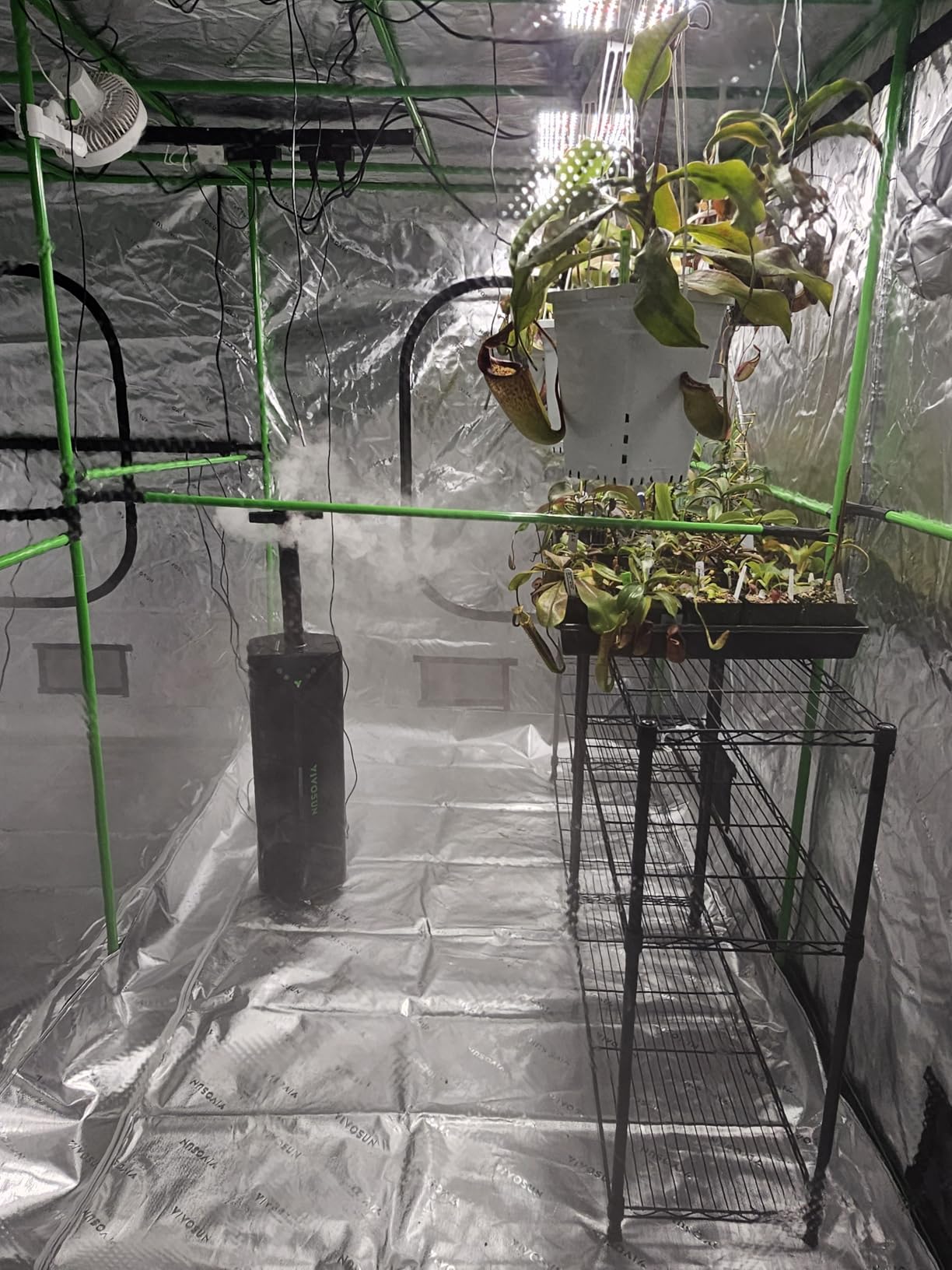
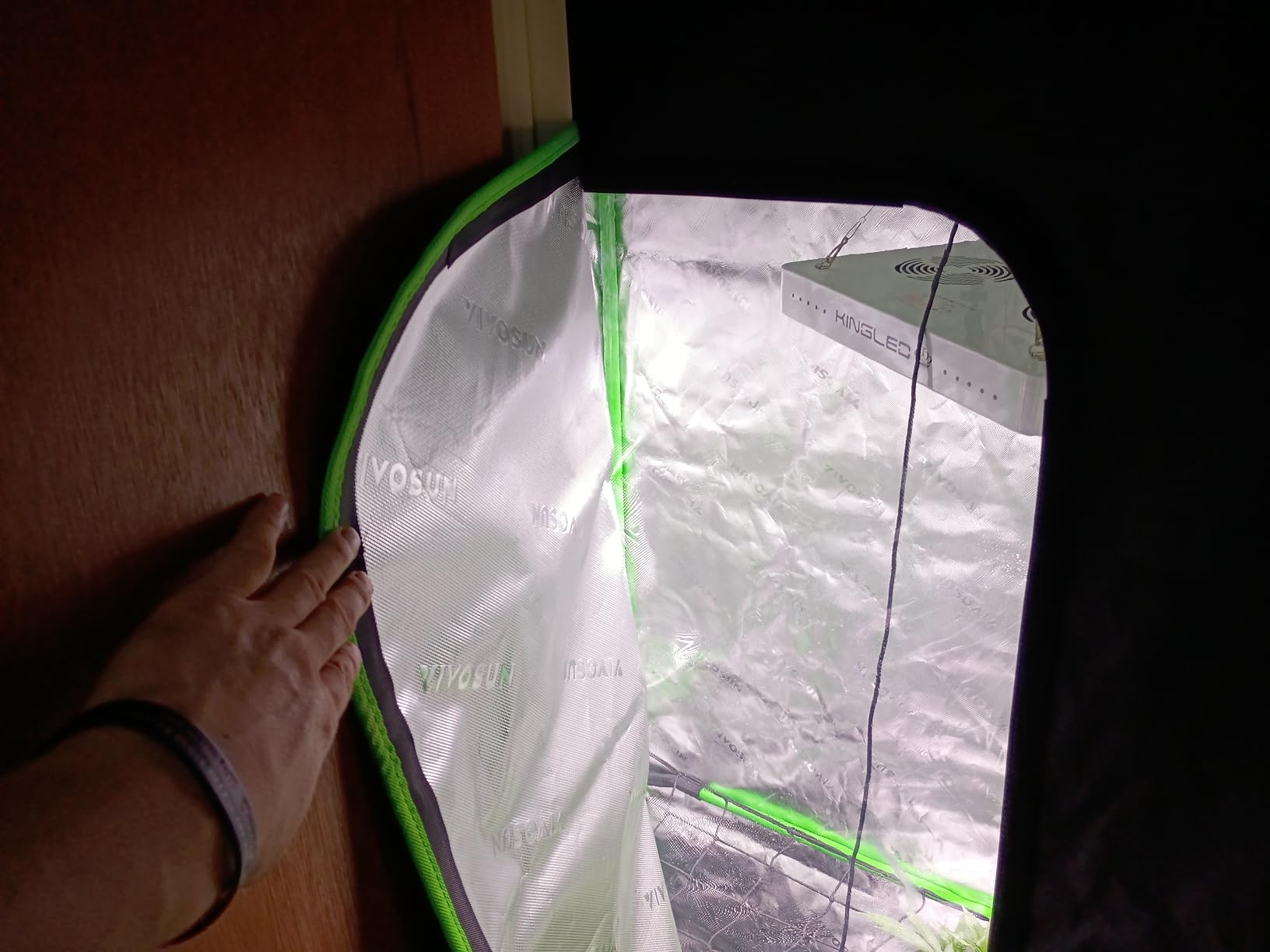
Build quality is the story across all 630 reviews. Reviewers consistently single out canvas thickness, pole gauge, Mylar reflectivity and the fit of the zippers. The removable SBS zipper door with hook-and-loop side fasteners and a large observation window make daily inspection easy without opening the whole front panel, and cable management slots along the top keep runs tidy.
The honest negatives are small but real. A few owners report faint light leaks at the zipper sections that need an interior tape flap to close fully, and some describe the vent openings as too small or too few to control humidity without a dedicated fan. At 48 by 48 by 80 inches, assembly is a two-person job, particularly when you are also fitting a filter housing to a rear port.
Why we picked the P448 over a bundled kit
Because a 4×4 tent with a real filter setup needs a frame that can take the load and a fabric that seals. The 400 pound rating and 22mm poles give you headroom to hang a light, a filter and ducting simultaneously, and the 2000D canvas means you are not replacing the enclosure after two seasons. Every fully bundled kit we reviewed pairs that frame quality with a 100W or 38W light, which is a mismatch at 4×4 scale.
If your plan is a serious multi-plant setup with training, the extra spend on this tent is money you keep. You are also not locked into one light brand, one fan brand or one filter size.
What you have to add yourself
You need an inline duct fan, an activated carbon filter matched to that fan, enough ducting to reach a wall or window, and a clamp set. A 6-inch fan and filter pair is the right starting point for a chamber this size, and you will want an intake opening with a small fan on it to hold negative pressure rather than letting air leak in wherever it can.
You also need a light, and that is the single largest gap in this package for anyone starting from nothing. A 4×4 footprint with a 2000D reflective interior needs far more light output than any light bundled in this roundup, so plan this as a tent-first purchase rather than an all-in-one purchase.
2. IPOW 2×2 Complete Grow Tent Kit With 190 CFM Inline Fan
IPOW Grow Tent Kit Complete System 2×2 ft with VS1000 Led Grow Light, 4 Inch 190CFM Inline Fan, Carbon Filter and 8ft Ducting Combo, 24″ x 24″ x 55″
24x24x55 tent
4 inch 190 CFM inline fan
Carbon filter and 8 ft ducting
100W dimmable LED
600D oxford
Pros
- Genuine all in one bundle with fan
- filter and ducting
- Inline fan and filter have ample capacity for a 2x2
- Alloy steel frame with double stitching and light blocking zipper
- Reflective mylar interior and waterproof floor tray
Cons
- Inline fan is loud and has no speed control
- Some reports of early inline fan failure
- Thermometer and hygrometer arrive without a battery
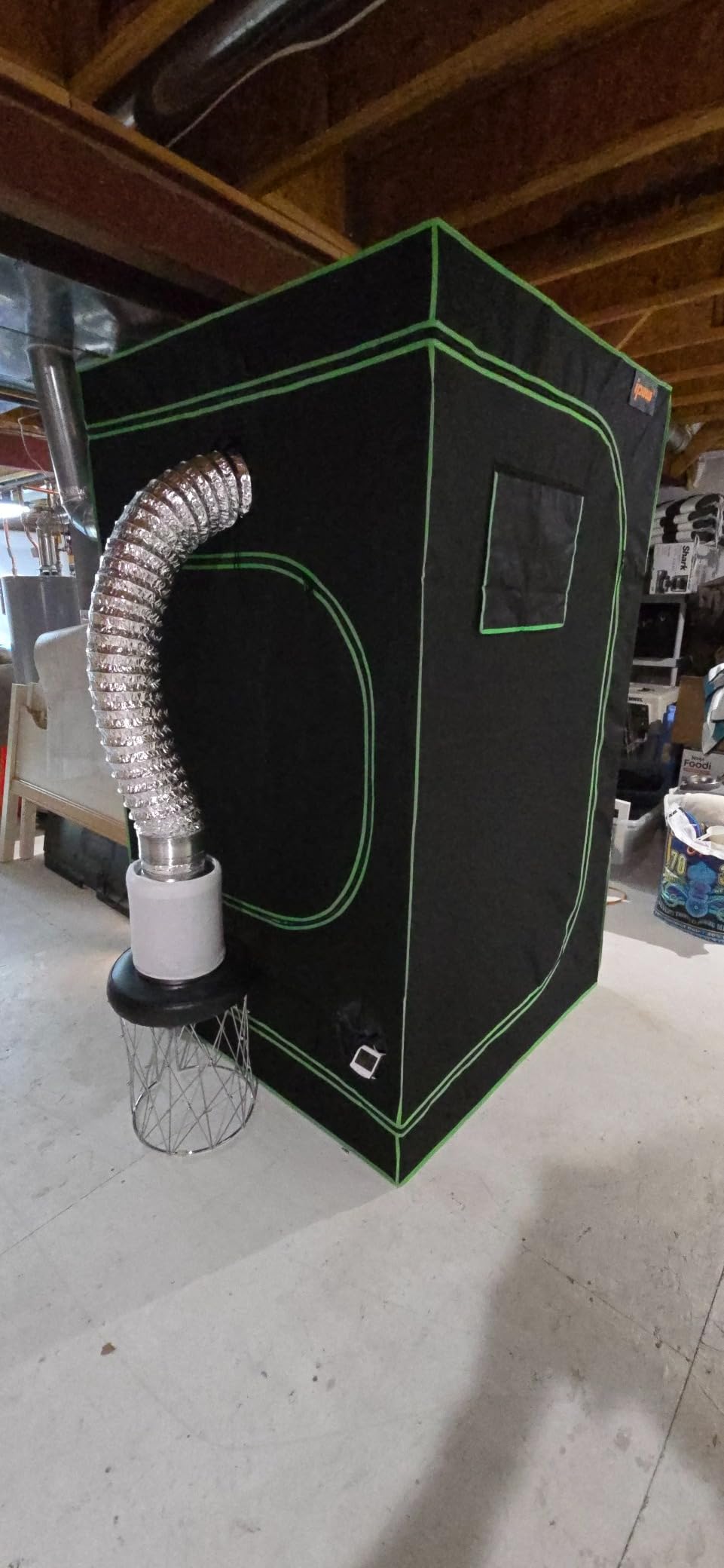
The IPOW 2×2 is the bundle we would hand to a first-time grower, because the air handling is sized correctly for the tent rather than tokenised. You get a 4-inch inline duct fan rated at 190 CFM, a carbon filter, 8 feet of ducting, three duct clamps, and a 100W dimmable full spectrum LED using 240 diodes. Nothing about that list is a placeholder.
That 190 CFM figure matters. Most 2×2 chambers need something in the 80 to 120 CFM range to exchange air comfortably several times an hour, so this fan is not just adequate, it leaves headroom for a second stage of intake or a bigger filter later. The 24 by 24 by 55 inch tent gives 17 cubic feet of chamber volume, which is a comfortable single-plant to three-plant footprint.
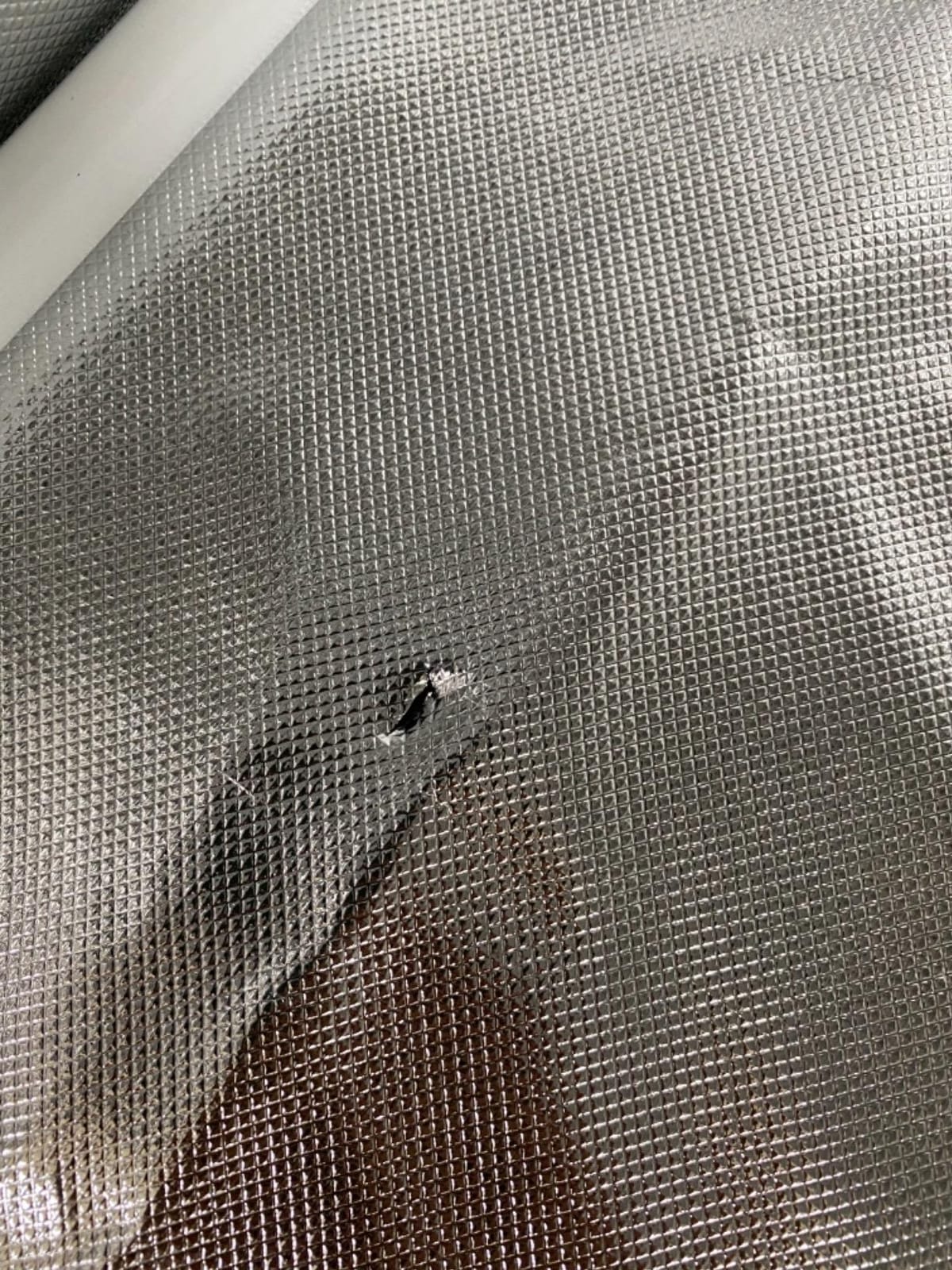
Construction is solid for the tier. The exterior is heavy duty 600D oxford cloth over an alloy steel frame, with double stitching and a light-blocking zipper, and the interior is reflective mylar over a waterproof floor tray. At 15.63 kg the whole package is a two-person lift from a box but a one-person build in a spare room.
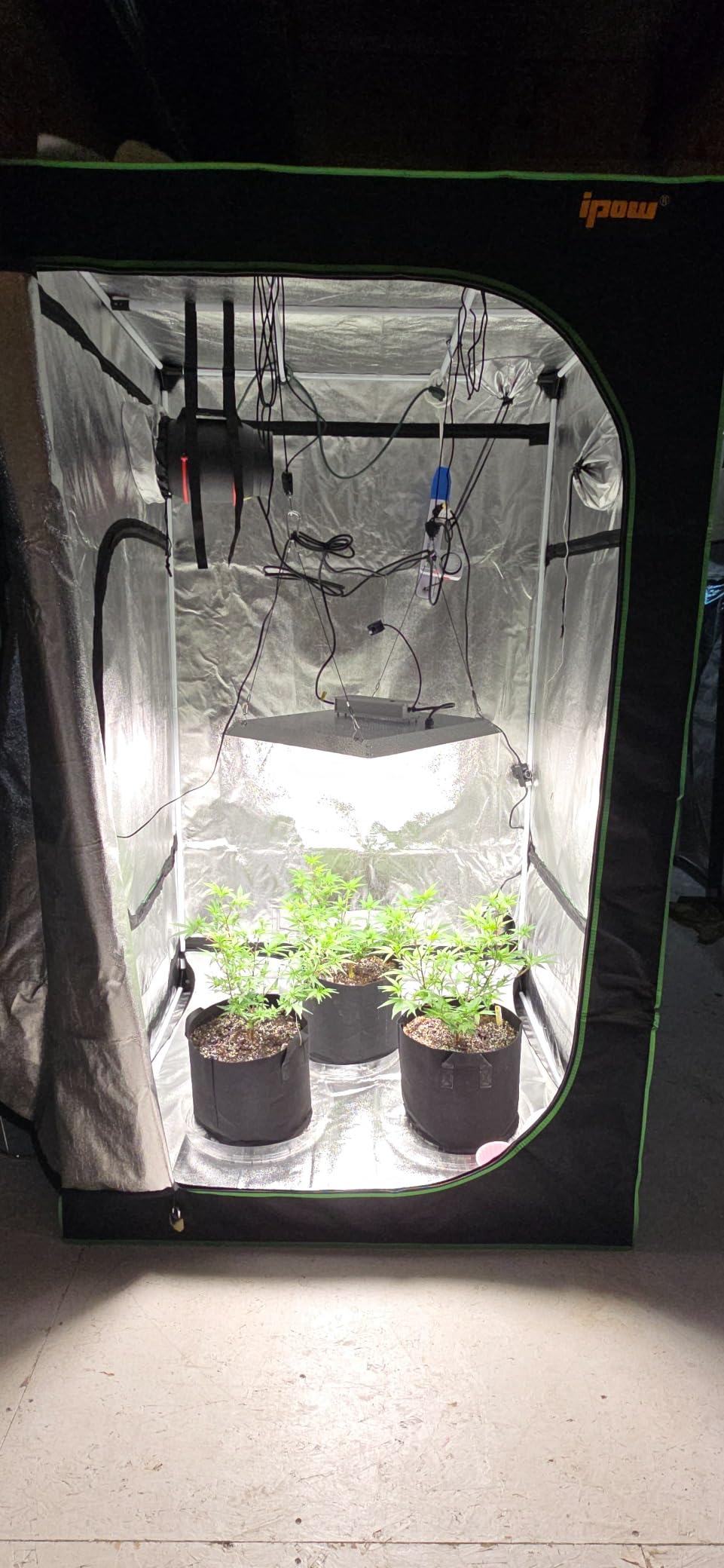
Owners consistently treat this as a strong first-grow kit. The 288 reviews break down to 67 percent at five stars and 16 percent at four, and the recurring praise is about construction quality, how well the tent holds light, and the fact that the included fan and filter have more capacity than the chamber requires. For a first cycle, that combination removes almost all the guesswork.
The recurring complaint is noise, and it is a genuine one. The inline fan runs loud and has no speed control, so a number of owners add an external speed controller. Running a fan slower and more continuously is also the approach experienced growers on growing forums recommend, since quieter moderate airflow beats loud full-speed airflow for both your ears and your electricity use.
Two smaller issues: some reviews report the inline fan failing early, and the included thermometer and hygrometer arrive without their button-cell battery, with no battery size stated. A cheap hygrometer is still worth buying separately anyway, since the included one is a rough indicator rather than a calibration-grade instrument.
Why we picked the IPOW over the other 2×2 bundles
Because it is the only 2×2 in this roundup that pairs a 100W light with a documented 190 CFM fan rating and 8 feet of ducting, and it does so at 288 reviews rather than 28. The competing 2×2 bundles either ship a 70W or 38W light, or leave the intake side and the speed control for you to source separately.
It also includes the small things that turn a box of parts into a working setup: clamps, a timer, rope hangers and grow bags. That is a real convenience difference on a first build.
What it is not good at
Quiet operation in an apartment. With no speed control on the fan, this kit runs at one setting, and that setting is audible in a shared-wall building. If noise is the deciding factor, the MELONFARM kits with a rubber duct coupling are the ones to look at, or add a small speed controller to this one.
It is also not a good match for anyone who wants a taller canopy space or a strong light. At 55 inches tall and 100W, it suits a compact vegetative setup or a seedling and clone station. Push it into full flowering and you will replace the light before you replace anything else.
3. TopoGrow 2×2 S1000 Complete Grow Kit
TopoGrow Upgrade Integrated Auto 2’X2′ Grow Tent Kit Complete System, S1000 LED Grow Light, Grow Tent with 4“Ventilation Kit, Inline Fan&Carbon Filter, Irrigation Kit, Humidifier and Clip Fan
24x24x48 tent variant
190 CFM 120V inline fan
1.5 inch coal-based carbon filter
25 ft ducting
S1000 dimmable light
Pros
- Exceptionally long accessory list for the parts count
- Irrigation kit
- humidifier
- trellis netting and clip fan included
- 190 CFM fan paired with a 1.5 inch activated carbon bed
- Light dims 10 to 100 percent on the included 24 hour timer
Cons
- Instructions frequently reported as missing or too thin
- Included S1000 light is small for the tent footprint
- 2x2x48 height wastes vertical space in a high ceiling room
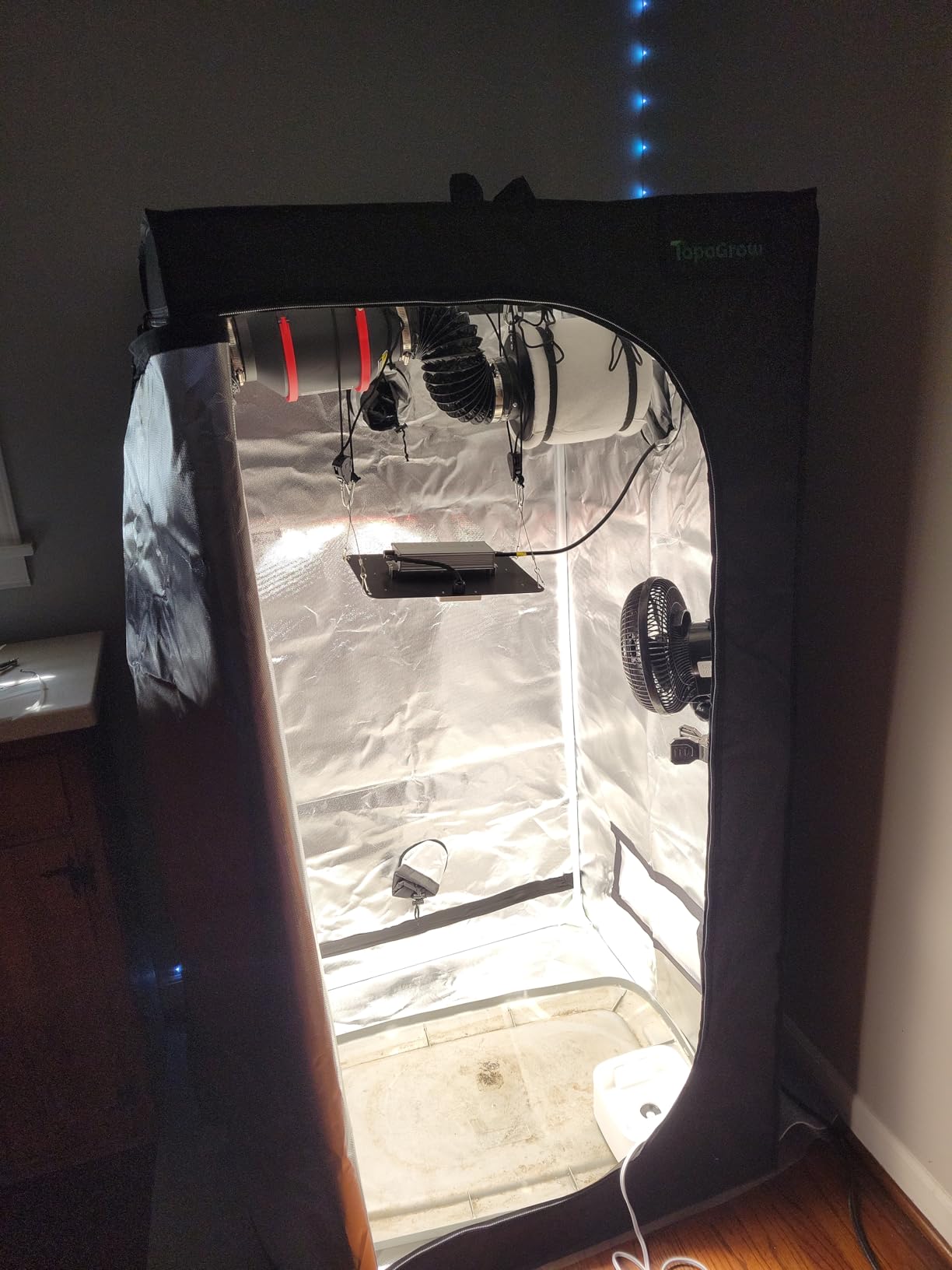
The TopoGrow 2×2 is unusual because it is less a grow tent kit and more a complete starting inventory. Alongside the tent, S1000 light, inline fan, carbon filter and 25 feet of ducting, you get a nursery pot set, fabric grow pots, an irrigation kit, a humidifier, a clip fan, trellis netting, a plant tray, a thermometer, a timer and rope hangers. There are very few bundles where the list genuinely runs this long.
The ventilation core is properly specified. A 190 CFM 120V 60Hz inline fan sits in line with a 1.5 inch coal-based activated carbon bed held in steel mesh, which is a thicker carbon layer than most bundles in this roundup manage. The 25 feet of ducting is the longest run included anywhere here, and three galvanized clamps are supplied to make the joints airtight.
On the tent itself, you get 600D oxford cloth with a high-reflective waterproof diamond Mylar lining, heavy duty zippers and mesh vents. Both a 24 by 24 by 48 inch and a 32 by 32 by 64 inch variant are offered, so the same bundle covers a small and a medium footprint.
Buyers frequently describe this as the best value they found after comparing many brands, and the 330 reviews at a 4.0 average put real weight behind that claim. The light is dimmable from 10 to 100 percent and works with the included 24-hour timer, which is more control than most bundles at this level offer.
The 4.0 average also tells you where the friction sits. Fourteen percent of reviews are one star, and that cluster is concentrated on two things: assembly documentation and the included light. Instructions are frequently reported as missing from the box or too thin to follow, which is frustrating when the tent has several ports and an irrigation kit that needs assembly.
The S1000 light is the other recurring complaint. Growers describe it as undersized for the tent footprint, and that is consistent with what we would expect: 300 watts of rated wattage across a 2×2 sounds adequate on paper but leaves little headroom once the Mylar lining and canopy shading are factored in. Budget for a light replacement, or use this kit as a propagation and vegetative station.
Who this kit suits
It suits a beginner who wants one box to open on day one and does not want to research which clip fan pairs with which irrigation line. The included humidifier, trellis netting and 24-hour timer cover the pieces that usually turn into a second shopping trip a week later.
It also suits anyone starting a propagation or clone run, where a 2×2 footprint and a modest light are exactly the right size. The 32 by 32 by 64 variant works as a small multi-plant vegetative tent for the same reason.
Where it falls short
Documentation and light output. The thin or missing instructions mean you will be researching port placement mid-build, which is exactly the frustration growing forum users describe about kits in general. And a light that most owners eventually replace makes the bundle’s headline convenience less valuable than it appears.
The 48 inch tent height is also among the shortest formats in this roundup. In a room with a high ceiling that is a lot of wasted vertical space, and there is no way to train a plant upward inside it.
4. SUPERGROWER 4x2x6 Complete Grow Tent Kit
Grow Tent Kit Complete 4X2X6 FT (Heigth Increase),S100 LED Grow Light GrowTent Complete System with Clip Fan+LED Light+Grow Tent+Humidifier+Clip Fan+Drip Kit+Heater+4″ Fan Filter
4x2x6 ft tent
4 inch vent fan with carbon filter
6 inch oscillating clip fan
100W LED
4L humidifier
Pros
- Taller 4x2x6 format gives real vertical room
- Includes drip irrigation
- humidifier and ceramic heater
- 4 inch exhaust fan and carbon filter as standard
- 600D canvas with double stitched zippers
Cons
- Bundled 100W light is small for a 4x2x6 footprint
- Humidifier and timer are simple add-on accessories
- Ceramic heater is supplemental rather than climate control
The SUPERGROWER 4x2x6 solves a problem most 2×2 bundles ignore: height. Where most compact kits stop at 48 to 55 inches, this tent is 48 by 24 by 70 inches, which is enough headroom to hang a light above a canopy that has stretched. For anyone who has watched a plant hit the ceiling of a short tent, that extra headroom is the whole point of this package.
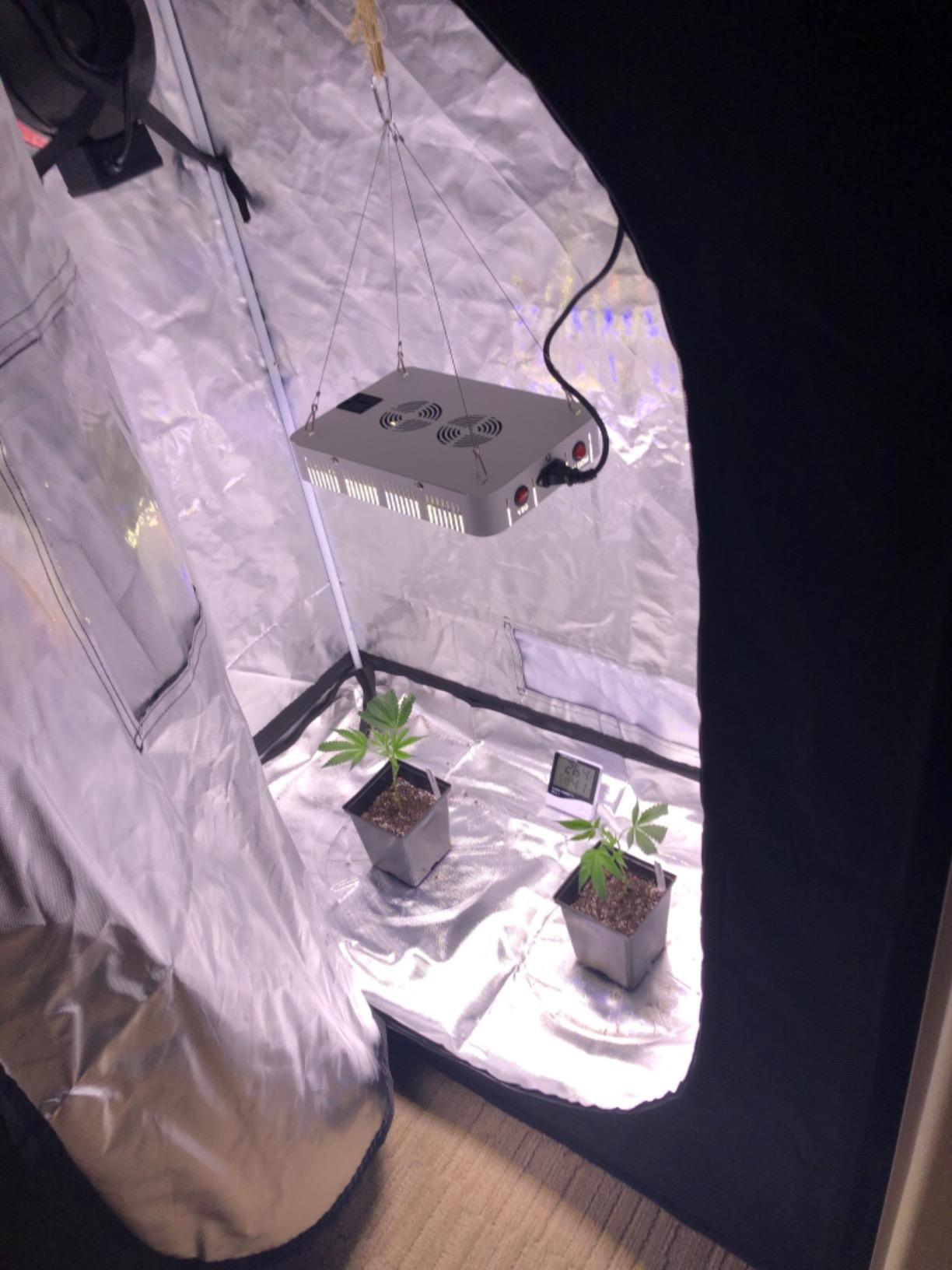
Its climate bundle is unusually complete. You get a 4 inch exhaust fan with a carbon filter for the exhaust side, a 6 inch oscillating clip fan for canopy circulation, a 4 litre digital humidifier with four mist levels and an LCD temperature and humidity readout, a drip irrigation system with 5, 15 and 30 minute run times and 0.5, 1.0 and 2.0 hour intervals, and a ceramic heater. Few competing kits address both ends of the climate problem at once.
The floor tray is 600D canvas with a tear-proof, double-stitched zipper design, and the steel frame is rated for hanging weight across the top. The chamber is listed at 16 cubic feet, which is a sensible working volume for a narrow, tall tent.
Owners value the breadth of the bundle and the taller format, which is exactly what the 126 reviews at 4.2 stars reflect. Sixty-one percent of reviews sit at five stars, and the drip system in particular gets called out for its timing modes, which is more control than a basic gravity setup gives you.
The central weakness is light-to-footprint mismatch. A 100W full spectrum LED across a 4 by 2 footprint covers the middle of the tent well and the edges poorly, and it is far short of what the tent volume needs once you run the full height. Most owners run it as a vegetative or early flower setup and upgrade the light.
The humidifier, timer and ceramic heater are worth being honest about. They are simple add-on accessories, and growers consider them filler in a package that already carries a long accessory list. A heater is a useful safety net in a cold room, but it is not a substitute for controlling heat in a warm one.
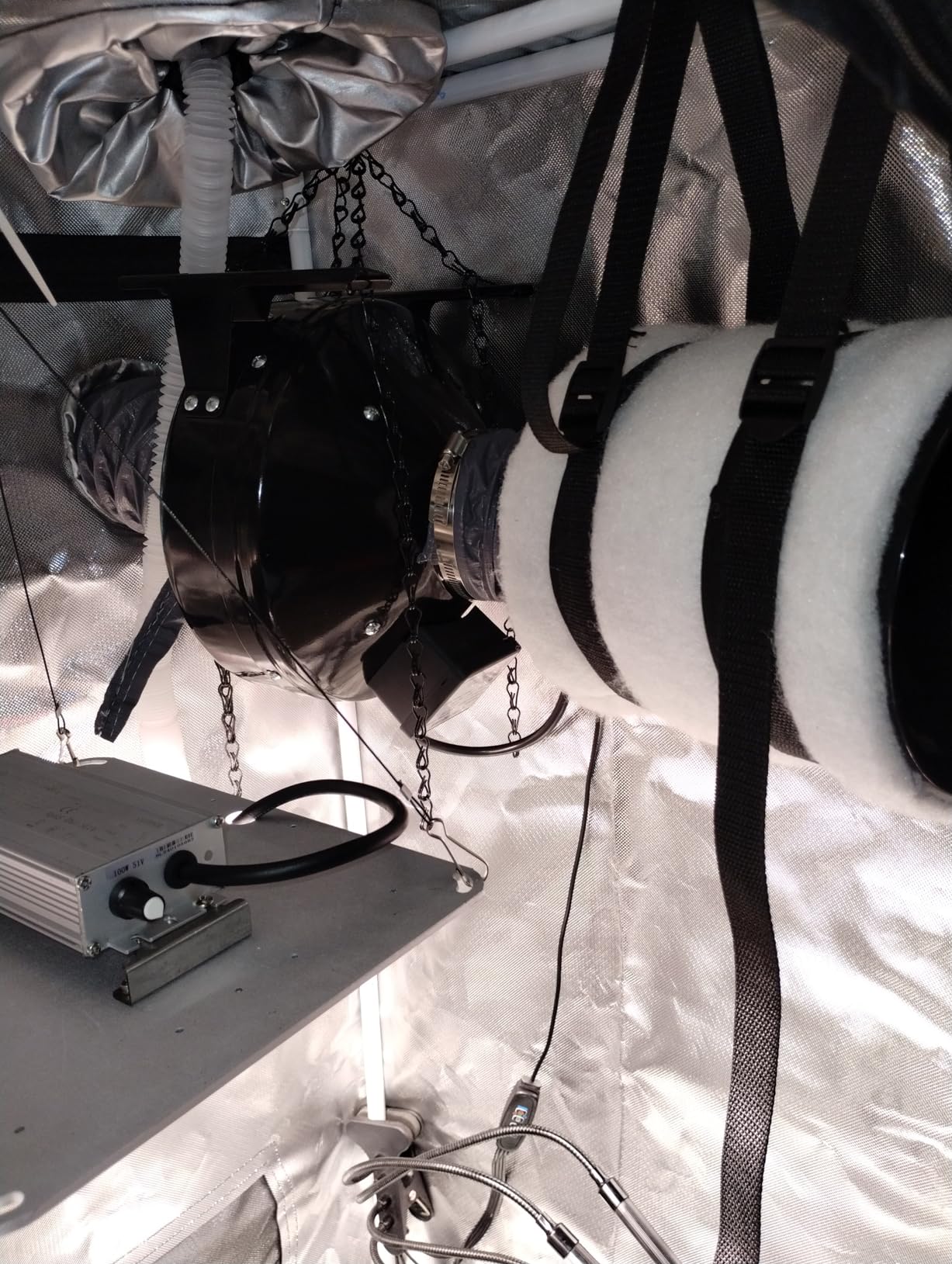
Why the taller footprint matters
Because plant height is the constraint you cannot engineer around later. A short tent forces you to prune or top a plant that wants to stretch, which costs yield and shape. A 70 inch tent gives you a canopy that can fill upward, which is also what makes low-stress training and screen-style setups practical rather than theoretical.
The narrow 24 inch width is the trade-off. You will fit fewer plants side by side, so this format rewards a tall single column or a staggered arrangement rather than a wide grid.
Who should skip it
Anyone who only wants a 2×2 footprint. You are paying for volume in height, not width, and a taller empty tent is just as expensive as a shorter full one.
Anyone in a warm climate. The bundle includes a heater but no serious cooling solution, and a tall chamber with a light inside runs warm. Adding a portable air conditioner is a larger addition to this kit than to a squat 2×2, because you have more internal volume to cool.
5. G HYDRO 3×3 WiFi App Controlled Grow Tent Kit
G HYDRO 3×3 Grow Tent Kit, 36″x36″x72″, 240W LED Grow Light, 1680D Canvas, WiFi APP, Drip Irrigation, 4″ Inline & 6″ Clip Fan, Carbon Filter, Ducting, Indoor, Black
36x36x72 tent
1680D Oxford canvas
54 cubic foot chamber
Integrated WiFi app controller
47.1 lb
Pros
- Integrated controller with WiFi app scheduling
- Heavy duty 1680D Oxford canvas with reflective lining
- Spacious 3x3 footprint for multiple plants
- 4.5 star average with 76 percent of reviews at five stars
Cons
- App connected controls add a setup learning curve
- At 47.1 lb the kit is heavy to reposition alone
- Some 3-star reviews want more CFM than the default airflow delivers
The G HYDRO 3×3 is the only kit here with a genuine smart controller built into the enclosure. An integrated controller with WiFi app control lets you monitor and adjust growing conditions from a phone rather than walking to a physical dial, and for anyone running a tent in a basement, garage or spare room that is a real convenience rather than a gimmick.
The enclosure is serious. You get 1680D Oxford canvas on both the interior and exterior, a reflective lining, a black light-tight outside, and a 3 foot by 3 foot interior giving 54 cubic feet of chamber volume. That is a substantial step up from the 17 cubic foot chambers most 2×2 bundles offer.
At 47.1 pounds, this is the heaviest package in the roundup by a wide margin. That weight comes from the canvas and the frame, and it is a good sign of material quality, but it also means moving the tent after assembly is a two-person operation.
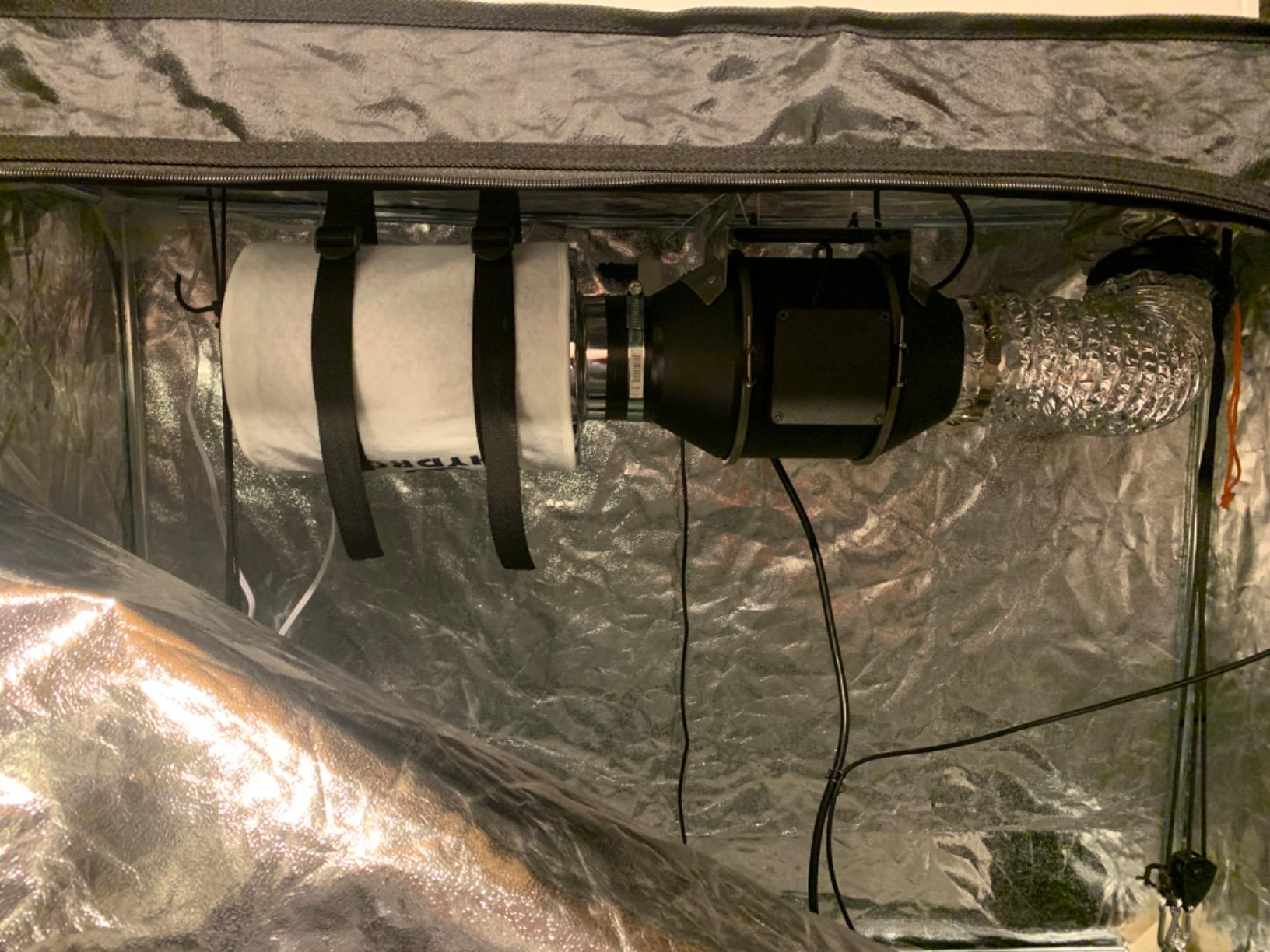
The 4.5 star average across 128 reviews is among the strongest rating profiles here, with 76 percent of reviews at five stars. Reviewers rate build quality and light sealing highly, and the filtration performs well against odor, which is the result you are buying when you pick a kit with a carbon bed already installed.
The honest criticism appears in the 3-star reviews and it is about volume. A 54 cubic foot chamber needs meaningfully more airflow than a 17 cubic foot one, and some owners note the default setup does not deliver enough CFM for that space. If you run this through a summer cycle, treat the included filtration as a starting point and plan to add intake capacity or a larger fan.
The app itself has a learning curve. Setting up WiFi scheduling takes an evening, and connectivity hiccups are the kind of thing that only surface once the tent has run a full day without you checking it. Pair it with a cheap standalone thermometer and hygrometer so you can verify what the app is telling you.
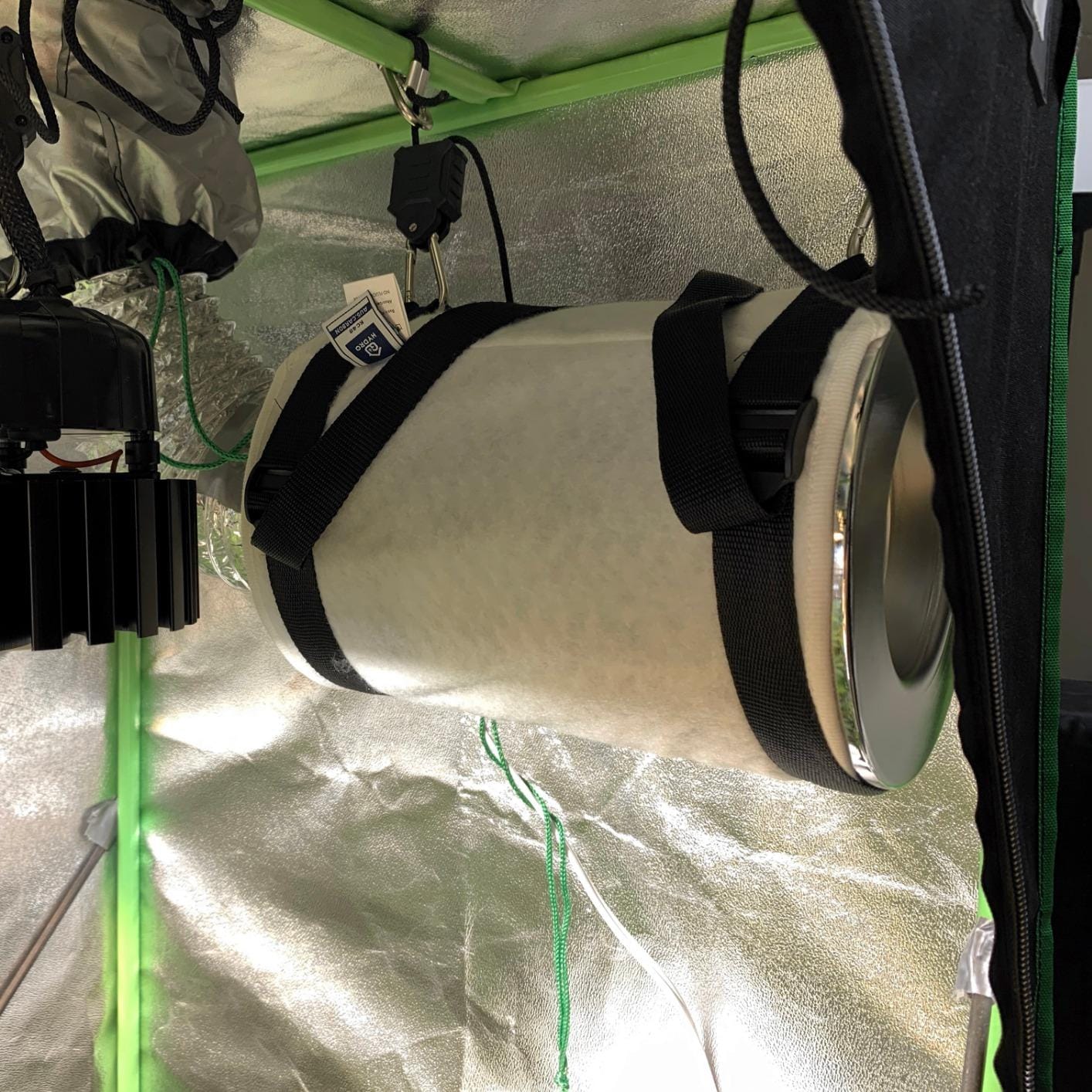
When app control actually pays off
It pays off when you are not in the room. A tent in a basement, garage or closet that you check twice a day is exactly the scenario where remote temperature and humidity readings and remote light scheduling save you trips and catch a heat spike early. Growing forum users running away-from-home schedules describe this as the feature that makes a long cycle less hands-on.
It is worth less if you are already standing next to the tent every day. Then the app is a readout rather than a benefit, and the same money spent on a better fan and filter is a more direct improvement.
What to check before you buy
Check the airflow requirement for a 54 cubic foot chamber and buy accordingly. The tent is built for more air than the default configuration moves, so budget for an intake fan and possibly a larger inline unit before the hot months rather than after.
Also check that you can physically move it. At 47.1 pounds with a metal frame, reassigning it to a different room mid-cycle is a two-person job, and the 72 inch height needs ceiling clearance in your space.
6. TopoGrow 32x32x63 APE600 Grow Tent Kit
TopoGrow New Tech LED APE600 Full-Spectrum Grow Light+32″X32″X63″Indoor Grow Tent+4″ Carbon Filter Exhaust Inline Fan Ventilation Kit Complete for Hydroponic Plant Growing
32x32x63 tent
APE600 light at 100W draw
4 inch carbon filter and fan kit
600D lightproof oxford
2.1 umol/J
Pros
- Highest average rating in the roundup at 4.6 stars
- Kit arrives complete with light
- filter
- fan
- duct and sensor
- 600D lightproof oxford with powder coated rods
- Light runs 100-277V so it works on household or commercial circuits
Cons
- Some buyers report a stiff zip that jostles the tent
- Instructions may not match the tent included
- 32x32 interior realistically suits one plant
- two at most
The TopoGrow 32x32x63 APE600 kit carries the highest average rating in this roundup at 4.6 stars, with 80 percent of its 54 reviews at five stars. That is a smaller review base than some competitors here, but the consistency of the feedback is notable and worth taking seriously.
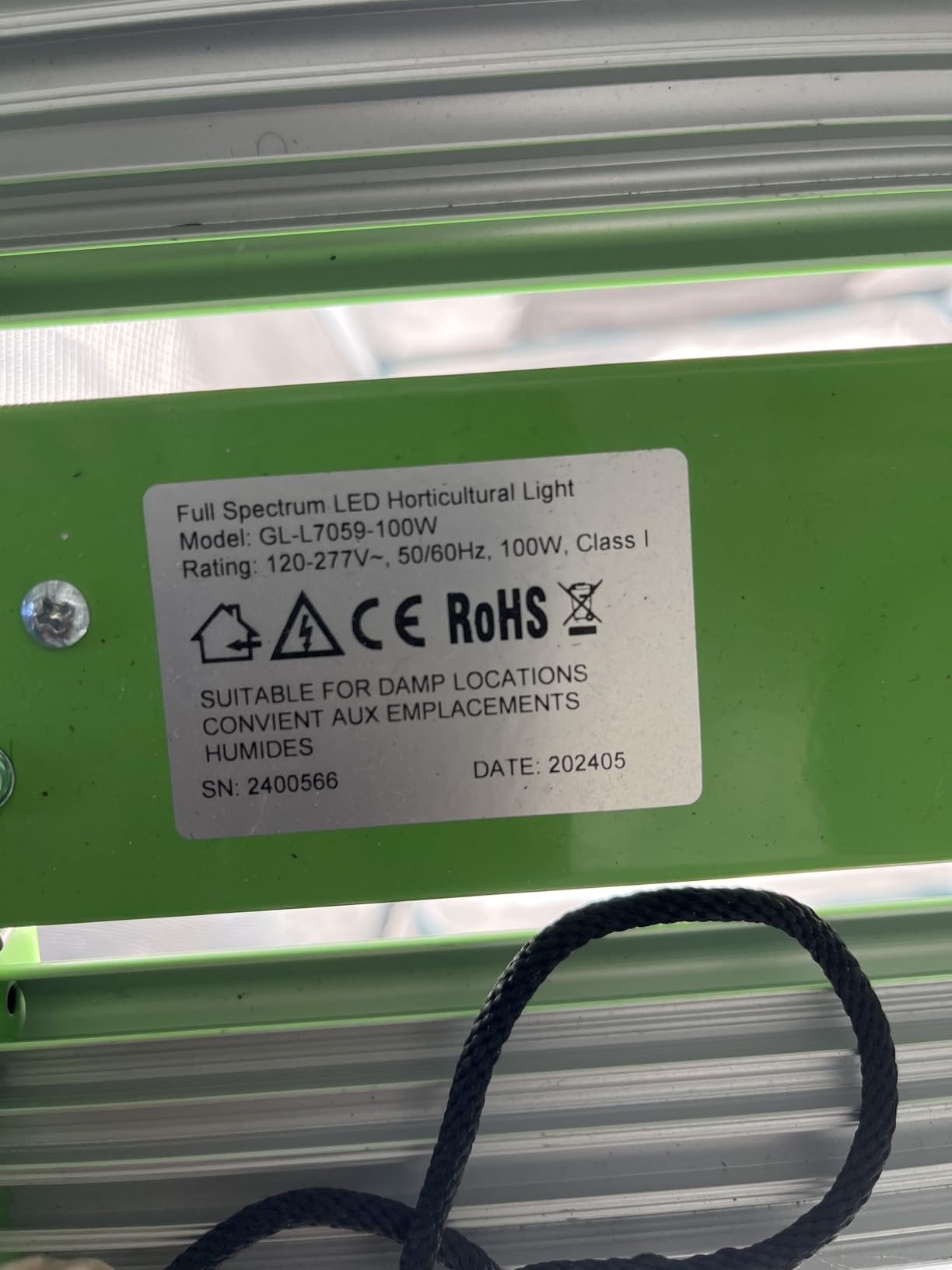
The APE600 light is the distinguishing component. It draws 100 watts actual across four passively cooled bars at 25 watts per bar, delivers a listed PPF of 210 umol/J and an efficacy of 2.1 umol/J, has a 50,000 hour rated lifetime, and runs on 100-277V so it works on commercial circuits as well as a household outlet. Four spread-out bars give wider, more even coverage than a single panel of the same wattage.
Ventilation is standard rather than optional here. The bundle includes a 4 inch carbon filter and inline fan kit along with the ducting, trellis netting and a temperature and humidity sensor. The tent itself is 32 by 32 by 63 inches in heavy duty 600D lightproof oxford cloth with white powder-coated metal rods and heavy duty zippers.
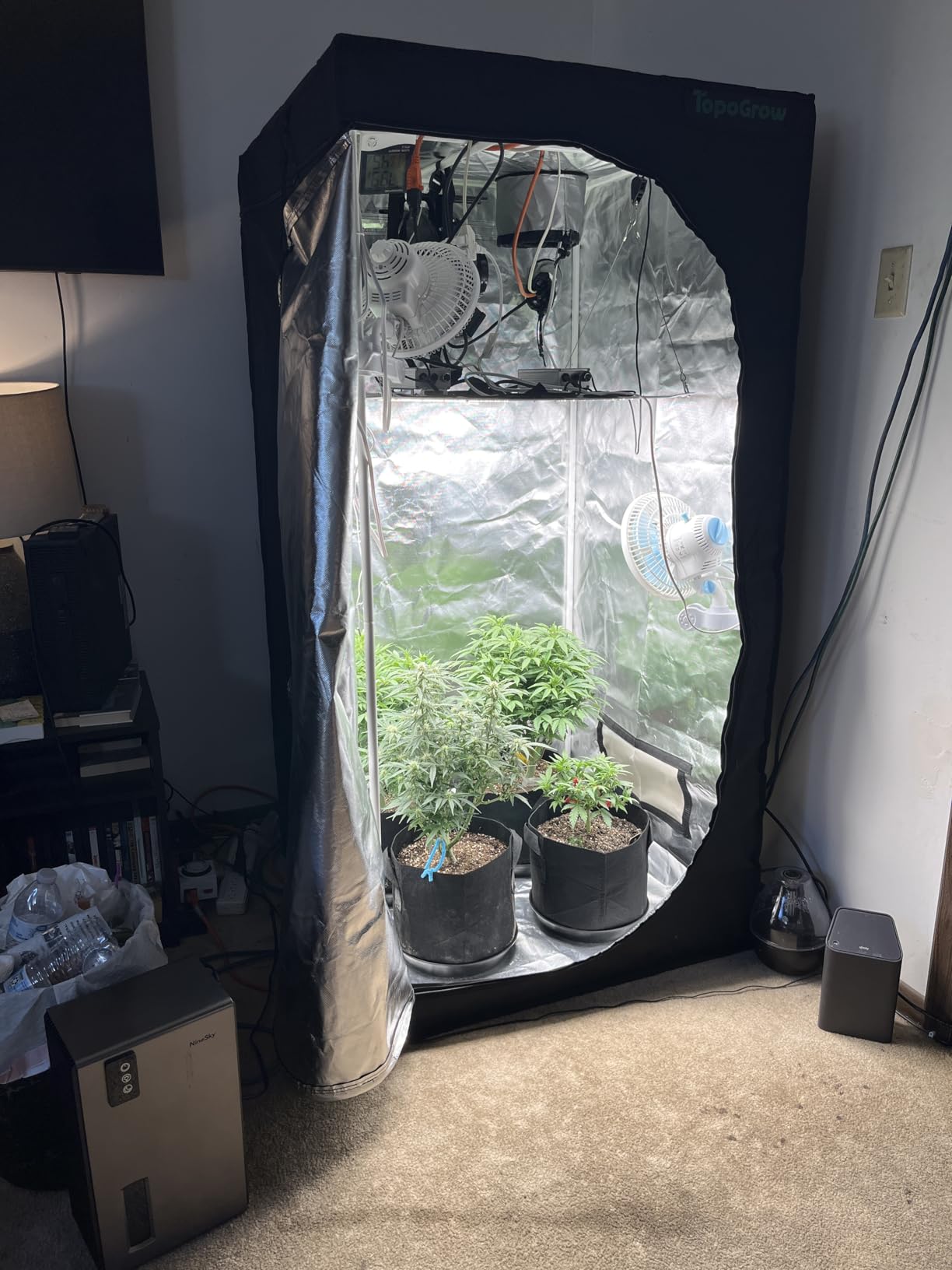
Reviewers are broadly satisfied across build, light output and the included ventilation parts, and the light in particular gets credit for board-coverage output from veg through bloom. For a 32 by 32 footprint, 100 watts spread over four bars is an efficient use of power, and the mount height guidance of 6 inches or greater is a real specification rather than a suggestion.
Two isolated problems recur. A few buyers report a stiff zip that shakes the tent when opened, which can disturb young seedlings during their first weeks. Some reviews also mention that the instructions may not match the tent actually included, which limits your installation options for the fan and filter ports until you work it out.
A minority of reviews found the light not working on arrival and needed a replacement from the seller, which is worth knowing about before you buy. Inspect the light on day one rather than assuming it works.
Why this light is efficient
Because four 25 watt bars spread across a 32 by 32 footprint give you coverage depth and width that a single panel of the same total wattage cannot, and passing efficiency is higher than most bundled lights in this roundup. That translates into more usable light per watt at a lower running cost, which matters most in setups that run lights 16 to 18 hours a day.
The 100-277V range is also genuinely useful if you ever move the tent to a shared space with a heavier circuit, since the same light does not need a step-down transformer.
What to watch out for
Plant count. A 32 by 32 interior realistically suits one plant, or two if you are willing to manage them closely. Growers who buy this size expecting a 3×3-style canopy are disappointed, and the fix is a different tent, not a different light.
Port instructions. If the documentation does not match the tent, budget time to work out which port takes the exhaust and which takes the intake before you cut anything. Measure twice, since cutting a port in the wrong place is not reversible.
7. MELONFARM 2×2 Kit With 100W LED and 190 CFM Fan
MELONFARM Grow Tent Complete System 2×2, Schedule Full Spectrum 100W LED Grow Light & Grow Tent Kit 24″x24″x48″, 4″ Adjustable Ventilation Kit, Noise-reducing Rubber Duct Connector
24x24x48 tent
100W LED at 2.75 umol/J
190 CFM adjustable speed fan
Carbon filter and rubber coupling
Five vent ports
Pros
- Same strong ventilation core as the 70W variant
- 100W LED uses Samsung LM301 diodes at 2.75 umol/J
- Five vent ports with double string closures
- Two metal cross bars for hanging light and filter
Cons
- Two reviews report the LED failing within one to two weeks
- Included electrical cords are short
- Frame is somewhat wobbly and instructions are thin
The MELONFARM 2×2 with the 100W light pairs the most efficient listed light in this roundup with a properly sized exhaust. The LED uses Samsung LM301 diodes at 2.75 umol/J, and the 100W output is more usable light than most kits in the same footprint deliver.
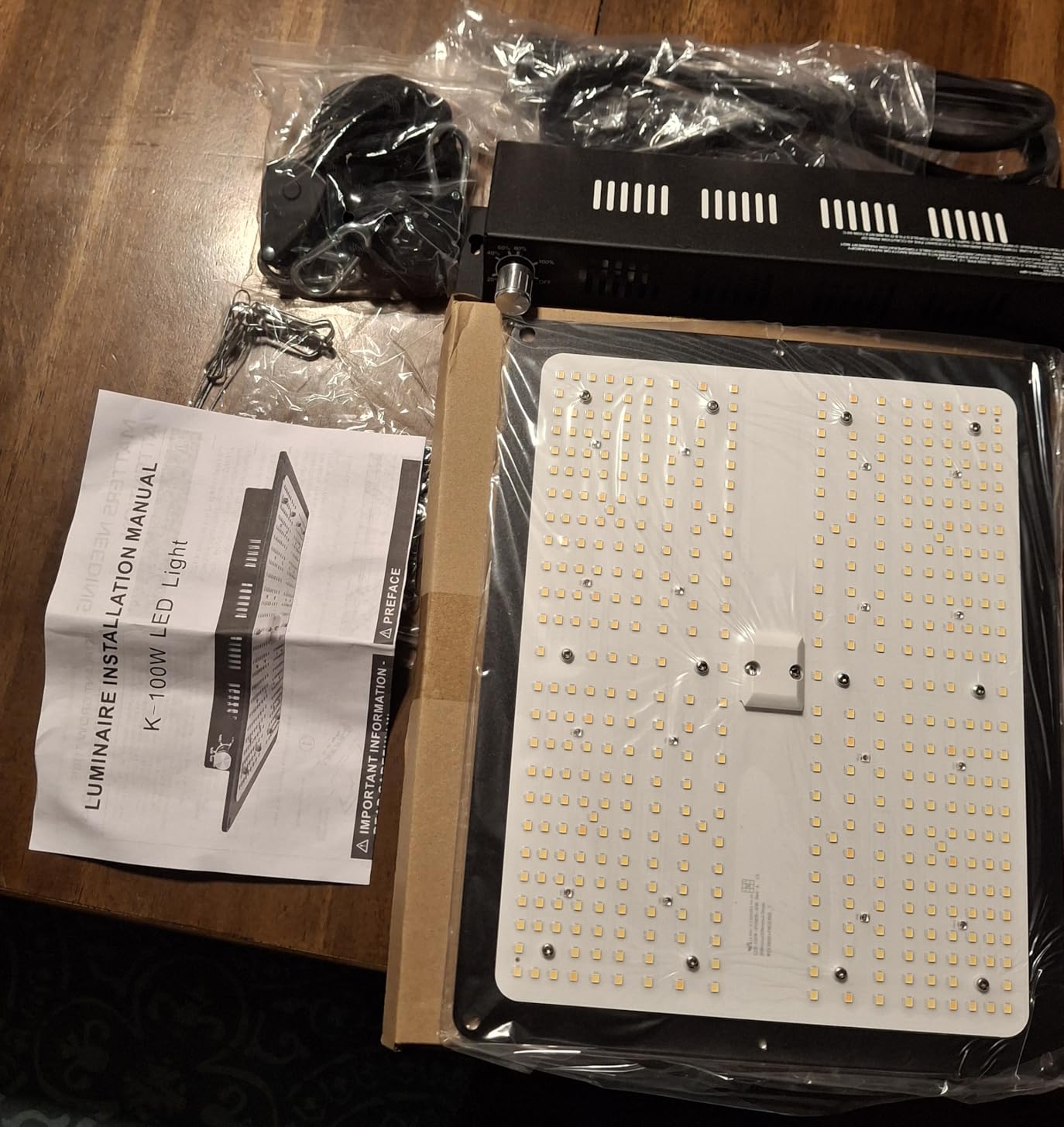
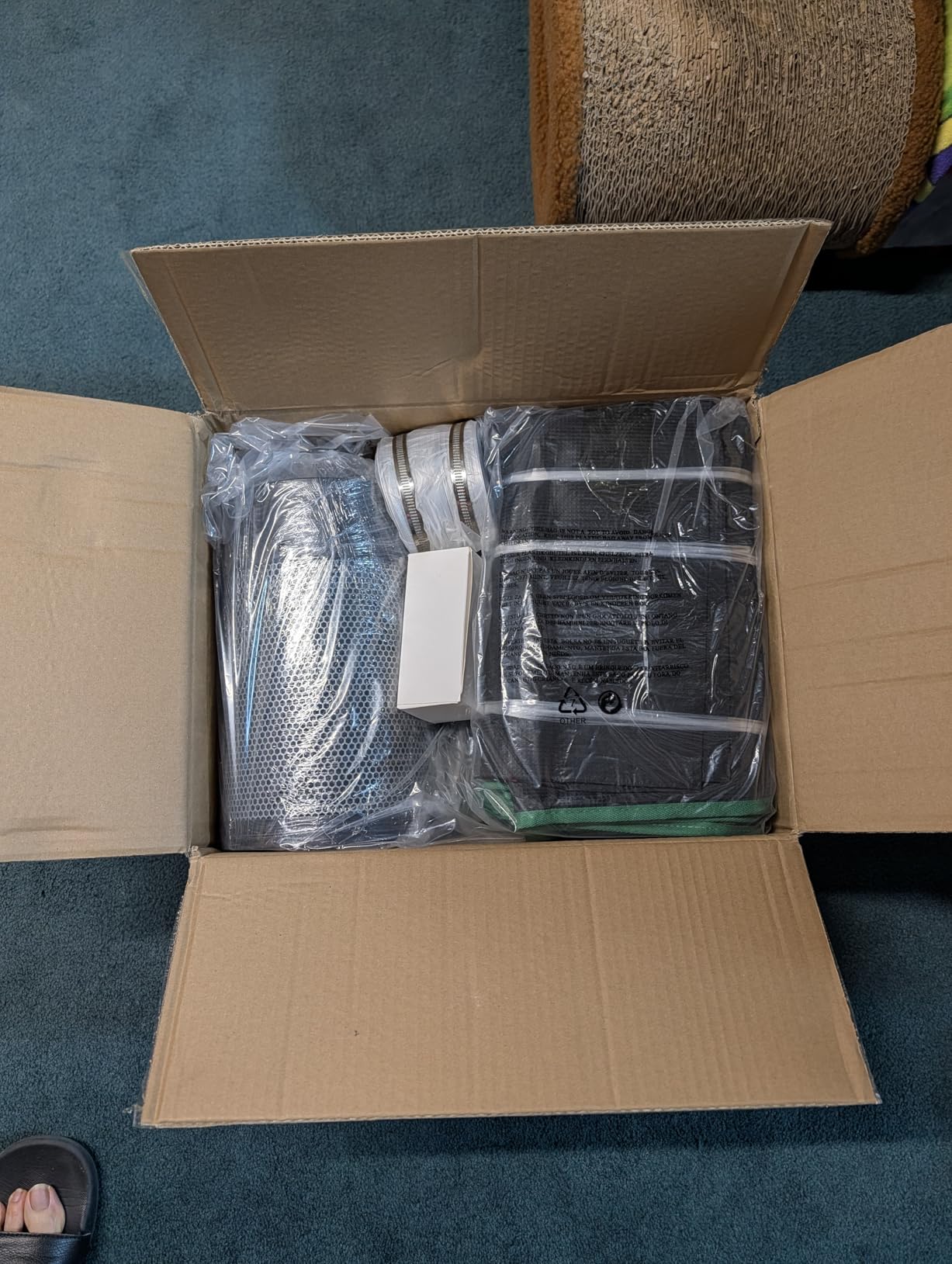
The ventilation hardware is the strongest reason to like it. A 4 inch 190 CFM adjustable-speed inline fan comes with a carbon filter, 16.4 feet of ducting, two stainless steel hose clamps, a rubber pipe coupling and a deflector to focus airflow. Adjustable speed control on a bundled fan is not common, and it is the single most useful feature for apartment growers.
Port layout is unusually thoughtful for a compact tent. Five vent ports with double string closures, three-side zippers on the top and bottom, a front viewing window, and two metal cross bars let you hang the light and the fan-filter unit independently, which is exactly what a real filter setup needs.
Owners like the value, the port layout and the light sealing, and the rubber duct connector gets called out specifically for cutting running noise. Seventy-eight percent of the 28 reviews sit at five stars, and owners report near-zero light leakage once zipped, plus good insulation in cold rooms.
The recurring negative is LED reliability. Two separate reviews report the light failing within one to two weeks after an otherwise five-star experience. With only 28 reviews in total, that is a small sample, but it is the kind of failure that ends a grow, so inspect the light immediately and keep the receipt.
Smaller gripes: the included electrical cords are short enough that most owners add an extension cord, and the frame is described as somewhat wobbly once assembled. Instructions are thin, so allow time to work out the port layout yourself.
Why adjustable fan speed matters
Because the alternative is one fixed setting, and fixed settings force a bad choice. Too slow and humidity climbs and mold follows. Too fast and the tent gets loud, the tent frame flexes, and your electricity cost rises. Adjustable speed lets you match airflow to the plant stage and to the noise tolerance of the room.
Experienced growers describe exactly this preference: run fans lower and more continuously rather than at full blast, because quiet efficient airflow beats loud high-speed airflow over a full cycle. A speed-controlled fan is the hardware that makes that advice possible.
Who should look elsewhere
Anyone who needs serious light. At 100W in a 24 by 24 tent, the 2.75 umol/J efficiency gets you further than most, but a 2×2 in full flowering wants more than 100 watts. Treat this as a vegetative and early flower kit, or plan a light swap.
Anyone who moves a lot. The wobbly frame and short cords are minor individually, but in a portable setup you are constantly working around both.
8. MELONFARM 2×2 Kit With 70W LED and Noise-Reducing Duct Coupling
MELONFARM Grow Tent Complete Setup 2×2, 70W Full Spectrum LED Grow Light & 24″x24″x48″ Grow Tent Bundle, 4″ Efficient Airflow Ventilation System with Soundproof Duct Connector
24x24x48 tent
70W LED at 2.75 umol/J
190 CFM fan and filter combo
Rubber noise reducing coupling
Stainless steel clamps
Pros
- 190 CFM fan with built-in carbon filter
- deflector and noise reducing coupling
- 70W LED uses Samsung LM301 diodes at 2.75 umol/J
- Stainless steel hose clamps prevent duct leaks
- Reinforced metal poles with a complete bundle
Cons
- 70W is the lower-output option against the 100W variant
- A 2x2x48 tent limits vertical growing space
- 55 reviews is a thinner feedback base than established brands
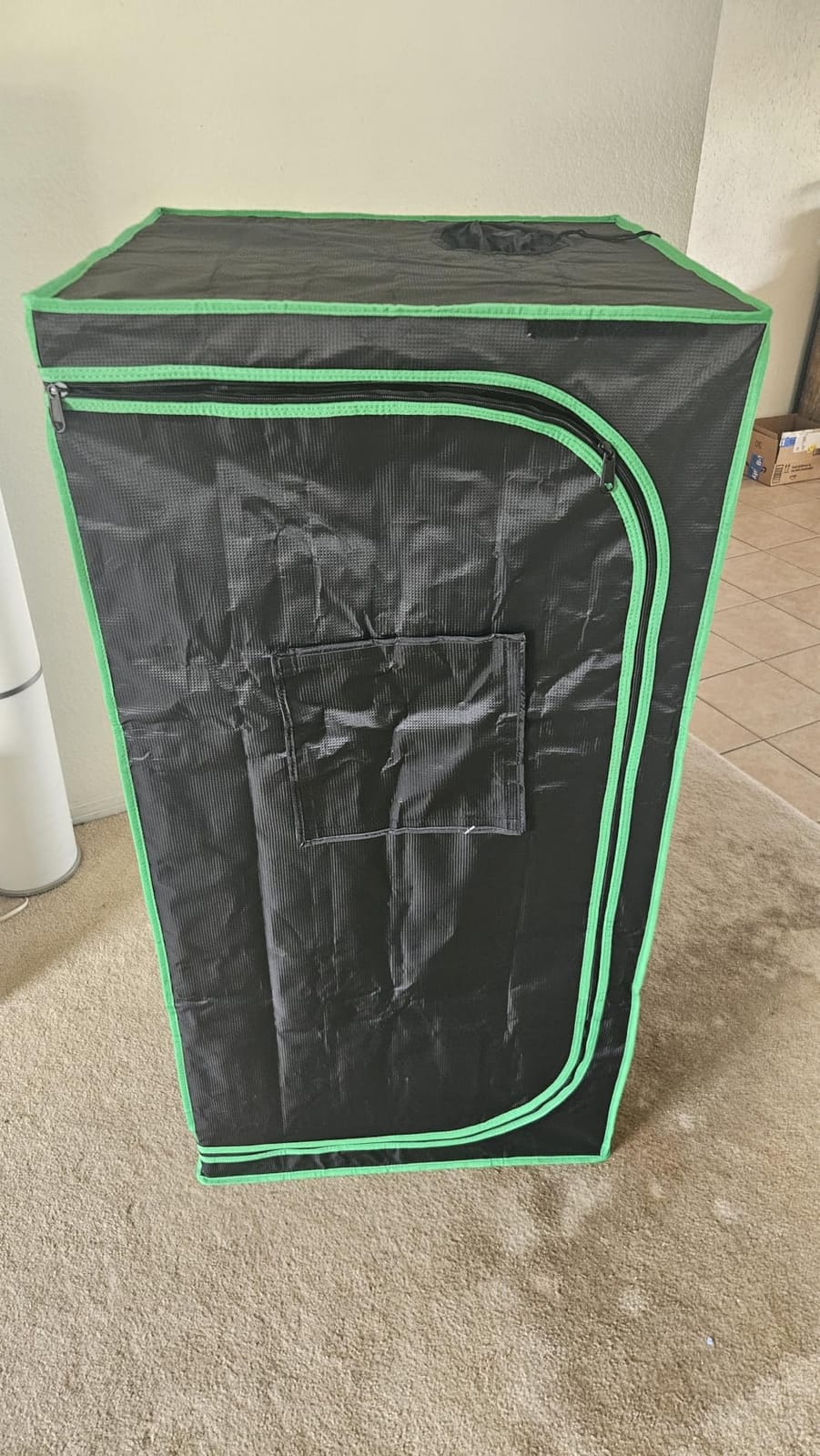
This MELONFARM 2×2 is the most deliberately quiet ventilation package we evaluated, and the reason is a single part: the rubber pipe coupling. It sits between the fan and the ducting to absorb fan and airflow vibration, which is the main source of the rattle and hum people associate with inline fans in apartments.
The rest of the air path is standard good practice. A 190 CFM inline fan is combined with a built-in carbon filter and a deflector to focus the airflow, 16.4 feet of ducting is included, and the two stainless steel hose clamps prevent air leaks at the joints. Leaky joints are the quiet killer, so clamps that actually bite are worth more than they look.
The light is a 70W full spectrum LED using Samsung LM301 diodes at 2.75 umol/J, the same diode generation as the 100W version. Efficiency is identical; only the output differs.
Owners single out the noise-reducing connector and the combined fan and filter unit as the features that make this bundle work in a lived-in space, and 70 percent of the 55 reviews sit at five stars. Reinforced metal poles and a complete bundle that removes the need to source compatible parts make the first build straightforward.
The 70W light is the main compromise, and owners say so. It is the lower-output option against the 100W variant in the same range, which makes this the version to choose for seedlings, clones and vegetative work, and the 100W version to choose once you are flowering.
Two more honest notes. A 2x2x48 tent is one of the shortest formats in this roundup, so vertical growing space is limited in rooms with higher ceilings. And 55 reviews is a thinner feedback base than the established tent brands carry, which means you are buying on a smaller sample of long-term experience.
Quiet ventilation in shared walls
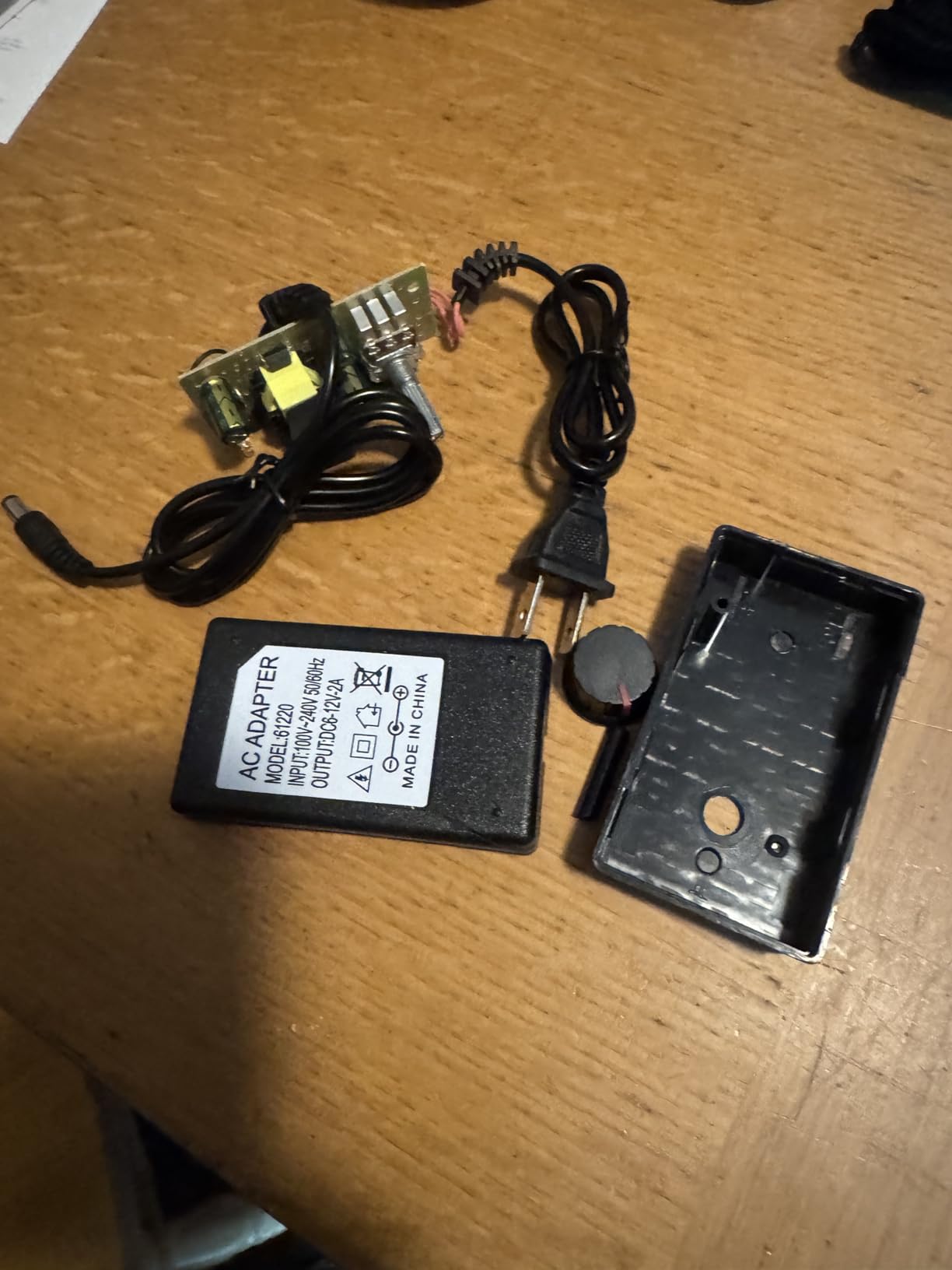
Noise tolerance is the number one concern for apartment growers and the least discussed topic in competing roundups. The hardware levers that matter, in order, are vibration isolation at the fan-to-duct joint, duct diameter and length, and fan speed. This kit addresses the first directly with the rubber coupling and gives you the third through the fan itself.
If you need more, flexible ducting routed with a long gentle curve absorbs more vibration than a short sharp run, and a speed controller lets you drop the fan to a lower speed at night. If you are in genuinely sound-sensitive housing, the honest answer is that no inline fan is silent, and a properly sized fan run at low speed beats a small fan run at full speed.
Where the 70W light limits you
At 70W in a 2×2, you have enough light for propagation, clones and vegetative growth through to early flower. Beyond that you will be stretching plants toward the light and watching them thin out, which is the pattern growers describe when they eventually swap this light for something stronger.
If your plan is a single full-cycle plant, buy the 100W version of this same kit instead. If your plan is a seed starting and clone station, this is the right pick and the quieter build is a genuine bonus.
9. iMeshbean 2×2 Kit With Included Fan Speed Controller
Complete Mylar Growing Tent 2×2 Grow Tent Kit 24″x24″x55″ Indoor Plant Growing Room LED Full Spectrum Grow Light Ventilation Inline Fan + Acceseries
24x24x55 tent
38W full spectrum LED
Extraction fan with adjustable power control
Two air ducts
600D Oxford nylon
Pros
- Includes an adjustable fan power controller most kits leave out
- 600D Oxford nylon with 100% reflective Mylar
- Chrome plated reinforced bars
- Feathered zipper flaps block light leaks
Cons
- 38W light is the weakest in the lineup
- Ports are not pre-cut so openings need measuring and cutting
- 600D fabric is lighter duty than 1680D or 2000D canvas
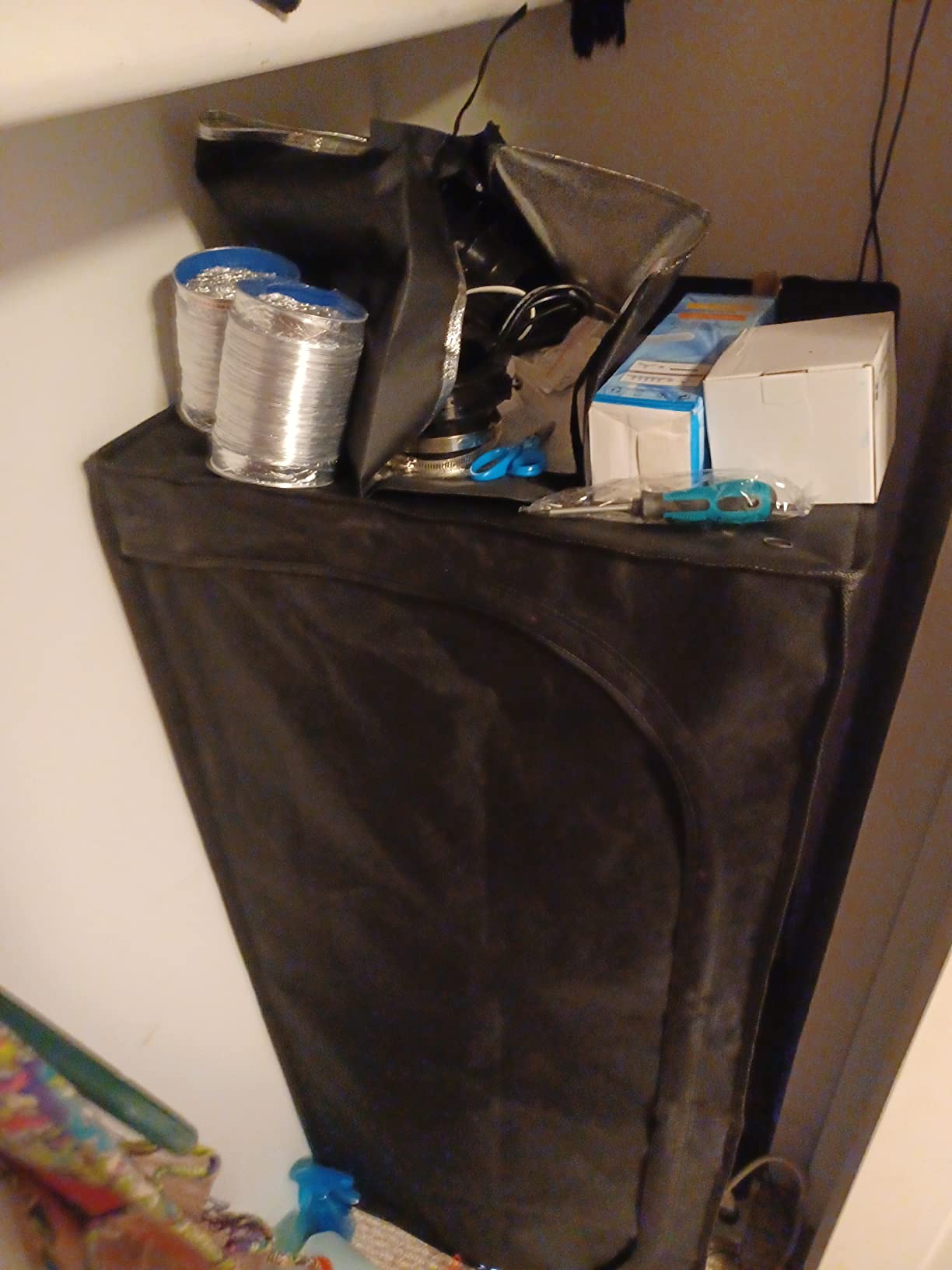
The iMeshbean 2×2 stands out for one component: an adjustable fan power controller is included in the box. Almost every other kit in this roundup includes a fan with a single fixed setting, so this one hands you the speed control that apartment growers usually have to buy separately for a few dollars.
The tent is 24 by 24 by 55 inches in a steel frame with 600D Oxford fabric and PVC, chrome-plated reinforced bars, and a 100% reflective Mylar interior. Feathered zipper flaps block light leaks, and a floor tray keeps the tent clean. The package also includes two air ducts, an extraction fan, a timer, a power supply, a planting bag and a set of accessories.
The design choice that needs the most attention is the DIY port layout. There are no factory-cut fan or vent holes, so you make your own openings wherever your room layout needs them. That flexibility is genuinely useful in an awkward closet or corner, but it moves the risk to the build.
Buyers single out the overall value, the included fan speed control and the light-blocking design, and 56 percent of the 47 reviews sit at five stars. At 14.5 pounds, this is also one of the lighter packages here, which makes it easy to move and reconfigure as your setup changes.
The 38W light is the weakest in the lineup and owners treat it that way. It is sized for seedlings and clones rather than full-cycle growth, and most serious growers upgrade it within a season. The 600D non-PVC fabric is also lighter duty than the 1680D and 2000D canvas used by the premium tents here, which is a fair trade for a starter build but not a permanent enclosure.
Cutting your own ports needs care. Measure the fan flange and mark the opening before cutting, and reinforce the cut edge with the supplied flange ring so the fabric does not fray around a hole that will be exposed to air pressure every hour of every day.
When this budget kit is the right call
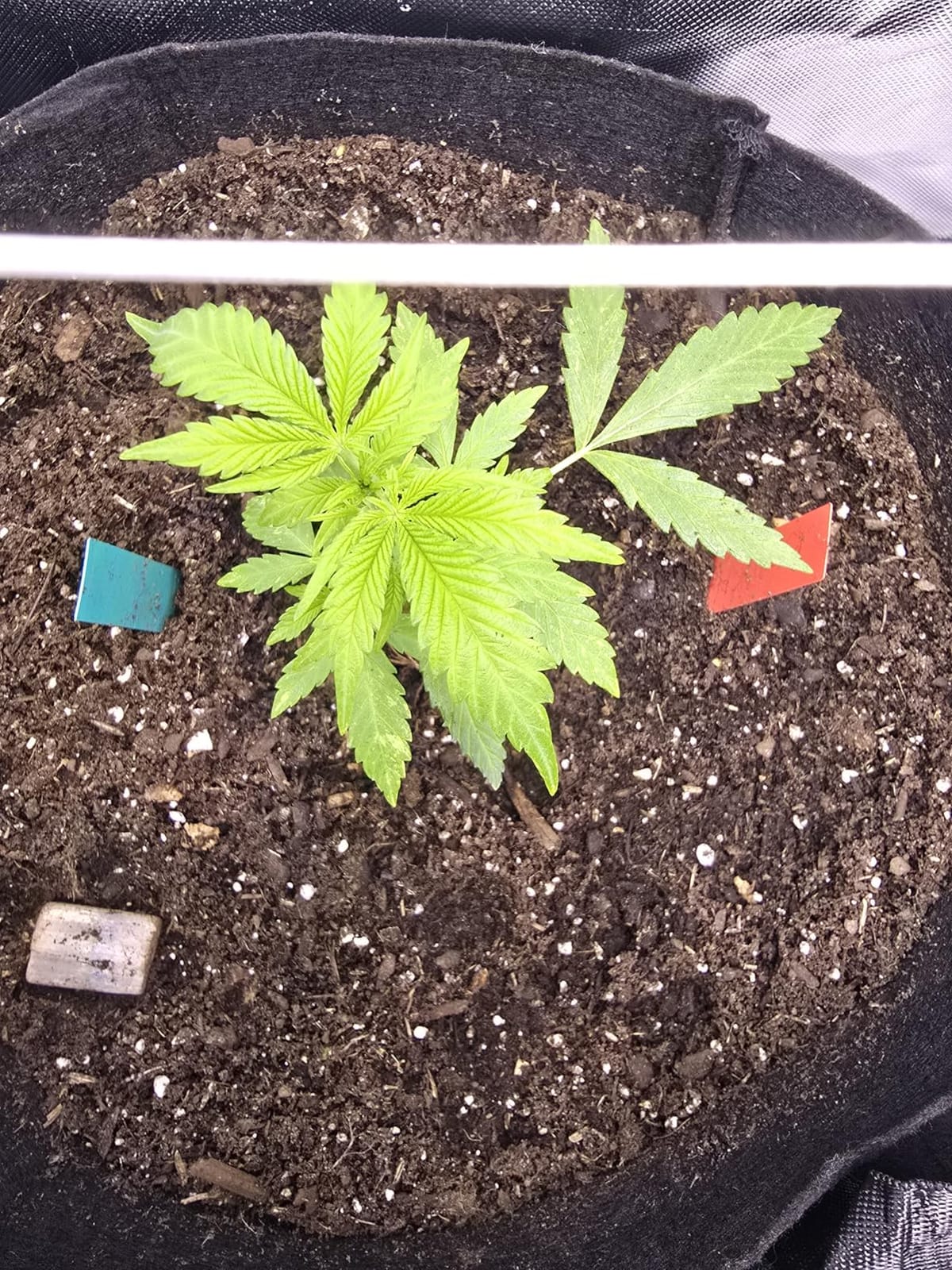
When you are on your first grow, on a strict budget, and you want the system running this week. A 55 inch tent, a light, an extraction fan, ducting, a timer and a speed control is a complete first-cycle system. Growing forum users repeatedly note that small closet setups with modest hardware produce perfectly healthy plants, and this is that setup.
It is also a good propagation station. At 2×2 with 55 inches of height, it handles seedlings, clones and mother plants comfortably, and the reflective Mylar interior keeps that stage bright.
When to spend more instead
When you plan to run this past one season. The 38W light is the first thing you will replace, and the 600D fabric is the second. If your plan is a full-cycle flowering grow, the money is better spent on a kit with a stronger light or on a better tent you keep for years.
The cut-your-own ports also mean more build time than a pre-ported kit. If you are impatient, pick a bundle where the fan and filter drop straight into place.
10. iMeshbean 32x32x63 Kit With Fan, Filter and Hydroponic Parts
Grow Tent Kit Complete System High Reflective Mylar Indoor Grow Tent Hydroponics Growing Tent with Full Spectrum LED Grow Light Observation Window, Ventilation Fan,Carbon Filter (32″ x32″ x 63″)
32x32x63 tent
38W full spectrum LED
Extraction fan and carbon filter
Hydroponic sponges, drippers, flanges
600D Oxford with Mylar
Pros
- Ventilation fan and carbon filter included as standard
- Widest accessory list in the lineup including drippers and sponges
- Observation window plus feathered zipper flaps
- Works with soil
- hydroponic and aeroponic systems
Cons
- 38W LED is low output for a 32x32 footprint
- 4.0 star average leaves more room for complaints
- 10 percent one-star share
- the highest among the iMeshbean bundles
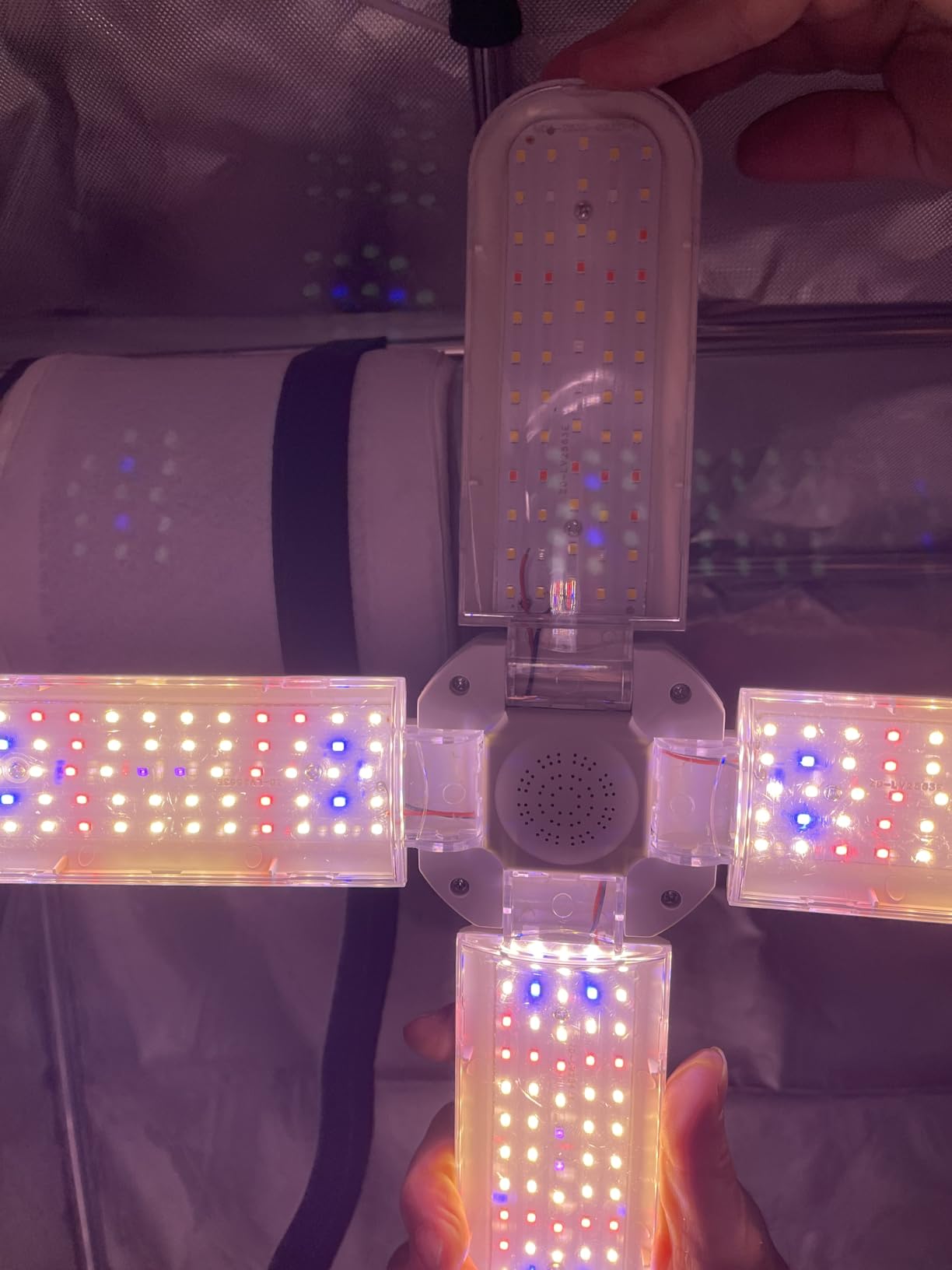
The iMeshbean 32x32x63 is the kit to consider if you are starting a hydroponic or aeroponic system, because the accessory list goes well past tent hardware. The box includes two water drippers, a thermostat, an herb dryer, five hydroponic sponges, a pair of goggles, eight flanges, a timer, a plastic floor tray, a fan plug, a power supply and a planting bag alongside the tent, light, ducts, extraction fan and carbon filter.
That is a strange amount of small plastic parts to receive in one box, and it is genuinely useful if you are running a cloning or seedling system where plugs, sponges and flanges are exactly what you need and easy to forget.
Ventilation is standard rather than optional. The extraction fan and carbon filter are part of the standard kit, not an add-on, which is the thing that trips up buyers of tents sold as complete. The tent is 32 by 32 by 63 inches in steel with 600D Oxford fabric, a 100% reflective Mylar interior, an observation window and heavy duty double-pull zippers with feathered flaps to prevent light leaks.
Reviewers highlight the breadth of included accessories and the ready-to-run vent and filter pairing, and they consistently note the system suits seedlings, succulents, vegetables and herbs as readily as anything else. That breadth makes this a reasonable kit for edible growing and propagation work rather than only indoor flowering.
The 38W LED is low output for a 32 by 32 footprint, and the most common upgrade path owners describe is exactly that: swap the light. At 4.0 stars with 31 reviews, this also has the highest one-star share among the iMeshbean bundles at 10 percent, and the bundled thermostat and small accessories are basic add-ons rather than calibrated instruments.
Buy your own thermometer and hygrometer. A cheap external meter is more reliable than a bundled thermostat and costs almost nothing, and it is the only way to know whether your ventilation is actually keeping the chamber in range.
Who this kit suits
It suits growers starting propagation, clones or a small hydroponic rack inside a 32 by 32 footprint, where the included sponges, drippers, flanges and goggle save a separate order. It also works for leafy greens, herbs and seedlings, which need far less light than a flowering crop.
The observation window and feathered zipper flaps make daily checks easy without opening the tent, which matters when you are inspecting cuttings for mold and root development.
Where it falls short
The light. A 38W LED in a 32 by 32 chamber is workable for vegetative growth and propagation but leaves a 32 inch footprint underlit, and you will be spacing plants to compensate. Plan a light upgrade before you commit to flowering in this size.
At 4.0 stars with 31 reviews, there is also less long-term evidence behind this bundle than behind the higher-rated kits in the roundup. For a first system that is an acceptable trade; for a tent you intend to keep for years, it is a reason to look further up the list.
11. THEBUDGROWER 24x24x60 Kit With Dual 300W Light and 5-Speed Fan
The Bud Grower – Indoor Home Grow Kit – Complete with Tent, 600 Watt LED (Dual 300-Watt) Grow Light, Heat & Humidity Monitor, and CFM Inline Exhausting Fan, & Premium Potting Soil – 24″ x 24″ x 60″
24x24x60 tent
Dual 300W panels with veg and bloom switches
5 speed high CFM inline fan
4 inch carbon filter
Two bags of growing medium
Pros
- Dual 300W full spectrum panels with separate veg and bloom switches
- 5 speed high CFM inline fan with 4 inch carbon filter and ducting
- Only kit here that includes two bags of growing medium
- Taller 60 inch tent gives more vertical room
Cons
- 13 percent one-star reviews with reports of missing items and weak after-sales support
- One review reports a variant that arrived shorter than advertised with no working switch
- Bundled clip fan is a cheap unit relative to the rest of the package
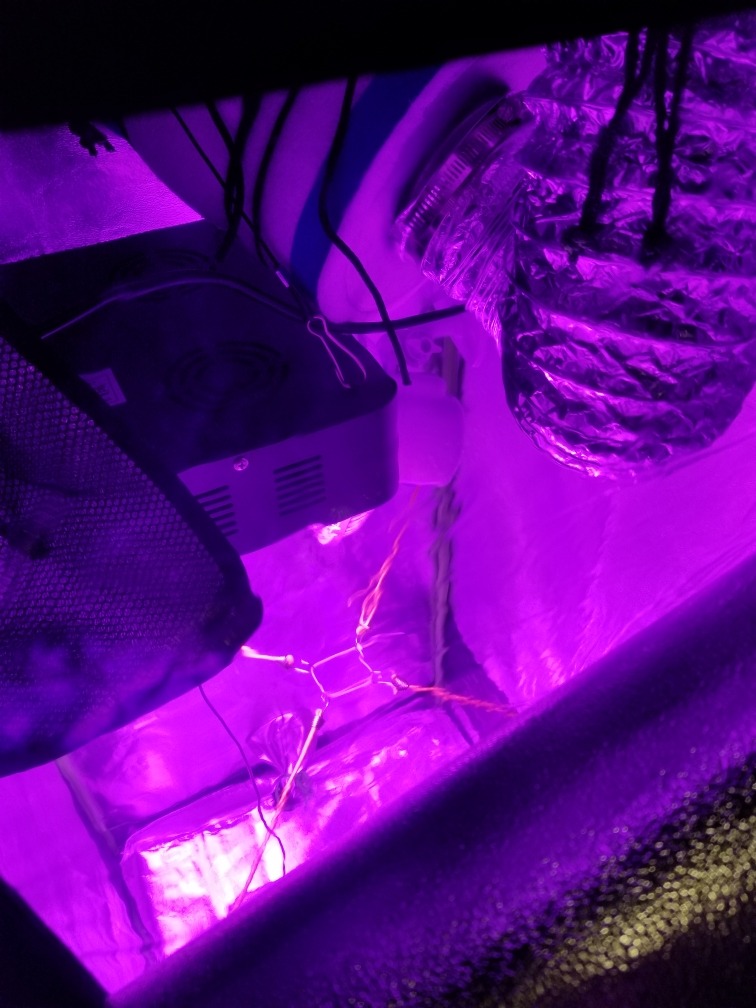
The THEBUDGROWER 24x24x60 is the only kit in this roundup that includes a genuinely high-output light, and it is the one to look at if you want to buy the light once. You get dual 300 watt full spectrum LED panels with separate Veg and Bloom switches, which is a control most bundled lights in this roundup do not offer at all.
Its ventilation hardware is also the most adjustable. A high CFM inline exhausting fan with 5-speed controls comes with a 4 inch carbon air filter, two lengths of steel ducting and four duct clamps. Multi-speed control on the exhaust is the single feature that most directly reduces noise, because you can run the fan lower in a quiet room and higher when heat builds.
The tent is 24 by 24 by 60 inches in premium 600D Mylar reflective fabric with an alloy steel frame, giving 20 cubic feet of chamber volume. The taller 60 inch height gives more vertical room than most 2×2 bundles, which matters when the light is powerful enough to drive stretch.
Most owners are delighted by the light power and the all-in-one convenience, with 71 percent of the 31 reviews at five stars. This is also the only kit here that includes two bags of growing medium, 6 lbs of CaliSuperSoil plus 20 quarts of Fox Farm potting mix, so you can plant on day one without a supply run.
The hand-assembled accessory list runs long too: a heat and humidity monitor, electronic timer, clip fan, rope hangers, pruning snips, two germination domes, five rapid rooters, gloves, a power cord and four fermenting bottles. The clip fan, however, is described as a cheap unit relative to the rest of the package.
The negatives are concentrated and worth weighing carefully. Thirteen percent of reviews are one star, with reports of missing items, incompatible components and unresponsive after-sales support. One review reports that a 24x48x72 variant arrived with a tent only 60 inches tall and no functioning Veg or Bloom switch, which is a packing error rather than a design flaw but still lands on the buyer.
The overall outlay is the other consideration, and at least one reviewer notes that much of it goes on the soil rather than on the equipment. If you are starting a single 2×2 grow, the money buys capability you may not use for a first cycle.
When the light power justifies the cost
When you want maximum light density in a small footprint and plan to keep the setup. Dual 300W panels in a 24 by 24 tent is a serious light delivery, and the separate Veg and Bloom switches let you run lower output in vegetative growth, which reduces both heat and electricity cost during the stage that lasts longest.
The 5-speed fan is the sleeper feature in an apartment. It lets you run the exhaust low and steady overnight, when noise tolerance is lowest and heat is usually not a problem, then raise it during the day.
Where it falls short
Cost per watt and support. You are paying a premium for light power in a tent format where the chamber is small, and a 13 percent one-star rate with reports of missing parts is a support profile you should factor in. Check that the box is complete on arrival.
It is also a 2×2 footprint. If you have room for a 3×3 or 4×4 and want a serious multi-plant setup, a tent-first approach with a separate light will spread the cost more usefully. The VIVOSUN P448 is the version of that plan.
12. iMeshbean 48x24x80 Kit With 80 Inch Height and Fan and Filter
Grow Tent Kit Complete System High Reflective Mylar Indoor Grow Tent Hydroponics Growing Tent with Full Spectrum LED Grow Light Observation Window, Ventilation Fan,Carbon Filter (48″x24″x80″)
48x24x80 tent
38W full spectrum LED
Extraction fan and carbon filter
Hydroponic accessory set
600D Oxford with Mylar
Pros
- 80 inch height in a 48x24 footprint for real headroom
- Ventilation fan and carbon filter are part of the standard bundle
- Same deep accessory list as the 32x32 sibling
- 600D Oxford exterior with reflective Mylar interior
Cons
- Shares the same 38W LED as the 32x32 variant
- 24 inch width limits plants placed side by side
- 4.0 star average with a 10 percent one-star share
The iMeshbean 48x24x80 solves a different space problem from the other bundles: it trades width for height. With an 80 inch interior height in a 48 by 24 footprint, this is one of the tallest enclosures we evaluated, and it is the right shape for a closet or against a wall in a room with a high ceiling where a square tent simply will not fit.
The accessory set matches the 32 by 32 sibling exactly. You get the tent, a 38W full spectrum light, two air ducts, an extraction fan, a carbon filter, a fan plug, two water drippers, a timer, eight flanges, goggles, a thermostat, a plastic floor tray, an herb dryer, five hydroponic sponges, a power supply and a planting bag.
Ventilation is standard, not an add-on, which is the deciding factor. The extraction fan and carbon filter are part of the standard bundle, and the 600D tear-resistant waterproof exterior with a 100% reflective Mylar interior is the same light-blocking build as the rest of the iMeshbean line. The system suits hydroponic, aeroponic and soil-based cultivation.
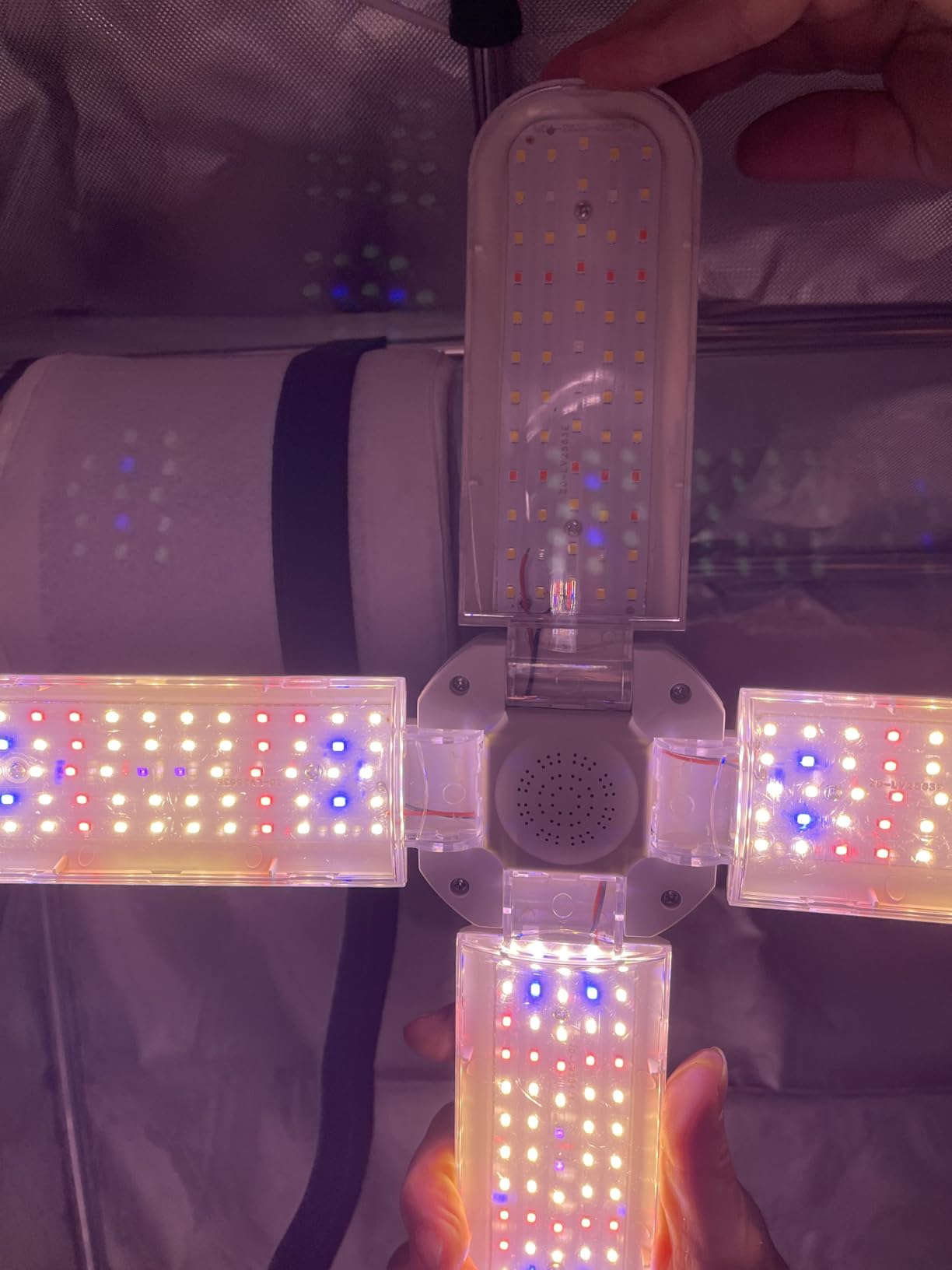
This is the tall-format option of the iMeshbean bundle line, sharing the same rating profile and the same 38W light as the 32 by 32 version. It appeals to growers who prioritise vertical space over footprint, and the reflective Mylar interior keeps light high in the chamber where tall plants can reach it.
The narrow 24 inch width is the trade-off. You will fit fewer plants side by side, so this format rewards a tall single column or a staggered arrangement rather than a grid. If you need plant count, a wider tent is the right shape even if it is shorter.
The 38W light is the weak point again. Sharing it with the 32 by 32 variant means a 48 by 24 by 80 chamber is dramatically underlit for its volume, and no number of height compensates for that. Growers using this format plan to run a stronger light on the hanging bars, which is a straightforward upgrade on a tent built to take one.
Who should choose this format
Growers with a tall, narrow space who have already worked out that width is the scarce dimension. An 80 inch chamber in a 48 by 24 footprint fits a closet, a corner behind a door or a stairwell alcove that a 3×3 or 4×4 square tent cannot occupy.
It also suits growers who want to train upward rather than outward, since the vertical space supports low-stress training and canopy management that a 48 inch tent makes impossible.
Who should choose something else
Anyone who wants a full-cycle flowering grow in this chamber. The light has to be replaced, and once you are replacing the light you should ask whether a tent with a better-matched light and a smaller footprint would serve you better.
Anyone who needs many plants. The 24 inch width is the hard limit, and no amount of height compensates for not being able to place plants next to each other.
How Much Airflow Your Grow Tent Actually Needs
Most kit marketing says a fan is included and stops there. The useful question is whether that fan moves enough air for the chamber it is sold with, and that is a simple calculation. A 2×2 tent needs roughly 80 to 120 CFM, a 2×4 needs around 150 to 200 CFM, and a 4×4 wants 250 to 400 CFM to exchange air several times an hour while the light is running.
Duct diameter follows from airflow. A 4-inch inline fan is the right fit for a 2×2 or 2×4 and is what most of the compact bundles in this roundup include. Step up to 6-inch ducting at 4×4 and above, because restricting airflow through a smaller duct raises noise, drops static pressure and forces the motor to run harder for the same air movement. The single most common sizing mistake is a 4-inch fan trying to ventilate a 4×4 tent.
The 190 CFM figure you see on the IPOW, TopoGrow and MELONFARM bundles is genuinely above what a 2×2 requires, which is why those bundles are the strongest out-of-the-box setups here. It also means the fan is not oversized for the room. Fan noise scales with speed, not with capacity, so a slightly oversized fan run at partial speed is quieter than a small fan run flat out.
Do not forget the intake side. Moving air out is only half of ventilation; if the only path in is a gap in the zipper, you are pulling unfiltered air through the cheapest possible crack and losing your negative pressure. A dedicated intake port with a small fan, or a filtered intake sleeve, is the part most bundles leave out.
If you are choosing where to put the tent itself, moisture and airflow problems overlap with the kind of air movement you already track in other parts of the home. Our guide to the best crawl space ventilation fans for moisture control covers the same airflow-versus-heat trade-off in a different part of the house, and the sizing logic carries over.
Intake vs Exhaust: Running Negative Pressure
Exhaust and intake are not alternatives. The correct configuration is a filtered exhaust fan on one port, a smaller intake fan on the opposite side, and a small pressure difference that keeps the tent slightly under vacuum. That is what negative pressure means, and it is the difference between odor leaving through a carbon filter and odor leaking out of every seam in the fabric.
Mount the filter on the exhaust port so air passes through the carbon bed on its way out, not the other way round. Clamp the ducting to the filter housing on the room side of the tent so no unfiltered air can shortcut into the duct.
Run the exhaust fan at the highest speed that still keeps noise acceptable, and set the intake fan to a lower speed so intake never exceeds exhaust. If intake is stronger, the tent goes positive and pushes scented, humid air into the room.
Test the seal with a light tissue held near the intake and door seams while the fan runs. If the tissue pulls toward the tent at every seam, pressure is negative and air is taking the intended path. If it pushes outward anywhere, close that gap first.
Keep the intake side on the opposite wall from the exhaust where possible. A short, straight exhaust path to a window or wall port also runs quieter than a long tangled duct run.
Add a clip fan inside the tent aimed across the canopy. It does not replace the exhaust; it moves air within the chamber so lower leaves get air movement too, which is what reduces the stagnant pockets that mold colonises.
Run the fans continuously, or at least for the full light cycle, rather than only during peak heat. Slower, steadier airflow keeps temperature and humidity stable and is quieter than cycling a fan on and off at full speed.
Intake-only setups do work, and growing forum users report healthy plants from small closet tents running nothing but clip fans and an open intake. That is a legitimate approach for a small setup in a room you control. It is not a substitute for a filtered exhaust in a shared building, because the odor leaves the tent by the same path it entered.
Odor Control, Carbon Filters and Noise
Carbon filters work by trapping odor molecules on a bed of activated carbon, and they work well as long as air actually passes through the bed. Two things break that. The first is bypassing the filter, which is what happens when the exhaust port is open or the duct is clamped to the wrong side. The second is a saturated bed, which stops absorbing odor and starts passing it through.
Bed thickness is the spec to read. The TopoGrow 2×2 includes a 1.5 inch coal-based activated carbon bed in steel mesh, which is a thicker layer than most bundles in this roundup provide, and thicker beds hold more carbon and last longer before saturation.
Replacement is a matter of use rather than a fixed calendar. A heavily scented crop in a warm climate will exhaust a filter far faster than a cool room with a modest plant count. Check the bed periodically by sniffing near the exhaust port rather than waiting for odor to reach the room, and treat a replacement as an annual running cost of odor control rather than a one-time purchase.
Noise is the other half of a ventilation decision, and it is the concern apartment growers raise most often. Sound comes from three places: fan motor hum, airflow noise through the duct, and vibration transmitted through the frame. Motor noise falls as you run a fan slower, airflow noise falls as you increase duct diameter, and vibration falls when you isolate the fan-to-duct joint with a rubber coupling and brace the tent against flex.
The MELONFARM kits address vibration directly with a rubber pipe coupling, the iMeshbean 2×2 includes an adjustable fan power controller, and the THEBUDGROWER bundle has a 5-speed exhaust. Those three are the quiet picks in this roundup. The rest run at a single fixed speed, which is fine in a detached room and marginal behind a shared wall.
What Comes in the Box vs What You Buy Separately
This is the audit that matters most, and it is where kit listings are least clear. A tent sold as a grow tent kit may include no fan, no filter and no light at all. The VIVOSUN P448 is the clearest example in this roundup: it is a superb 4×4 enclosure that includes the tent, four hanging bars, four CFM support poles, a floor tray and instructions. The CFM support poles exist to brace the frame against a fan you have to buy yourself.
Ten of the twelve kits in this roundup include an extraction fan and a carbon filter, which is better than most competitor listings manage. Of those ten, three add a speed control, adjustable fan speeds or a vibration-isolating coupling. The remaining gaps fall into three categories: intake, light output and measurement.
Intake is the gap nobody fills. Not one kit in this roundup includes an intake fan, so every one of them relies on an open port or a passive gap for fresh air. Add a small intake fan before you run a filtered exhaust at speed, or your negative pressure will not hold.
Light output is the second gap and it is where most disappointment lives. Bundled lights in this roundup run from 38W to 100W for the 2×2 and 2×4 formats, with one 3×3 listing a 1000 watt source figure and one kit including dual 300W panels. If your tent is 3×3 or larger, assume you are replacing the light and choose a tent-first kit instead of saving money on a bundle you will strip.
Measurement is the third. Hygrometers and thermometers bundled with kits are rough indicators, and one kit in this roundup includes a meter without the button-cell battery. A standalone thermometer and hygrometer costs very little and tells you whether your ventilation is actually working, which is the one measurement that governs everything else on this list.
When to Skip the Kit and Buy Parts Separately
The most consistent piece of advice on growing forums is that experienced growers often skip kits entirely. A tent, an inline fan and a carbon filter bought as separate components frequently cost only slightly more than a full kit, and the parts tend to last much longer because you are not paying for a bundled light, humidifier and timer you will not use.
Skip the kit when you already own a light, when you want a tent size that no bundle covers well, or when you care about noise and want a speed-controlled fan and a vibration-isolating duct joint. In all three cases the kit saves you convenience rather than money, and the convenience is real but bounded.
Stay with the kit when you are starting from nothing, when you want the system running this week, or when you are not confident sizing an inline fan and matching it to a filter. A correctly sized bundle is worth a small premium over assembling the same parts yourself if it removes the single most error-prone decision in the build.
The community consensus worth carrying into any purchase: match the fan to the chamber, not to the tent listing. Every kit here with a 190 CFM fan is well matched to a 2×2. None of them is well matched to a 4×4, including the ones sold as 4×4 packages. If you are growing at that scale, buy the tent and the air handling as separate decisions.
Frequently Asked Questions
What is the best ventilation setup for a grow tent?
The best setup is one filtered exhaust fan pulling air through an activated carbon bed, a smaller intake fan on the opposite port, and a clip fan inside the tent moving air across the canopy. The exhaust must always be stronger than the intake so the tent sits under slight negative pressure. That keeps unfiltered, odor-laden air from leaking out of the fabric and carries heat and humidity out of the chamber. Size the fan to the chamber: roughly 80 to 120 CFM for a 2×2, 150 to 200 CFM for a 2×4, and 250 to 400 CFM for a 4×4.
Do grow tents need ventilation?
Yes. Grow lights add heat to an enclosed space and plant transpiration pushes humidity up, and stagnant wet air is what drives mold and mildew. Airflow controls temperature, humidity, carbon dioxide and odor at the same time, so a tent without air movement will produce weak growth and health problems even when the light is strong. At minimum, run an extraction fan. For odor control in a shared building, that fan needs to push through a carbon filter.
Should I use an intake fan or an exhaust fan in my grow tent?
Use both, with exhaust stronger. A filtered exhaust fan removes heat, humidity and odor, while a smaller intake fan supplies fresh air. If the intake runs at the same speed or faster than the exhaust, the tent goes positive and pushes scented air into the room. Set the intake to a lower speed, then test with a tissue held near the door seams: it should pull toward the tent everywhere, which confirms negative pressure.
Do carbon filters and inline carbon filters really work in grow tents?
Yes, provided air actually passes through the carbon bed. Inline carbon filters are effective because the entire exhaust stream is forced through the activated carbon, which traps odor molecules rather than diluting them with room air. They stop working when the path is bypassed, such as an open exhaust port or a duct clamped to the wrong side of the housing, and they lose effectiveness as the bed saturates. Thicker beds such as the 1.5 inch bed in one of our top picks hold more carbon and last longer.
What’s better, AC Infinity or VIVOSUN for a grow tent with ventilation?
VIVOSUN is the brand represented in this roundup, with the P448 offering 2000D Oxford canvas, 22mm poles, a 400 pound load capacity and CFM support poles built for strong extraction. AC Infinity is widely treated on growing forums as the benchmark for quiet, durable inline fans and carbon filters, and it often includes tents without ventilation hardware at all. Many experienced growers buy an AC Infinity fan and filter and put them in a VIVOSUN or Gorilla Grow Tent, because component quality matters more than brand matching for air handling.
Are grow tent kits worth it for beginners?
For a first grow, a correctly sized kit is usually worth it, because the bundle removes the most error-prone decision: matching an inline fan to a chamber and a carbon filter to that fan. Buy a kit where the included fan and filter suit the footprint, and where the light can carry the space. Skip the kit if you already own a light or if you want a tent size no bundle covers, since the bundled light is usually the first thing you replace anyway. A standalone thermometer and hygrometer is worth adding to any kit.
What size inline fan do I need for my grow tent, and is a 4 inch fan enough for a 2×2?
A 4-inch inline fan is the right size for a 2×2 tent and is enough, especially at a rated 190 CFM against the 80 to 120 CFM a 2×2 chamber actually needs. Step up to 6-inch ducting at 4×4 and above, because pushing that volume through 4-inch duct raises static pressure, noise and motor load. Many compact kits include a 190 CFM fan for a 2×2, which leaves headroom for a second intake stage and lets you run the fan at a lower, quieter speed.
The Best Grow Tent Kits With Ventilation in 2026
After comparing 12 complete kits, the VIVOSUN P448 4×4 PRO is our pick for the best grow tent kit with ventilation, because it is the only enclosure here built to be braced against a real extraction setup and it carries 630 reviews at 4.5 stars. It is an enclosure only, so you choose the fan and filter yourself, which is exactly the trade experienced growers on growing forums describe: components bought separately last longer, and the parts you actually trust are the ones you picked.
If you want the system running this week, the IPOW 2×2 is the strongest all-in-one package, pairing a 4 inch 190 CFM inline fan, a carbon filter, 8 feet of ducting and a dimmable 100W LED. For quiet operation behind a shared wall, look at the MELONFARM 2×2 with the rubber noise-reducing duct coupling, and for remote monitoring the G HYDRO 3×3 is the only kit with a built-in WiFi controller.
Whatever you choose, check three things before you buy: that the included fan moves enough air for the chamber, that an intake path exists so the tent can hold negative pressure, and that the included light can actually carry the footprint. Add a small intake fan and a standalone thermometer and hygrometer, and the best grow tent kits with ventilation in 2026 will run properly from the first night.