

Most of the Casio outdoor catalogue solves the same problem in different ways, and picking the wrong one means paying for sensors you will never read or lugging a watch that will not fit over a glove cuff. The best Casio watches for outdoor work fall into three clear groups: G-Shock for shock and abuse, Mudmaster for mud and debris, and ProTrek for compass, altimeter and barometer data. Our overall pick is the Casio G-Shock GA-700UC, the model with the largest owner base in this roundup and a case light enough for a full shift.
I put these twelve watches through their specifications, owner reviews and failure reports side by side rather than ranking them on brand alone. The result is a shortlist that maps specific jobs to specific models, because that mapping is exactly what forum threads never manage to give anyone.
Casio built its reputation on a development standard called Triple 10: survive a ten-metre drop, hold ten bar of water resistance, and run on a battery for ten years. That standard is the reason a Casio ends up on a welder’s wrist or a forestry crew, and it is the filter I used when separating the watches worth buying from the ones that are just styled to look the part.
The honest part first, because you will hear it anyway. Enthusiasts on WatchUSeek argue openly against recommending G-Shocks for active sport use, and the complaints are legitimate: negative LCD panels wash out in direct sun, the cases are enormous next to a dress watch, and mud sealing makes buttons stiff. I have listed those drawbacks on every model below rather than pretending they do not exist.
One more thing worth saying up front. Owners on r/casio and r/BuyItForLife overwhelmingly run two watches, keeping a beaten-up work model separate from whatever they wear at the weekend. It is a sensible habit, and it is also why the watch you choose for the van does not have to be the prettiest one you own.
Table of Contents
Top 3 Best Casio Watches for Outdoor Work in 2026

Casio G-Shock GA-700UC
- 52.8mm resin case
- 200M water resistance
- World time and five daily alarms
- CR2016 battery approx 5 years
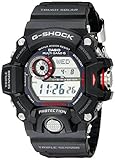
G-Shock Rangeman GW-9400
- 53mm case
- Compass altimeter barometer thermometer
- Solar and multi-band timekeeping
- 200M water resistance

Casio TRT-110H
- Mud and low temperature resistant
- Vibration alarm
- Approx 10 year battery
- 100M water resistance
All 12 Best Casio Watches for Outdoor Work in October
| Product | Specs | Action |
|---|---|---|
| Casio G-Shock GA-700UC-5ACR |
|
Check Latest Price |
 Casio G-Shock DW-9052-1VDR Casio G-Shock DW-9052-1VDR |
|
Check Latest Price |
 Casio G-Shock GA-100-1A1 Casio G-Shock GA-100-1A1 |
|
Check Latest Price |
| G-Shock Rangeman GW-9400 |
|
Check Latest Price |
 Casio MTG-M900DA-8CR Casio MTG-M900DA-8CR |
|
Check Latest Price |
| Casio TRT-110H-5BVCF |
|
Check Latest Price |
 G-Shock GW-7900B-1 G-Shock GW-7900B-1 |
|
Check Latest Price |
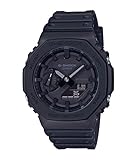 G-Shock GA-2100 G-Shock GA-2100 |
|
Check Latest Price |
 Casio ProTrek PRG-270-1 Casio ProTrek PRG-270-1 |
|
Check Latest Price |
 Casio G-Shock GD100-1B Casio G-Shock GD100-1B |
|
Check Latest Price |
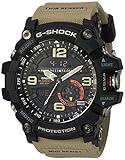 G-Shock Mudmaster GG-1000-1A5 G-Shock Mudmaster GG-1000-1A5 |
|
Check Latest Price |
 Casio ProTrek PRG600YB-3 Casio ProTrek PRG600YB-3 |
|
Check Latest Price |
Why Casio Watches Dominate Job Sites
Casio watches are tough because of how they are built, not because of a marketing claim. A resin case and bezel flex and absorb impact instead of transmitting it, an internal Alpha Gel layer cushions the movement, and sealed buttons and gaskets keep water and dirt out of the module.
That layered approach is what allows a normal quartz movement to survive a working life that would destroy a thin dress watch in a season. The same resin that shrugs off a dropped sledgehammer also keeps the case light enough to wear for twelve hours without thinking about it.
Water resistance is where the numbers matter most. A rating of 200M, often printed as 20 ATM, is the work-grade standard across most of this list and covers professional marine activity and serious surface water sports. Models rated 100M are fine for swimming and snorkelling but are not dive watches.
Sealing is also the source of the most common complaint on this page. Mud-resistant models use tighter button guards and port covers to stop debris entering, and that sealing is exactly why their buttons feel stiffer than those on a standard resin G-Shock. It is a genuine trade-off, not a defect.
For most outdoor work the honest comparison is against a cheap analog watch rather than against another Casio. If your main concern is lighting a dark site early, our guide to rechargeable work lights for job sites covers that side of the kit properly.
G-Shock vs Mudmaster vs ProTrek vs Rangeman: Which Line for Which Job
G-Shock, Mudmaster, ProTrek and Rangeman share a shock-resistant pedigree, and they are not interchangeable. The differences are about what kind of abuse the watch is defending against and how much data you want on the display.
G-Shock is the baseline. Impact resistance, 200M water resistance, a stopwatch and alarms. Choose it when the main threat is drops, vibration, dust and general physical abuse, which covers most construction, transport and trades work.
Mudmaster adds sealing designed specifically for mud, dust and debris. The button guards, port covers and case structure are built to be dunked in site muck rather than rinsed off. Forestry, groundworks and excavation are where this line earns its price.
ProTrek is the sensor line, built around altimeter, barometer, thermometer and digital compass. Tough Solar charging on most models means you never think about a cell. Pick it for surveying, hiking, backcountry maintenance and remote fieldwork.
Rangeman sits at the top of the G-Shock range and combines the full sensor suite with Tough Solar and multi-band radio timekeeping. It is the most capable watch here, and also the largest.
MT-G models trade resin for a stainless steel band and case, which suits people who wear the same watch to a client meeting and then to a site without changing it.
One family is not covered by any of the above. Frogman and ISO-rated dive models exist for people whose work is genuinely underwater, and Outgear covers the low end of the rugged range. Neither appeared in our results for this search, so neither is shortlisted here.
1. Casio G-Shock GA-700UC-5ACR – The Work Watch With the Most Owners
Casio Men’s Watch XL Series G-Shock Quartz 200M Water Resistant, Shock Resistant, Matte Tan Resin Finish, Durable Men’s Wrist Watches, Digital Casio G-Shock for Men (Model GA-700UC-5ACR)
52.8mm resin case
200M water resistance
Lithium cell approx 5 years
World time and five alarms
Pros
- Lightweight for its 52.8mm case
- Resin build shrugs off rain and knocks
- Bright display readable in sunlight
- World time with stopwatch and countdown
Cons
- LED backlight lights the hands but not the display
- Setup has a real learning curve
- Resin strap wears out first
This is the watch I keep coming back to for general outdoor work, and the reason is the numbers behind it. With more than ten thousand ratings and 80 percent of them at five stars, it is the model where the longest ownership histories are documented, and those histories are full of oil fields, construction, corrections and firefighting.
It weighs 2.5 ounces, which is remarkably light for a case measuring 52.8mm across. That combination is unusual: most G-Shocks at this diameter feel like a brick, and this one does not. Over a twelve-hour shift the difference between a heavy watch and a light one is the difference between forgetting you are wearing it and constantly adjusting your wrist.

The feature set is the standard G-Shock work kit. World time, a 1/100-second stopwatch, countdown timer, five daily alarms, hourly time signal and hand shift, all on a full auto-calendar with 12 and 24-hour formats. The analog hands sit over a digital readout, so you can glance at the time without pressing anything, which matters when both hands are full.
Water resistance is 200M, rated for professional marine activity and serious surface water sports. Rain, wash-downs and being fished out of a flooded ditch are all within spec, and the battery is a lithium cell rated at approximately five years.
The display is the standout. Owners consistently describe it as bright and clean in sunlight, which is not something you can say for every G-Shock, and that is where the 200M model’s case and lens layout pays off on an open site.
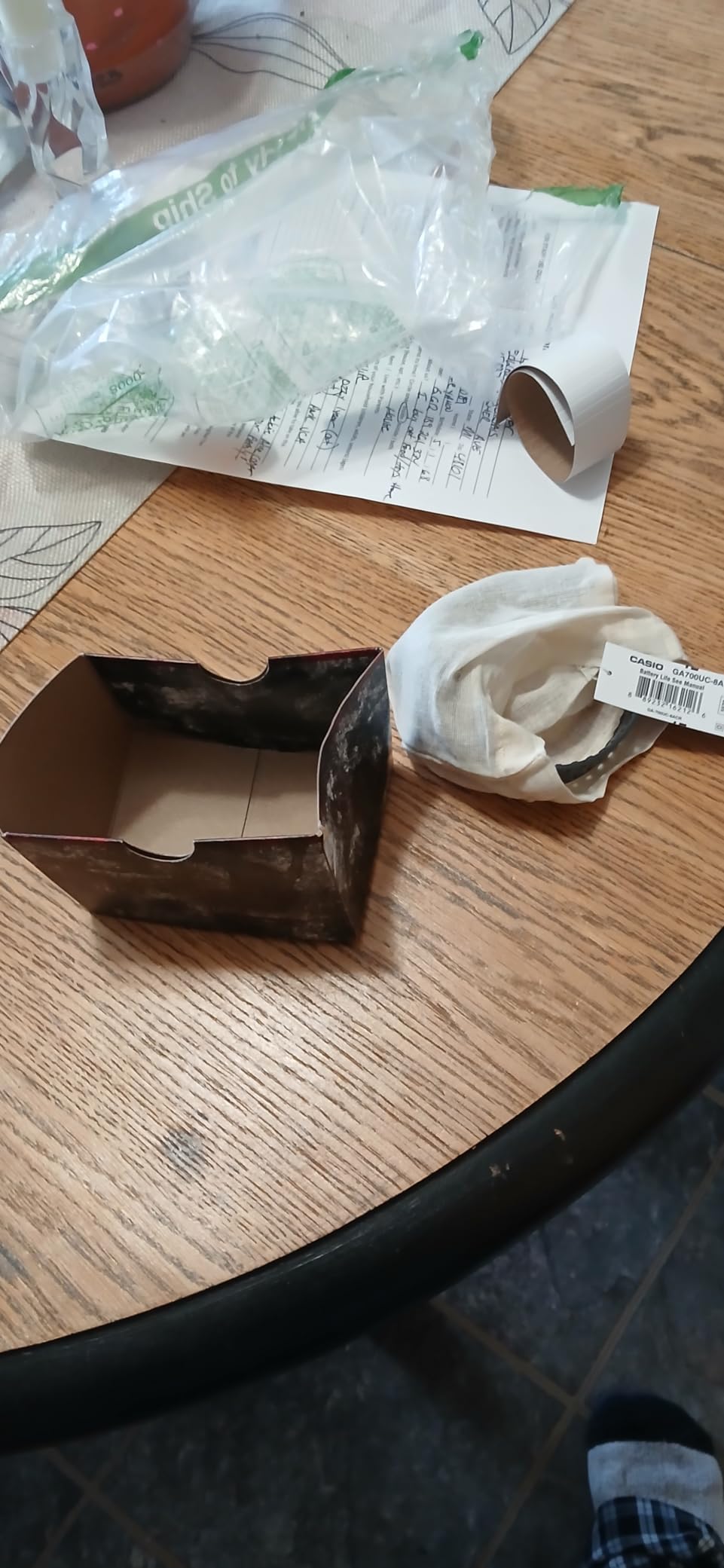
Is it comfortable over a long shift
Yes, and that is the single biggest reason it tops this list. At 2.5 ounces it is one of the lighter full-size G-Shocks, and owners coming from bigger cases consistently report the switch is immediately noticeable. The case still sits proud of a dress watch, but it does not slide around or dig in when your elbow is bent.
The 52.8mm diameter is the number to check before you buy. On a slim wrist it will look large, but the weight keeps it from feeling like a mistake. If you are between sizes, the GA-2100 further down this page is the smaller alternative.
What should you know before buying
The backlight illuminates the analog hands but not the digital display, which is the most repeated complaint in owner reviews. On a night shift that means pressing a button to read the date or the seconds, and on a job where you need gloved hands on a backlit button that is a small daily friction.
Setup also takes longer than it should. Setting the time and cycling through world time has a real learning curve, so budget ten minutes with a manual before your first shift. The resin strap and clasp are the parts most likely to need replacing eventually, which is normal for this construction and worth knowing before you judge the watch later.
2. Casio G-Shock DW-9052-1VDR – The Default No-Frills Work Watch
Casio Men’s G-Shock DW9052-1V Shock Resistant Black Resin Sport Watch
Rugged resin case
200M water resistance
EL backlight with afterglow
CR2016 up to 2 years
Pros
- Indestructible resin case and bezel
- 200M water resistance rated for real water use
- EL backlight with afterglow
- Stopwatch and countdown cover job timing
- Very high owner satisfaction
Cons
- Bulky case can feel oversized on small wrists
- Fewer sensors than newer G-Shock modules
If you want one watch that does everything and asks nothing of you, this is it. The DW-9052 is the entry point that the entire G-Shock reputation rests on, and with 83 percent five-star ratings across more than ten thousand reviews it is the least arguable recommendation in this roundup.
It is a simple module by modern standards: 1/100-second stopwatch, 24-hour countdown, multi-alarm with flash alert, auto-calendar programmed through 2099 and dual time. There is no Bluetooth, no solar and no altimeter, and on a job site none of those are the features you actually reach for.
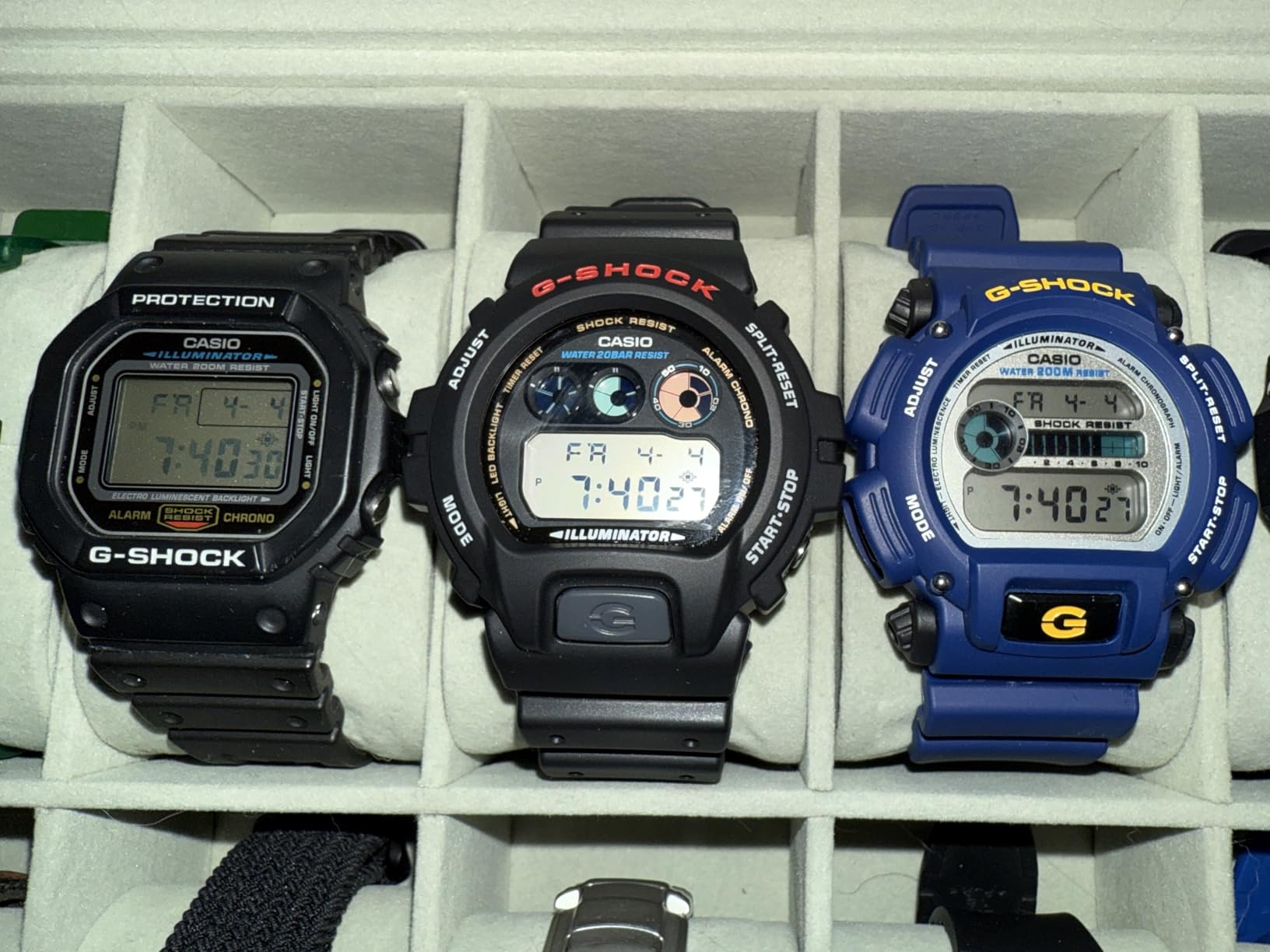
Water resistance is 200M and the listing rates it for swimming, snorkelling and scuba diving. That rating is a big part of why it has survived two decades of use in every environment from a building site to open water, and it is the number to insist on if your work involves water.
One clarification worth making: 200M is a pressure rating, not a guarantee against a hot bath, a hot shower or a steam room, none of which are good for any watch at that rating. Wear it in the water, not in the steam.
The battery is a CR2016 rated up to two years, which is the main weakness of the whole module. On a long attachment away from a shop, that is one more thing to carry. The TRT-110H in this list is the answer to that problem, with a roughly ten-year cell.
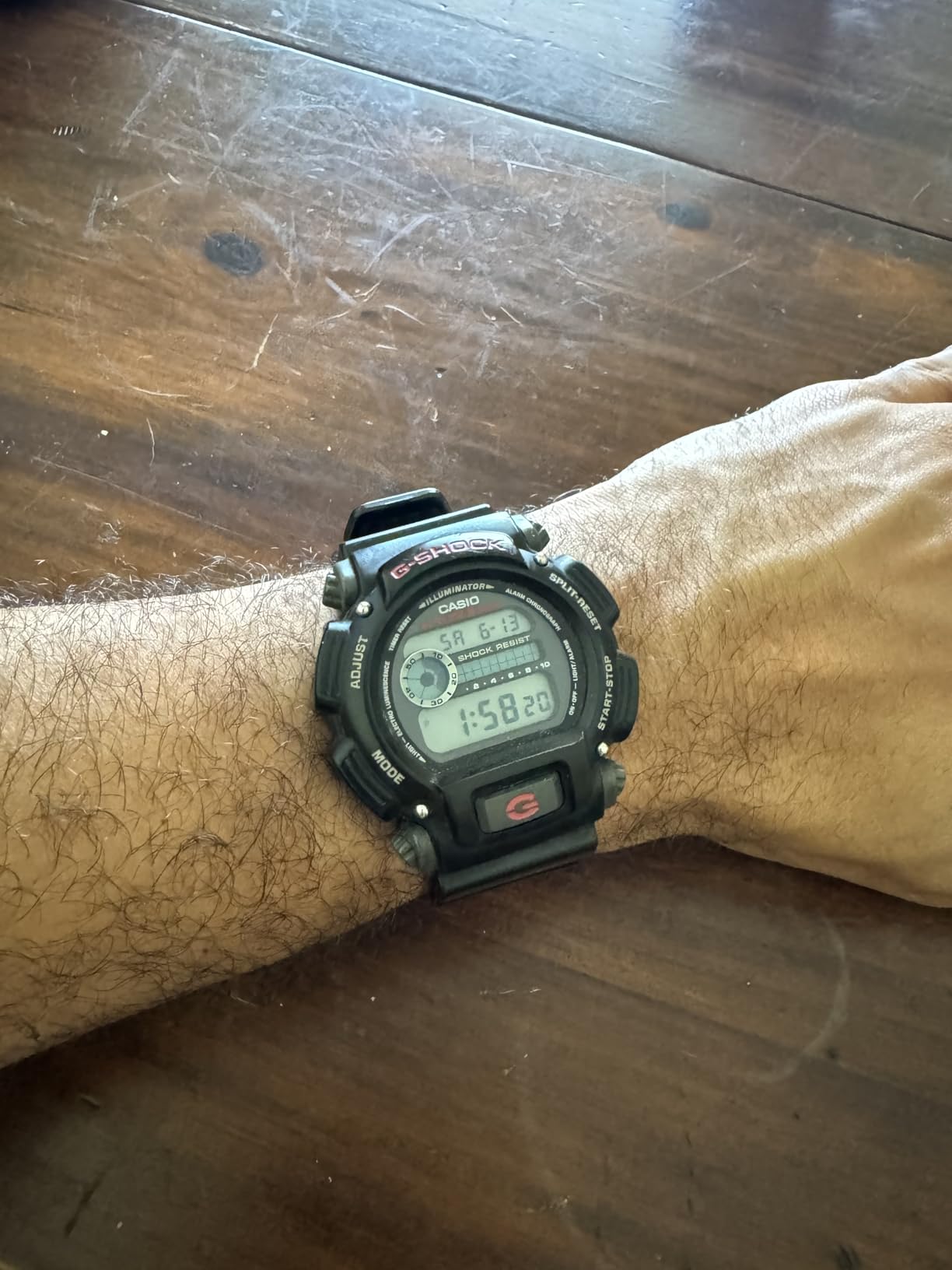
Why it is still the value pick
Because nothing you lose matters. The case does not have a sensor stack to damage, the display is a straightforward high-contrast panel that works with any light, and the module has been in production long enough that parts and straps are easy to find.
Owners describe the EL backlight with afterglow as the feature that makes it usable at night, since it lights the whole display rather than a small window. For welders working after dark, night-shift warehouse crews and anyone driving between sites, that is the practical difference between this and a cheaper quartz watch.
Where it falls short
The case is bulky and owners with smaller wrists regularly flag that it looks oversized. The module is basic, with no environmental sensors, so it will not tell you the temperature, the pressure or which way is north.
At 5.61 ounces it is also heavier on the wrist than the GA-700UC, which is the main reason I placed the GA-700UC first despite the DW-9052 having a slightly higher rating. Both are excellent. If your priority is light weight over longest battery, take the GA-700UC; if your priority is the simplest, most proven watch available, take this one.
3. Casio G-Shock GA-100-1A1 – Magnetic Resistant Around Machinery
Casio G-Shock GA100-1A1 | Men’s Tough Analog-Digital Watch | 200M Water Resistant | Shock & Magnetic Resistant | Sporty & Rugged Design
Analog-digital display
200M water resistance
Shock and magnetic resistant
Auto LED with afterglow
Pros
- Analog hands readable at a glance
- Shock and magnetic resistant
- Auto LED with afterglow
- 200M water resistance
Cons
- Large bold case sits big on smaller wrists
- Busier dial than minimalist models
Most rugged watches are not magnetic resistant, and on a workshop floor surrounded by electric motors, generators and steel stock that is a real limitation. The GA-100 is the one in this roundup that specifies magnetic resistance alongside shock resistance, which makes it the natural choice for mechanics, plant operators and anyone working around heavy machinery.
The layout is full-size analog-digital. Analog hands carry the time so you read it without waking anything, and three digital windows below give you the stopwatch, the date and the seconds. For a machinist switching between a job card and a dial indicator, that combination is more usable than a pure digital module.
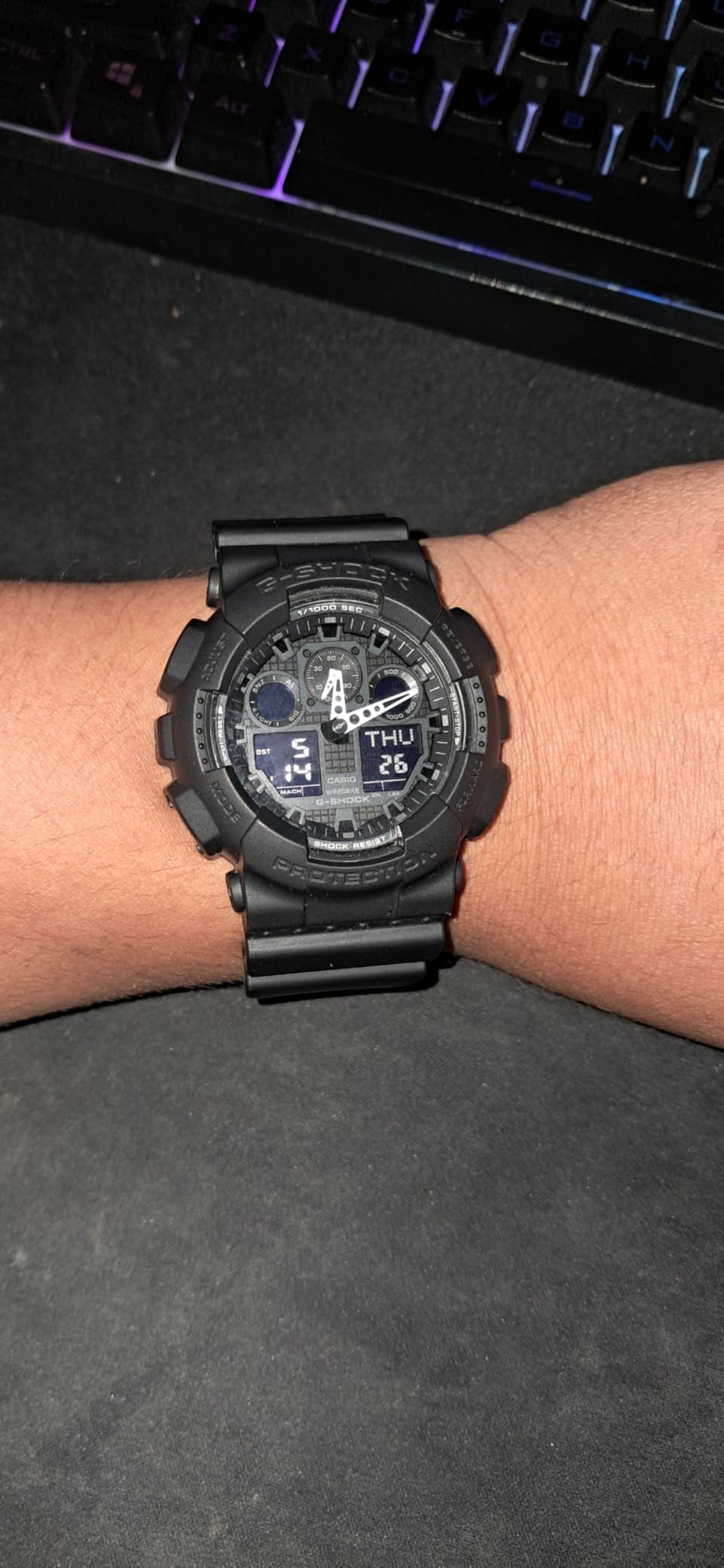
At 2.5 ounces it stays comfortable through a long shift, and the case fits a standard men’s band size, which makes strap replacement straightforward. The auto LED with afterglow means the display lights in dim conditions without you having to remember a button sequence.
Owners consistently point to the shock and magnetic resistance combination as the reason the watch holds up in steel mills and rough trades, and the 200M water resistance covers the coolant, rain and wash-downs that come with that work.
When the analog-digital layout helps
It helps most when you are wearing gloves and working by feel. Reading a large analog hand does not require pressing anything, and the digital windows only matter when you actively want the stopwatch. That is the opposite of a display that becomes unreadable the moment the light drops.
It is also the watch I would choose if you work around electrical equipment and want a second time source away from a phone. Owners in industrial settings describe exactly that pattern of use.
What it costs you in bulk and clarity
The case is large and bold, and reviewers with smaller wrists describe it as sitting big. The dial is busier than a minimalist G-Shock, which is a fair trade for the extra data but is worth seeing in person if you are used to a sparse layout.
There is no backlight option that lights everything evenly in the way the GD100 later in this list does, and the module carries no sensors. If your work is near live electrical gear, check your own site rules first; a watch is a tool, not a safety certification.
4. G-Shock Rangeman GW-9400 – Full Sensor Suite, No Charging
Casio Men’s GW-9400-1CR Master of G Stainless Steel Solar Watch, Black (GW9400-1CR)
53mm case
Digital compass altimeter barometer thermometer
Tough Solar and multi-band timekeeping
200M water resistance
Pros
- Highest satisfaction rating in this group
- Compass altimeter barometer and thermometer
- Solar power with multi-band timekeeping
- High contrast display
Cons
- One of the two largest cases here at 53mm
- Stainless steel band is heavier and bulkier than resin
The GW-9400 has the highest satisfaction rating in this roundup, with 88 percent five-star reviews, and that number is easy to understand once you have carried one. This is the flagship G-Shock: full sensor suite, Tough Solar charging, multi-band radio timekeeping and 200M water resistance in a 53mm case.
For outdoor work the case diameter is the first thing to check. At 53mm it is one of the two largest cases in this list, and owners repeatedly describe the watch as imposing. If you work in a long-sleeved shirt or a jacket cuff, test it over your actual workwear before committing.
The sensors are the reason to buy. Digital compass, altimeter, barometer and thermometer mean the watch can tell you roughly where you are, how high you are, whether the pressure is dropping and how cold it is, without a phone or a paper map. For land inspection, forestry, trail and utility work that is real capability rather than a spec-sheet line.
Tough Solar removes the battery from the maintenance schedule entirely, and multi-band timekeeping corrects the watch by radio signal when it can reach a transmitter. The practical result is a watch that is accurate to the second and never needs a cell, which on a two-week attachment in the field is the feature that matters most.
Why it earns the highest rating
Because there are very few complaints beyond size. Reviewers treat it as a top-tier G-Shock that holds up to heavy outdoor use, and the recurring note is that the watch simply does the job without demanding attention. No charging, no cell swaps, no menu navigation.
Radio-controlled timekeeping is also underrated for shift work. A watch that self-corrects never drifts across a long deployment, and if you log hours on site you are not relying on your phone battery to know what time it is.
Where the size becomes the problem
At 6 ounces with a stainless steel band, that mass sits high on the wrist. Buyers who move to it from a resin model describe the first week as an adjustment, and the consensus is that it becomes unnoticeable. Buy it if you want the capability, not if you want the lightest watch.
The steel band also runs hot in summer and feels rigid in cold field conditions, and unlike a resin strap it is not something you can swap for a cheap spare. If you need dual time or world time, expect to learn that menu as well.
5. Casio MTG-M900DA-8CR – Office to Job Site in One Watch
Casio Men’s G-Shock MTGM900DA-8CR Tough Solar Atomic Stainless Steel Sport Watch
Tough Solar and Multi Band 6
Stainless steel band
200M water resistance
Approx 9 months per charge
Pros
- Steel band looks dressier on a site
- Tough Solar plus atomic timekeeping
- World time and five alarms
- Full auto EL backlight
Cons
- Stainless band is heavy and cold to wear
- Fewer environmental sensors than Rangeman and ProTrek
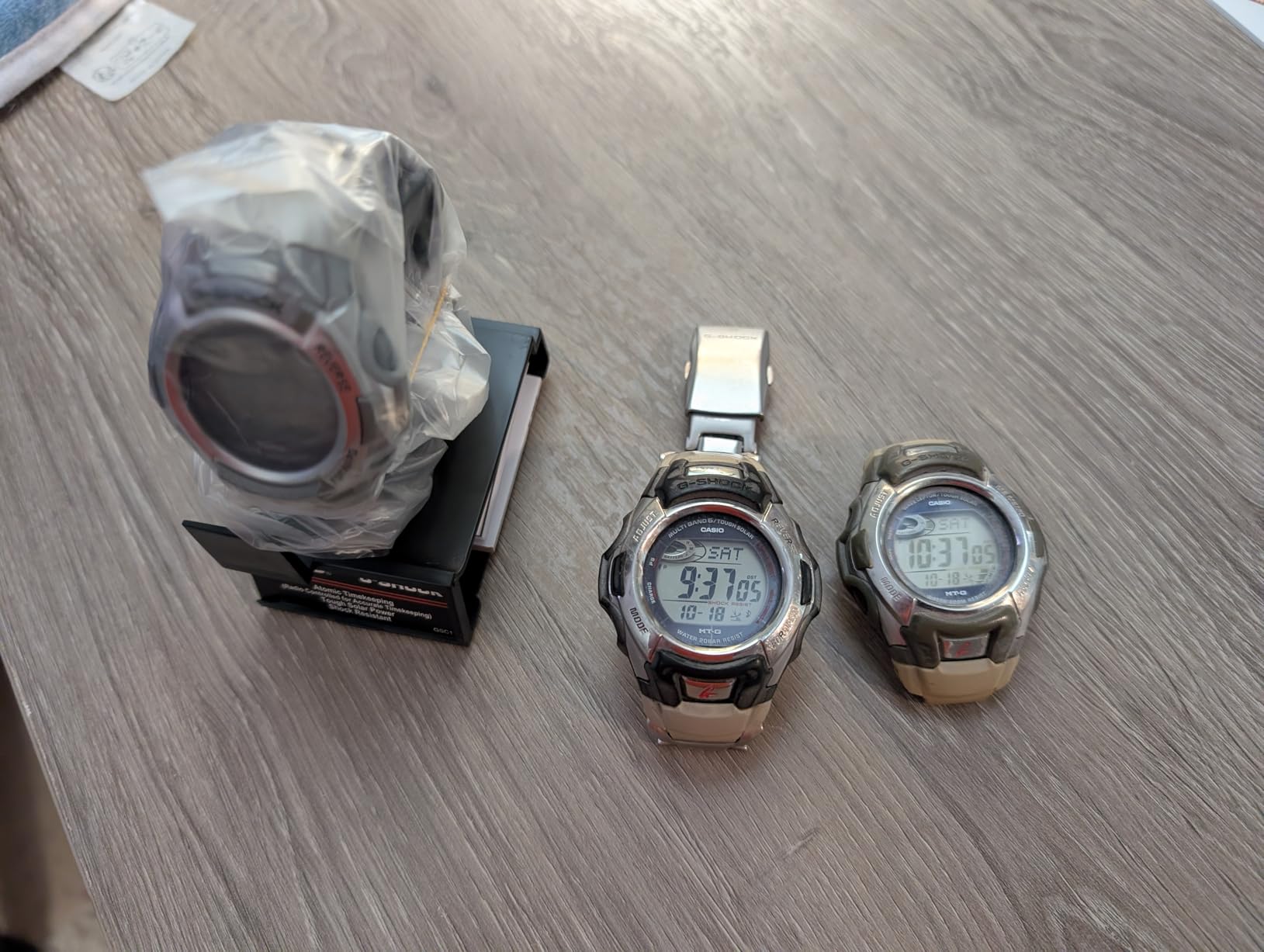
This is the watch for people whose week splits between a meeting room and a muddy field, which is the situation r/casio owners describe constantly when they ask which model to wear to work. The MTG-M900DA gives you G-Shock shock resistance with a stainless steel band, so it passes a client meeting without looking like equipment.
The case combines resin and stainless steel, which is what keeps the weight reasonable for a metal-banded watch. The band uses a one-touch three-fold clasp, so you can size it with gloves on rather than hunting for a pin tool.
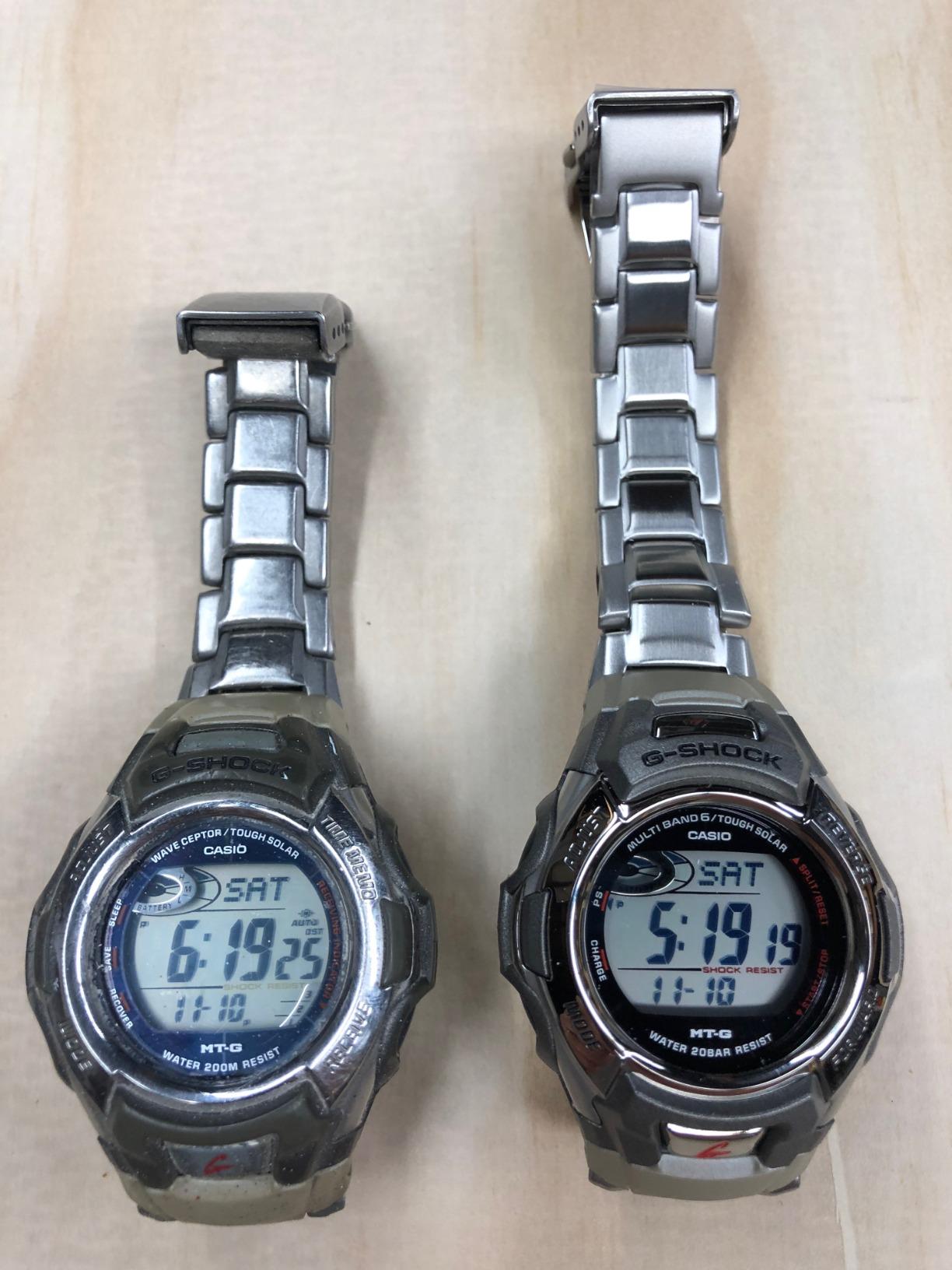
Tough Solar with Multi Band 6 means the watch charges itself and corrects itself by radio. Owners report roughly nine months of power from a full charge, which in practice means you might never think about power at all. World time covers 31 time zones and 48 cities, 1/100-second stopwatch, 24-hour countdown and five daily alarms with snooze round out a genuinely useful shift toolkit.
Water resistance is 200M, rated for professional marine activity and serious surface water sports. The full auto EL backlight with afterglow activates in dim light without a button press, which matters when your hands are wet or gloved.
When mixed dress and work is the real brief
Most people who buy one watch for work end up with two, and that is a reasonable pattern. But if you would rather not juggle, a metal-banded model like this is the compromise most people settle on, because it survives the site and still looks deliberate in a meeting.
It is also the right choice for anyone who travels between sites in different time zones. Radio timekeeping plus world time means the watch is right without you thinking about it.
What you give up for the metal
The band is heavy and reviewers specifically call it hot in warm conditions and rigid in cold ones. That is the trade you make for the look, and if you work in winter or in a foundry it is a trade worth thinking about twice.
There are no altimeter, barometer or compass sensors here, so for navigation or weather reading you want the Rangeman or a ProTrek instead. The absence of sensors is the single most cited reservation among owners.
6. Casio TRT-110H-5BVCF – Mud Resistance and a Vibration Alarm
Casio Mud Resistant 10-Year Battery
47.9mm case
100M water resistance
Mud and low temperature resistant
Approx 10 year battery
Pros
- Mud and low temperature resistant
- Vibration alarm useful on noisy sites
- Approx 10 year battery life
- Super Illuminator LED and 1/100 stopwatch
Cons
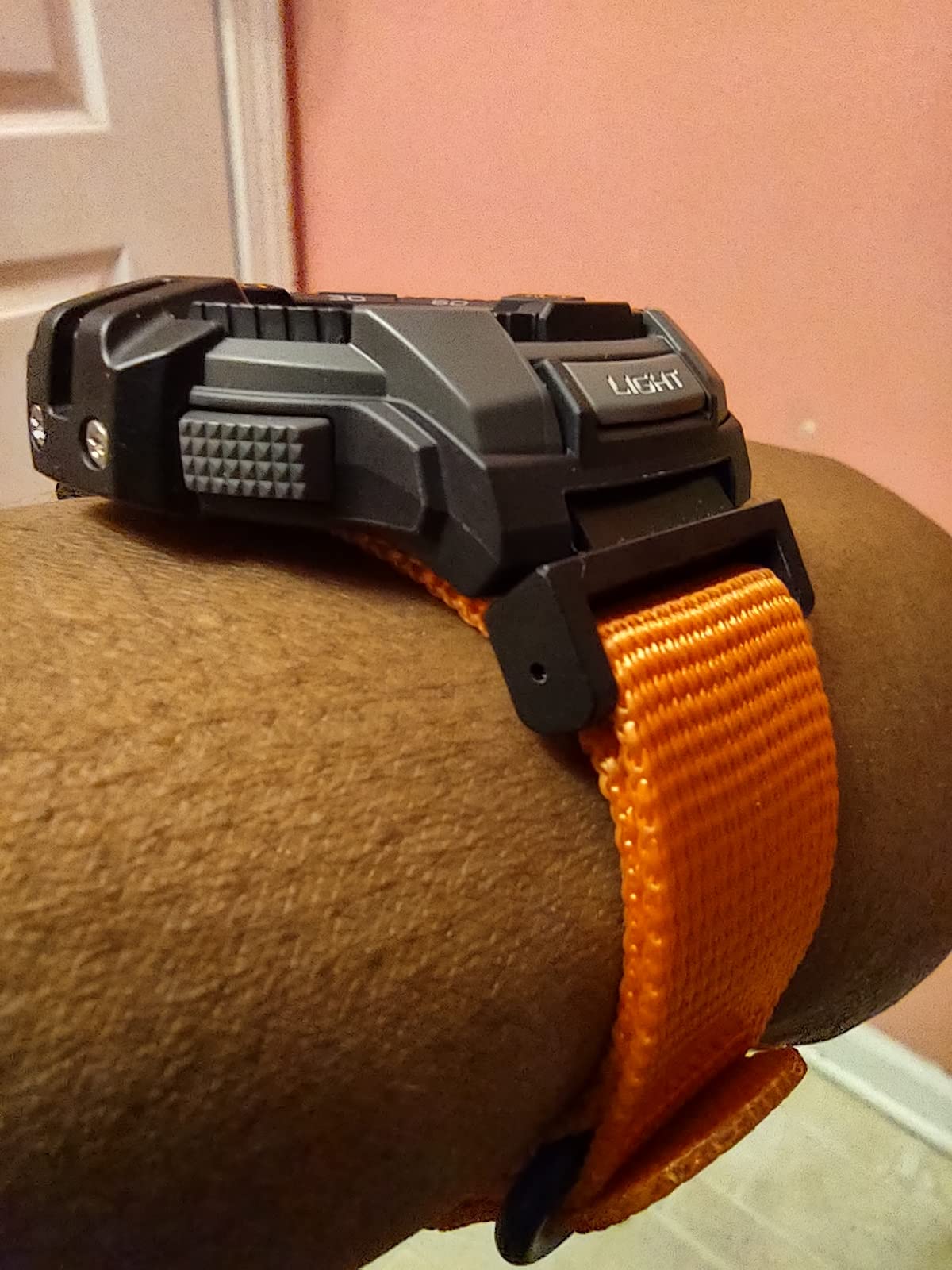
- Sealed mud-resistant buttons are stiff
- Negative LCD hard to read for some eyesight
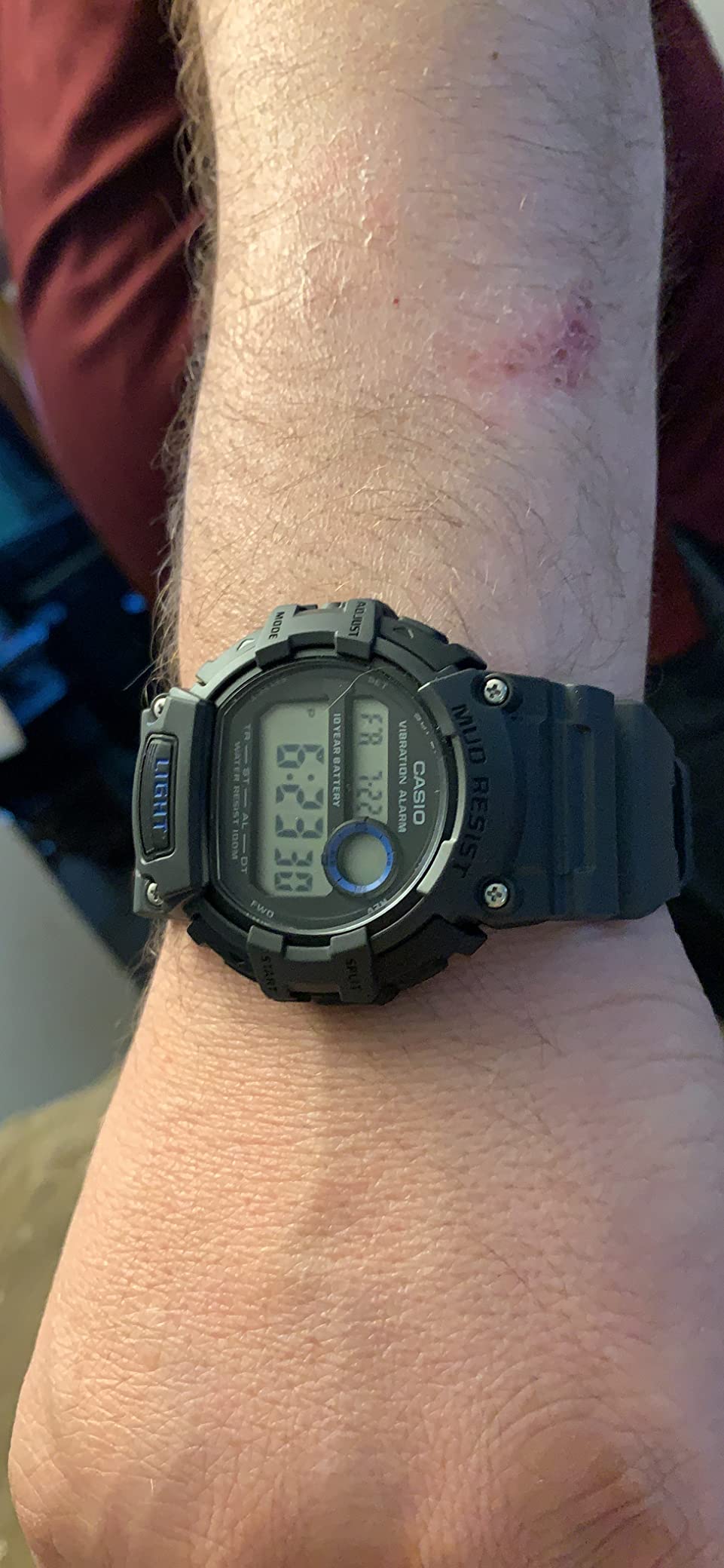
The TRT-110H answers a question most G-Shocks cannot: what happens on a site so loud you cannot hear an alarm? It has a vibration alarm, and owners in trades, military and outdoor settings single that out as the reason they bought it.
On a noisy site, a beeping watch is decoration. A vibration alarm is a silent tap on the wrist that you feel through a glove, which makes it useful for shift changes, break times and any job where you cannot stop to listen.
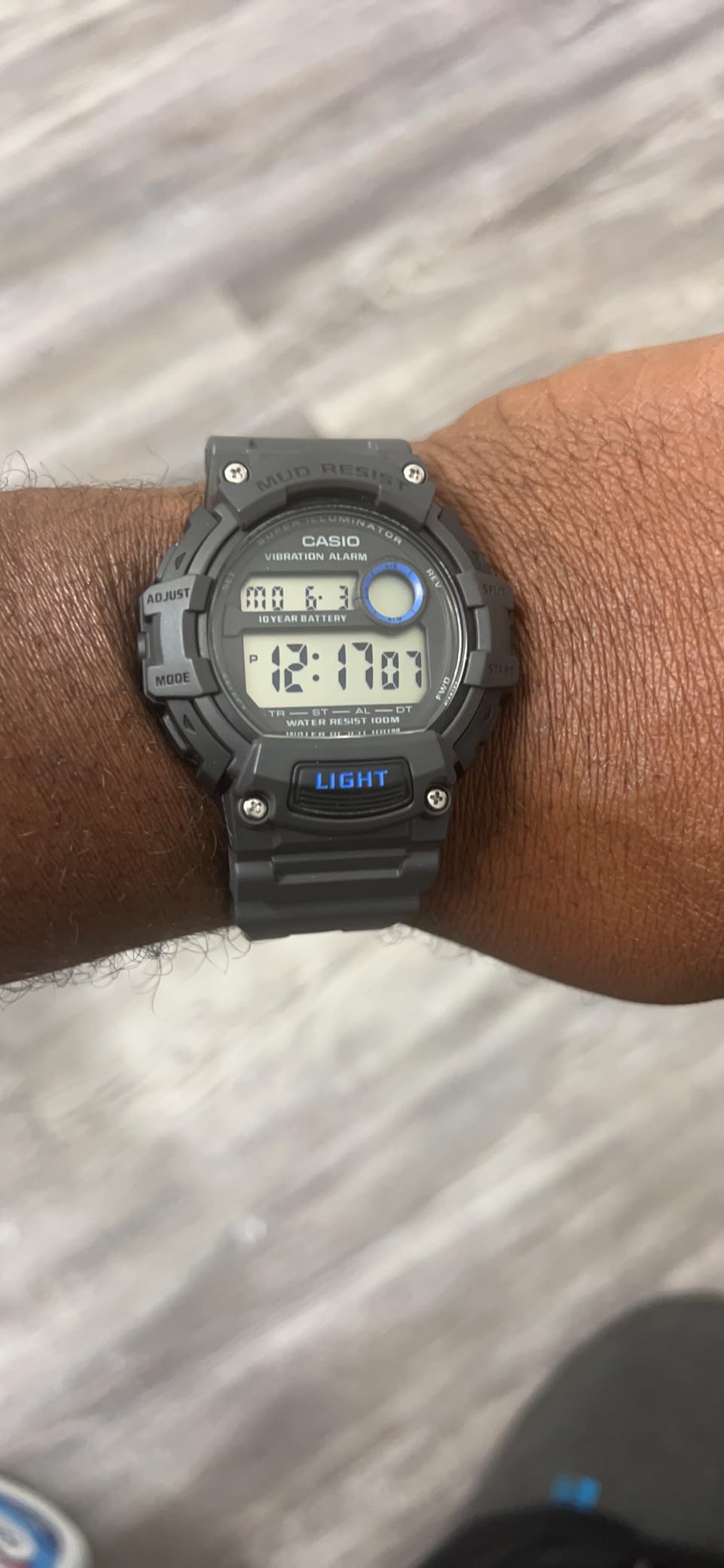
The build is mud resistant and low temperature resistant, at a case diameter of 47.9mm, which makes it one of the smaller watches here. That is a genuine advantage over a 53 or 56mm case when you are wearing a glove cuff or a long sleeve.
Battery life is the other headline. A quartz movement with an approximately ten-year battery removes cell changes from the maintenance schedule almost entirely. Water resistance is 100M, suitable for swimming and snorkelling but not scuba, which is a lower figure than most of the G-Shocks on this list.
One owner reports the watch survived eleven weeks of Army basic training, which is a good indicator of the abuse tolerance owners report generally. The dedicated super LED light button, 1/100-second stopwatch and 1/10-second countdown timer are simple but well chosen.
When vibration beats sound
Anywhere noise is a hazard: fabrication, sawing, plant operation, quarry work and busy warehouses. You set the alarm, forget about it, and feel it land on your wrist instead of trying to hear it over a compressor.
It is also the reason this watch is worth considering for anyone who wears hearing protection for a full shift. Combined with the ten-year cell and the mud resistance, it is the least fuss option in this roundup for a harsh job.
What the mud resistance costs you
Those sealed buttons are stiff and need deliberate pressure, which is the direct trade-off of the mud protection. Owners also flag the negative LCD as hard to read for anyone with reduced eyesight, and the 100M rating is below the 200M standard most work G-Shocks meet.
So it is not the toughest watch here, but it is arguably the most considered one at the money. If vibration and battery life matter more to you than absolute shock rating, this is the pick.
7. G-Shock GW-7900B-1 – Tide and Moon Data for Marine Jobs
G-Shock Solar Atomic Rescue GW7900B Black/Black One Size
50mm resin case
Solar and atomic timekeeping
Tide graph and moon phase
200M water resistance
Pros
- Solar and atomic sync keep time accurate
- Tide graph and moon phase useful on the water
- Rugged 50mm resin case with thick straps
- 200M water resistance
Cons
- Negative display hard to read at many angles
- Mineral crystal scratches easily with sand
- Very thick owners manual
For anyone who works on or near water, the GW-7900B does something no other watch in this roundup does. It displays a tide graph and a moon phase graph, and for commercial fishing, marina work, aquaculture and beach operations that is not a party trick.
Owners report years of daily wear through showers, ocean and camping, with the solar cell holding full charge and the atomic sync keeping the time accurate to the second. At-home time sync works reliably when the watch spends time near a window, which is how most people actually use it.
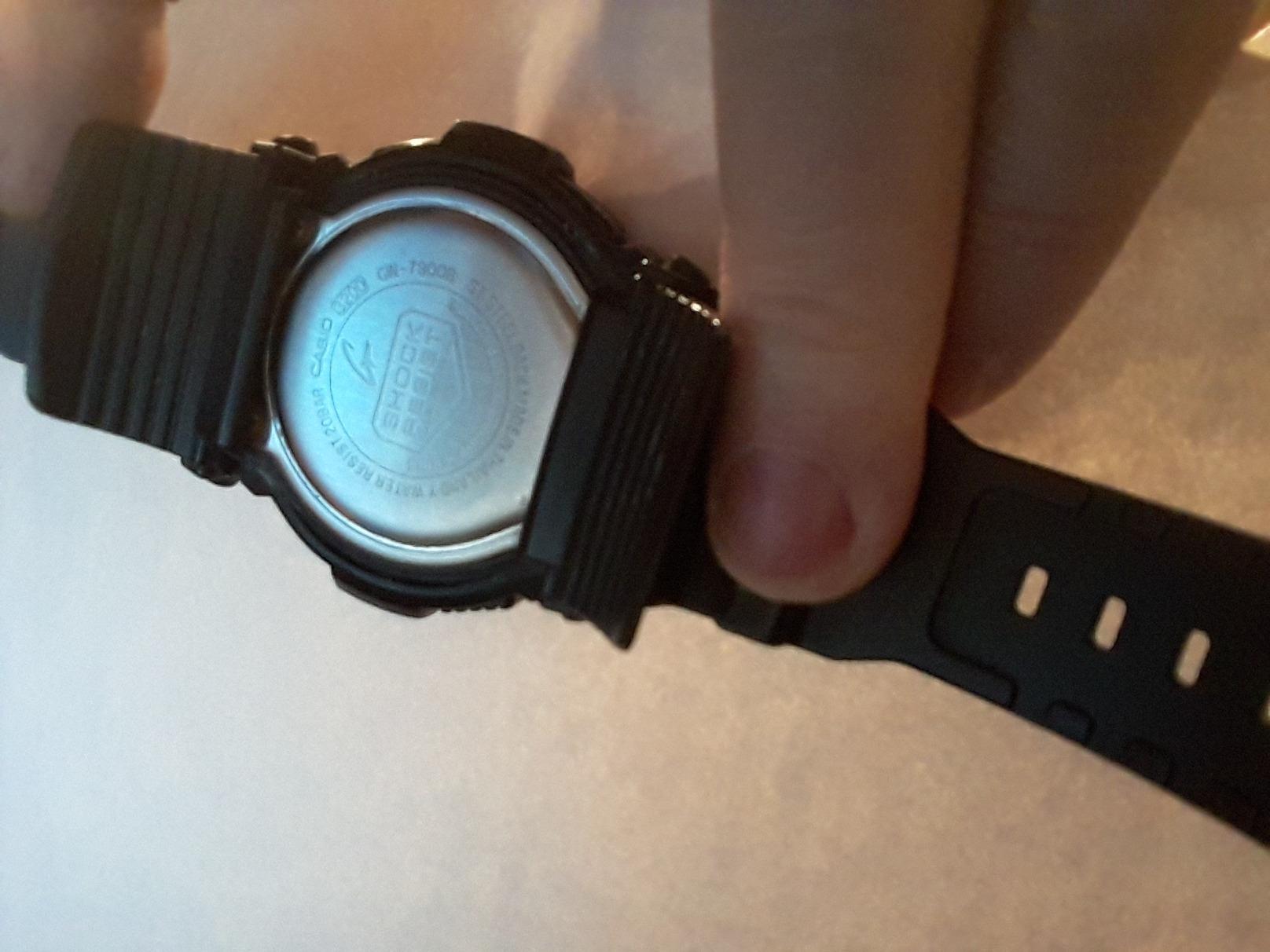
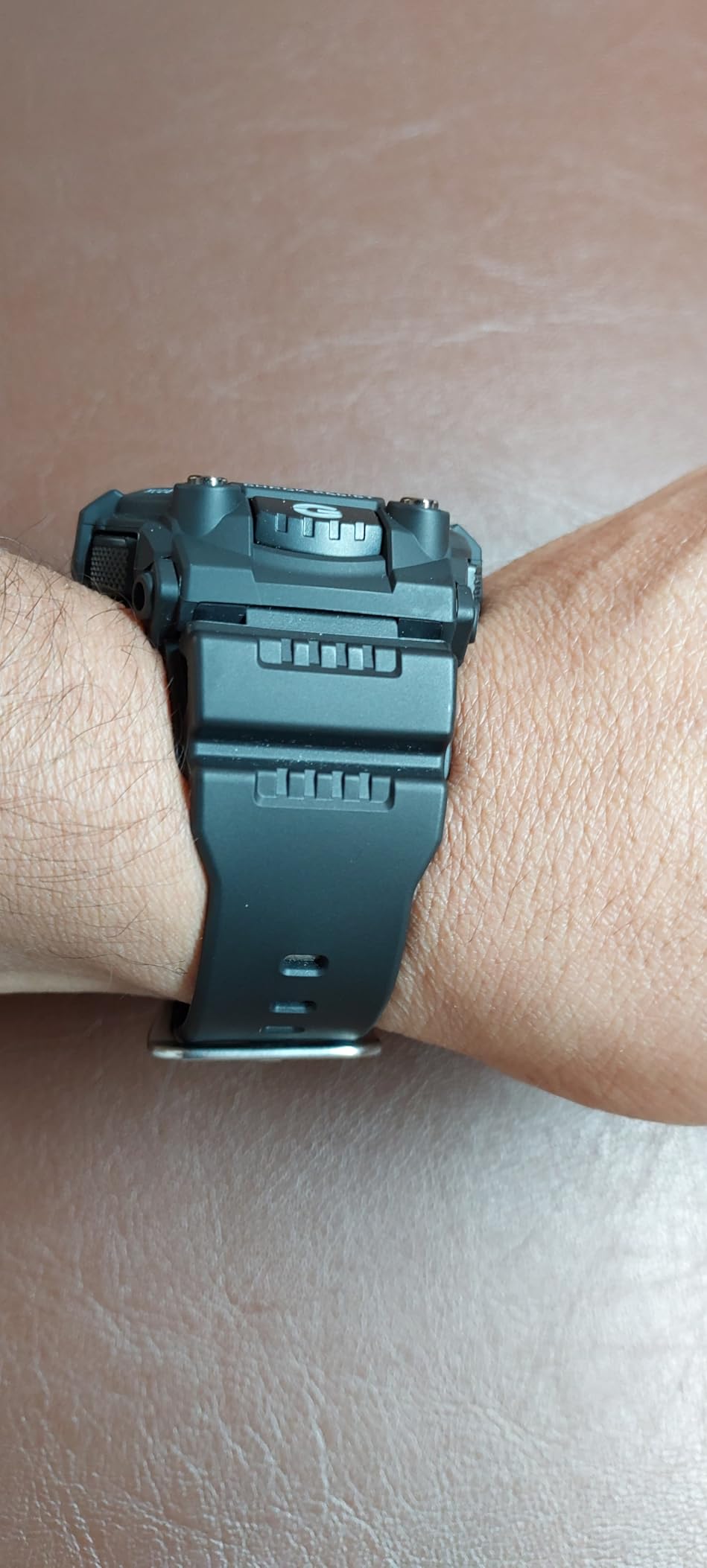
The case is 50mm resin with a mineral dial window, a resin band with buckle closure, and a rubber-coated exterior with a metal clasp. Water resistance is 200M for professional marine activity and serious surface water sports. The 1/100-second stopwatch, daily alarm with snooze and 12 and 24-hour formats cover the rest of the shift.
That combination of solar and atomic means the watch has no scheduled maintenance. For a crew member on a boat for days at a time with no access to a battery replacement, that is a practical advantage over every cell-powered model in this list.
Who actually needs tide data
If you are working a boat, a dock, a breakwater or a stretch of coast, tide timing and moon phase are part of the job, not a hobby feature. The same screen set also shows sunrise and sunset behaviour across 31 time zones, which helps crews working unusual hours.
For swim and pool training, our guide to fitness watches for swimming covers the specialist end of the market, but for a working watch that also handles salt water and knocks, this is the right tool.
Where the display and crystal disappoint
The negative grey-on-black display is the most cited drawback. Owners report it is hard to read at many angles and needs the backlight in low light, and on a bright deck at midday that is a real limitation.
The mineral crystal also scratches easily when exposed to sand, which is a genuine risk on a beach or a worksite rather than a theoretical one. The owners manual is universally described as enormous, and the tide and moon screens have a steep learning curve, so allow yourself a proper read-through.
8. G-Shock GA-2100 – Slim Enough for Sleeves and Small Wrists
G-Shock GA-2100-1A1 Black One Size
45.4mm carbon reinforced resin case
Analog-digital with double LED
World time
200M water resistance
Pros
- Slimmest case here at 45.4mm
- Carbon reinforced resin case is light and strong
- Clean dial with a bright double LED
- Synthetic band rinses clean easily
Cons
- Dark hands on a dark dial take longer to spot
- Setup is unintuitive without a walkthrough
- Small face on large wrists
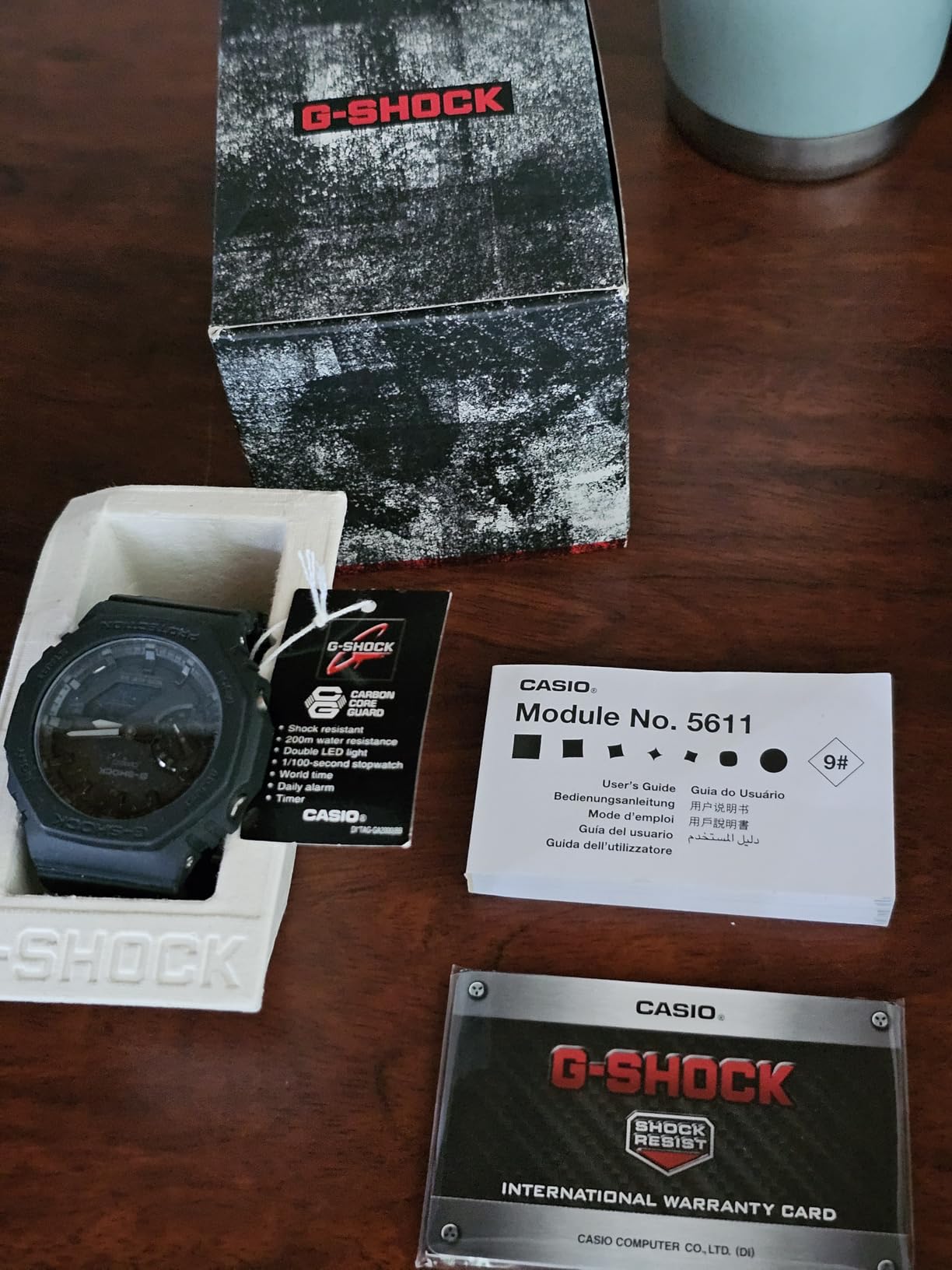
Sizing anxiety is the single most common theme in Casio owner threads, and the GA-2100 is the answer for anyone who has been put off by a 55mm Mudmaster. At 45.4mm it is the smallest case in this roundup, and it still carries 200M water resistance and shock-resistant construction.
The case is resin mixed with carbon fibre, which is how it stays light. Owners confirm G-Shock toughness at noticeably lower weight, and that combination means it slips under a shirt cuff or a jacket sleeve without catching, which is exactly the complaint large G-Shocks generate.
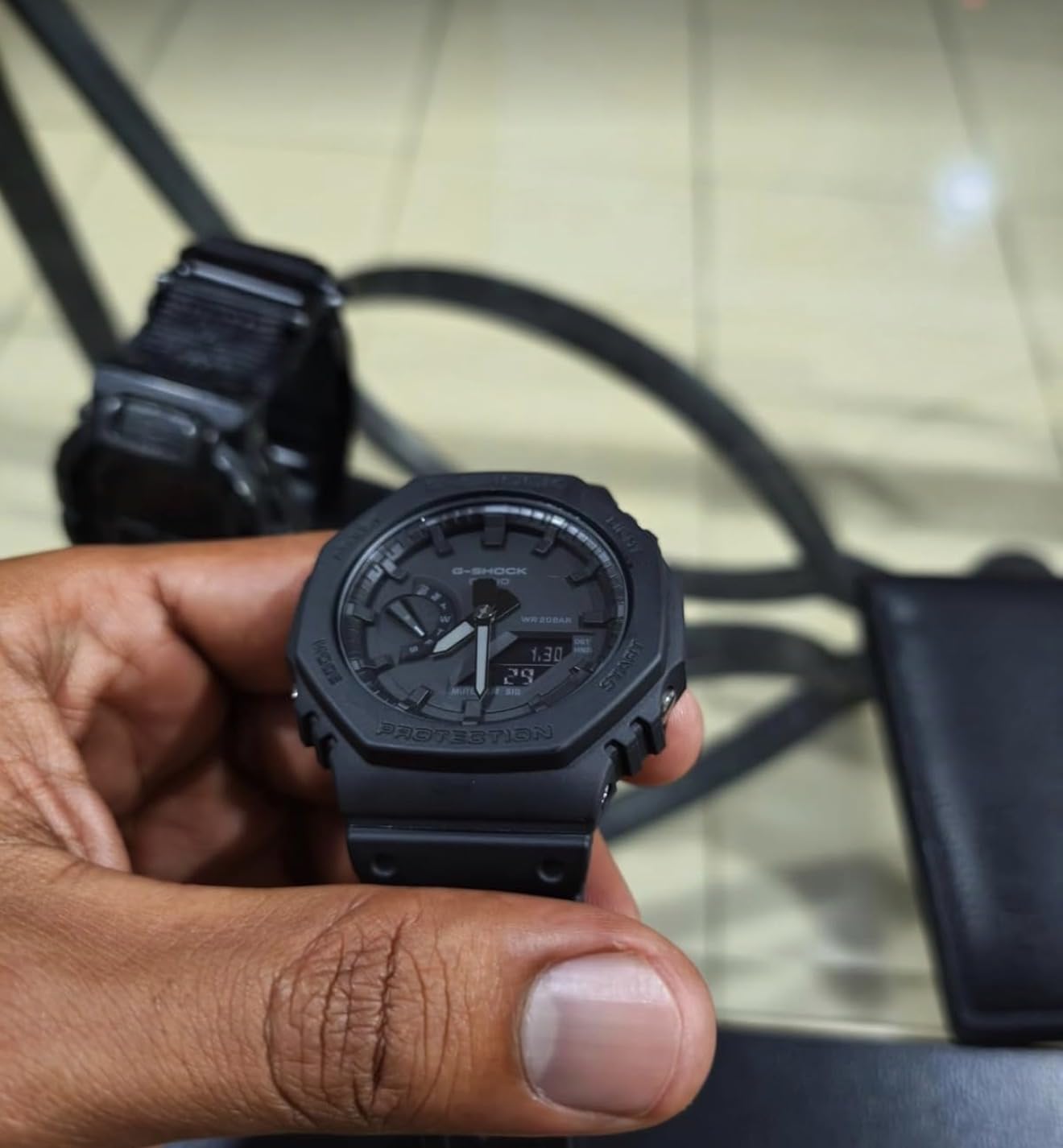
The analog-digital display has a double LED light that owners describe as bright enough for full darkness, which solves a problem several cheaper models have. The synthetic band rinses clean easily and handles kayaking and hiking use, which matters if you wear the same watch through wet and dirty weeks.
World time is included, along with the standard G-Shock shock and water resistance. The clean, uncluttered dial is quick to read at a glance, and for a watch you wear every day, that simplicity is worth more than a screen full of data.
Who should size down to this
Anyone on a smaller wrist, or anyone in workwear with tight cuffs and gloves. Sizing anxiety is the most common reason people abandon a G-Shock entirely, and this is the most direct way past it without giving up the durability standard.
It is also the best option for people who want one watch that works both on a site and in a normal working day, because it does not read as oversized or overly sporty. The carbon-fibre-reinforced case keeps the weight down across a long shift.
What you trade for the smaller case
On the all-black version the hands can blend into the background and take longer to spot, particularly when the light is poor. Setup, especially world time selection, is unintuitive without a video walkthrough.
Some buyers also find 45.4mm too small on a large wrist, and there is no sensor suite here at all. If you need compass and altimeter data, look at the ProTrek models further down instead of compromising on this one.
9. Casio ProTrek PRG-270-1 – Best Value Triple Sensor Watch
Casio Men’s Pro Trek PRG-270-1 Tough Solar Triple Sensor Multifunction Digital Sport Watch
Tough Solar and triple sensor
Altimeter compass barometer thermometer
100M water resistance
Low temperature resistant
Pros
- Full triple sensor suite in a solar watch
- Compass and barometer accurate once calibrated
- Sunrise and sunset data for shift work
- Backlight auto lights on wrist raise
- Nine months of power per charge
Cons
- Heaviest watch in the roundup
- No atomic time sync
- Altimeter drifts with pressure changes
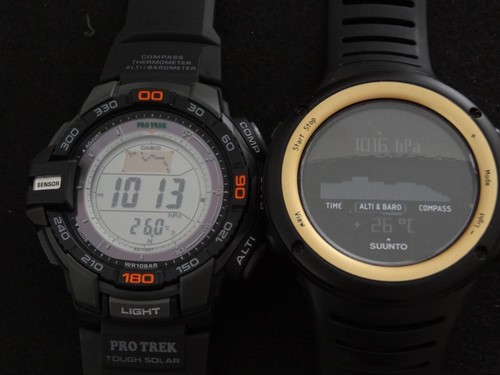
The PRG-270 is the one I would pick if outdoor work means being a long way from a vehicle and a resupply point. It combines Tough Solar charging with a full triple sensor suite, and it is rated low temperature resistant to minus 10C, which matters more in winter fieldwork than almost any other spec on this page.
The sensors are altimeter, digital compass with bearing memory, barometer and thermometer covering minus 10 to 60C. Owners report compass and barometer readings as genuinely accurate once calibrated, and timekeeping as accurate to the second against reference clocks.
Tough Solar gives approximately nine months on a full charge, and many owners report a year or more between charges in practice. World time covers 31 time zones across 48 cities plus UTC, with sunrise and sunset data, five daily alarms, a 1/10-second stopwatch and a countdown timer.
The full auto LED Super Illuminator lights on wrist raise, which owners specifically praise because it means you can read the display with gloves on without finding a button. That is a small detail with an outsized effect on a cold morning.
Owners also note the negative sentiment around this watch usually comes from skipping setup, not from hardware faults. Entering your location, calibrating the barometer and taking the thermometer off your wrist are the steps that decide whether the sensors seem useful or useless.
What the sensors are good for
Altitude on a forestry or survey job, barometric trend before a weather window opens, a bearing when you are walking a boundary line, and sunrise and sunset times when your shift is not a normal shift. That is real situational awareness for anyone working away from a road.
Our guide to GPS running watches covers the case where you need tracked routes rather than sensor data, but for a fixed working site a triple sensor is simpler and far longer lasting.
Where the setup will trip you up
It is the heaviest watch in this roundup, and owners say it may need removing to reach tight spaces. The altimeter drifts with barometric pressure changes and needs recalibrating, and the thermometer only reads accurately off the wrist and away from body heat.
There is no atomic time sync, so it loses a few seconds a month. Two of the side buttons are unlabelled, which slows the learning curve, and alarm volume is on the quiet side. If you work somewhere genuinely loud, the TRT-110H vibration alarm is a better answer.
10. Casio G-Shock GD100-1B – The Brightest Backlight in the Line
Casio G-Shock GD100-1B | Men’s Tough Digital Watch | 200M Water Resistant | High-Brightness LED | Dual Time & 7-Year Battery
High brightness Super Illuminator LED
200M water resistance
CR2025 approx 7 years
Dual time
Pros
- Light guide plate lights the whole display
- Approx 7 year battery life
- Shock resistant for rough trades
- Good readability for wearers who need glasses
Cons
- Negative display is difficult to read without the light
- Very large case
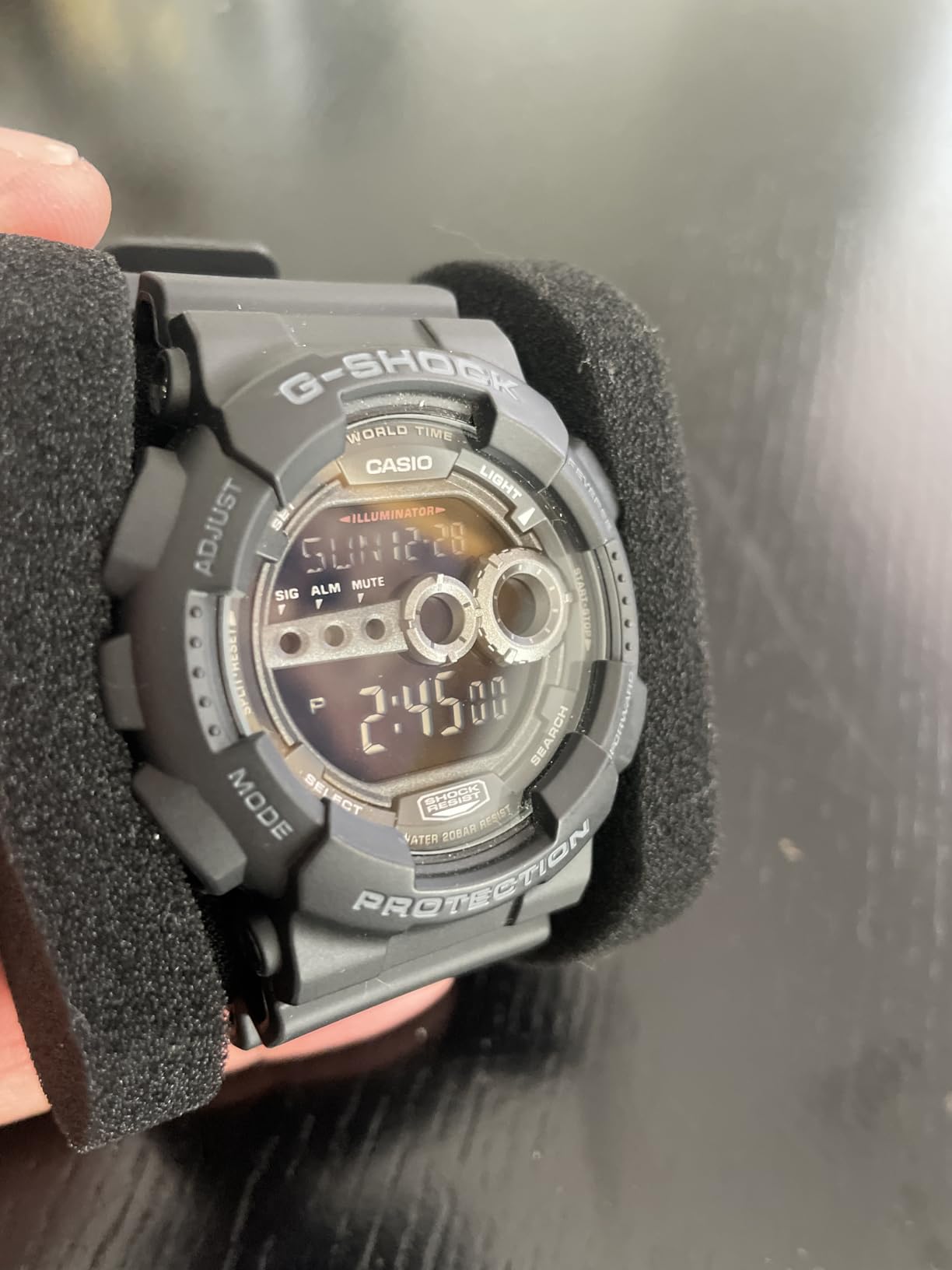
Several watches here use the phrase high-brightness backlight in their marketing. On the GD100-1B it is actually true, because the LED is paired with a light guide plate that spreads the light across the whole display rather than firing a narrow beam at the hands.
Buyers in industrial and first-responder settings describe the result in practical terms: you can read the full readout in total darkness, which matters for night shifts, emergency response and any early start before sunrise. Owners also note readability holds up for wearers who need glasses for close work.
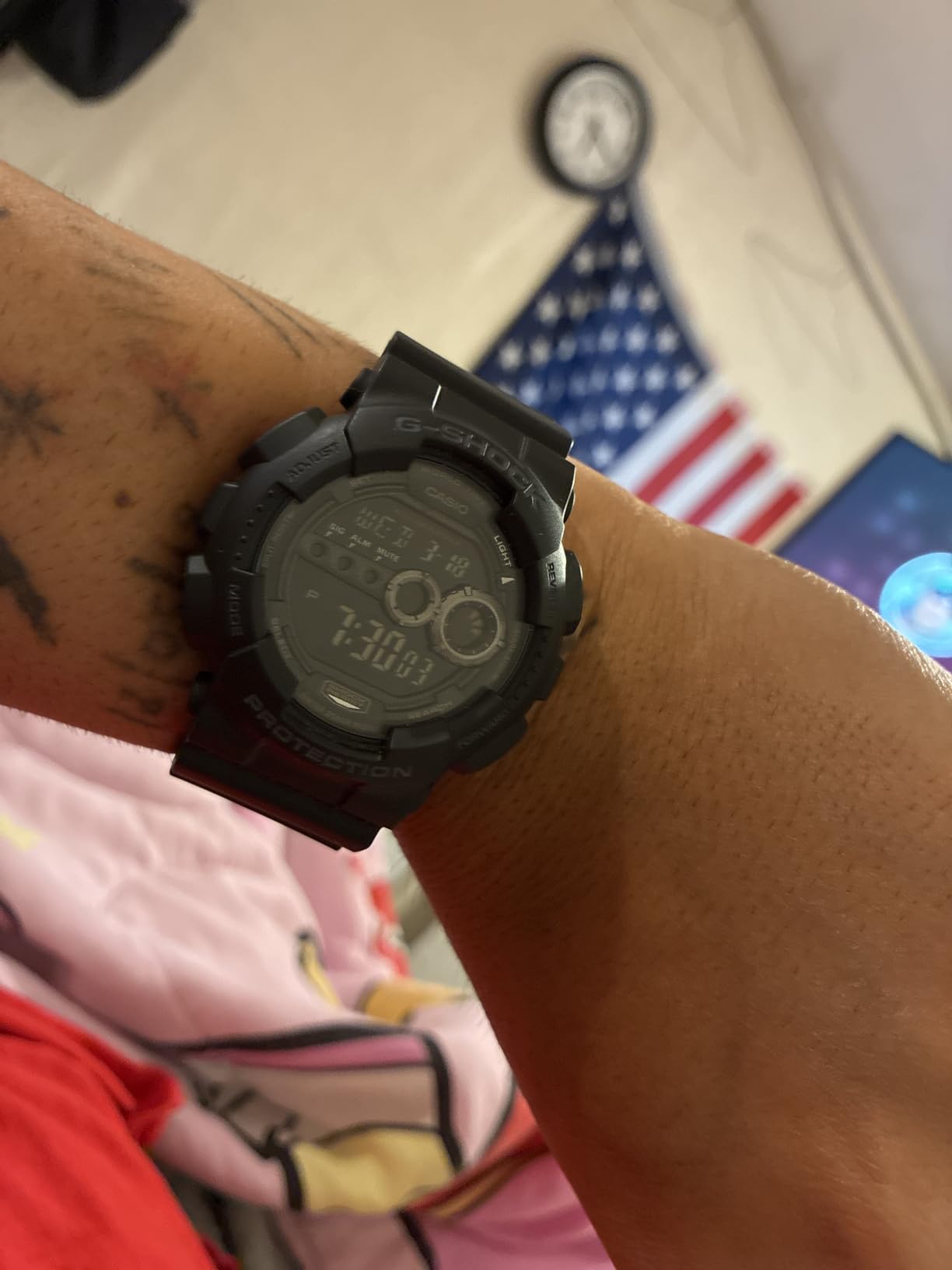
The battery is a CR2025 rated at approximately seven years, a large step up from the two-year cell in the DW-9052. Seven years is long enough that the cell may never need changing in the working life of the watch.
Water resistance is 200M for swimming, snorkelling and outdoor use, and the shock-resistant structure is described by owners as holding up in steel mills and first-responder work. Dual time is a small extra that suits crews working across zones, and the matte black finish keeps it discreet.
Why the backlight is the deciding feature
Dark sites are the hardest part of a lot of outdoor work. Digging, inspection, animal handling, night security and pre-dawn starts all happen in conditions where a negative LCD is close to useless without a light, and this watch is the one here that fixes that properly.
It is a good pairing with proper site lighting rather than a substitute for it. If you are planning kit for a dark job, our magnetic work lights for mechanics guide covers the light itself.
What the dark finish and big case cost you
The negative display is still difficult to read in dim conditions without pressing the light, so the backlight solves the problem rather than removing it. Owners rank display contrast in low light as the most common negative for this model.
The case is also very large and reviewers flag it as looking oversized on smaller wrists. At 2.5 ounces the weight is fine, so this is a diameter problem rather than a comfort problem, and the GA-2100 is the answer if the number is the issue.
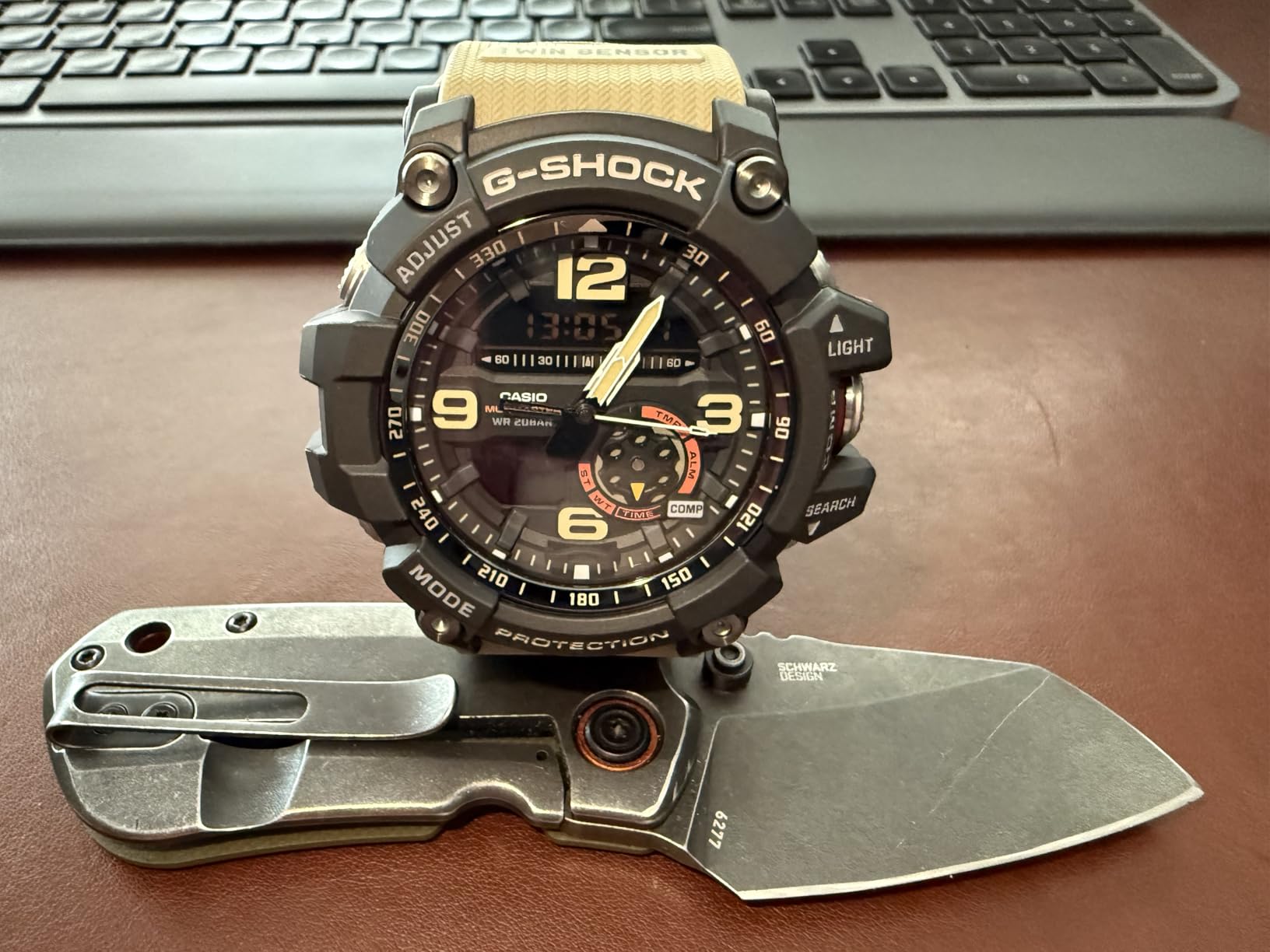
11. G-Shock Mudmaster GG-1000-1A5 – Built for Mud and Debris
Casio G-Shock MUDMASTER GG1000-1A5 Twin Sensor Watch Mud Resistant Shock Resistant 200M Water Resistant Compass Thermometer
MUDMASTER mud and debris sealing
Twin sensor compass and thermometer
200M water resistance
56mm dial
Pros
- MUDMASTER sealing built for mud and debris
- Working compass and thermometer
- Large buttons easy to press with gloves
- Light on the wrist despite the 56mm dial
Cons
- Very large 56mm case
- Backlight favours the analog hands
- Thermometer only accurate off the wrist
The Mudmaster name is not a marketing flourish. This watch is built to resist mud, dust, dirt and debris in a way a standard G-Shock is not, with tightened port covers and button guards designed to be filled with muck and rinsed out at the end of the shift.
If your work involves excavation, forestry, groundworks, drainage or anything where the watch spends hours in soil and slurry, that sealing is the entire point. It is the difference between a watch you rinse and a watch you eventually have to service.
The twin sensors are a digital compass measuring 16 points across 0 to 359 degrees and a thermometer covering 14F to 140F. Owners use both on real jobs, and the compass is the one that gets the most use on forestry and land work.
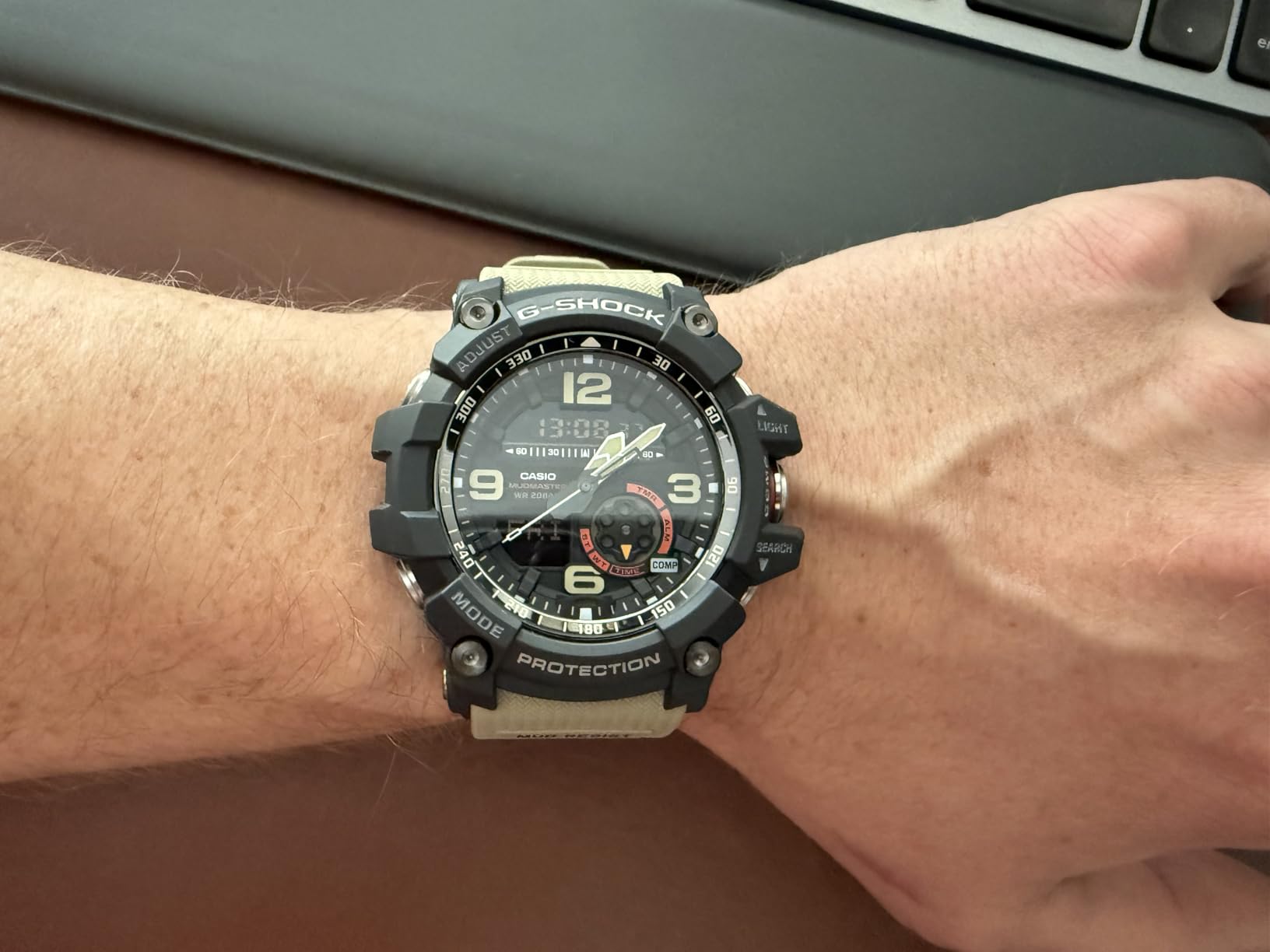
Water resistance is 200M for serious surface water and marine work. The Super Illuminator white LED has an auto light switch with 1.5 and 3-second illumination and afterglow, and world time covers 48 cities with a 1/100-second stopwatch, 60-minute countdown and five daily alarms with snooze.
The large buttons are easy to press with work gloves on, which is a genuine advantage over models with tighter, stiffer controls. Owners also describe it as one of the best-looking and most tactical G-Shocks in the line, which matters if you have to wear it every day.
Who the MUDMASTER construction is for
Anyone whose watch regularly ends up in dirt. Forestry and logging, excavation and groundworks, farming, drainage work and construction in wet conditions. In those environments the sealing is doing real work and the extra case bulk is a fair price.
Reviewers describe the watch as the most rugged in the group, and the glove-friendly buttons are called out specifically. If you are out in bad weather and cannot feel a small button through a glove, this solves that.
What the 56mm case really means
It is very large, and owners flag that it looks huge with short sleeves or on a small wrist. It is also light on the wrist at 3.2 ounces, so the bulk is visual rather than tiring.
There is one design compromise worth knowing: the backlight fully illuminates the analog hands rather than the digital readout, so reading the date or the stopwatch in the dark needs more attention. The thermometer only reads accurately off the wrist, and the analog hands can cover the day and date windows. Setup plus a very small printed manual is a learning curve, so budget time for it.
12. Casio ProTrek PRG600YB-3 – Solar Plus Atomic Timekeeping
Casio Men’s PRG-600YB-3CR PRO TREK Analog-Digital Display Quartz Green Watch (PRG600YB-3)
Tough Solar and atomic timekeeping
Compass altimeter barometer thermometer
52mm case
100M water resistance
Pros
- Only watch here combining solar
- atomic and triple sensor
- Sensors cover most backcountry and worksite needs
- Light at 2.36 ounces for a 52mm case
- Stopwatch countdown and world time
Cons
- 52mm case sits above a sleeve on smaller wrists
- Radial layout takes practice to navigate
- 100M water resistance so no diving
The PRG600 is the most complete specification in this roundup, and the reason is the combination rather than any single feature. Tough Solar charging, atomic radio-controlled timekeeping and a full triple sensor suite in one watch is not something else here manages.
Atomic timekeeping means the watch corrects itself by radio signal when it can reach a transmitter, so the time is right without you doing anything. Solar charging removes the battery from the maintenance list. Together they mean a watch that can be left in a van for a month and still be accurate.
The triple sensor covers digital compass, altimeter, barometer and thermometer, which handles most backcountry and worksite navigation needs without a phone. Water resistance is 100M, so swimming and snorkelling are fine but scuba is not.
At 2.36 ounces it is unusually light for a 52mm case, and owners single that out as surprising. The 1/100-second stopwatch, countdown timer and world time round out a field toolkit that covers timing, navigation and scheduling in one device.
With 83 percent five-star reviews across more than twelve hundred ratings, owner satisfaction is high, and the reported reservations are consistent rather than serious.
Why solar and atomic together matter on a job
Because the two failure modes of a work watch are a dead battery and a wrong time. Solar solves the first permanently. Atomic timekeeping solves the second, which matters if you are logging hours, running to a schedule or coordinating with a crew across sites.
It is the pick for remote or rotating work where the watch will not be near a mains supply for weeks. The PRG-270 is the cheaper way to get most of this, but it gives up atomic timekeeping and a couple of functions.
What you accept for the feature set
The 52mm case is large and sits above a sleeve on smaller wrists, which is the single most common reservation. The radial and rotating bezel-style layout takes practice to navigate, and 100M water resistance rules out scuba work.
Setup matters here too. Altimeter, barometer and compass all need calibration before they are useful, and skipping that is the usual reason owners report sensor readings as disappointing. Read the manual before you judge the sensors.
How to Pick a Casio Watch by Job Type
Start from the job rather than the model. Forum threads answer this question constantly and almost always at family level, which is why buyers end up with a watch that is either over-equipped or under-protected. These are the mappings I would use.
Construction and building sites – the G-Shock GA-700UC. Light, 200M rated, bright in sun, and the largest owner base in this roundup means its long-term failures are well documented. Add the DW-9052 if you want the simplest proven module.
Forestry, logging and arboriculture – the Mudmaster GG-1000-1A5. The MUDMASTER sealing is the deciding factor when a watch spends the day in bark chips and soil, and the compass gets used on boundary and plantation work. The Rangeman GW-9400 is the alternative if you need solar power more than mud sealing.
Marine, fishing and aquaculture – the GW-7900B. Tide graph and moon phase are working tools rather than extras, and solar with atomic sync means no maintenance aboard. For divers rather than deck work, none of these twelve is the right watch.
Utility, electrical and line work – the G-Shock GA-100-1A1 for machinery environments, or the GA-700UC for general field work. Magnetic resistance matters near plant and generators; follow your own site safety rules regardless of watch.
Military, law enforcement and tactical use – the Rangeman GW-9400 for full sensor capability and no charging, or the GG-1000-1A5 if mud and debris are the constant. The TRT-110H is the practical choice where silence matters more than sensors.
Agriculture, farming and groundworks – the GG-1000-1A5 for mud, or the TRT-110H for cold mornings with a vibration alarm and a ten-year battery. Both cope with being rained on and dropped at a field gate.
First response and emergency work – the GD100-1B. The high-brightness light guide plate is the feature that matters when you need to read the display in the dark, and the seven-year cell means it does not fail mid-incident.
Workwear with tight cuffs or smaller wrists – the GA-2100. At 45.4mm it is the smallest case in this roundup, and it slips under a tight glove cuff while keeping 200M water resistance.
One honest alternative worth naming: forum users frequently recommend the Timex Ironman when they want ruggedness at a lower outlay. Casio still wins on the size of the owner base, the availability of straps and the fact that sensors and cases are proven over decades rather than years.
Gloves, Alarms, Sizing and Battery: The Criteria That Decide It
Most buying guides stop at water resistance and shock rating. Those matter, but six other criteria decide whether a watch works a full shift, and every one of them comes up repeatedly in owner feedback.
Glove-operable buttons. Mud sealing and button guards make buttons stiffer, which is the top complaint on the sealed models and a genuine cost of the protection. If you will be operating the watch in gloves all day, the GG-1000-1A5 is explicitly praised for large, glove-friendly buttons, and the PRG-270 lights on wrist raise so you do not have to find a button at all.
Vibration versus audible alarms. On a loud site a beeping alarm is wasted. The TRT-110H is the only watch here with a vibration alarm, and that is why its owners in trades and military settings single it out. Everything else in this roundup relies on sound alone.
Case size against your wrist and cuff. The spread here runs from 45.4mm on the GA-2100 to 56mm on the Mudmaster, and that is a large enough difference to change your mind entirely. Check the diameter against your wrist and, more importantly, over the cuff of your actual workwear and over a glove cuff. If you can slide a glove over the band, you can operate it.
Display type in real conditions. Negative LCD panels, the grey-on-black style used by the TRT-110H and GW-7900B among others, need light. WatchUSeek criticism of G-Shocks for active use centres on exactly this, and it is fair. A watch with a light guide plate across the whole display, like the GD100-1B, or a bright double LED like the GA-2100, solves the night problem better.
Power source over ten years. The batteries specified here run from approximately two years on a CR2016 in the DW-9052, through five years on the GA-700UC and seven years on the GD100-1B, to approximately ten years on the TRT-110H. Tough Solar models run about nine months per full charge. Over a decade of ownership that is the difference between four cell changes and none, so weight solar higher if you are away from shops regularly.
Sensor setup time. A triple sensor is only worth carrying if it is calibrated. Owners report that complaints about altimeter drift and compass inaccuracy almost always trace back to skipping location entry and barometer calibration, and that the thermometer needs to come off the wrist. Ten minutes of setup removes most of the disappointment.
Finally, buy from an authorised channel. For a watch you will beat up daily, the warranty and the seal on the case matter, and a grey-market unit with a compromised case gasket is a poor trade for a small saving. Scratches and band wear on a work watch are normal and not a defect, so judge failure by seals and buttons rather than cosmetics.
Frequently Asked Questions
Which Casio do Navy Seals use?
Service members who are issued or recommend a watch usually point to standard resin G-Shock models rather than anything exotic, and the plain square G-Shock has become the reference for a tough, serviceable watch. Whatever the exact issue model, the reasoning transfers directly to outdoor work: shock resistance, 200M water resistance and a battery that runs for years without attention. Our GA-700UC pick covers the same ground with the added benefit of the largest owner base.
Are there any waterproof Casio watches?
Not waterproof in the absolute sense, but most of this roundup is rated 200M or 20 ATM, which covers professional marine activity and serious surface water sports. That is the work-grade standard and is what you want for rain, wash-downs and boat work. Two watches here are rated 100M, good for swimming and snorkelling but not diving. Avoid hot baths and steam with any of them.
What is the best Casio military watch?
For full capability with no charging, the Rangeman GW-9400 is the answer: compass, altimeter, barometer and thermometer, Tough Solar power, atomic timekeeping and 200M water resistance. Where mud and debris are the constant rather than a sensor priority, the Mudmaster GG-1000-1A5 is the tougher choice. Where silence on a noisy deployment matters, the TRT-110H vibration alarm is the practical pick.
Are Casio watches tough?
Yes, and the reason is construction rather than marketing. A resin case and bezel absorb impact, an Alpha Gel layer cushions the movement, and sealed buttons and gaskets keep water and mud out. Casio’s Triple 10 development standard calls for surviving a ten-metre drop, ten bar of water resistance and a ten-year battery. The honest caveat is that mud-resistant models use tighter button guards, so their buttons feel stiffer.
How long does a Casio G-Shock battery last?
It depends entirely on the module. The DW-9052 runs about two years on a CR2016, the GA-700UC about five years, the GD100-1B about seven years on a CR2025, and the TRT-110H roughly ten years. Tough Solar models such as the Rangeman GW-9400 and ProTrek PRG-270-1 hold around nine months per full charge and never need a cell replacement.
Can you wear a Casio G-Shock with gloves?
You can, but button feel is the deciding factor. Mud-resistant models like the Mudmaster GG-1000-1A5 have deliberately stiff buttons from their tighter sealing, and some owners find buttons dig into the wrist when the arm bends. The GG-1000’s larger buttons are the easiest here to press through a glove, and the ProTrek PRG-270-1 lights automatically on wrist raise so you rarely need to press anything at all.
The Verdict
The best Casio watches for outdoor work in 2026 come down to which failure you are worried about. The G-Shock GA-700UC is the safest general answer: light for its size, 200M rated, bright in sunlight and backed by the largest owner base in this roundup. The Mudmaster GG-1000-1A5 is the choice when mud is the constant, the Rangeman GW-9400 when you want every sensor and never touching a battery, and the TRT-110H when the site is cold, muddy and loud.
Whichever you pick, measure the case against your cuff, try the buttons in gloves and buy through an authorised channel. The watch is the one tool on site you should never have to think about, and that is exactly what this family was built to do.