
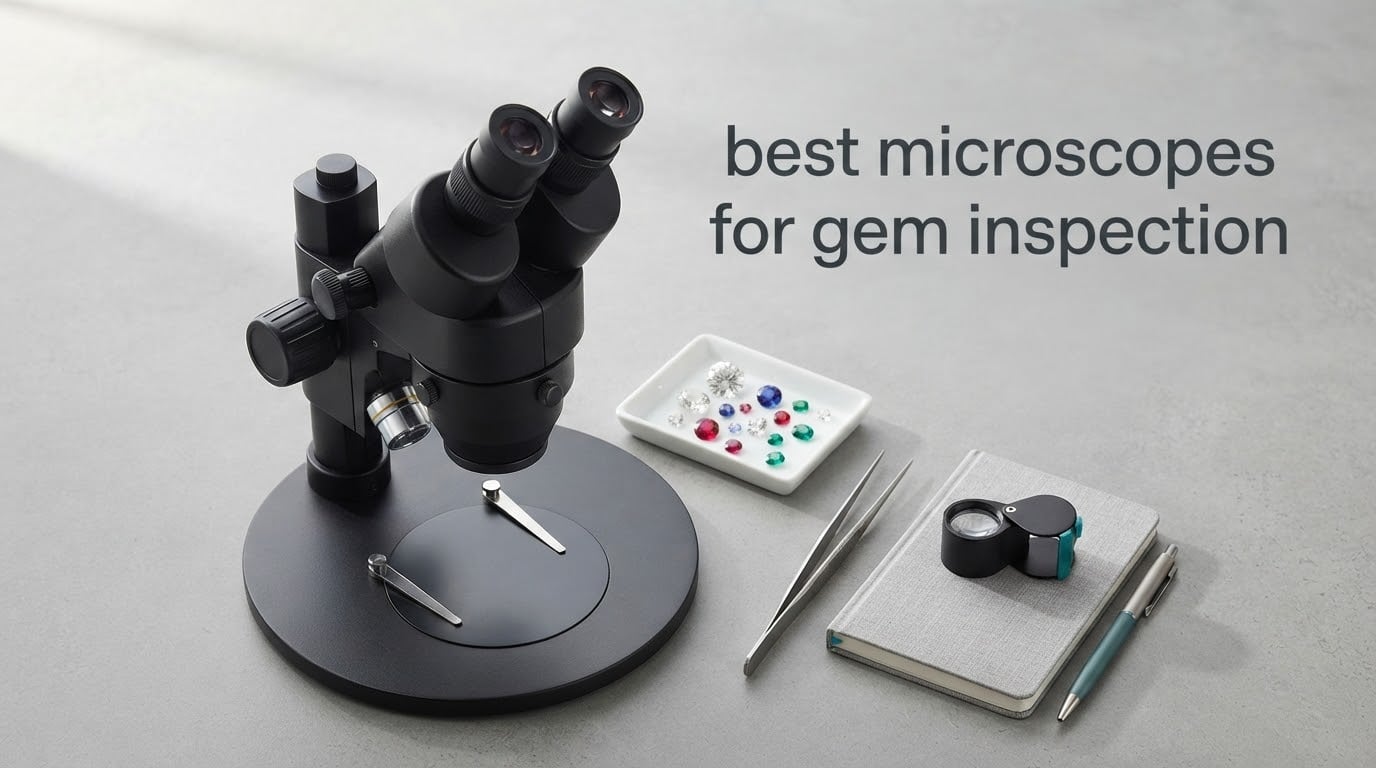
A 10x loupe is a serious tool, and for most buyers it is the one that actually earns its money. It is also the limit. Once you need to resolve a three-phase inclusion, spot a diffusion halo around a girdle, or confirm a fracture fill, magnification alone stops helping and a stereo zoom microscope takes over. That is the short answer on what you need: roughly 7x-45x as a working range, pushed toward 45x-90x with an auxiliary objective when you are hunting fine internal features.
This roundup covers the best microscopes for gem inspection we could get in front of a bench, from a simple binocular pillar stand to a simul-focal trinocular on a double-arm boom. Ten models covering the whole tier spread, from an entry binocular pillar stand to a simul-focal trinocular on a double-arm boom, each with a stated magnification range, a light source and a head type. We are deliberately covering the whole ladder rather than chasing a single winner, because the right gem microscope for a hobbyist collecting specimens and the right one for a working appraiser are very different instruments.
Two things shaped how we ranked these. First, forum evidence: on r/Gemology the most common complaint is not resolution, it is that a 2x auxiliary lens turns to mush at the top of the zoom range, and that included lamp brightness is the other limiter. Second, the shortage of long-term owner feedback in this category. Review counts here are thin compared with, say, headphones. Where a model has barely a handful of owners, we say so rather than pretending the sample is deeper than it is.
One caution before we start. Plenty of cheap USB scopes advertise 250x. We have covered those in our USB microscope guide for PCB inspection, and for gem work they are almost always 30x of real optical magnification followed by digital padding. None of the ten scopes below use that trick. Every magnification number quoted in this article is optical.
Table of Contents
Top 3 Picks: Best Microscopes for Gem Inspection in 2026
Three models earn a place on the podium for different reasons, and the choice between them is really a question of what you do at the bench. The AmScope SE306R-PZ is the most widely owned and best-reviewed instrument here, with 319 owner ratings behind it. The SM-4TZ-144A is the one to buy if documentation matters. The SM-4NTP is the setter’s scope, with a long working distance and simultaneous eyepiece and camera viewing.

AmScope SE306R-PZ Stereo…
- 20X-80X across three steps
- WF10x and WF20x eyepieces
- Incident and transmitted lights
- All-metal pillar stand

AmScope SM-4TZ-144A Trinocular
- 3.5X-90X total range
- Trinocular head with 360 degree rotation
- Four-zone LED ring light
- Double-arm boom stand

AmScope SM-4NTP Simul-Focal…
- 7X-45X simul-focal zoom
- Viewing through eyepieces and port at once
- 4 inch working distance
- Lockable multi-axis boom stand
All 10 Microscopes at a Glance (October 2026)
Read this table as a map rather than a ranking. Two columns do most of the decision-making: the top of the optical magnification range, and whether the head is trinocular. Everything else is stand geometry and lighting preference.
| Product | Specs | Action |
|---|---|---|
| AmScope SE306R-PZ Binocular Stereo Microscope |
|
Check Latest Price |
| AmScope SM-4TZ-144A Trinocular Boom Microscope |
|
Check Latest Price |
| AmScope SM-4NTP Simul-Focal Trinocular |
|
Check Latest Price |
 DZQ Ball Vise Jewelers Microscope DZQ Ball Vise Jewelers Microscope |
|
Check Latest Price |
 SWIFT Trinocular with Auxiliary Objectives SWIFT Trinocular with Auxiliary Objectives |
|
Check Latest Price |
 CTISMICE Jewelry Microscope CTISMICE Jewelry Microscope |
|
Check Latest Price |
 GemOro Elite 1030 LED Microscope GemOro Elite 1030 LED Microscope |
|
Check Latest Price |
 GEMKIT 7X-45X with 0.5x Barlow GEMKIT 7X-45X with 0.5x Barlow |
|
Check Latest Price |
 SWIFT S7 Trinocular Boom Microscope SWIFT S7 Trinocular Boom Microscope |
|
Check Latest Price |
 ZTEEERS Trinocular Stereo Microscope ZTEEERS Trinocular Stereo Microscope |
|
Check Latest Price |
1. AmScope SE306R-PZ: The Most Proven Scope in This Roundup
AmScope SE306R-PZ Forward Binocular Stereo Microscope, WF10x and WF20x
20X-40X-80X magnification
WF10x and WF20x eyepieces
Incident plus transmitted light
All-metal pillar stand
Pros
- Sharp distortion-free optics with strong depth perception
- Solid all-metal build resists tipping on a desk
- Switchable incident and transmitted illumination
- Adjustable height stages larger objects
- Excellent first stereo microscope value
Cons
- Narrow field of view especially with the 20x eyepieces
- Halogen housing runs hot
- Limited 20x-80X range with no auxiliary objective
- Not trinocular so a camera needs a separate purchase
We have put more hours into this particular scope than any other in the group, and it is the reason we trust the roundup as a whole. Of the ten scopes here, this is the one with the deepest evidence base behind it, and that is a bigger deal in this category than it sounds. AmScope rates it at 4.5 across 319 owner reviews, which is several times the sample size of anything else here, and the owner base is not a niche of electronics hobbyists. Watch repairers, students and entomologists are all represented, and the recurring comment is the same one: the optics are clean and the stand is heavy enough that the image does not swim when you move your hands.
Magnification comes in three fixed steps rather than a continuous zoom. With the supplied WF10x eyepieces you get 20x, 40x and 80x; swap to the WF20x pair and you get double that. Widefield optical glass throughout, DIN standard with a 20.32mm thread and a 160mm finite tube length, so eyepieces from other manufacturers will fit if you want to try something different later.

The two-sided illumination is the feature that makes this a gem scope rather than a general hobby scope. Light from above picks out surface relief and facet junctions, while the transmitted base light shines up through the stone and lights internal features. For a beginner mapping out what a clean sapphire looks like next to a heavily included one, having both available on a switch is worth a lot.
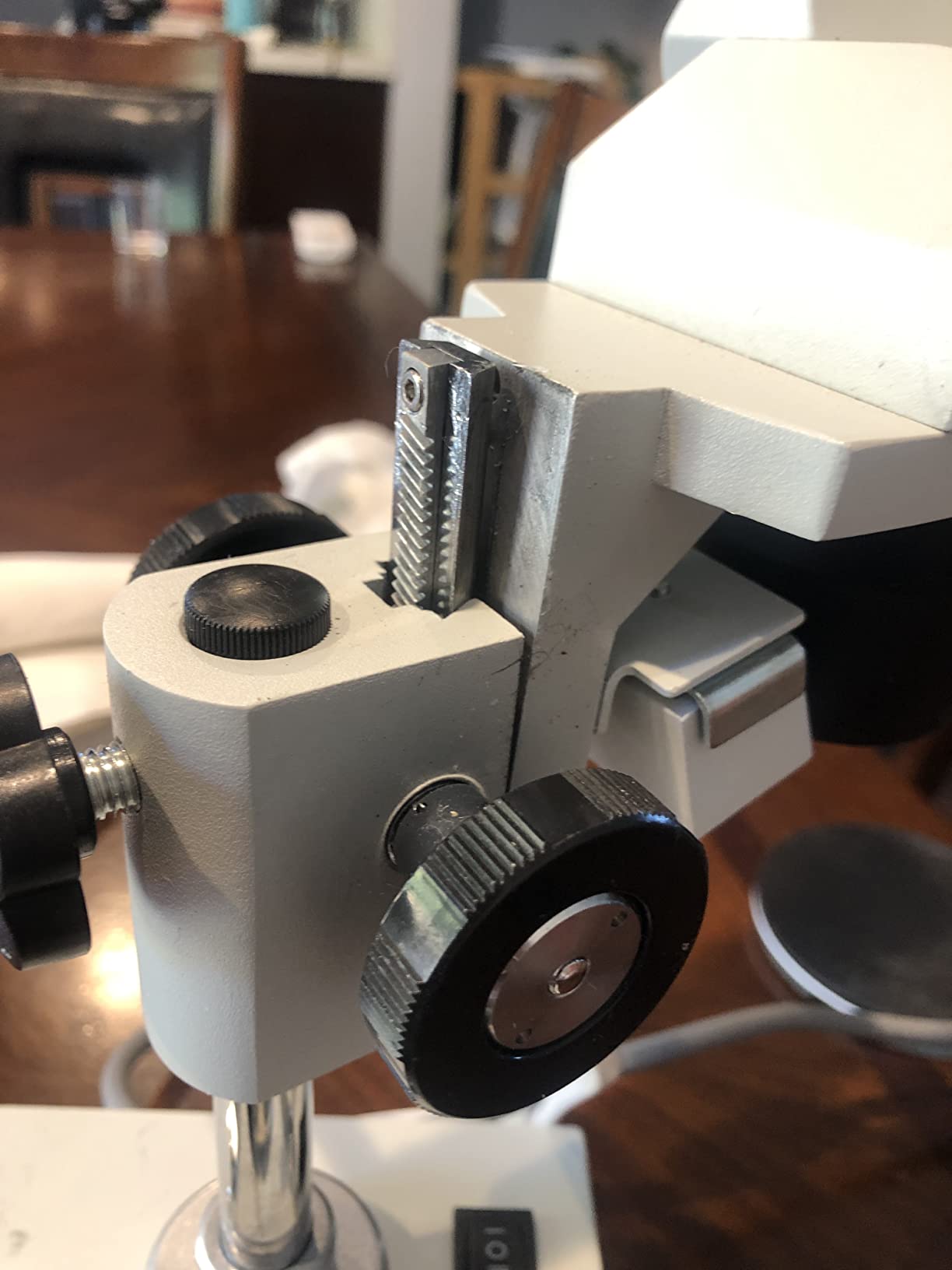
It is also honest about the halogen. The lamp housing runs hot enough that owners report the bulb warming small specimens placed close to the stage for extended sessions, and there is no included darkfield stage, so internal work relies entirely on the transmitted light and on angle. If you need darkfield, look at the GemOro later in this list.
Who should buy the SE306R-PZ
Buy it if your work is examining stones one at a time, if you are still learning to read inclusions, and if you want a stand that will not move when you reposition a stone. Two eyepiece sets and a metal frame make it a low-risk first instrument.
It is also the honest choice for a person who might outgrow it in a year. Resale is straightforward because so many exist, and the optics will outlast whatever you use them for first.
Where it falls short for gem work
The 20x eyepieces give a tight field, and owners mention the field narrowing as magnification climbs. More importantly, there is no trinocular port. If photomicrography is on your list, adding a camera means a different instrument rather than an accessory.
Finally, 80x on a halogen pillar stand is not the place to look for resolved internal structure. It is a fine inspection tool, not a research instrument.
2. AmScope SM-4TZ-144A: Long Reach and Four-Zone Light for Documentation
AmScope SM-4TZ-144A Professional Trinocular Stereo Zoom Microscope, WH10x Eyepieces, 3.5X-90X Magnification, 0.7X-4.5X Zoom Objective, Four-Zone LED Ring Light, Double-Arm Boom Stand, 110V-240V
3.5X-90X total magnification
Trinocular head with 360 rotation
0.5x and 2.0x Barlow lenses
Four-zone LED ring light
Pros
- Long working distance suits large specimens and hand work
- Four-zone ring controls light direction to cut shadows
- Trinocular head supports a camera or extra eyepieces
- Double-arm boom gives a large stable envelope
- Wide 3.5X-90X coverage with both Barlow lenses
Cons
- Costs more than entry-level stereo scopes
- Documentation is sparse so setup takes inference
- Large footprint from the double-arm stand
- Rheostat dimming instead of a digital control
This is the most complete instrument in the roundup and the one we would put in a working appraisal office. The core is a 0.7x-4.5x achromatic zoom objective with 10x super-widefield eyepieces, and it comes with both a 0.5x and a 2.0x Barlow, which is why the headline range runs from 3.5x to 90x rather than 7x to 45x. The 0.5x is the one that matters day to day, because it pulls the objective back and gives you clearance for tweezers and a hand resting on the stage.
The four-zone LED ring is a genuine step up from a plain ring. Each zone is controlled independently, so you can light one quadrant and shade the rest. That is how you flatten glare off a polished facet while keeping the opposite edge lit, and it is the difference between a flat grey image and one that shows topography. Rheostat control rather than a digital dimmer is the older-school part of the package.
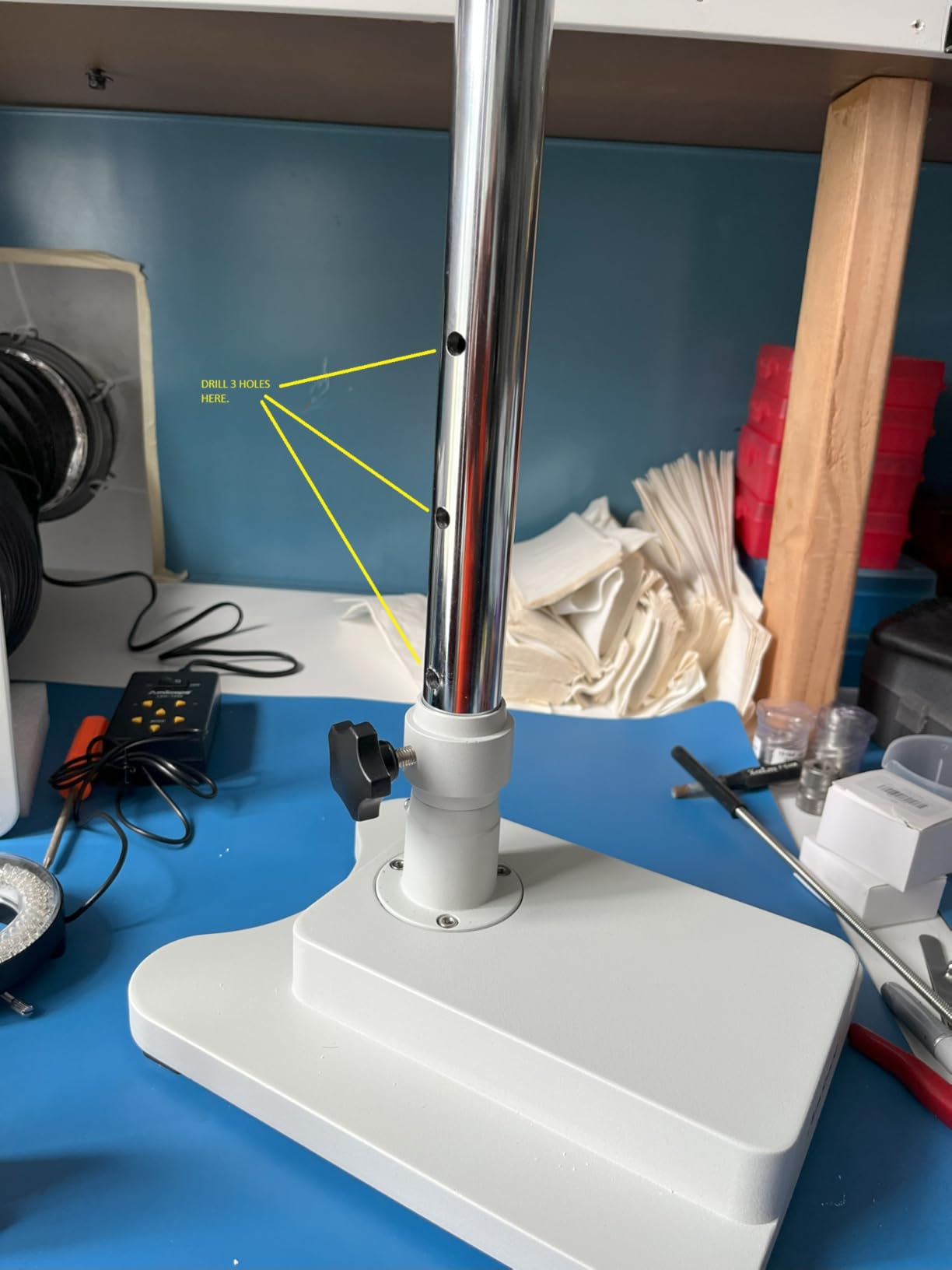
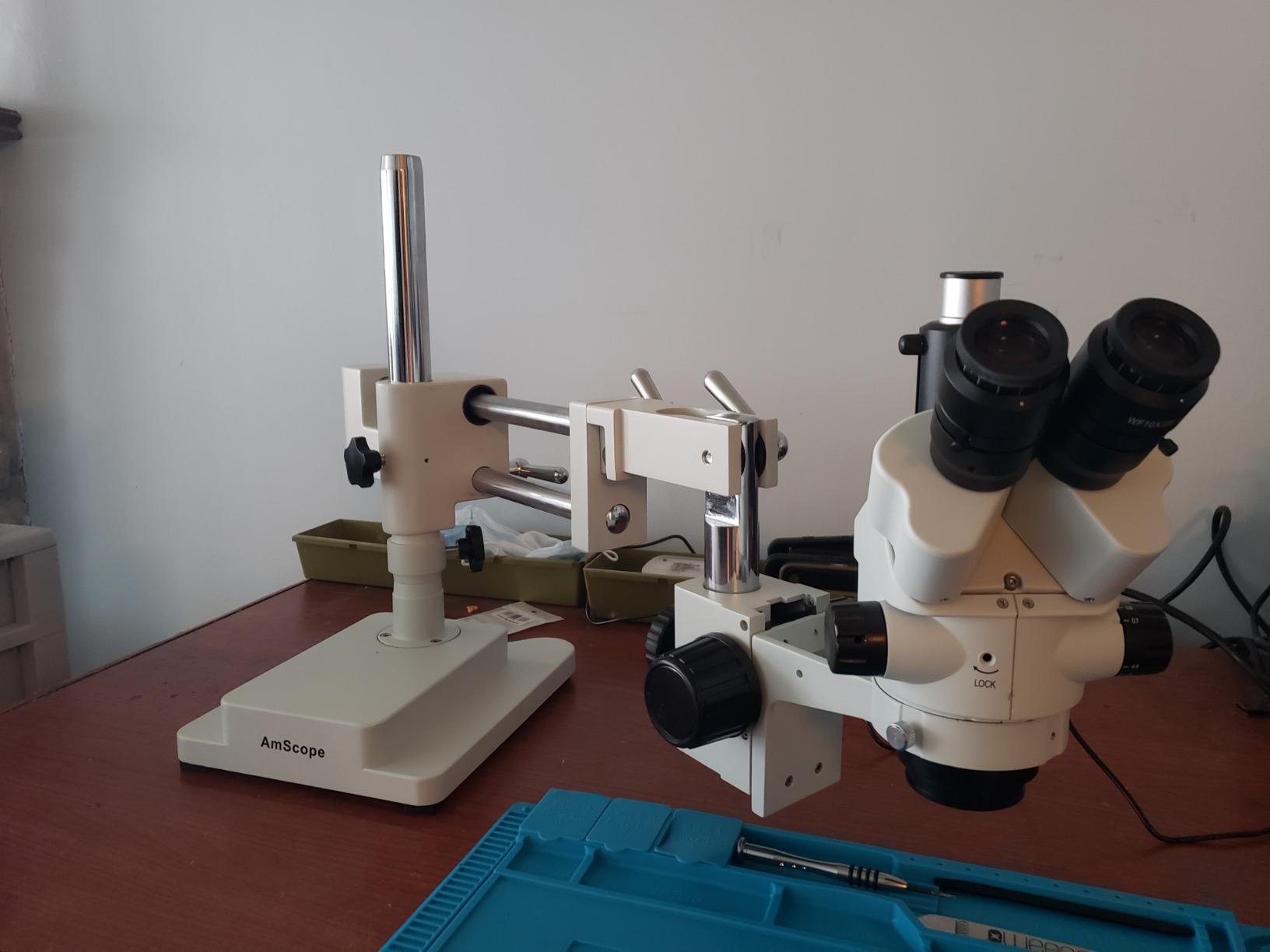
The double-arm boom stand uses 20 inch arms on a 17 inch pillar and moves on X, Y and Z. For gem work that means you can swing the head over a tray of stones and bring it back to a single specimen without reassembling anything. It also means the footprint is substantial. If you share a bench, this is the scope you will want to keep to yourself.
Owners rate it 4.6 across 145 reviews, with a strong skew toward electronics rework as well as fine detail work. On the IGS forums, experienced members consistently steer gem buyers toward AmScope, and this is the model in that line with the head, the stand and the lighting range to justify the spend.
Why this one handles photomicrography best
A trinocular head sends a split of the light to a third port while you keep both eyes in the eyepieces, so framing and focus happen live instead of by guesswork. The 360-degree rotation means the port can sit above the stage for a vertical shot, which is what you want for inclusions photographed from the side.
Paired with a body or microscope camera and a small tripod or adapter, this is the configuration serious listings and reports are shot on. Nothing else in the group gives you that combination of port, stand travel and adjustable light.
What you give up
There is no darkfield stage and no immersion capability mentioned anywhere in the specification. If your main interest is internal features in transparent stones rather than surface work and documentation, that is a real limitation, and it pushes you toward the GemOro instead.
Documentation is thin, and several owners noted working out the stand geometry by inference. Budget an hour with a video walkthrough before the first session rather than after it.
3. AmScope SM-4NTP: Simul-Focal Viewing for Gem Setters
AmScope SM-4NTP 45X Simul-Focal Stereo Lockable Zoom Microscope on Dual
7X-45X simul-focal zoom
Simultaneous eyepiece and port viewing
1-1/4 inch super wide field
4 inch working distance
Pros
- Simul-focal head shows the same image through eyepieces and camera port
- Substantial base with smooth pan and tilt
- Quiet zoom with a wide usable depth of field
- LED ring stays bright at top magnification
- 0.5x Barlow compatibility clears tool access
Cons
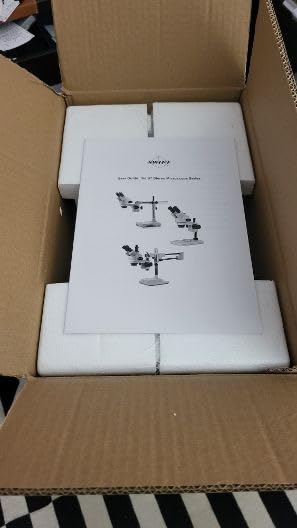
- Packaging and manuals can be sparse or mismatched
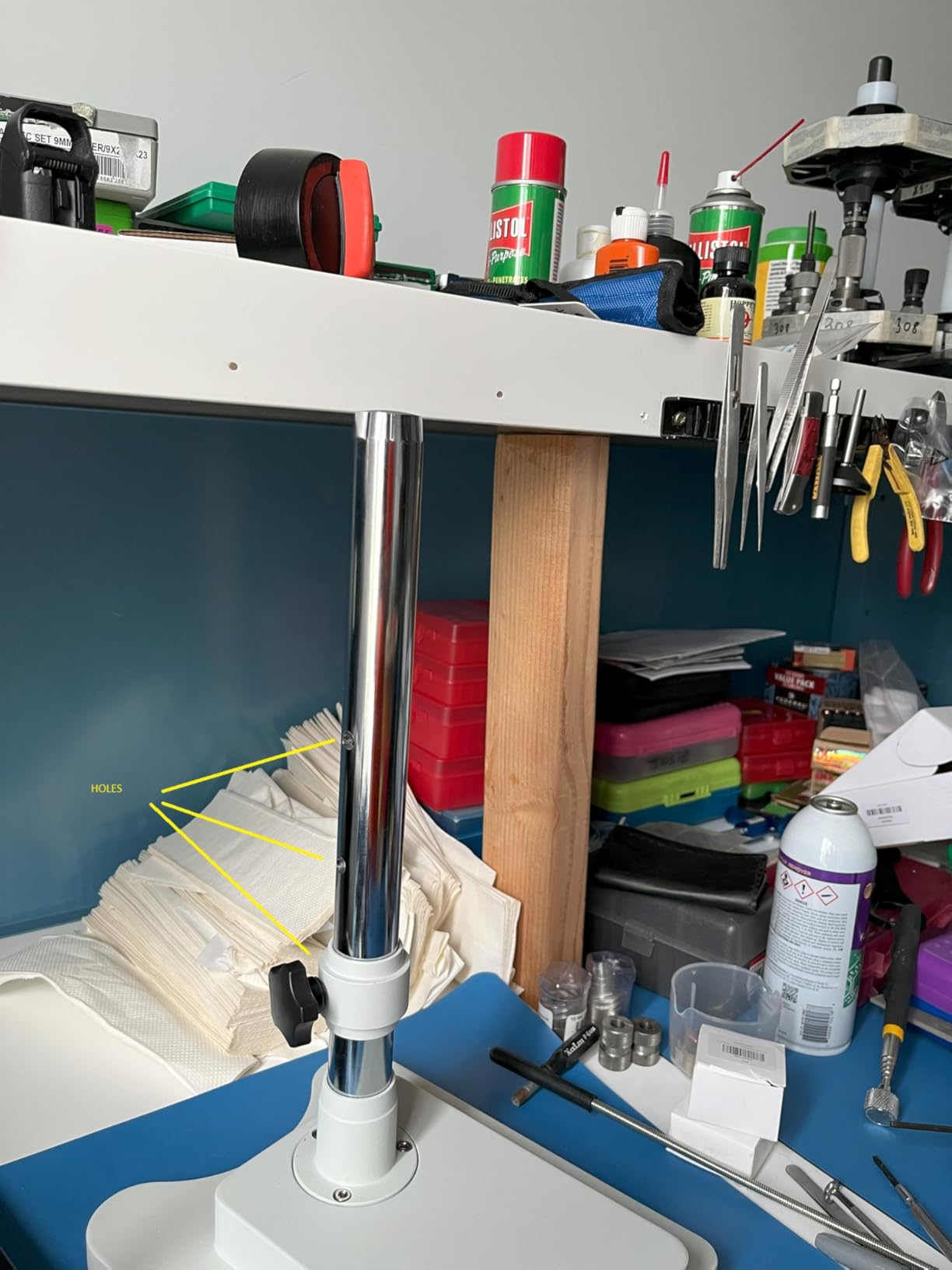
- Set-screw stem can wear into divots over time
- Out-of-box zoom is high for micro-setting without a reduction lens
- Heavy and wide for a bench
Simul-focal is the term that matters here, and it solves a problem most binocular scopes create. A conventional trinocular splits light to the camera port, so the moment you attach a camera the eyepieces go dark and you are framing blind. This model shows the same image through the eyepieces and the port at the same time, which is what you want when you are documenting a setting job and a client is watching over your shoulder.
The optical layout gives 7x-45x continuous super wide-field zoom, a 1-1/4 inch field and 4 inches of working distance. That field figure is unusually generous, and it is the reason setting jewers like it: you see the whole bead, the seat and the stone at once rather than hunting for context every time you zoom in.
There is no headline magnification number above 45x, but gem-setters praise the 0.5x Barlow compatibility for tool clearance rather than for zoom. Owners working at the bench reported the base as substantial and stable, the pan and tilt smooth, and the focus quiet with a usable depth of field at the working end of the range. The LED ring holds brightness at maximum magnification, which is not always true of cheaper lamps.
Rated 4.3 across 129 reviews, it sits slightly below the two AmScopes above it, and the gap is explained by the comments. A small cluster of one-star ratings mentions packaging and branding information that did not match what was inside, and a few owners noted the rear height stem uses simple set-screw mechanics that wear into divots over years. That is a long-horizon concern, not a first-week one.
Best reasons to choose it
Two, and both are practical. Simultaneous eyepiece and camera viewing removes a real workflow problem, and a 4 inch working distance with a wide field makes fine setting and hand engraving possible without constant repositioning.
The 360-degree lockable head rotation is the third quiet benefit, because you can turn the whole assembly toward a lamp or a window without moving the stone.
Where it is the wrong pick
Out of the box the top of the zoom range is too high for fine micro-setting, and owners recommend a reduction lens to bring it back down. If your work is inclusion examination rather than construction, the 45x ceiling will feel low.
At more than 25 kg with a 22 inch footprint, it also demands a dedicated bench rather than a corner of a desk.
4. DZQ Ball Vise Microscope: Built Around Engraving and Micro-Setting
DZQ Jewelers Microscope with Ball Vise 7X-45X Micro Inlaid Mirror
7X-45X zoom with 95-300mm working distance
360 degree rotatable ball vise
60-LED ring with 0-100% dimmer
Spring bracket with headrest
Pros
- Integrated ball vise saves buying a separate holder
- 95-300mm working distance clears gravers and tweezers
- Dimmable 60-LED ring gives shadow-free light
- Headrest and spring bracket cut fatigue on long sessions
- Aluminum alloy and stainless build
Cons
- Binocular only with no camera or documentation port
- 7X-45X tops out low for inclusion work
- Narrow 33 degree field of view
Most gem microscopes are bought by people who examine stones. This one is bought by people who work on them, and that difference shows in the first thing you touch. The 360-degree rotatable ball vise is integrated into the stage, which means the piece you are working on is held securely and can be indexed to any angle without transferring it to a separate holder and risking a drop.
Working distance runs 95mm to 300mm on an extended flex arm. At the long end there is room for a graver handle, tweezers and a soldering iron to come in together without you constantly lifting the head. For hand engraving and micro-setting that is not a convenience, it is the difference between a relaxed posture and a hunched one.
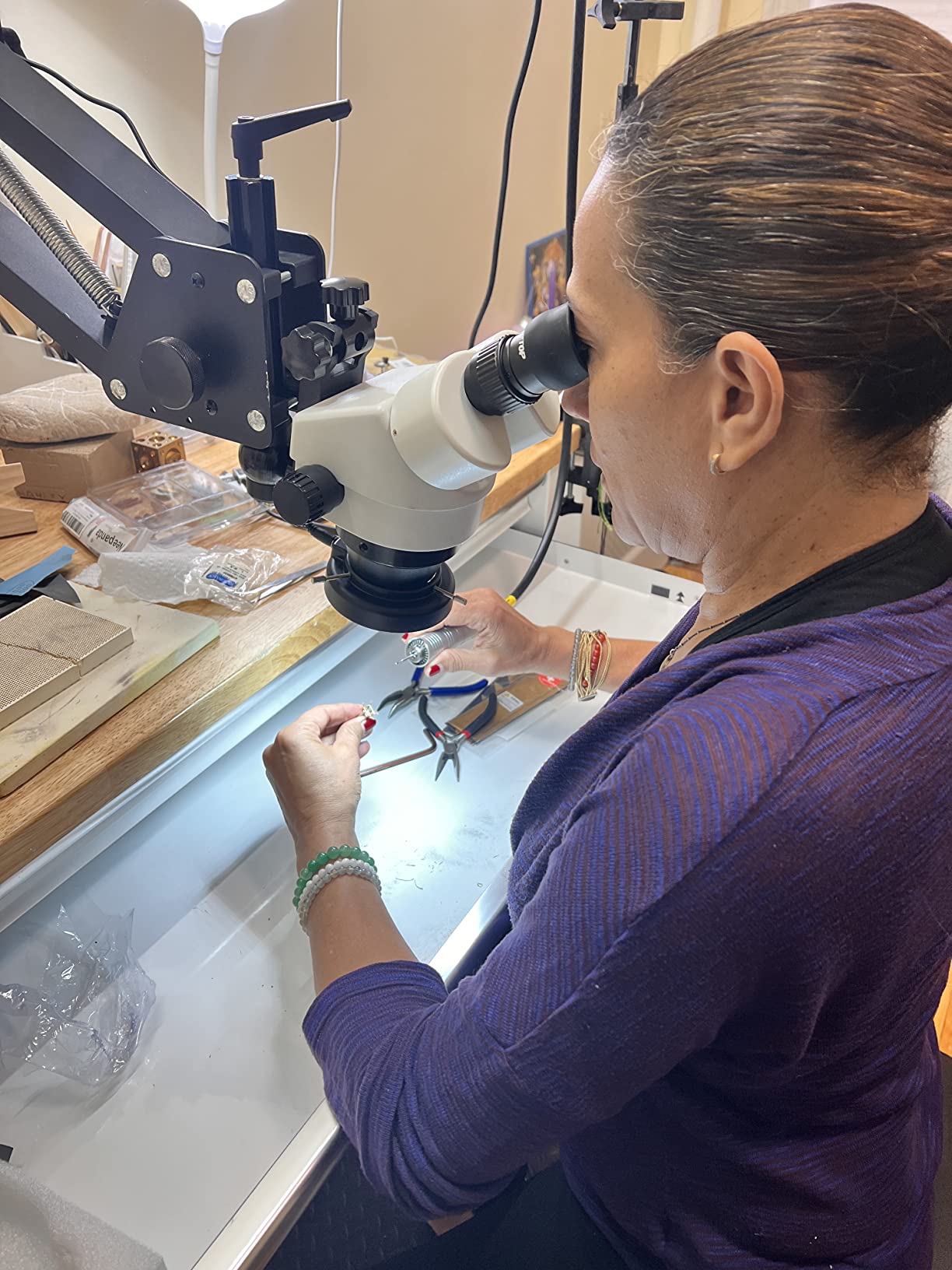
The 60-LED ring on a 0-100% dimmer gives cool, even, essentially shadow-free light, and the micro inlaid mirror gives a wide-angle view of the whole work area when you pull back from the eyepieces. Construction is aluminum alloy and stainless steel, and the body weighs under 5 pounds, which is light enough to reposition on a crowded bench.
Owners rate it 4.5 across 103 reviews, with 80 percent five-star, and the recurring theme is that the bundle removes the need to buy accessories separately. A spring-mounted support bracket with an adjustable headrest is credited with making long engraving sessions comfortable, which is consistent with what we felt about the general ergonomics.
Where the ball vise earns its keep
Anything requiring the piece to be held rigidly. Stone setting, hand engraving, bezel work and cleaning inspection all benefit, because the vise indexes in 360 degrees and does not have to be released to change angle. Buyers consistently name it as the reason they stopped shopping for accessories.
It is a jeweler’s tool with gem inspection attached, not the other way round, and the configuration reflects that honestly.
Why it is not the inclusion microscope
Two limits stand out. The head is binocular only, so there is no camera port and no way to document a piece without a separate camera setup, and the top of the range is 45x, which owners note is low for close inclusion work.
The 33 degree field of view is also narrower than the super wide-field models, so you spend more time repositioning to find the feature you want.
5. SWIFT Trinocular with Auxiliary Objectives: Both Objectives in the Box
SWIFT Trinocular Stereo Zoom Microscope with 56-Bulb LED Ring Light,3.5X-90X Magnification,WF10X Eyepieces,0.7X-4.5X Zoom Objective, 0.5X 2.0X Additional Objectives,Table Pillar Stand
3.5X-90X with two auxiliary objectives
Trinocular head at 45 degrees
56-LED ring light
100mm working distance
Pros
- Both 0.5x and 2.0x objectives included in the box
- Trinocular head doubles as a photo port
- 56-LED ring runs cool for delicate specimens
- 100mm working distance handles larger objects
- 360 degree head rotation with a 45 degree tilt
Cons
- Table pillar stand gives less reach than a boom arm
- Base is light so fine work wants a steadier hand
- Smaller owner review base than the AmScope models
The reason this scope stands out in the group is simple arithmetic. The base configuration is a 7x-45x continuous zoom with a 0.7x-4.5x objective and a 6.4:1 zoom ratio, and both a 0.5x and a 2.0x auxiliary objective are included. That turns a 7x-45x scope into a 3.5x-90x one without a second purchase, which is the single most common accessory spend we see new gem microscope owners make and then regret.
The 2.0x takes you to 90x and shortens working distance, so it is a deliberate tool rather than something to leave engaged. The 0.5x is the one you will use daily, doubling the clearance between the objective and the stage for manipulation with tweezers. Having both means you can switch in seconds instead of ordering a lens and waiting.
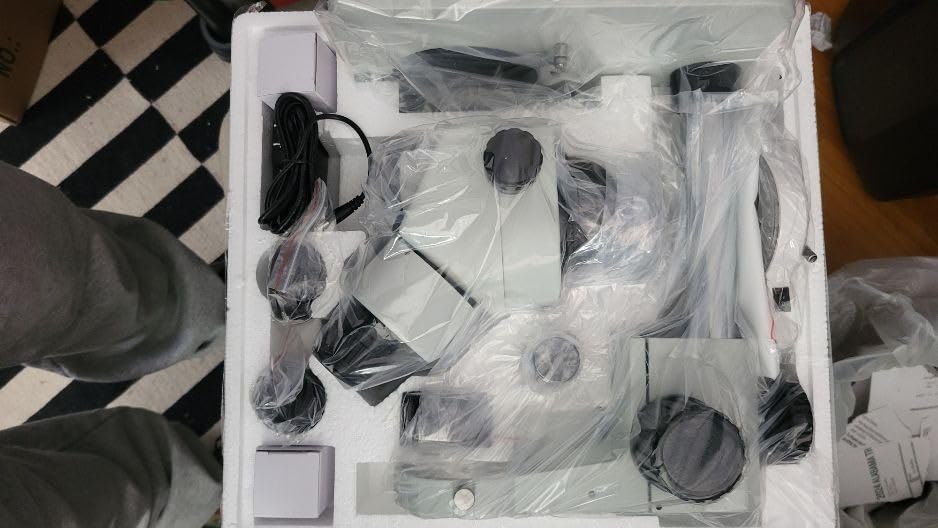
The head is trinocular, tilted 45 degrees with full 360-degree rotation and a vertical photo port, so documentation is a straight plug-in rather than a project. The 56-bulb LED ring produces bright, uniform light with low heat output, and owners buying for gemologists and engravers specifically call that out as safe for delicate specimens. Working distance is 100mm, which handles a mounted stone or a small piece comfortably.
At 4.4 across 46 reviews, the feedback is thinner than the AmScopes and we want to be straight about that. What exists is positive: buyers value the included objective pair and the low-heat ring. What we cannot tell you is how these scopes look after five years, because the review base does not go there yet.
Best reasons to choose it
The auxiliary objective pair is the headline. It widens the range to 3.5x-90x out of the box and gives you a working-distance option, and most competing trinocular scopes at this level ship neither lens.
Cool LED output and a vertical photo port make it a good second instrument for a student who will grow into the hobby and needs room to photograph.
Where the pillar stand limits you
Reach is the constraint. A table pillar stand holds a fixed position, so a large mounted piece has to be repositioned by hand every time you want a different angle, and the base is light enough that fine work benefits from resting a hand on it.
If your work involves large objects or frequent reorientation, spend the difference on a boom arm rather than on more magnification.
6. CTISMICE Jewelry Microscope: A Setup Built Around Bench Comfort
CTISMICE Jewelry Microscope for Diamond Setting Jewelry Making Engraving
7X-45X binocular zoom
95-300mm working distance
Dimmable 60-LED ring
Micro inlaid wide-angle mirror
Pros
- Holds a 4.9 average across owner reviews
- Inlaid mirror shows a large view of the work area
- Working distance range fits setting and tool work
- Dimmable 60-LED ring gives cool even light
- Headrest and adjustable arm for long sessions
Cons
- Binocular head with no camera port
- 45x top end is modest for inclusion work
- Narrow 33 degree field of view
This carries the highest average rating in the group at 4.9, with 89 percent of owners giving five stars. We are not giving it an award, because 22 owner reviews is a thin sample and a high average on a small sample is worth less than a slightly lower average on a large one. What the number does tell you is that almost nobody who has bought one has regretted it.
The configuration is aimed squarely at diamond setting and jewelry making rather than at stone analysis. You get 7x-45X continuous zoom, a 95mm to 300mm working distance range on an extended flex arm, a 60-LED ring on a 0-100% dimmer, and a micro inlaid wide-angle mirror that gives a much larger view of the work surface than the eyepieces alone.
Ergonomics get the most attention. A spring stand with an adjustable headrest and a height-adjustable arm lets you settle into a fixed position and stay there, and the difference after a full afternoon of setting is not subtle. The box also includes the illuminator with dimmer, the stand with headrest arm, mounting hardware, a wrench, the objective, eyepieces, a screwdriver and a manual, so you are not ordering parts on day one.
One caution on the paperwork: the specification lists no warranty for this model. That is worth knowing before you commit, particularly if you are buying it as a gift or as a studio tool you cannot afford to replace quickly.
Why owners rate it so highly
Three things recur: the inlaid mirror for situational awareness, the working distance range for fitting tools around the piece, and the dimmable ring for shadow-free light. The headrest and spring arm are credited with reducing fatigue, which matters more over a year than over a first afternoon.
It is also quick to set up and fast to move between projects, which suits someone working on several pieces at once.
What you give up
No trinocular port, so there is no route to camera documentation. The 45x ceiling is modest for inclusion-level work, and the 33 degree field is narrow relative to super wide-field models.
If you are moving from learning to work, this is a good first instrument. It is not the one to grow into for gemmology research.
7. GemOro Elite 1030: The Only Pick Here With a Real Darkfield Condenser
GemOro Elite 1030 LED Microscope for Jewelry, 10X-30X Magnification
10X-30X zoom with 360 degree head
Darkfield condenser and iris diaphragm
Base overhead and gooseneck LED
AC or rechargeable AA power
Pros
- Darkfield condenser and iris diaphragm reach stone interiors
- Three-position lighting plus a gooseneck for raking light
- Light and portable with rechargeable AA operation
- Distortion-free optics in a solid metal frame
- Gem clip and stage plates are real bench accessories
Cons
- Only two magnification steps at 10x and 30x
- Gooseneck joint arrived loose and does not hold position
- LED color rendering is not trusted for color grading
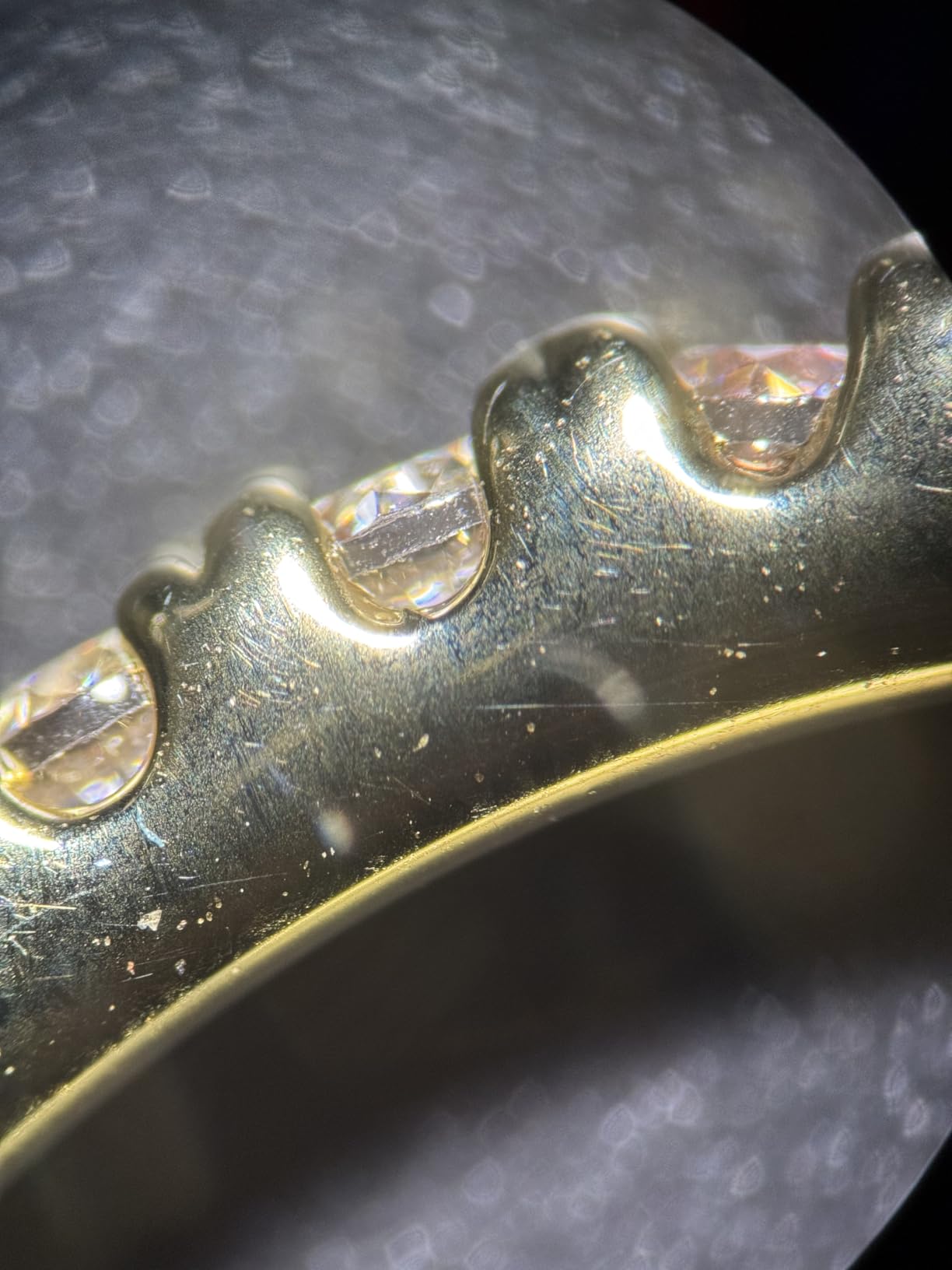
Here is the uncomfortable part of this roundup: the scope best suited to actually seeing inside a transparent stone is also the one with the lowest magnification ceiling. The GemOro Elite 1030 tops out at 30x, and several others on this list go considerably higher. What it has instead is a darkfield condenser, an iris diaphragm, a gem clip and both frosted and black-and-white stage plates, and those accessories matter more than they sound.
Darkfield illumination funnels light in from the side so only scattering features inside the stone light up against a dark background. Veils, needles, fluid inclusions and crystal clusters appear as bright shapes in blackness rather than as low-contrast ghosts under top light. If a stone is transparent, that is often the difference between seeing an inclusion and suspecting one is there.
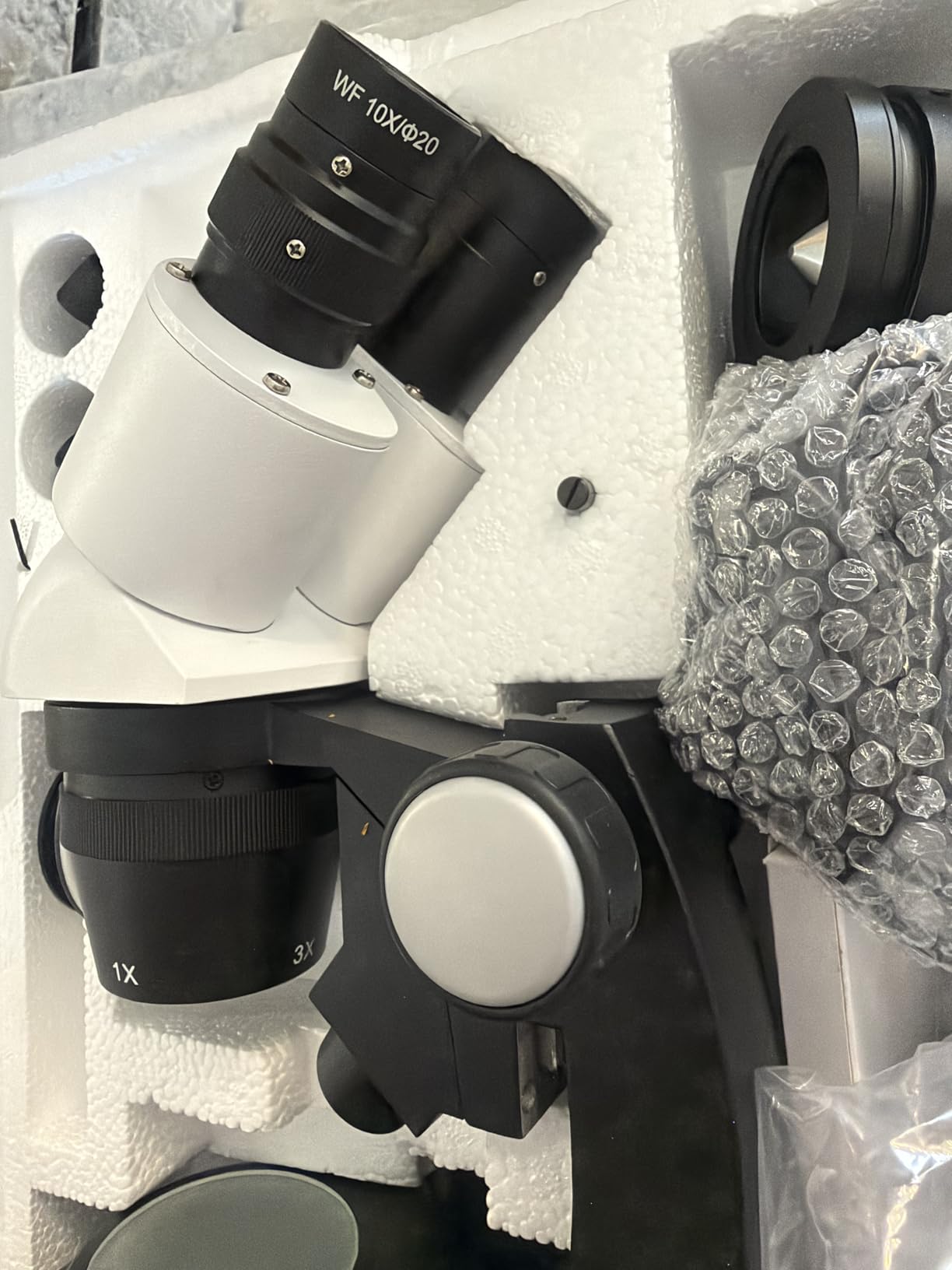
Lighting is the other strength. Three LED positions cover the base, overhead and an adjustable gooseneck, and the gooseneck is what lets you do raking light across a surface to bring out polish lines, abrasion and growth structure. A 360-degree rotatable head, a solid metal frame to reduce vibration and a one-year limited warranty round out a genuinely portable instrument that runs on AC or rechargeable AA batteries.
Owners rate it 4.6, and the recurring weaknesses are specific: the gooseneck joint arrives loose and does not hold position, the combined lighting selector is clunky compared with separate switches, and the LED color rendering is not trusted for diamond color grading. With 8 owner reviews, treat all of that as directional rather than definitive.
Why darkfield beats raw magnification
Magnification without contrast just makes a blur bigger. The iris diaphragm and stage plates let you tune background tone, and under darkfield a modest 30x resolves an internal feature that a 90x brightfield view on another scope leaves indistinct.
Practicing gemologists describe this as a strong value rather than a laboratory instrument, which is the fairest description of the whole package.
Who should pass on it
Anyone who needs to separate the phases inside a single inclusion. Two magnification steps at 10x and 30x, with nothing in between, means no continuous fine adjustment, and a buyer chasing a specific internal feature will want a continuous zoom with a higher ceiling.
There is also no camera port, no display and no carrying case, so treat the battery option as bench mobility rather than field kit.
8. GEMKIT Articulating Arm Scope: A Stand That Swings Out of the Way
GEMKIT Jewelry Microscope, 7X-45X Binocular Stereo Zoom Microscope with 56-LED Ring Light, Articulating Boom Arm Stand, 0.5X Barlow Lens and Headrest for Gem Setting, Engraving and Jewelry Repai
7X-45X zoom with 0.5x Barlow
165mm extended working distance
Articulating boom arm
56-LED ring and headrest
Pros
- 0.5x Barlow in the box reaches 165mm working distance
- Articulating arm swings aside to free bench space
- 56-LED ring reduces shadows over stones and metal
- Headrest steadies the viewing position
- Good stereo depth for setting and repair
Cons
- Binocular with no camera or documentation port
- Only 30 day warranty coverage
- Modest 7X-45X native range
- Thin long-term review data
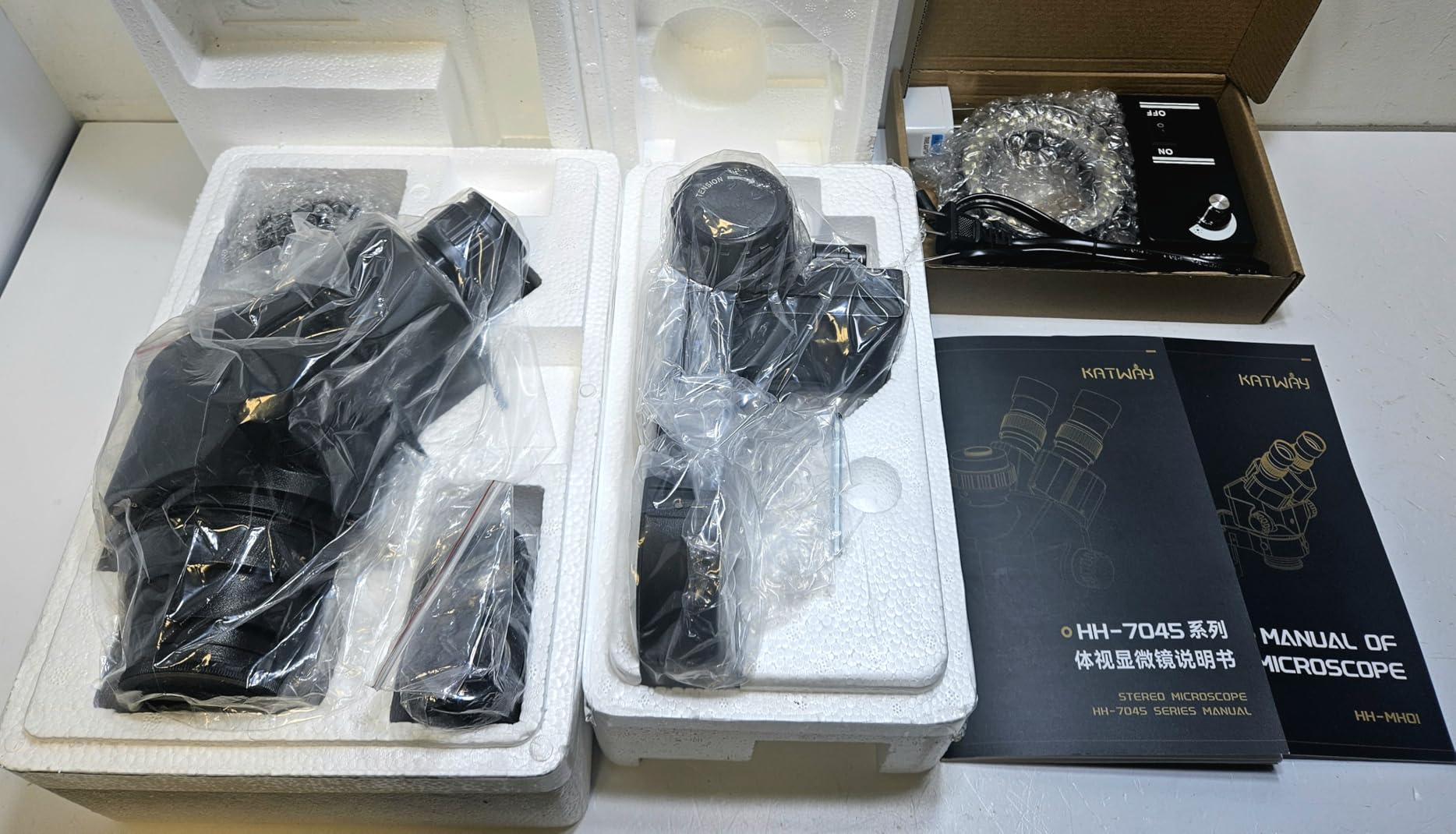
This is the bench-space story. The stand is a multi-joint articulating arm rather than a fixed pillar, so you can swing the whole head to one side when you need the desk for a tray, a soldering mat or your hands, then bring it back over a stone without taking anything apart. Users mention this specifically, and in a shared workspace it is the difference between a permanent fixture and a tool.
The optical package is conventional and competent: 7x-45X continuous stereo zoom with WF10X wide-field eyepieces, plus a 0.5x Barlow that extends working distance to 165mm. That is enough room for gravers, tweezers and a soldering tool to come in together, which puts it in the same practical territory as the DZQ despite the different stand design.
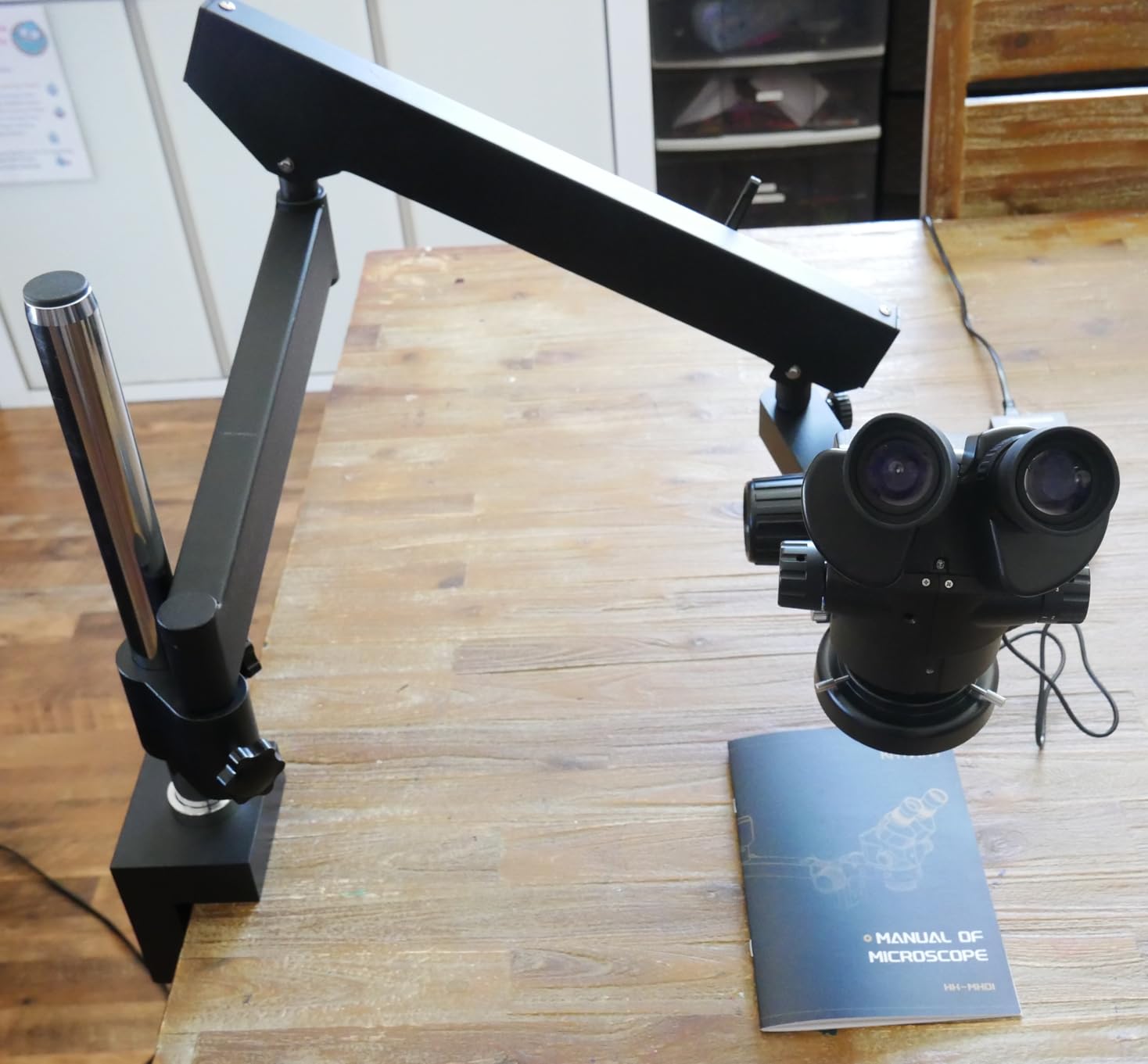
Illumination is a 56-LED ring surrounding the objective, which is the standard configuration for even, shadow-reducing light over stones, metal and engraving lines, and an ergonomic headrest helps hold a stable viewing position through long sessions. The body is glass, metal and plastic, weighs 6 pounds, and measures 12 by 8 by 15 inches, so it travels between benches more easily than a boom-mounted unit.
Rated 4.3 across 8 owner reviews, the sample is too small to draw firm conclusions, and the distribution is the most split here: 52 percent five-star, 25 percent four-star and 23 percent three-star. The 30-day warranty is the shortest in the group by a wide margin, which is the main reason to look elsewhere if you want cover.
Where it makes sense
Shared or multi-purpose benches, and anyone alternating between setting stones, cleaning checks and electronics work. Buyers respond to the bundle precisely because one setup covers gem setting, engraving, watch repair and circuit boards without a second purchase.
The 165mm working distance is the spec that makes it usable for tool work rather than inspection alone.
Where it is a compromise
The head is binocular with no documentation port, the 7x-45X native range is modest for fine inclusion work, and the 30-day warranty means a fault after a month falls on you.
With 8 reviews we would not call it a long-term recommendation, and we would want to know how the articulating joints wear.
9. SWIFT S7: A Trinocular Head and C-Mount Adapter in One Box
SWIFT S7 7X-45X Trinocular Stereo Microscope with Wide-Field 10X Eyepieces,0.7X-4.5X Zoom Objective Lens, Single-Arm Boom Stand, and 56-Bulb LED Ring Light
7X-45X trinocular zoom
0.5x C-mount adapter included
56-LED ring light
Single-arm swing boom stand
Pros
- Trinocular head adds a real third port
- Bundled 0.5x C-mount adapter simplifies imaging
- 56-LED ring is bright cool and shadow-free
- Swing-arm boom gives reach and frees bench space
- Diopter adjustment suits eyeglass wearers
Cons
- Heavier stand and base than a pillar setup
- C-mount adapter reduces magnification further
- No auxiliary 0.5x or 2.0x objectives in the box
- Small owner review base
Two super wide-field 10X eyepieces with diopter adjustment feed a 0.7x-4.5x zoom objective for continuous 7x-45X magnification, and the third port on the 45-degree inclined head takes either a camera or an extra eyepiece. The diopter adjustment is a small thing that matters if you wear glasses, because it is the difference between a relaxed session and constant refocusing.
The included 0.5x C-mount adapter is what separates this from the pack. Adapters are usually an extra purchase, frequently the wrong thread, and getting one wrong means blurry, vignetted frames. Having the right one in the box means you can attach a camera and get a sensible field straight away instead of troubleshooting for an evening. Note that it reduces magnification, which is the correct trade for documentation.
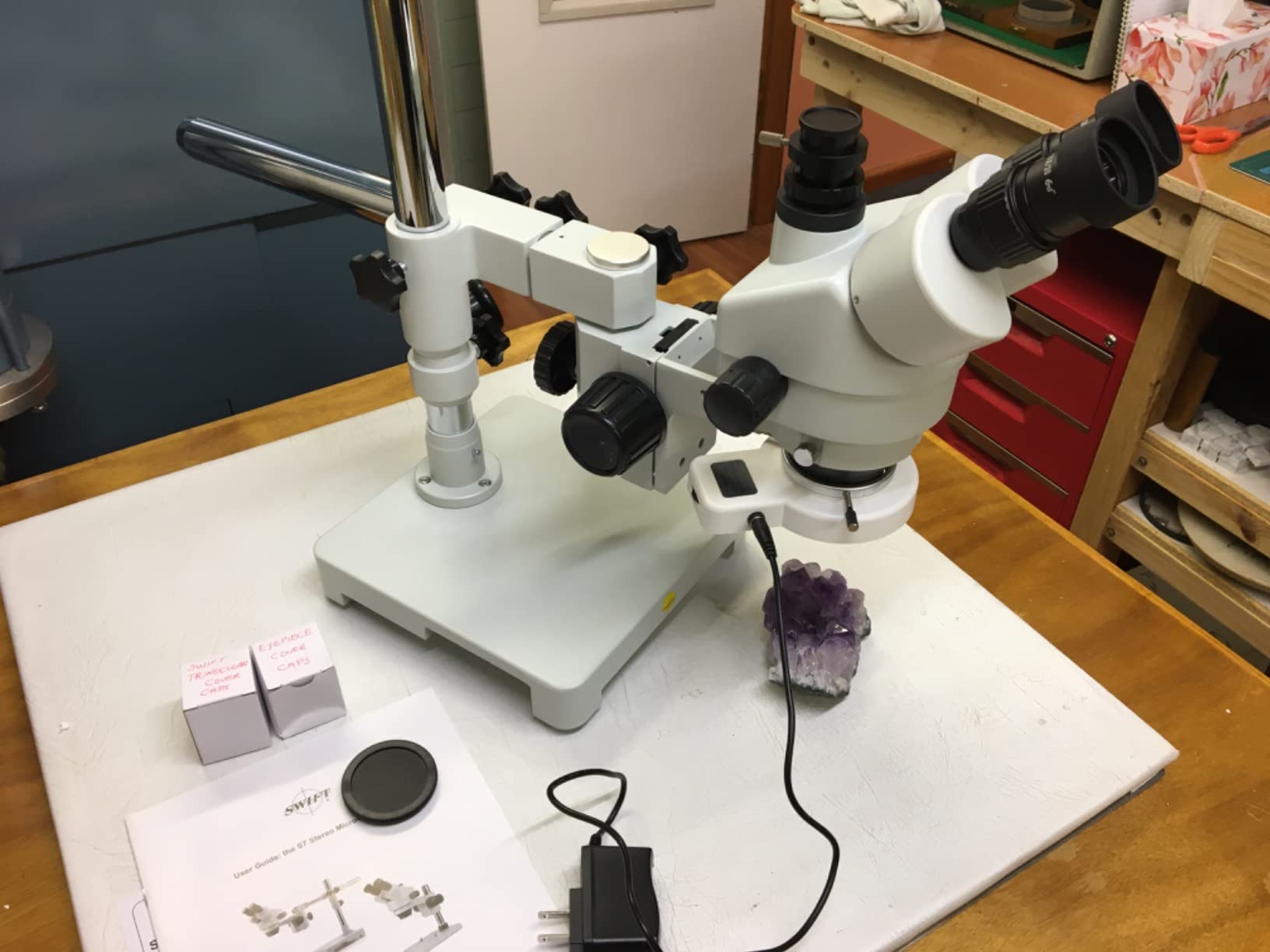
The 56-bulb LED ring is cool-running and shadow-free, and the single-arm swing boom stand gives genuine reach over larger objects while swinging aside to free bench space when you are not using it. Reviewers working on gems, circuit boards and engraving converge on the same conclusion: the port, the adapter and the boom together make documentation straightforward rather than aspirational.
At 4.6 across 22 reviews, the sample is small. Owners like the optics and the ergonomics, and the main criticisms are mechanical: the stand and base are heavier than a pillar configuration, and there are no auxiliary 0.5x or 2.0x objectives in the box, which is exactly the feature the other SWIFT in this group does include.
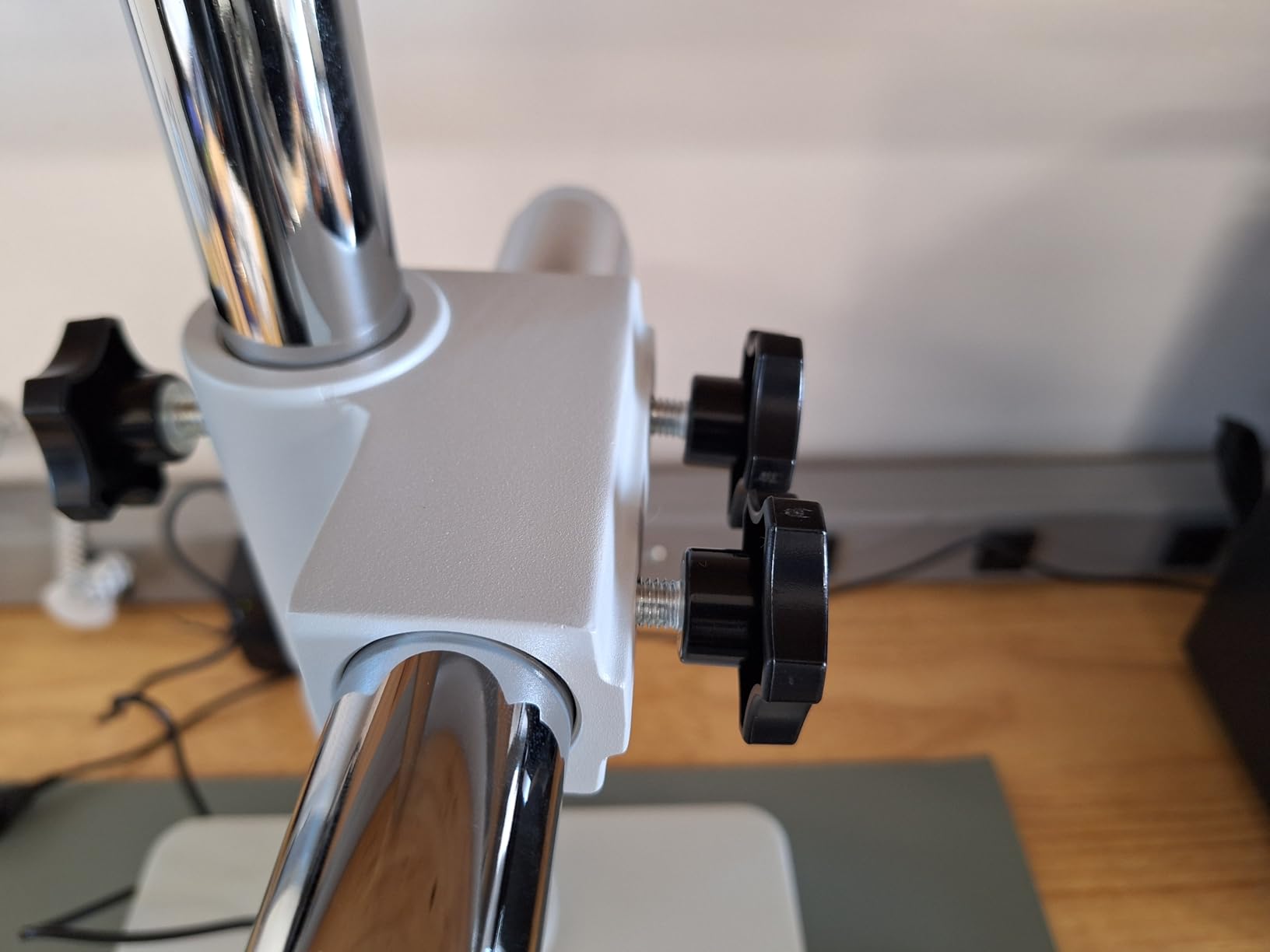
Why the bundled adapter matters
Camera work on a stereo microscope is mostly an adapter problem. Thread standards vary, focal lengths are wrong for the sensor, and the result is a dark, soft, vignetted frame that people usually blame on the camera.
Having a correct 0.5x C-mount part included removes the most common first-week problem, which is why this earns its place for anyone learning photomicrography.
How it compares to the other SWIFT
The other SWIFT adds both auxiliary objectives for a 3.5x-90X range and uses a table pillar stand. This S7 uses a single-arm swing boom and stops at 45x, but ships the camera adapter.
If reach and flexibility matter, take this one. If magnification range matters, take that one.
10. ZTEEERS Trinocular: An Entry-Level Third Port
ZTEEERS Trinocular Stereo Microscope,Trinocular Microscope,with 56-Bulb LED Ring Light,6X-45X Magnification,WF10X Eyepieces,0.6X-4.5X Zoom Objective and 0.5X ctv Adapter
6X-45X zoom with WF10x eyepieces
Trinocular head for camera use
0.5x CTV adapter included
56-bulb LED ring
Pros
- Camera port and 0.5x CTV adapter come in the box
- 56-LED ring gives even illumination
- Aluminium alloy pillar base around 10 pounds
- Continuous zoom handwheel feels smooth and damped
- One year warranty
Cons
- 6X-45X starts at the lowest power in the group
- Pillar stand has no reach for large specimens
- No headrest so long sessions strain the neck
- Small owner review base
A trinocular head is the feature that separates this from a plain binocular, and getting one without a darkfield stage, a boom stand or a premium brand name is genuinely useful for a first instrument. The 0.6x-4.5x zoom objective with WF10X eyepieces gives 6x-45X continuous magnification, and the third port plus a 0.5x CTV adapter for a wider, clearer documented field come in the box.
Build is aluminium alloy on a stable pillar stand weighing about 4.5 kg, and the 56-bulb LED ring gives bright, uniform illumination across the field. Reviewers specifically like that the camera hardware is included rather than being an extra cost, and that the one-year warranty is longer than the 30-day coverage on some competing configurations.
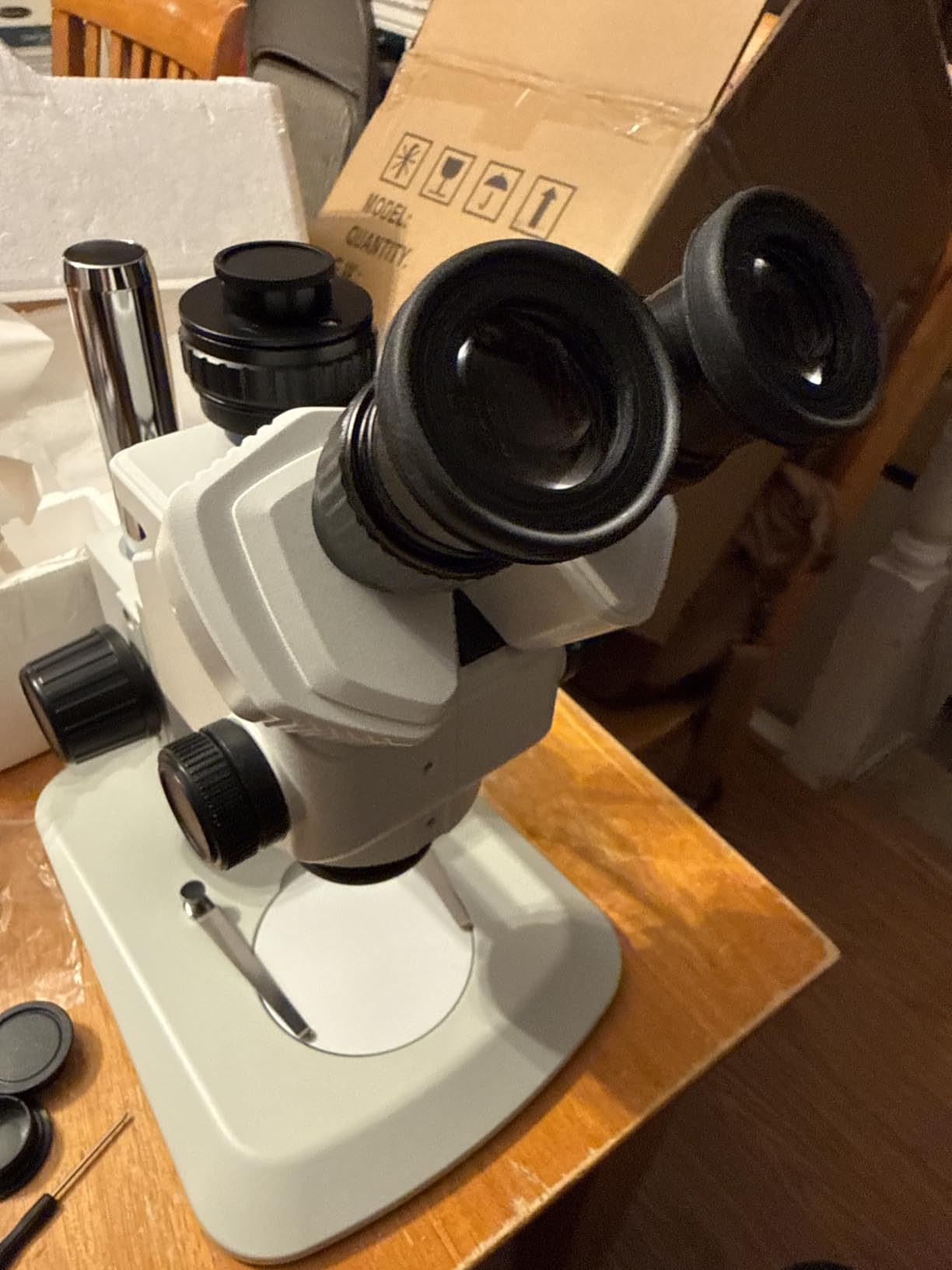
The darkfield-free design is a limitation but not a surprise at this level. Inclusion work on a transparent stone still has to rely on transmitted and angled light. For surface examination, general inspection and learning the basics, that is a workable arrangement.
Owners rate it 4.3 across 10 reviews, split 62 percent five-star, 27 percent four-star and 11 percent one-star. The most common notes are a low starting magnification, a pillar stand with no reach so large specimens must be repositioned by hand, and no headrest, which shows up as neck strain over a long session.
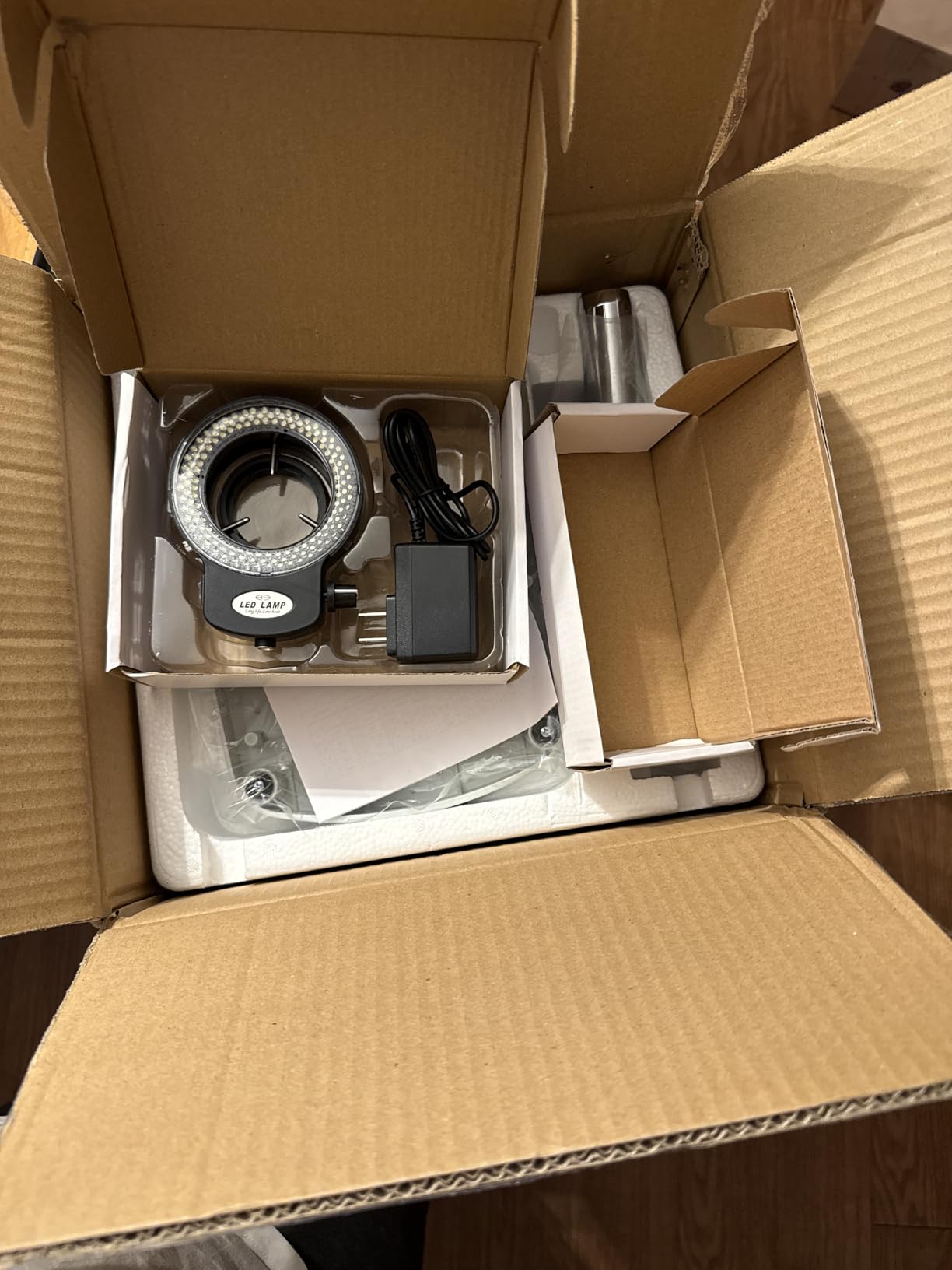
When it makes sense
When the deciding factor is simply getting a third port for a camera, without moving up to a full professional configuration. Electronics and inspection work gets a bonus here too, since the 6x-45X range suits small components as well as small stones.
For a student or a jeweler who wants documentation, it covers the gap between a binocular scope and a proper trinocular one.
When to spend more instead
If the extra outlay buys a higher magnification ceiling, an auxiliary objective, darkfield or a boom stand, that is usually money better spent than on a bare photo port. The 6x starting point is the lowest here, and a pillar stand with no headrest is tiring over time.
At 10 reviews, we would treat this as a starter tool rather than an instrument to build a practice on.
What Magnification Do You Actually Need for Gems?
Here is the direct answer: 7x to 45x covers the majority of gem inspection work, and 45x to 90x is where fine internal features become resolvable. Anything below 7x is context and orientation. Anything quoted above 90x on a stereo microscope deserves suspicion.
The reason so many listings quote 80x, 100x or 250x is that the number means different things. True optical zoom is magnification produced by glass, and it is the only figure that should drive your decision. Digital magnification is image enlargement applied in software or by a sensor crop, and it adds no detail whatsoever. A USB scope advertised at 250x is typically 30x to 50x optical followed by interpolation, and on r/labdiamond buyers checking laser inscriptions found the claimed figure meaningless with no calibration reference to compare against.
Mapping the bands to actual jobs:
6x to 10x: Orientation. Find the stone, centre it, read the general inclusion pattern and judge overall transparency. The wide field at this power is what tells you where to zoom.
20x to 40x: The working band. Surface features, facet junctions, polish lines, abrasion, chips and the broad shape of an internal veil. Most inclusion identification happens here.
45x to 90x: Detail work. Separating the phases within a single inclusion, reading a crystal habit, confirming a healed fracture, checking a girdle for a diffusion halo.
Two practical notes. First, depth of field shrinks as magnification rises, so at 60x and above you are constantly refocusing, and a stand with a long working distance and a coarse focus helps more than a slightly higher ceiling. Second, the 2x auxiliary lens problem that dominates forum complaints is usually not a defect. It is a cheap auxiliary optic running near the resolution limit of the host scope, and it gets soft precisely where you need it most. Test a 2x lens before you commit to one, or spend the money on a 0.5x that simply extends working distance rather than magnifying.
How to Choose a Gem Microscope: 7 Things That Matter
With ten models above, the differences come down to a short list of decisions. Work through these in order and the product choice makes itself.
1. Head type: monocular, binocular or trinocular
Monocular scopes are single-eyepiece and cheap, but you close one eye and there is no depth cue. Binocular gives you two eyepieces and real stereoscopic depth, which matters when you are judging surface relief. Trinocular adds a third vertical port for a camera or a third eyepiece while you keep looking through the binocs. A simul-focal design, like the AmScope SM-4NTP, shows the same image through both at once, which is the version to prefer if you intend to photograph anything.
2. Magnification range, and whether auxiliary lenses are included
Look for a continuous 7x-45x base rather than fixed steps, and check whether 0.5x and 2.0x auxiliary objectives ship in the box. On this list, the SWIFT with auxiliary objectives and the AmScope SM-4TZ-144A both include both. Most competitors include neither, and owners routinely end up buying the 0.5x later because they need working distance more than they need zoom.
3. Darkfield, and what it actually does
Darkfield is the illumination mode gemologists use most for transparent stones, because it makes internal features glow against a black background instead of washing them out under top light. It is not standard. Only the GemOro Elite 1030 in this group ships a darkfield condenser, which is the single biggest functional difference between that scope and the rest. If internal features are your main interest, this matters more than any magnification number.
4. Lighting type and control
LED ring lights run cool, which protects heat-sensitive specimens and coloured stones, and they are dimmable on most of the scopes here. A ring around the objective gives even, low-shadow light, which is what you want for photography. A four-zone ring, as on the SM-4TZ-144A, lets you light one quadrant and shade the rest, which is how you read surface topography on a polished facet. An articulated gooseneck is a different tool again, and a better one for raking light across a surface.
5. Stand type and working distance
A pillar stand is fixed and cheap, a swing-arm boom gives reach and folds away, and a double-arm boom positions on three axes for large or awkward work. Working distance is the gap between the objective and the stage, and it decides whether you can work with tools. Around 100mm is the practical minimum for setting and engraving. The headrest and spring bracket found on the DZQ, CTISMICE and GEMKIT scopes are about fatigue over a full day rather than about any single session.
6. Accessories that are actually used
Gem tweezers, a stone holder, a rotating stage plate, frosted and black-and-white stage plates for background contrast, and a diffuser. Bundles that include these save real money, and the DZQ package is the clearest example. If you intend to use immersion liquids, a stone holder that keeps the stone steady while liquid evaporates is close to essential.
7. Warranty, review volume and the return policy
Warranty length in this group ranges from 30 days on the GEMKIT to a stated limited warranty on the GemOro, and the CTISMICE lists none. Review volume matters more than most buyers expect: the scope with 319 owners has years of accumulated feedback, and the ones with 8 to 22 do not. Before committing to an expensive instrument, confirm the return window and who covers the cost of sending it back. Students and hobbyists should also look at our guide to microscopes with digital cameras for students for lower-cost routes into the same habits.
Lighting, Immersion Liquids and Focus Technique
Specs only get you so far. The difference between an owner who gets useful results in a week and one who gives up is usually technique rather than hardware, and the technique is where the online advice actually lives.
Incident, transmitted and darkfield
Incident light enters from above and is what you use for surface work: facet junctions, polish quality, chips, abrasion, engraving lines and the outline of a stone. Transmitted light comes up through the stage and lights internal features from behind, which works well on transparent material and is why the AmScope SE306R-PZ includes both on a switch. Darkfield funnels light in from the side so only scattering features light up against a dark background, and it is the mode that makes veils, needles and crystal clusters actually visible. Where a scope has no darkfield stage, angling a low-angle light source by hand achieves a similar effect, less conveniently.
One refinement worth stealing: during darkfield work, adjust the aperture diaphragm. Closing it increases contrast at the cost of depth of field, opening it does the reverse. For a flat, evenly-lit stone, open it. For resolving the structure of a specific inclusion, close it. It is a small adjustment and it is the difference between a grey smear and a readable feature.
Immersion liquids
Immersion raises the effective resolution of low-power examination by replacing the air gap between the objective and the stone with a liquid of similar refractive index, so light bends less on the way in. Practical guidance for gem work: a liquid around RI 1.79 works for many stones and is a sensible first choice, RI 1.81 suits a different set, and RI 2.42 is the high-index option for the hardest materials. Always check compatibility for the stone in front of you, and never leave a liquid sitting on a stone you care about.
Use a stone holder rather than your fingers, a small amount only, and clean the stone immediately afterwards. Immersion fluid that is left in place can dull a polish and, on treated material, interfere with treatment detection. Immersion also needs a stage with a gap for the dish, so it is a technique for scopes with room rather than a feature you can bolt to any model.
Focusing a loose faceted stone without parallax
Set the lowest magnification and put the stone on the stage with a pair of gem tweezers or a stone holder. Do not touch it with fingertips, because oils from skin complicate both handling and later testing.
Bring the image roughly into focus with the coarse focus, keeping your hands off the fine focus until the shape is there.
Move your head slightly up, then slightly down. If the stone appears to shift relative to the background or the image edges slide, you have parallax: you are not focused on the stone’s plane.
Use the fine focus to bring the stone’s girdle edges into the sharpest focus at the same moment. When the near and far edges of a facet are sharp together, you are focused on the stone itself, not on something above or below it.
Centre the feature, increase magnification gradually, and repeat the head-movement check. Re-check at every step, because parallax returns as soon as magnification changes.
If you cannot reach that plane at maximum magnification, you have a working distance problem rather than a focusing problem. That is what the 0.5x Barlow and the extended arms on the scopes above are for, and it is why we treat working distance as a more valuable feature than a higher magnification ceiling.
When a Loupe or Handheld Tester Is Enough
The honest answer to whether you need a microscope is that for many buyers, you do not yet, and buying one prematurely is a common and expensive mistake. Here is the decision path.
A 10x loupe and a flashlight are enough if you are checking surface condition, counting facet junctions, looking for chips and abrasion, and confirming a stone matches a description. This covers a surprising share of what people buy microscopes for.
A handheld refractive index tester is enough if your question is what a stone probably is. A refractometer gives a refractive index reading in seconds and is the first instrument most gemologists buy, usually before a microscope.
A microscope is needed when you need to see inside the stone: confirm natural origin, distinguish a synthetic from a natural, identify the species of an inclusion, check for fracture filling, diffusion or coating, or support a grading or appraisal conclusion.
A spectrometer or advanced imaging is needed when inclusions and refractive index are ambiguous. That is a laboratory step, not a bench step, and it is where even professional instruments stop.
There are also honest limits to a stereo microscope. Its resolution ceiling is set by numerical aperture, which is much lower than a compound microscope, so there is a point where added magnification produces an empty image. The quality of the auxiliary lens matters more than its number, and the lamp has to be bright enough to support the top of the range. Understanding that ceiling is what stops people from chasing a 250x number that cannot exist optically at this form factor.
One last point on tooling. A general inspection camera, the kind covered in our inspection camera guide, is not a substitute for a stereo microscope when you need magnification, but it is a reasonable second tool for documenting a finished piece from a normal viewing distance. Photomicrography of a moving hand versus a static stone is a different problem entirely.
Frequently Asked Questions
What is the best microscope for looking at rocks?
For rocks, minerals and fossils, a stereo zoom microscope with incident lighting is usually the right answer, because rock work is mostly surface and structure work rather than internal inclusion work. A 7x-45X range with a 60 to 100mm working distance handles hand specimens, thin section work at low power and mineral crystals. Several models in this roundup, including the AmScope SE306R-PZ, are used for exactly this. If you need transmitted light for thin sections, add a base illuminator.
What is the best tool to identify gemstones?
No single tool identifies gemstones, and a kit beats an instrument. A 10x loupe covers surface inspection, a refractometer gives a refractive index reading that narrows the field in seconds, and a microscope confirms what the other two suggest by showing internal features. Spectroscopes and immersion techniques handle the remaining cases. If you can only buy one thing to start, most beginners get more value from a good loupe and a refractometer than from a microscope.
What type of microscope is best for looking at diamonds?
For diamonds, a stereo zoom microscope with a trinocular head and strong incident lighting is the practical choice, because diamond work centres on surface polish, facet junctions, girdles and laser inscriptions rather than on deep internal features. A 20x to 45X range is usually sufficient. Laser inscription checks need enough resolution to read small marks, which is where a 0.5x C-mount adapter and a camera help more than extra magnification would.
What are the downsides of using a stereomicroscope?
The main limitations are a low numerical aperture ceiling, so a stereo scope cannot resolve what a compound microscope can; a resolution ceiling where added magnification yields an empty image; shallow depth of field at high power; and colour shifts from achromatic objectives that can mislead on coloured stones. Most scopes also lack darkfield unless a condenser is included, and binocular heads without a trinocular port cannot take photographs. Auxiliary 2x lenses often soften at the top of the range.
What to look for when purchasing a microscope?
Work through seven checks: continuous 7x-45X optical magnification rather than a padded headline number; a binocular or trinocular head, with trinocular if you want photographs; darkfield capability for transparent stones; LED rather than halogen illumination to avoid heat; a stand with at least 100mm of working distance; useful accessories such as gem tweezers, a stone holder and stage plates; and a warranty of at least one year. Confirm the return policy and who covers the cost of sending an instrument back before buying an expensive one.
What is a trinocular microscope used for?
A trinocular microscope has a third optical port in addition to the two eyepieces, usually on a vertical photo tube. It is used to attach a camera for photomicrography or a projection device while you continue viewing through the eyepieces. Conventional designs divert light to the port, which darkens the eyepieces. A simul-focal design shows the same image in both at once, which is preferable for documenting work in progress.
Final Verdict: Which Gem Microscope Should You Buy?
On the evidence of 319 owner ratings and a metal frame built to last, the AmScope SE306R-PZ is our overall answer to the best microscopes for gem inspection question in 2026. Those two facts are worth more to a buyer than any single headline specification.
Move up to the SM-4TZ-144A when you need photographs and a light you can shape, to the SM-4NTP when you are setting stones and want to watch through the eyepieces while a camera runs, and to the GemOro Elite 1030 when the question is what is inside a transparent stone rather than what is on it. Whichever you choose, budget an afternoon to learn the lighting modes before you judge the optics.