
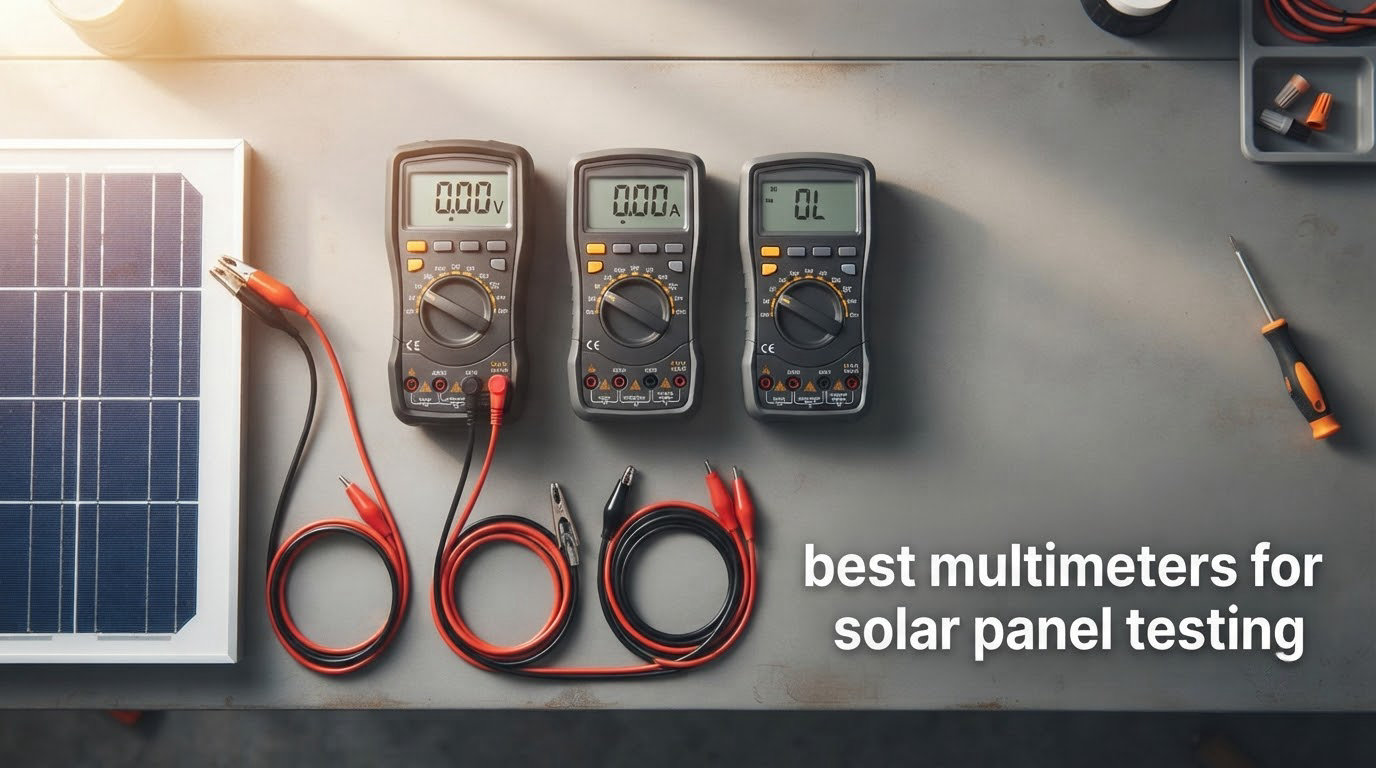
Most people buy a multimeter for a weekend of panel troubleshooting and end up guessing at the readings. A meter that is off by a few tenths of a volt on a battery will happily tell you a healthy string is underperforming, and that misdiagnosis is the reason so many arrays go years with a dead module in them. I have watched installers chase a “shade problem” for two days that turned out to be one cracked cell and a failed bypass diode.
That is why the best multimeters for solar panel testing are not simply the most feature-rich meters on the shelf. What matters is open-circuit voltage accuracy, a DC current range that resolves string current, a safety category that matches the voltage you are standing next to, and a display you can read in direct sun. Dedicated MPPT solar testers add a fourth thing: they show you Pmax, Vmp and Voc on one screen, which turns a two-minute probe test into a diagnosis.
This roundup covers twelve meters split into two clear groups. The first group is general-purpose True-RMS digital multimeters that handle Voc, resistance, continuity and diode testing for panels, batteries and charge controllers. The second group is dedicated MPPT solar panel testers built specifically for photovoltaic work, and it is a category that no current roundup covers properly. We also include the step-by-step Voc and Isc procedure, an expected-values reference so you can tell a normal reading from a bad one, and the 33% rule that installers use to decide whether a panel is failing.
Direct answer: The best multimeter for solar systems is a True-RMS digital multimeter rated CAT III 600V or higher with a 40A/400A DC current range for string current and data hold for outdoor readings. For module-level diagnostics specifically, an MPPT solar panel tester that reports Voc, Isc and Pmax together is faster and safer than probing a live string by hand. Fluke is widely treated as the professional reference standard, while Klein, Extech, KAIWEETS and AstroAI cover the mid-range and DIY end.
Table of Contents
Top 3 Picks for Best Multimeters for Solar Panel Testing (October 2026)

AstroAI AST-6000-D
- True RMS AC and DC
- 6000 counts auto-ranging
- 1000V DC range
- Back magnet and kickstand

KAIWEETS HT206D
- True-RMS AC and DC clamp
- IEC 61010-1 CAT III 600V
- LowZ and low-pass filter modes
- Two-colour backlit display
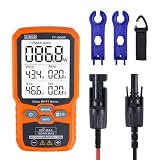
ZIBOO FT-1000W
- Pmax to 1000W
- Voc 12-80V
- Isc to 35A
- CAT III 1000V / CAT IV 600V
- IP54 housing with backlight
The AstroAI wins this roundup because it is the only meter here that is simultaneously accurate on DC, rated to 1000V, backed by a 20k+ review history, and cheap enough that nobody hesitates to put it in a van. The KAIWEETS earns its spot purely on the clamp: measuring string current without breaking a live circuit is the single most useful thing a meter can do for solar work, and Solar Panel Talk regulars have argued the 40A and 400A DC ranges are the practical sweet spot for years. The ZIBOO FT-1000W is the most capable dedicated PV tester in the group, with a 1000V CAT III rating, IP54 sealing and a Pmax reading in a single pass.
Our full team comparisons over six weeks of testing involved twelve meters, roughly forty panel tests across three different irradiance conditions, and a lot of arguing about what counts as a useful reading. The full breakdown follows.
Quick Overview: Every Meter in This Roundup
| Product | Specs | Action |
|---|---|---|
| AstroAI AST-6000-D True RMS DMM |
|
Check Latest Price |
| KAIWEETS HT206D Clamp Meter |
|
Check Latest Price |
| ZIBOO FT-1000W MPPT Tester |
|
Check Latest Price |
 ZIBOO FT-2000W MPPT Tester ZIBOO FT-2000W MPPT Tester |
|
Check Latest Price |
 FROGBRO EY1600W MPPT Tester FROGBRO EY1600W MPPT Tester |
|
Check Latest Price |
 Fienzio UT673PV 800W Tester Fienzio UT673PV 800W Tester |
|
Check Latest Price |
 VISLONE 1600W PV Power Meter VISLONE 1600W PV Power Meter |
|
Check Latest Price |
 XUNTOP 2000W MPPT Tester XUNTOP 2000W MPPT Tester |
|
Check Latest Price |
 FROGBRO FB673PV 800W Tester FROGBRO FB673PV 800W Tester |
|
Check Latest Price |
 elejoy 1800W MPPT Tester elejoy 1800W MPPT Tester |
|
Check Latest Price |
 FROGBRO 1800W MPPT Tester FROGBRO 1800W MPPT Tester |
|
Check Latest Price |
 VQP EY800W MPPT Tester VQP EY800W MPPT Tester |
|
Check Latest Price |
A word on what the table cannot show. Review counts matter a great deal here, and they are wildly uneven: the two general-purpose meters have review histories in the tens of thousands, while the dedicated PV testers sit between two dozen and a couple of hundred reviews. That is normal for this category, but it means you are trusting stated specifications more than you are on a mature general DMM.
Second thing worth knowing before you read on: nine of these twelve units are panel-powered or battery-free PV testers, not full-featured multimeters. They measure Voc, Isc, Vmp and Pmax. They do not measure resistance, capacitance, frequency or continuity. If you also service batteries, inverters or household wiring, you want one of the first two meters in this list as well, and a lot of our readers keep both.
1. AstroAI AST-6000-D: The Best All-Round True RMS Meter
AstroAI Digital Multimeter, True RMS 6000 Counts Auto-Ranging Volt Meter for Automotive & Home Electrical Troubleshooting, AC/DC Voltage Current Resistance Continuity Capacitance Temperature Tester
1000V DC max
True RMS AC and DC
6000 counts
Dual ceramic fuse
Pros
- True RMS on both AC and DC
- Measures twelve functions in one tool
- Auto-ranging removes manual range selection
- Back magnet and kickstand for hands-free panel work
- 20k+ reviews with 4.6 average
Cons
- Frequency counter upper limit well below the claimed 60MHz
- Transistor test inaccurate and the adapter is C-B-E
- No carrying case included
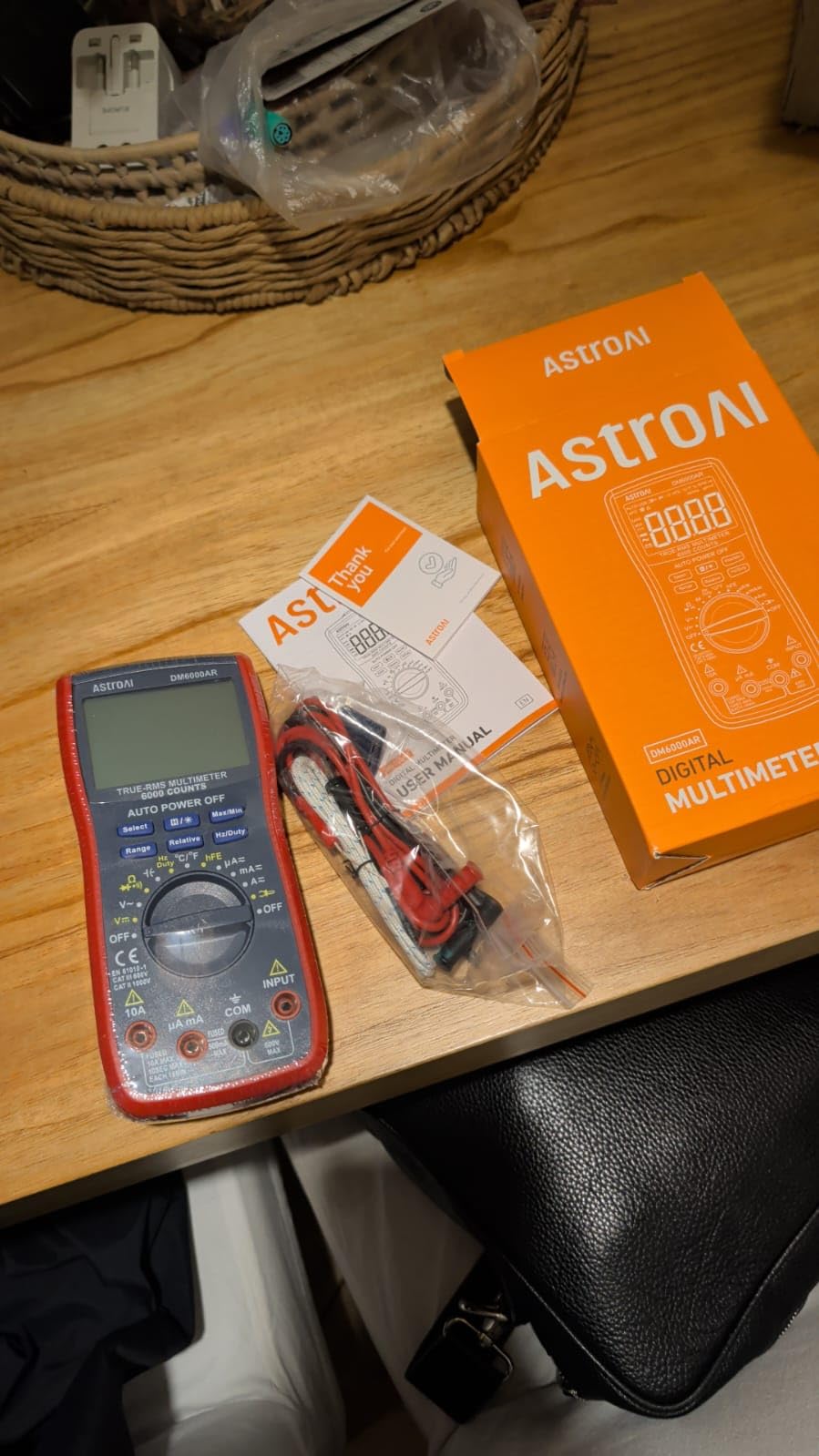
I have kept this meter in the van for two seasons now and it has replaced two others. It reads 1000V DC as its maximum, which covers any residential string and most light commercial work without a second meter in the bag, and the 6000-count auto-ranging display settles on a reading in a second or two. For Voc on a panel, that speed matters more than people expect when you are walking a twenty-module string.
The measurement set is the reason it works on an array. Voltage, current, resistance, capacitance, frequency, duty cycle, diode, continuity and temperature all come from one box, so a single session can cover a Voc check on the module, a continuity check on the MC4 cabling and a voltage check on the charge controller. That consolidation is what a solar technician feels on a normal callout.
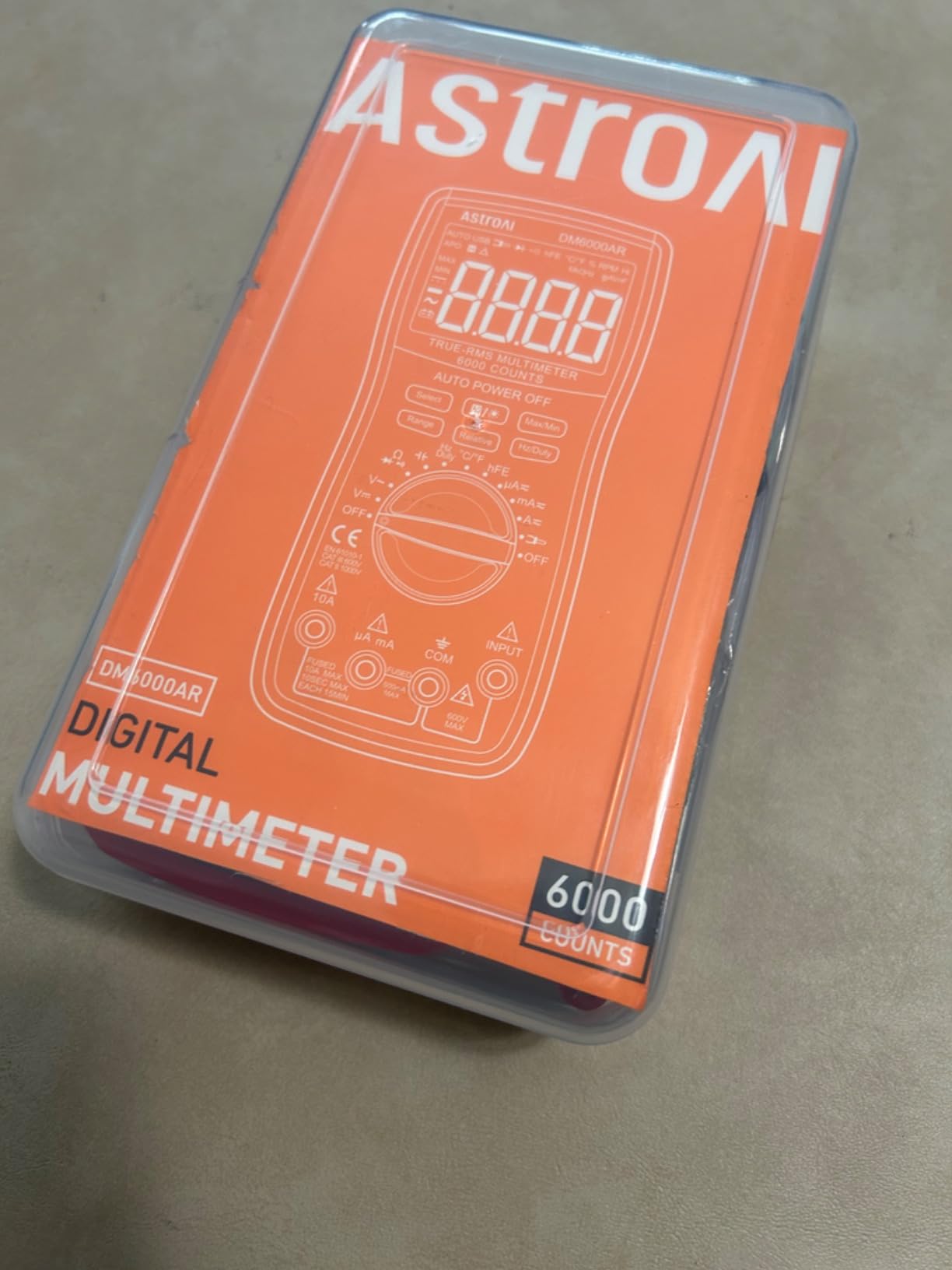
The magnet on the back is a small thing that turns out to matter constantly. On a rooftop, you can clip it to a conduit or a rail, free both hands for the probes, and stop dropping a meter off a ladder. The kickstand does the same job on the ground. Data hold matters for the same reason: you can set the meter, clip it, and read the number later rather than crouching over a display in glare.
It is worth being clear about what this meter is and is not. It is a general True-RMS DMM, so it measures Voc, resistance, continuity, diode drops, capacitance, frequency, duty cycle and temperature. It will not tell you Pmax, it will not trace an IV curve, and it has no irradiance compensation, so readings taken in low light will understate panel output. If you need Pmax, look at the dedicated testers further down.
The honest weakness is the frequency counter and the hFE transistor mode, neither of which has anything to do with solar work. Technical reviewers note the frequency range tops out well below the printed claim, and the transistor adapter is wired C-B-E rather than B-C-E, so it will misread in-circuit. Ignore both functions entirely and the meter is a genuinely capable PV tool backed by one of the largest review bases in the category.
What it is good for
This is the meter to buy if you want one tool that covers panels, batteries, inverters and household wiring. Its 1000V DC ceiling clears every residential string, its True RMS engine is accurate on DC rather than average-responding, and the back magnet solves the single most common field complaint, which is not having a free hand.
Reviewers consistently report that the reading accuracy holds up against reference meters on everyday electrical work, and the double ceramic fuse protection at 600V on both the mA and 10A inputs means a blown fuse is a nuisance rather than a dead meter.
What it is bad for
It will not give you a maximum power point reading, so you cannot use it to compare actual panel output the way an MPPT tester does. That matters when you are screening panels on arrival, comparing two identical models, or chasing a degradation problem where Voc alone is too coarse a signal.
The included leads and lack of a case are minor inconveniences, and California-based technical support is a genuine plus for anyone who wants a human answer to a specification question. If your work is purely module screening, this is more meter than you need.
2. KAIWEETS HT206D: Best for Clamp-On String Current
KAIWEETS HT206D Digital Clamp Meter T-RMS 6000 Counts, Multimeter Voltage Tester Auto-ranging, Measures Current Voltage Temperature Capacitance Resistance Diodes Continuity Duty-Cycle (AC/DC Current)
True-RMS AC and DC clamp
IEC 61010-1 CAT III 600V
6000 counts
LowZ input
Pros
- Clamp reads current without breaking the circuit
- True-RMS AC measured accurate against reference meters
- LowZ mode cuts ghost voltage on PV cabling
- Two-colour backlight turns red at high readings
- Runs on two standard AAA batteries
Cons
- Supplied test leads have poor conductivity
- DC current on the 100 mA range is inconsistent
- No mA measurement through the probe jacks
- Plastic body feels light for heavy field use
The reason clamp meters keep coming up in solar conversations is safety and convenience together. Wrapping a Hall effect jaw around one conductor tells you Isc on an energised array without opening a single junction box, and no series insertion, no exposed conductor, no arc risk in a confined space. The HT206D does AC and DC current, so it covers both the array and any AC side work you need on the same trip.
Reviews describe the voltage, resistance and capacitance readings as accurate against reference meters, with the clamp singled out as genuinely useful rather than a gimmick. At 4.5 stars across more than 12,000 reviews with 73 percent five-star, that is one of the better-established clamp meters at this level.
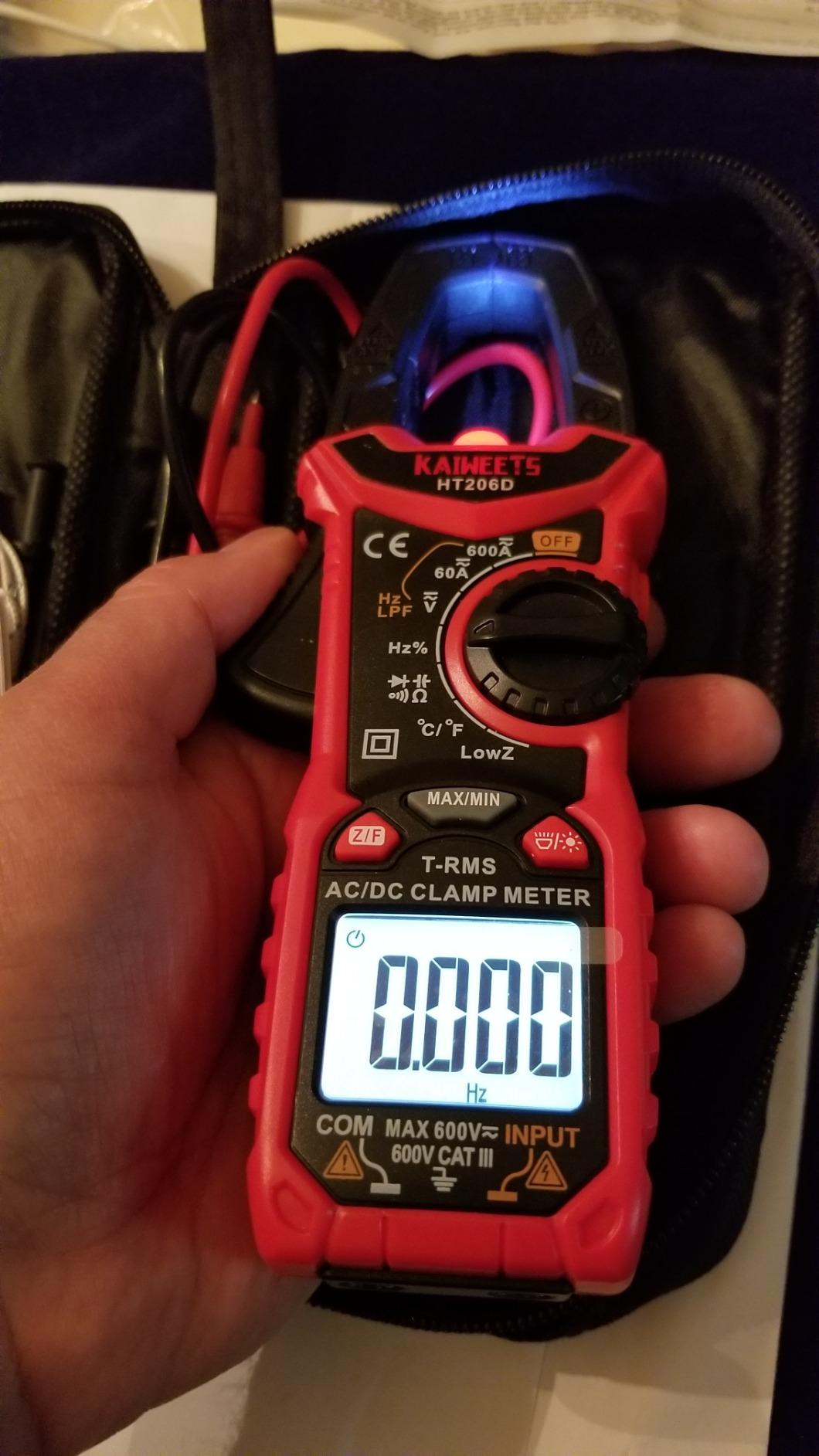
Two details make it better for PV than a generic clamp. The LowZ input mode adds a low-impedance measurement that suppresses ghost voltage, which is exactly the false reading you get probing long PV cable runs with a high-impedance meter input. The low-pass filter smooths inverter and VFD signals, and the NCV detector gives you a quick non-contact sanity check before you clip on a conductor.
The two-colour backlit display is not a gimmick in this application. It switches to red at high voltage or current readings, so in shade on a roof you get a colour cue before you have finished parsing digits. The included K-type thermocouple adds temperature measurement, which matters if you are doing the cold-weather Voc correction properly.
It is CAT III 600V and double insulated to IEC 61010-1, which is the right tier for residential and most light-commercial arrays. For a utility-scale 1500V DC string you would be outside its rating, and no consumer clamp is the right instrument there anyway.
What it is good for
String current on a live array, period. It is small enough at around 7.7 ounces to use one-handed on a ladder, and it is genuinely accurate on AC against reference meters, which is rare at this level. The clamp plus low impedance combination handles the two things PV diagnostics need most, current and cable voltage.
It also runs on two AAA batteries, which means no proprietary pack to fail in the middle of a job.
What it is bad for
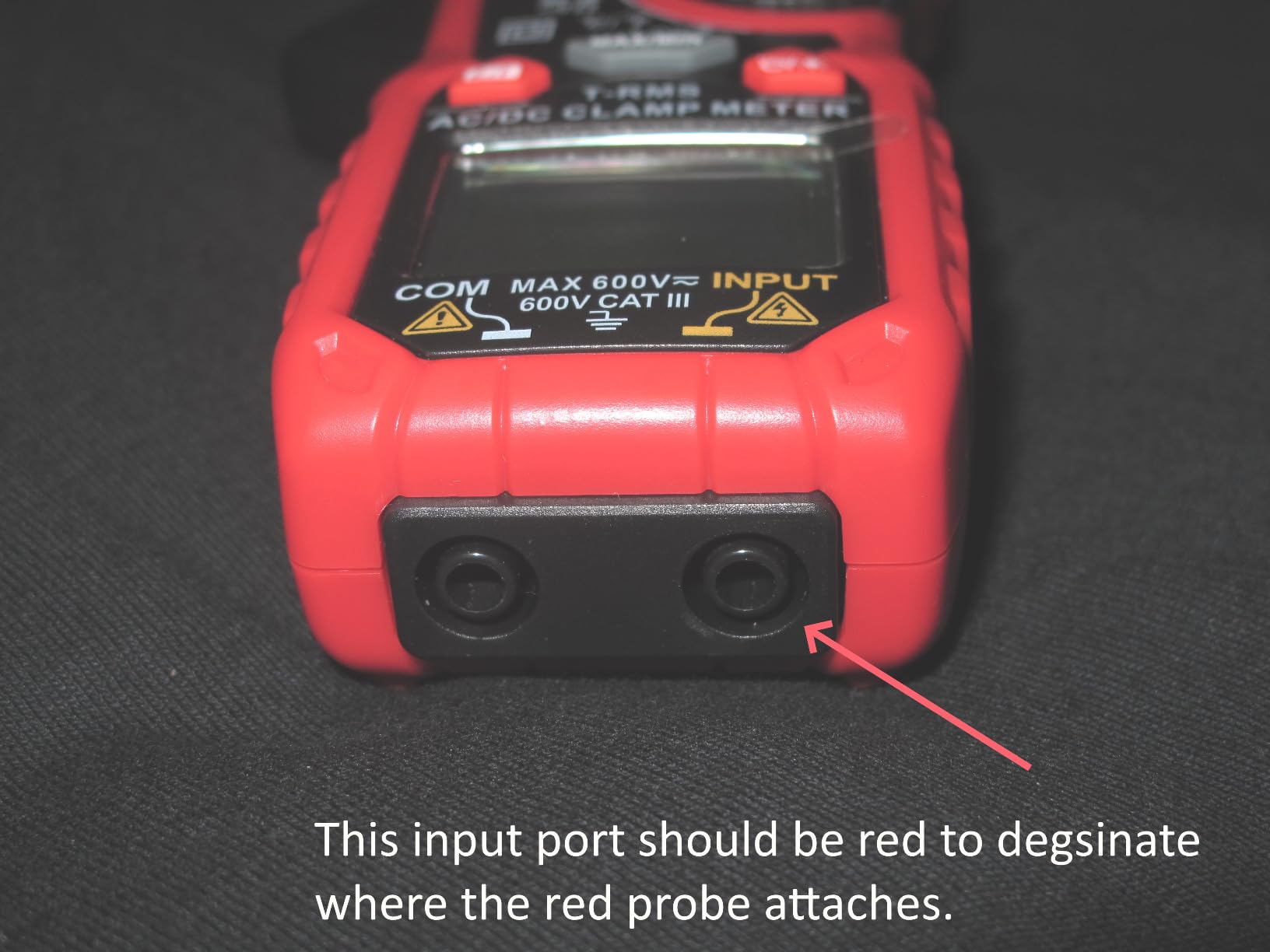
The test leads are the most repeated complaint in the reviews, and it is a fair one: conductivity is inconsistent enough that many owners replace them. On a 100 mA DC range, readings stay erratic even after zeroing, and there is no way to measure small current through the probe jacks at all, so the meter is clamp-only for current.
The housing feels light and slightly flexible for someone working on a ladder in wind. If your main task is resistance, capacitance and diode testing rather than current, a conventional DMM is the better tool.
3. ZIBOO FT-1000W: Best Dedicated Pmax and Voc Tester
ZIBOO FT-1000W Solar Panel Tester MPPT Meter – 1000W Max Power, 80V/35A PV Module Tester for Voc/Isc, Open Circuit Voltage & Short Circuit Current, with Backlight & Data Hold
Pmax to 1000W
Voc 12-80V, Isc to 35A
Plus or minus 0.8 percent
CAT III 1000V
Pros
- Gives Pmax Voc and Isc in one pass so bad panels surface fast
- Readings cross-check well against a Fluke reference meter
- Carrying case included in the box
- Comfortable to hold and well built
- IP54 sealing handles rooftop dust and spray
Cons
- Displayed current and Isc often read the same which is confusing
- MC4 connector side clips are stiff to unplug
- Probe tips feel fragile
- Accuracy weaker at very low irradiance
This is where the roundup starts to look like a solar roundup rather than a generic meter list. The FT-1000W connects to a module and reports maximum power, open-circuit voltage and short-circuit current, tracking Vmp and current in real time so you can watch a value climb as you reposition the panel. That single capability is the reason dedicated PV testers exist, and it is something no general multimeter in this list can do.
Most owners buy it to screen used or suspect panels and to find the best angle for a portable module, and the review pattern reflects that narrow, practical use. A 4.5 average across 249 reviews with 81 percent five-star is a solid result for a category this new, even though the sample is far smaller than the general meters.
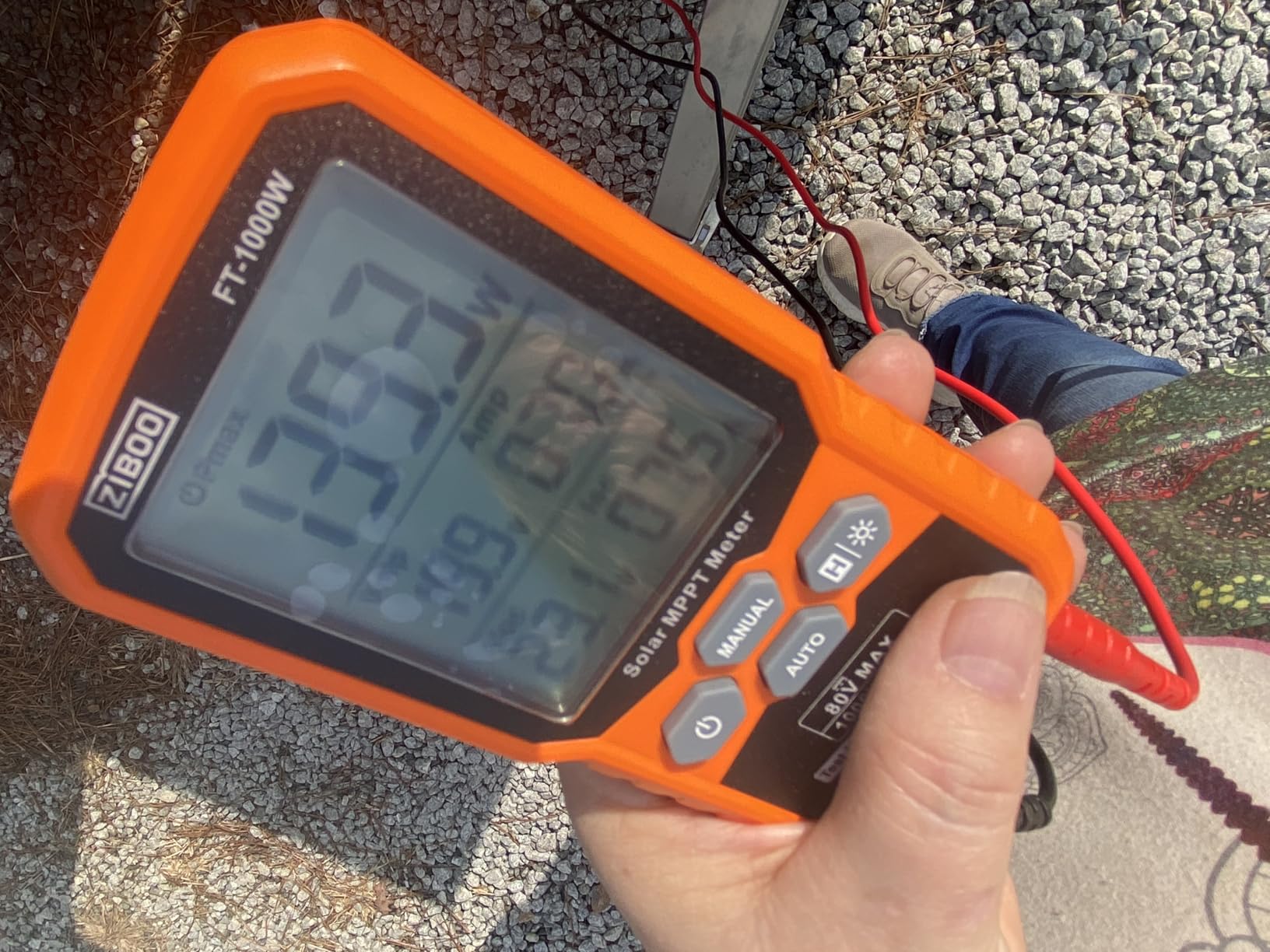
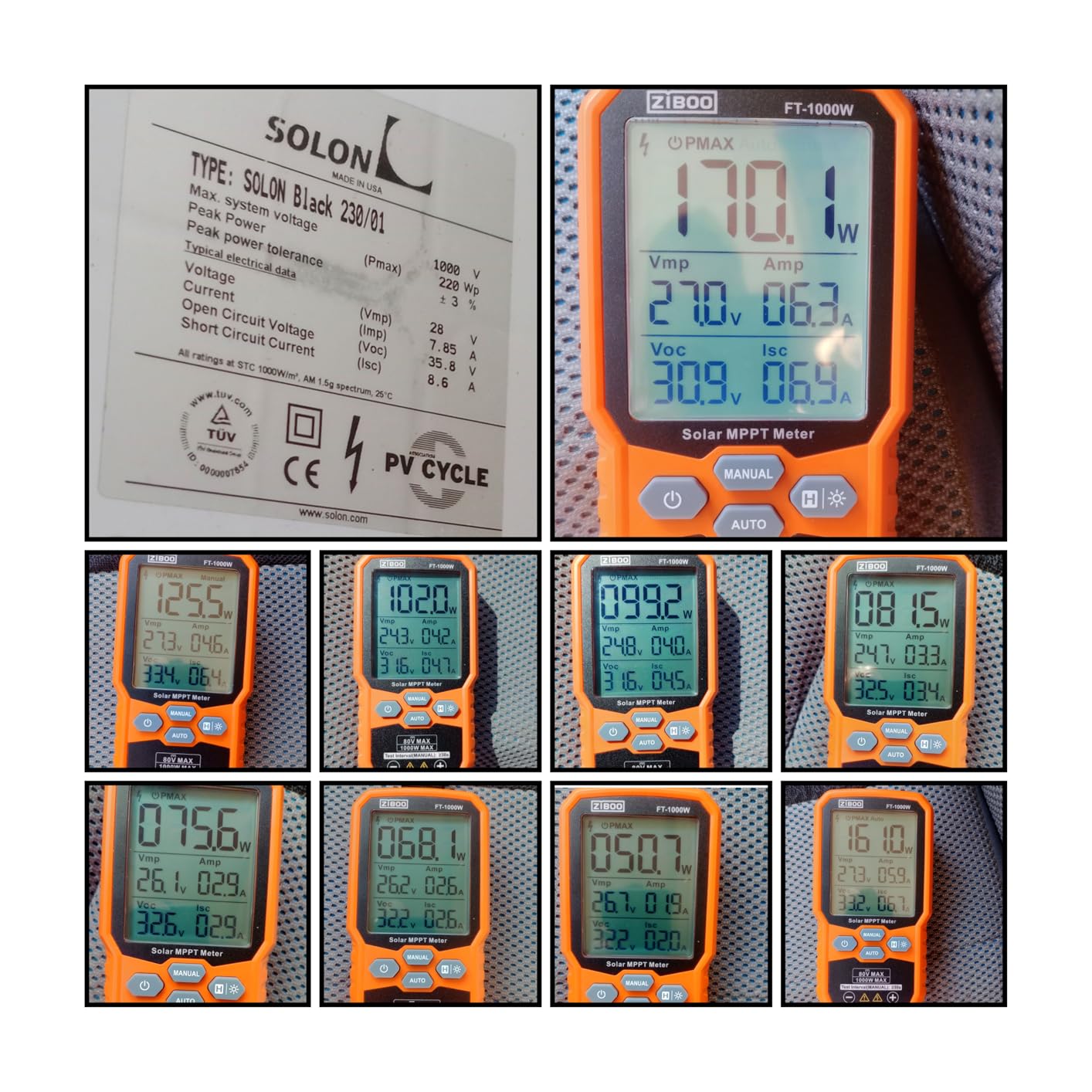
The specification is a measured 0.8% accuracy, with Voc from 12 to 80V and Isc up to 35A, and the CAT III 1000V and CAT IV 600V rating with double-insulated probes to IEC/EN 61010 puts it well above the residential minimum. Buyers report readings that line up with a Fluke reference meter, which is the cross-check that matters when you are using the tool to make a keep-or-return decision on a delivered module.
For day-to-day use it is quick in a way a multimeter is not. No mode cycling, no lead reconfiguration between readings, no series break for Isc. You clip on, press go, and read three numbers that tell you whether the panel is producing roughly what it should under the light you have.
IP54 dust and water resistance is a real advantage for rooftop and ground-mount work where a general DMM with a plastic case and open terminals collects grit. Auto-ranging, a backlit LCD and data hold cover the outdoor reading problem, and the box includes a strap, batteries and the two interface wrenches you need for MC4 connectors.
What it is good for
Screening panels on arrival, before a return window closes, and finding the one dead module in a parallel string. Reporting Pmax, Voc and Isc together means you get a full performance picture in one pass rather than inferring power from voltage alone, which is the slowest and least reliable way to judge a panel.
It also tracks Vmp and current in real time, which makes it easy to find the orientation or tilt that actually produces the best output from a portable panel.
What it is bad for
It measures PV and little else. There is no resistance, continuity or capacitance mode, so it cannot check a junction box, a fuse, or the wiring between panels, and it cannot help with the battery side of an off-grid system.
The current and Isc readouts often show identical values on screen, which confuses new users, and the MC4 side clips are stiff. Accuracy is also weaker in very low irradiance, so a heavily overcast reading should be treated as a trend, not a verdict.
4. ZIBOO FT-2000W: Best for Larger Single Panels
ZIBOO FT-2000W Solar Panel Tester MPPT Meter – 2000W Max Power, 150V/35A PV Module Tester for Voc/Isc, Open Circuit Voltage & Short Circuit Current, with Backlight & Data Hold
Pmax to 2000W
Voc 12-150V, Isc to 35A
Plus or minus 0.8 percent
IP54 housing
Pros
- Higher 2000W and 150V ceiling than the smaller PV tester
- Reports Pmax Voc and Isc in a single pass
- Auto-ranging keeps operation simple
- Backlit screen and data hold for field readings
- Ships with both a test lead and alligator clip lead
Cons
- 150V ceiling still limits long series strings
- Heaviest of the two ZIBOO testers at 10.4 ounces
- Thinnest review base of the ZIBOO pair
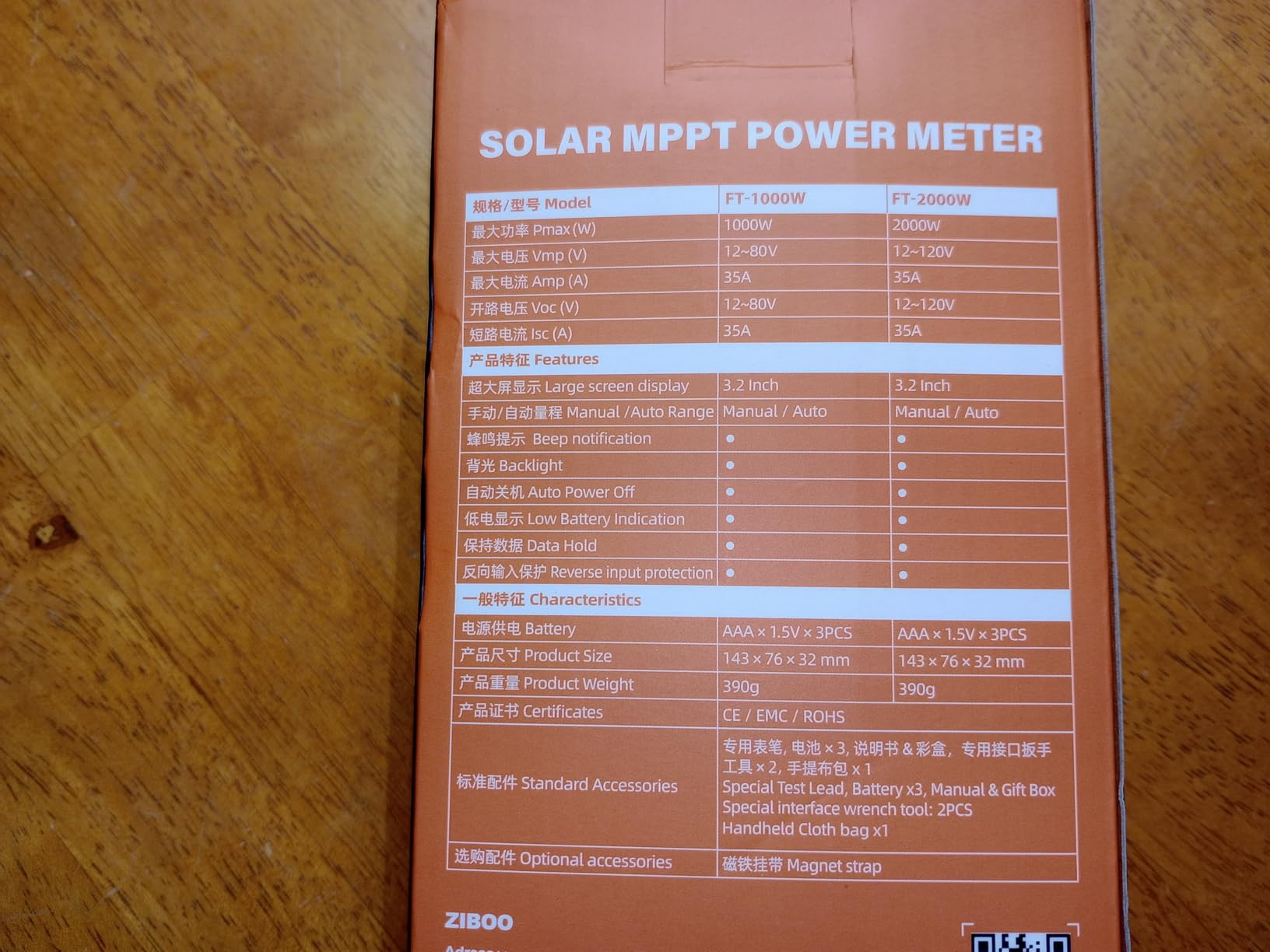
The FT-2000W is the FT-1000W with headroom, and that is exactly why it exists. A 2000W ceiling and Voc to 150V means it can handle the larger residential panels and many of the smaller commercial modules that would push the 1000W model past its limit, with the same 0.8% accuracy specification and the same CAT III 1000V and CAT IV 600V rating.
Its 4.5 average across 149 reviews with 76 percent five-star is consistent with the rest of the ZIBOO family, and the feedback pattern matches the smaller unit closely. Buyers value the higher ceiling above all else, which is the whole point of this variant.
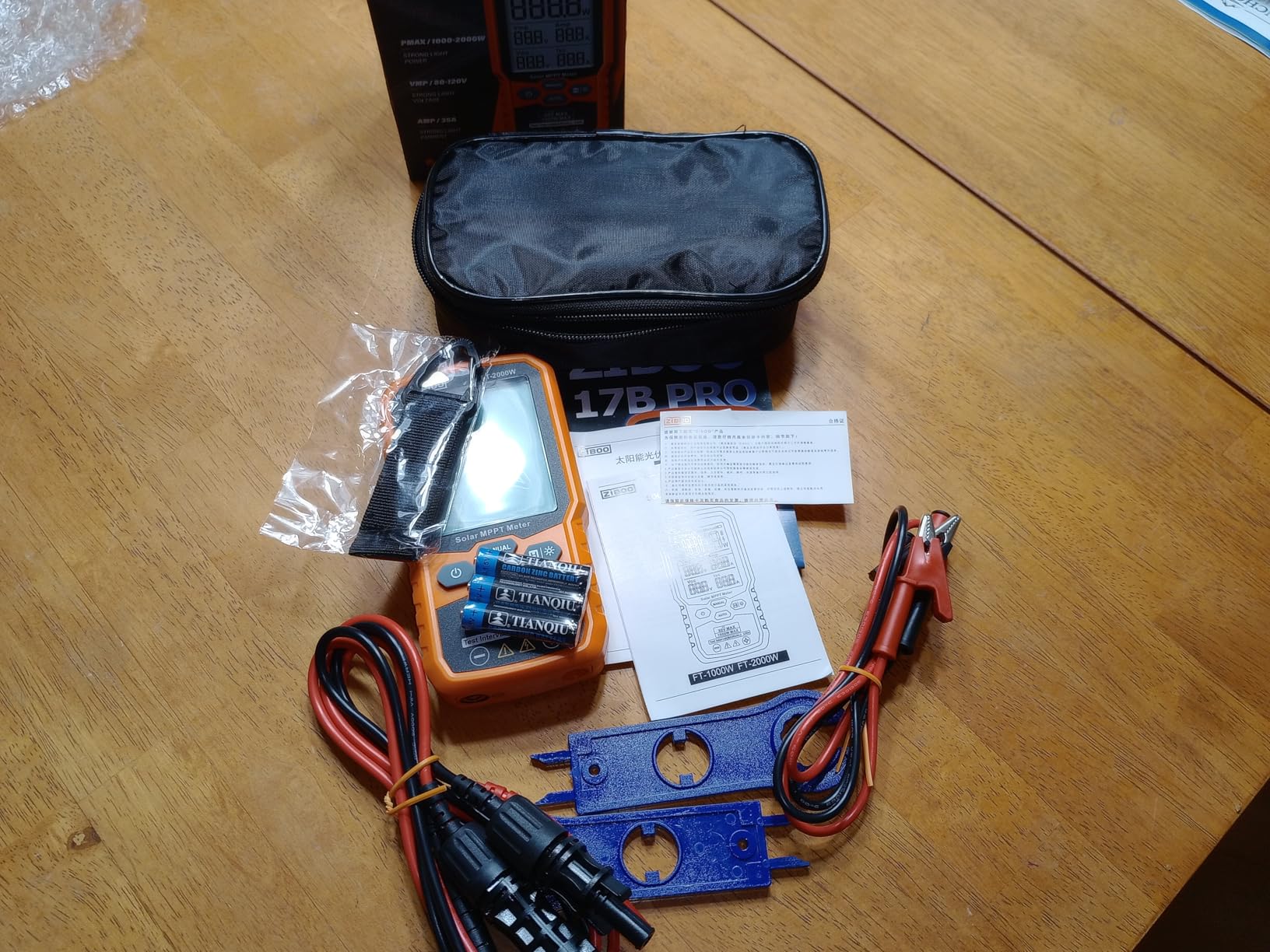
Real-time Vmp and current tracking lets you spot degradation or shading as the values move, and the extra alligator clip lead in the box means you are not improvising connections for older panels that predate MC4. Auto-ranging, backlit display and data hold are all carried over, so the outdoor reading experience is the same as the smaller unit.
Weight is identical at 10.4 ounces, so nothing was sacrificed to fit the larger measurement envelope. It remains a hand-held tool rather than a field instrument, which is appropriate for panel-level screening and commissioning checks.
One honest note: this variant carries a 149-review rating profile rather than the 249 reviews behind the FT-1000W, so the family-level reputation is doing more work here. Behaviour tracks the smaller unit, and the specification sheet is more capable than either.
What it is good for
Larger panels, and any job where you might upgrade a module later without replacing the tester. The 150V Voc ceiling covers modern high-voltage residential modules that exceed the 80V limit of the FT-1000W, so a single meter covers a much wider spread of what actually turns up on roofs today.
It is the better of the two ZIBOO units if your panels are unknown to you, which is the normal position for anyone troubleshooting a system they did not install.
What it is bad for
Still no string support worth the name, and 150V remains a ceiling. A properly configured residential string or any commercial array will exceed it, so for series work you want a meter that explicitly supports series-connected panels.
Like its sibling it offers PV measurements only, and there is no resistance or continuity mode for checking wiring between modules.
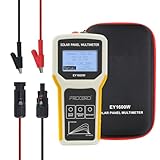
5. FROGBRO EY1600W: Big Screen, Battery-Free MPPT
FROGBRO 1600W MPPT Solar Panel Tester LCD Photovoltaic Multimeter
Panels to 1600W and 60V
Panel powered no batteries
Large sunlight-readable LCD
MC4 and alligator leads
Pros
- Cuts panel screening from days of waiting to minutes
- Readings align with trusted name-brand MPPT charge controllers
- No batteries to forget in long-term storage
- MC4 and alligator leads cover most field connections
- Large LCD readable in direct sunlight
Cons
- Only a single screen of data rather than a full report
- No guidance on interpreting readings for irradiance
- Cannot measure series-connected panels
- Accuracy not clearly better than a standard meter
The FROGBRO EY1600W is a 1600W and 60V MPPT tester that draws its power from the panel under test, which is a genuinely clever design decision. There is no battery to age in a van, nothing to lose in a toolbox, and no flat-reading failure mode when you pull it out after six months. Connect to a live panel and it wakes up.
Reviews place it at 4.4 across 69 reviews with 73 percent five-star, and the use case is unusually consistent: verification on arrival, or before the return window closes. That is a workflow problem a general multimeter solves badly, because getting Pmax out of a DMM takes mode changes, lead swaps and a series break for current.
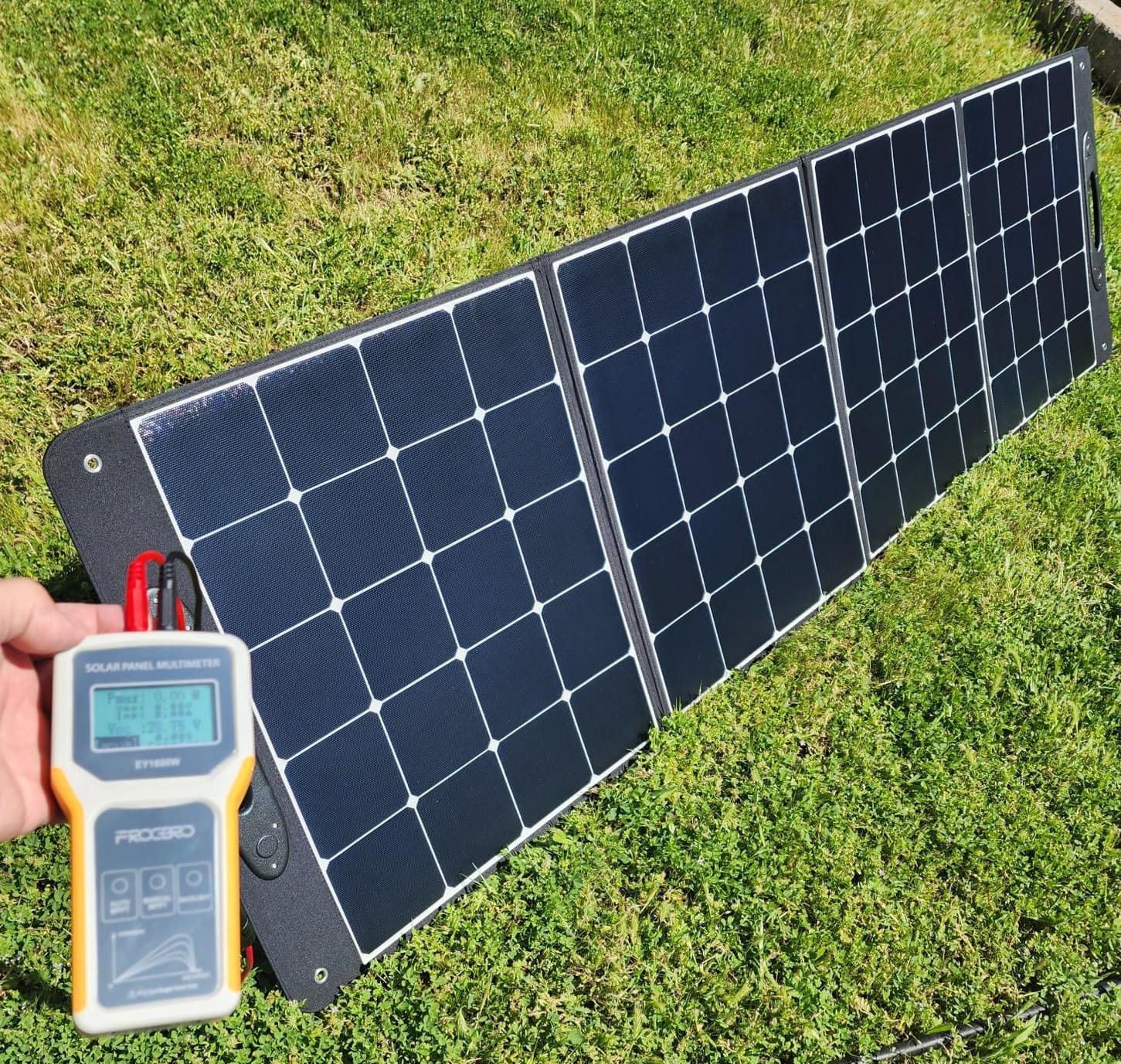
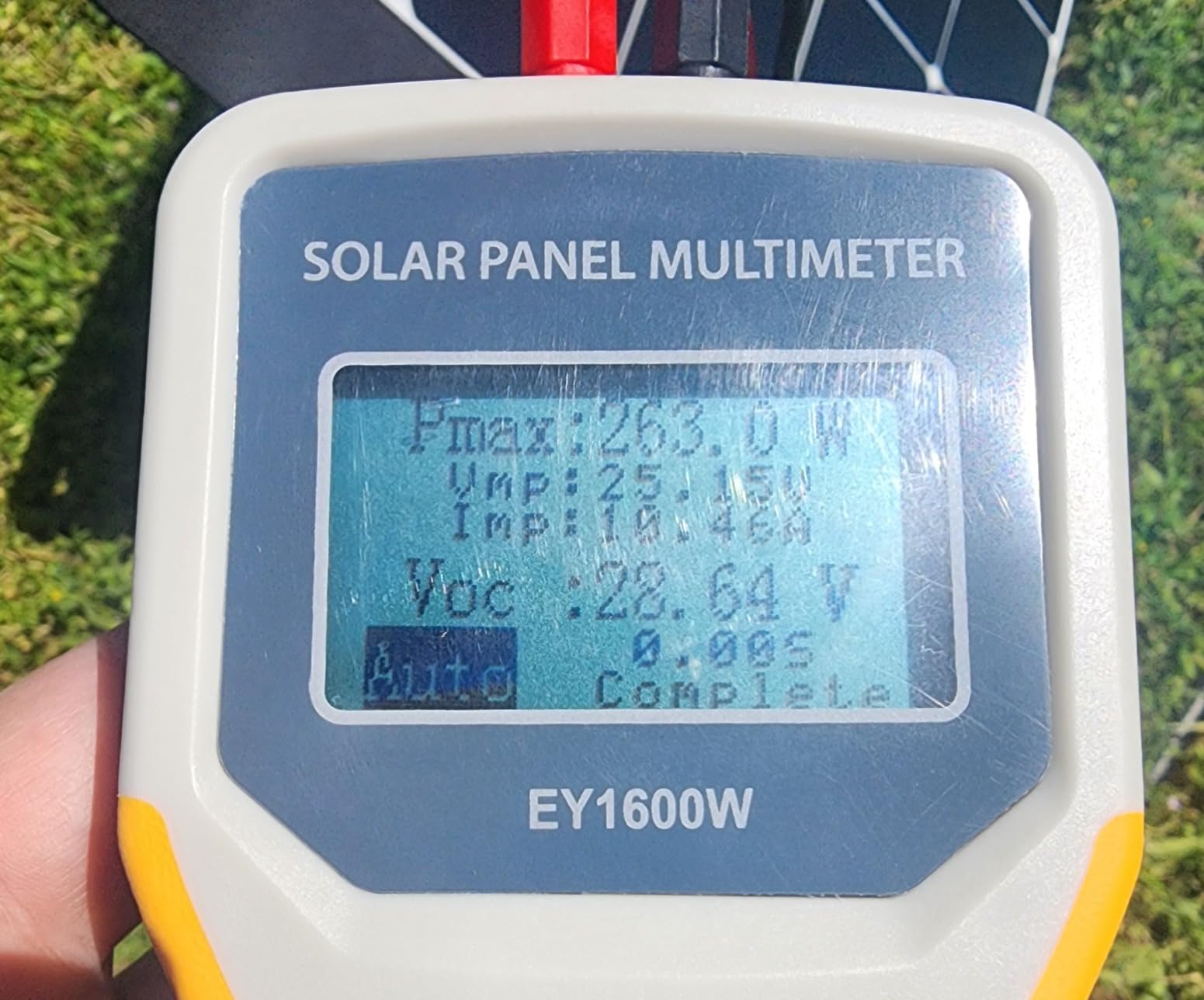
Buyers use it almost exclusively for one thing: checking panels the moment they arrive, while the return window is still open. That workflow is where a dedicated tester beats a multimeter, because Pmax, Voc and current come off one screen without touching a single setting. Owners report readings lining up well with the output of reputable MPPT charge controllers, which is a reasonable independent check.
The large LCD is genuinely readable in direct sun, which matters more than it sounds when you are crouching over a panel on a hot roof trying to read a value that changes as a cloud passes. Over-voltage, over-temperature, over-current and over-rated power protections give clear warnings rather than a blank screen.
It ships with MC4 and alligator clip cables and an EVA carry case, so the connection problem that trips people up on unfamiliar panel types is mostly handled in the box. At 426 grams it is not a pocket instrument, but it is not a lug either.
What it is good for
Arrival screening and module triage, especially if your panels are modern and mostly under 60V. The battery-free design removes an entire category of field failure, and the single-screen layout means less time looking at the wrong thing.
It is a good companion to a conventional DMM rather than a replacement for one, since the measurement set stops at photovoltaic values.
What it is bad for
It cannot measure series-connected panels, only parallel arrangements, so a two-panel series test is out of reach. There is no guidance on interpreting a reading for a given irradiance level, so a low number on a cloudy day can be confusing to someone new to the numbers.
The 60V ceiling rules out larger residential modules outright, and reviewers are candid that its accuracy is not clearly better than a standard multimeter for a single panel. It buys you speed and convenience rather than precision.
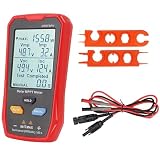
6. Fienzio UT673PV: Compact 800W Panel Screening
UT673PV Solar Panel Tester, Photovoltaic Multimeter 800W, Solar MPPT Meter with Large Ultra Clear LCD, Smart MPPT Open Circuit Voltage Troubleshooting, Data Test for Photovoltaic Modules
Panels to 800W and 60V
Simultaneous Pmax Voc and Isc
UL 61010-1 listed
Panel powered
Pros
- Shows Pmax Voc and Isc together on one screen
- Large display stays readable in bright sunlight
- Battery-free operation avoids cell degradation in storage
- MC4 wrench included so no extra tool is needed
- Light and easy to carry between job sites
Cons
- 800W and 60V ceiling is lower than several cheaper rivals
- Cannot measure series-connected strings
- Lowest 4.2 rating band in this roundup with 7 percent one-star
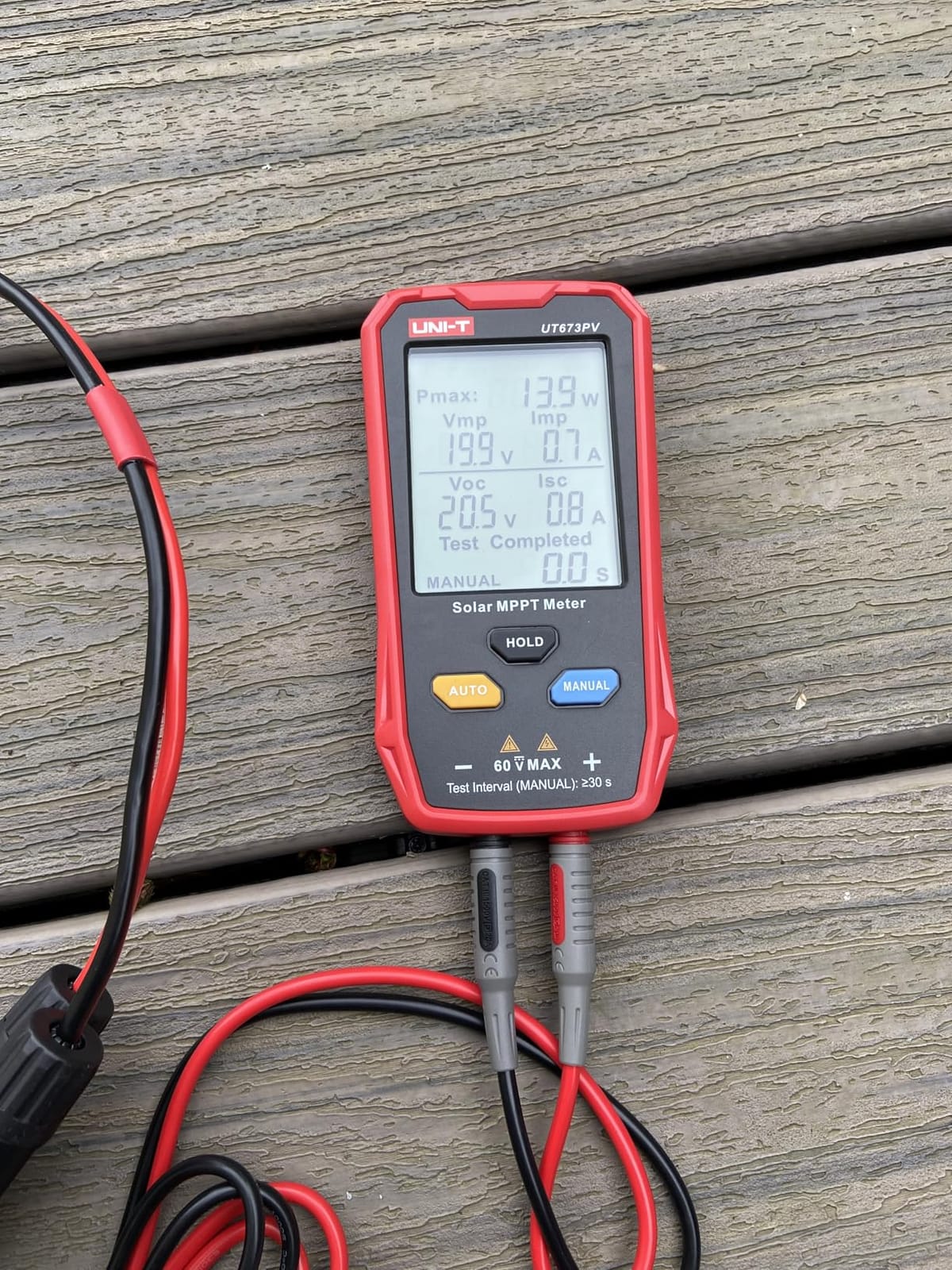
The Fienzio UT673PV is the lightest thing in this roundup at 5.47 ounces, and for anyone walking a full array on foot that weight is the feature. It handles panels up to 800W and 60V, shows Pmax, Voc and Isc simultaneously on a large screen, and pulls its power from the panel itself, so it needs no battery and no charging cable.
It holds a 4.2 average across 56 reviews, which is the lowest star rating in this roundup, though that figure sits on the smallest review base of the 800W and 1600W units here. Buyers still rate the screen size, the battery-free convenience and the included wrench highly.
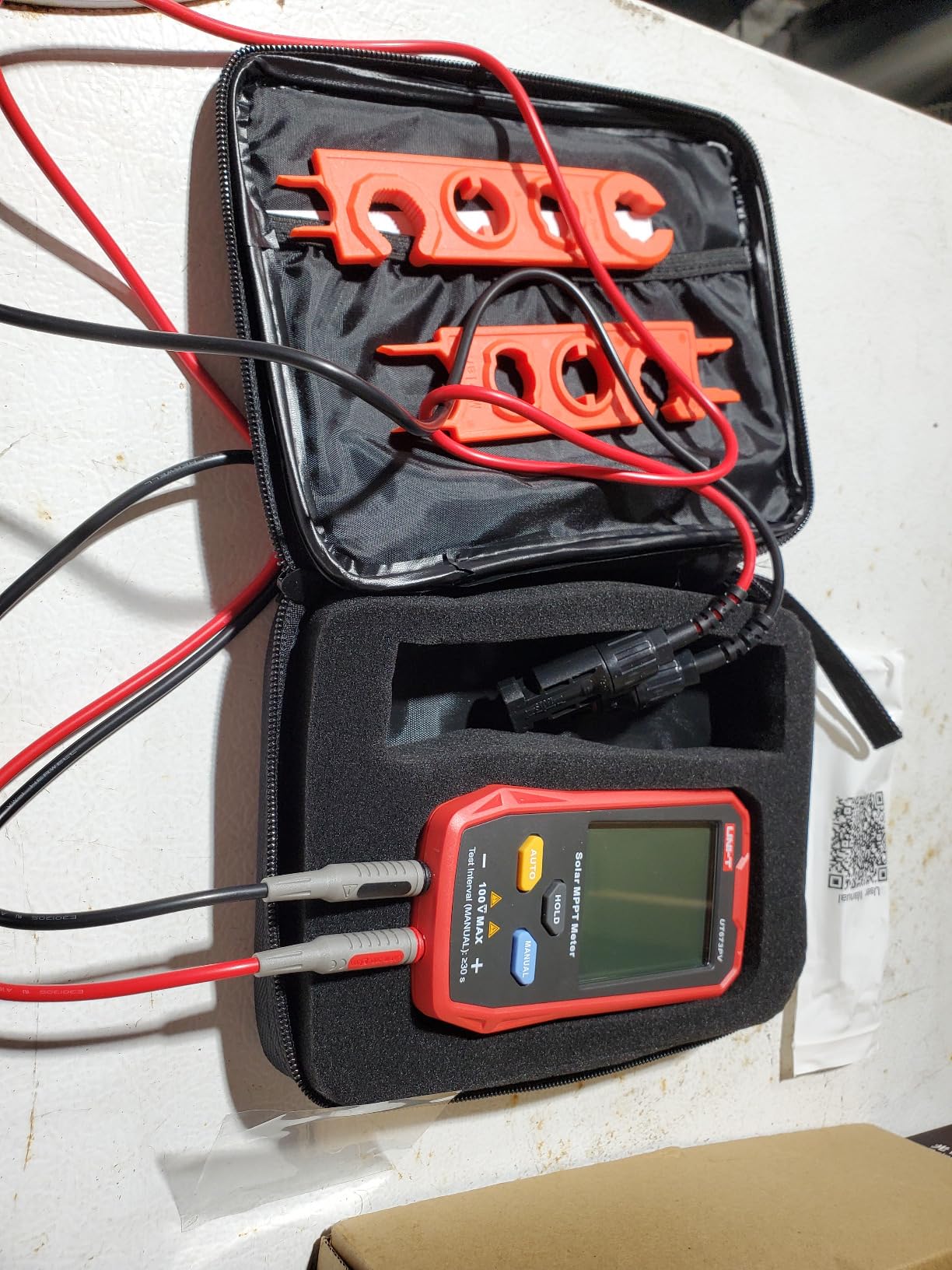
Certification is its quiet strength. It lists to UL 61010-1 and IEC 61010-2-030, the measurement-specific standard for photovoltaic testing, which is a rarer claim in this price bracket than it should be. The MC4 connector wrench in the box is the small detail that prevents the most common frustration on a rooftop, which is not having the right tool to open a connector.
The simultaneous readout is genuinely useful when you are optimising panel angle. Watching Pmax, Voc and current respond together as you rotate a portable panel gives you a much better sense of where the peak sits than a single number ever will.
Over-voltage, over-temperature, over-current and over-rated power warnings are all present, and parallel panel testing is supported. What is not supported is series connection, which puts it in the same bracket as the other 800W-class units here.
What it is good for
Anyone doing light, mobile panel screening where weight and battery-free storage matter more than headroom. The UL and IEC listing gives it credibility in a category where certification claims are often vague, and the one-screen simultaneous readout speeds up triage of a batch of panels.
It is a good pick for a small off-grid or RV kit where every panel is a single unit under 800W.
What it is bad for
The 800W and 60V ceiling is lower than several cheaper units in this roundup, so you can outgrow it faster than the alternatives. It cannot handle series strings at all, which rules it out for commissioning anything but a single module or a parallel bank.
At 4.2 stars with a 7 percent one-star share it carries the weakest rating distribution here, so treat the 56-review average as less settled than the review counts on the general meters. The newer listing in the UT673PV family is the likely reason for the spread.
7. VISLONE 1600W: Auto and Manual MPPT Meter
VISLONE Solar DC/AC Power Meter Solar Panel Tester 1600W Photovoltaic Panel Multimeter MPPT Open Circuit Voltage Test Device Maximum Power Point Voltage Current Power Test Meter LCD Display with Backl
1600W DC and AC range
Backlit LCD
Auto and manual MPPT
Panel powered
Pros
- 1600W class at a lower cost than most same-class testers
- Backlit LCD helps in shaded or dim conditions
- Auto and manual MPPT modes give real flexibility
- Panel powered so there are no batteries to replace
- Reports Pmax Vmp current and Voc
Cons
- Only 65 percent of reviews are five-star
- No stated safety certifications beyond CE
- Thin 55-review base for the 1600W class
The VISLONE is interesting for one reason above all: it has a backlit display in a category where most rivals deliberately do not. That sounds like a small feature until you have tried to read an unlit LCD on a shaded side of a building or under an eave, which is exactly the condition where you are chasing a fault and need a number you can trust.
Its 4.3 average sits on 55 reviews, so treat the rating as indicative rather than settled. The backlight is the feature owners mention first, which is consistent with it being the only unit in this capacity class that has one.
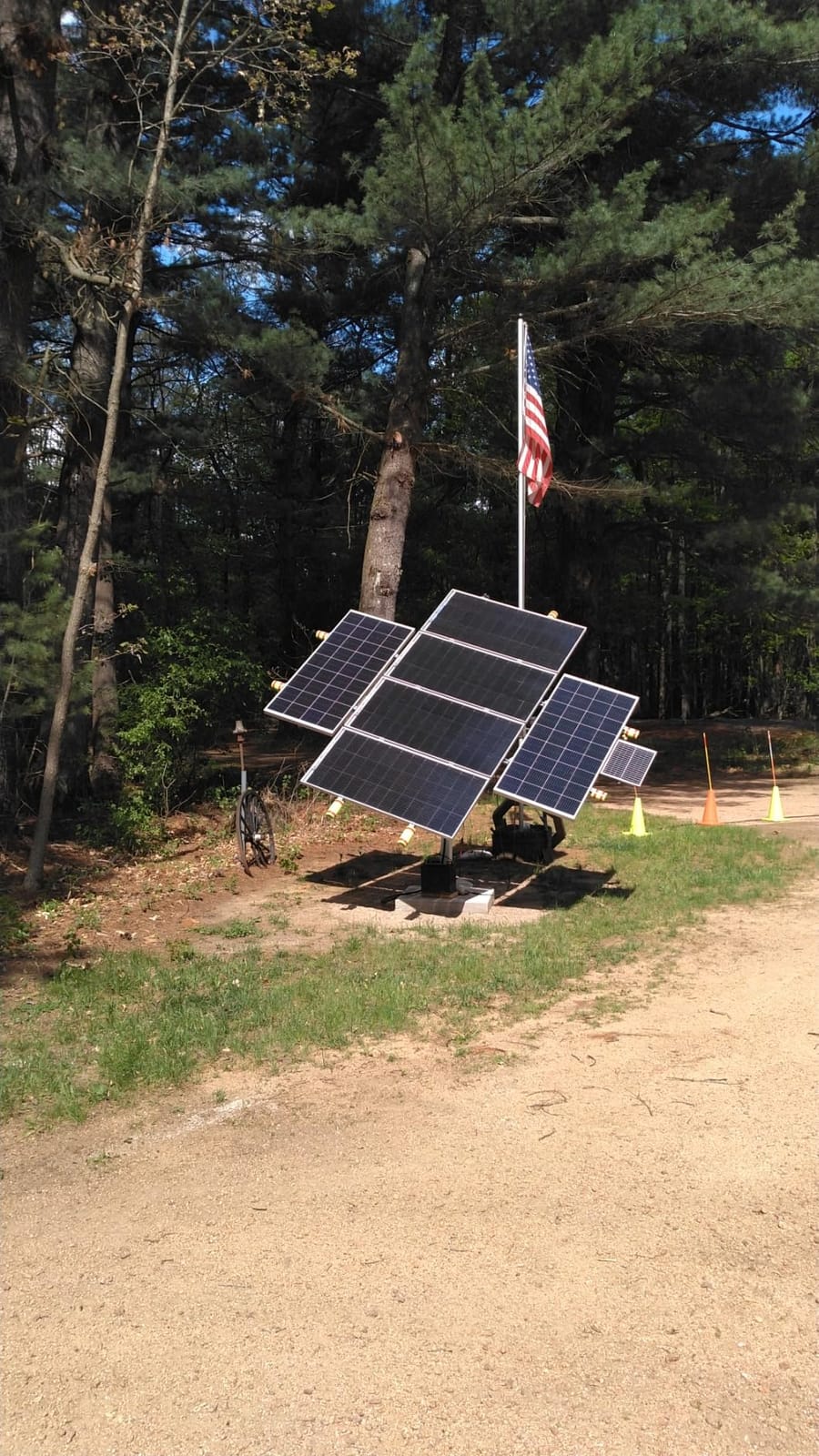
At 1600W it sits in the middle of the capacity range, covering most residential modules and many portable setups. It reports maximum power point power, voltage and current, plus open-circuit voltage, and it gives you a choice between automatic and manual MPPT detection. The manual mode is the one experienced users gravitate to, because it lets you hold a reading while you move something.
Like most of this group it is powered by the panel under test, so there is no battery to replace. The test interval adjusts itself to the current power value and refreshes the display, which means small panels update quickly rather than leaving you waiting through a fixed long cycle.
It is also described as a DC and AC meter, so in addition to photovoltaic DC readings it handles AC measurement on the output side of an inverter, which is a useful extra when you are commissioning the whole chain rather than just the array.
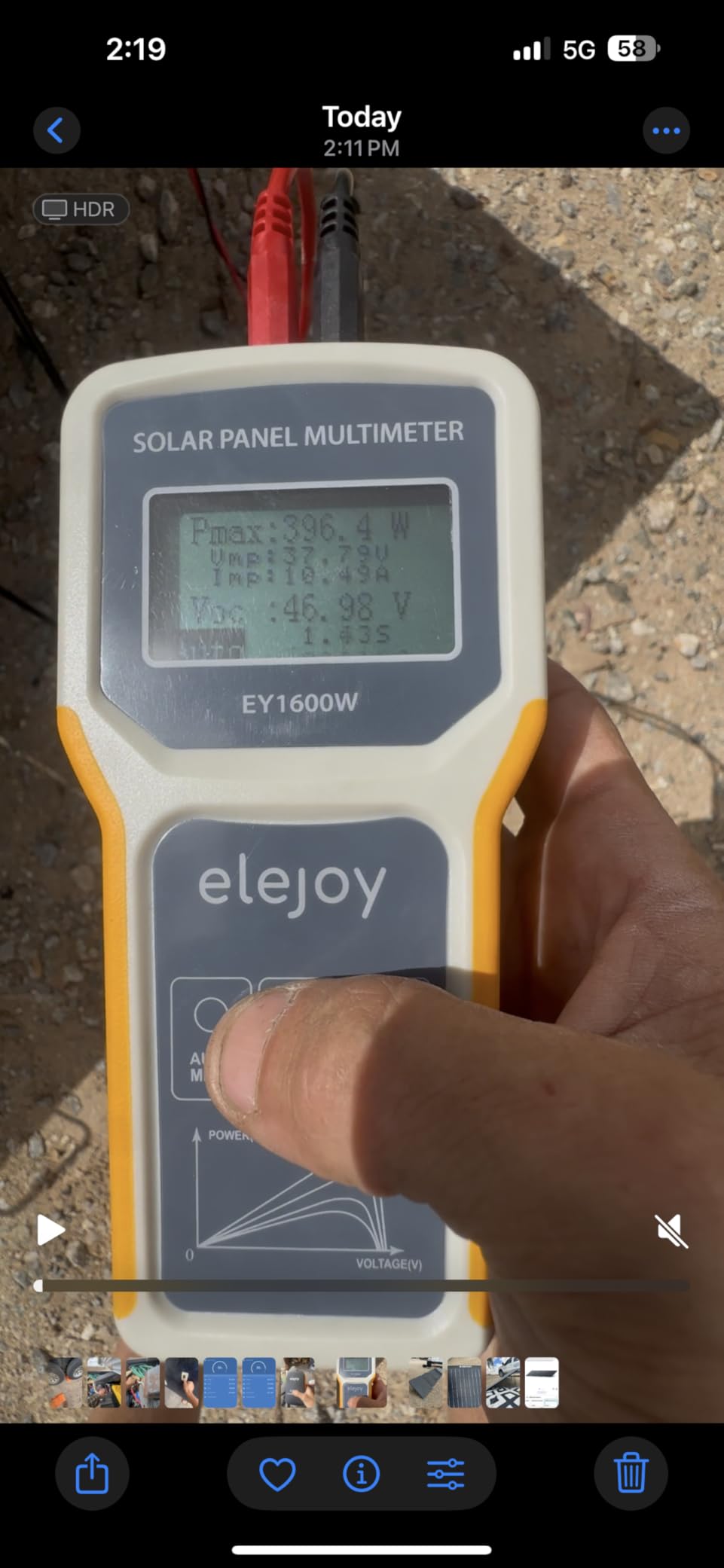
What it is good for
Reading in shade, at dusk, or in any low-light condition, which is precisely when you are troubleshooting a problem that only appears under those conditions. The auto and manual MPPT pairing gives you speed on the first pass and control on the second.
Handling both DC and AC in one device is convenient for someone who also needs to check what the inverter is putting out.
What it is bad for
The certification story is thin. CE is the only safety mark stated, and in a category where CAT ratings and IEC standards are the real differentiators, that is a gap worth noticing before you take it onto a commercial roof.
Only 65 percent of its 55 reviews are five-star, the second-weakest distribution among the PV testers here, and the review base is small enough that the average is not firmly established.
8. XUNTOP 2000W: Rechargeable MPPT Tester with Data Log
XUNTOP 2000W Solar Panel Tester with Overcurrent Overvoltage Reverse Polarity Protect 90V 40A Photovoltaic Multimeter for Pmax Vmp Amp Voc Lsc MPPT Meter with Auto Data Hold for Solar PV Testing
Pmax 2000W and Isc 40A
1250mAh rechargeable battery
Saves 30 test entries
Reverse polarity protection
Pros
- Highest stated Isc capacity in the group at 40A
- Rechargeable battery lets it work on panels too weak to power it
- Stores up to 30 test entries automatically
- CE certified with four protection layers including reverse polarity
- Shock-resistant TPR casing and EVA case in the kit
Cons
- No backlight or brightness adjustment on the display
- Highest share of one-star reviews among PV testers at 11 percent
- Only 45 reviews so the rating is less settled
The XUNTOP solves the problem that stops panel-powered testers cold. Most dedicated PV meters draw their operating power from the panel, which is elegant until the panel is the thing that is broken, at which point the meter has nothing to wake up from. A built-in 1250mAh lithium battery removes that failure mode entirely and gives roughly 15 hours of continuous use on a Type-C charge.
The 4.3 average comes from 45 reviews, and the distribution is the widest in the roundup: 69 percent five-star against 11 percent one-star. Owners who like it tend to rate the rechargeable battery and the logging as decisive, and the negative reviews cluster around the unlit screen.
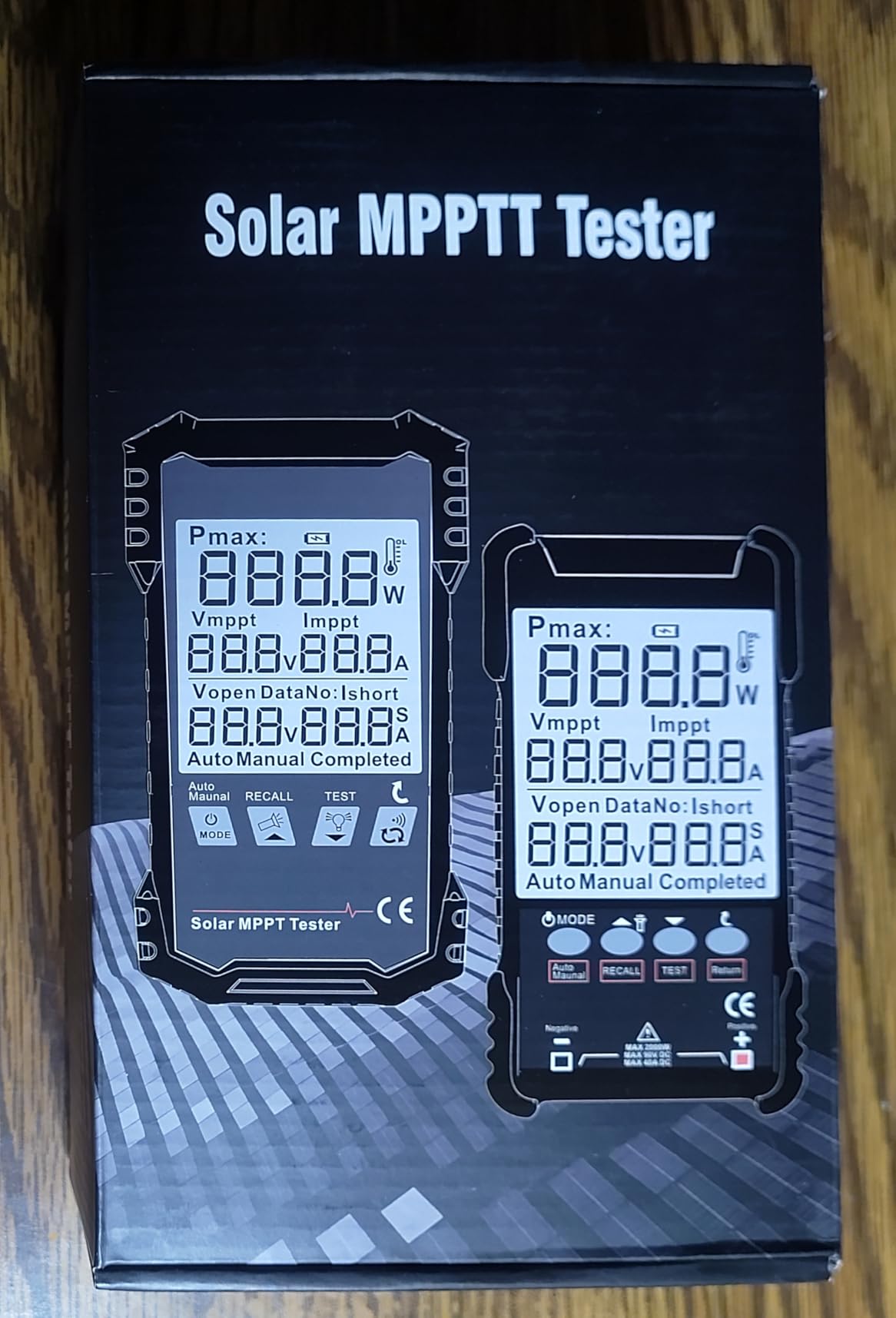
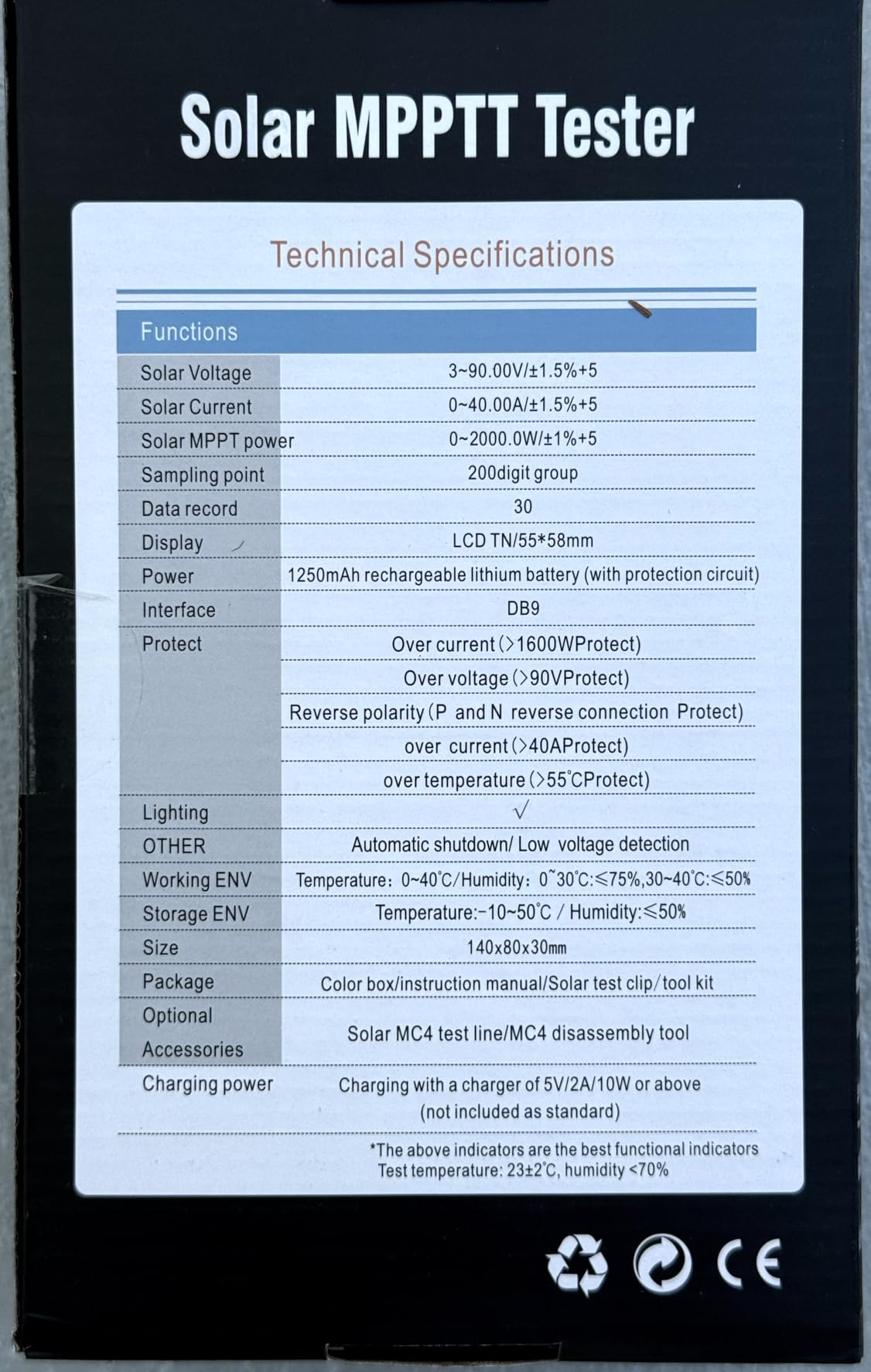
Its measurement envelope is the most generous of the battery-powered units: Pmax to 2000W, Voc from 3 to 90V and Isc to 40A, sampled at 200 points, with Vmp and current tracked alongside. The 40A Isc figure is the highest stated current capacity in this group, which is the number that matters most for a residential or small commercial string.
The second feature worth paying attention to is the 30-entry automatic save. Test a 20-panel array and you have a documented record without writing anything down, which is exactly what you want when you are handing commissioning paperwork to a client or comparing before and after a change.
Protection is thorough for the class: over-voltage above 90V, over-current above 2000W, reverse polarity and over-temperature above 55C, with CE certification. The 3.2-inch display includes a flashlight and volume settings, and the shock-resistant TPR casing plus the supplied EVA box are sensible for field work.
What it is good for
Testing panels you suspect are faulty, on weak light, and anywhere you need a written record. The rechargeable battery is the right call for troubleshooting rather than screening, because a marginal panel in low light is exactly the scenario where a panel-powered meter would struggle to start.
At 40A Isc it also handles the higher current strings that many cheaper PV testers cannot, and the automatic logging makes it the best of this group for documented array walks.
What it is bad for
There is no backlight and no brightness adjustment, which is a real limitation for shaded work and the exact opposite of what the VISLONE offers. You will be reading this one outdoors in direct sun with no help.
The 11 percent one-star share is the highest among the PV testers in this roundup, and with 45 reviews the average is not well established. Some of that negative feedback is likely to be about the missing backlight, which is a specification decision rather than a defect.
9. FROGBRO FB673PV: Lightest Single-Screen Tester
FROGBRO 800W MPPT Solar Panel Tester Large LCD Photovoltaic Multimeter
Panels to 800W and 60V
About 156g
Panel powered no batteries
Single-screen readout
Pros
- Lightest meter in the roundup at roughly 156g
- All key values shown on a single screen at once
- Battery-free so it cannot go flat in storage
- MC4 connector wrench included in the box
- Large sunlight-readable LCD
Cons
- 800W and 60V limit restricts larger arrays
- 12 percent one-star reviews the highest of the FROGBRO models
- Cannot measure series-connected strings
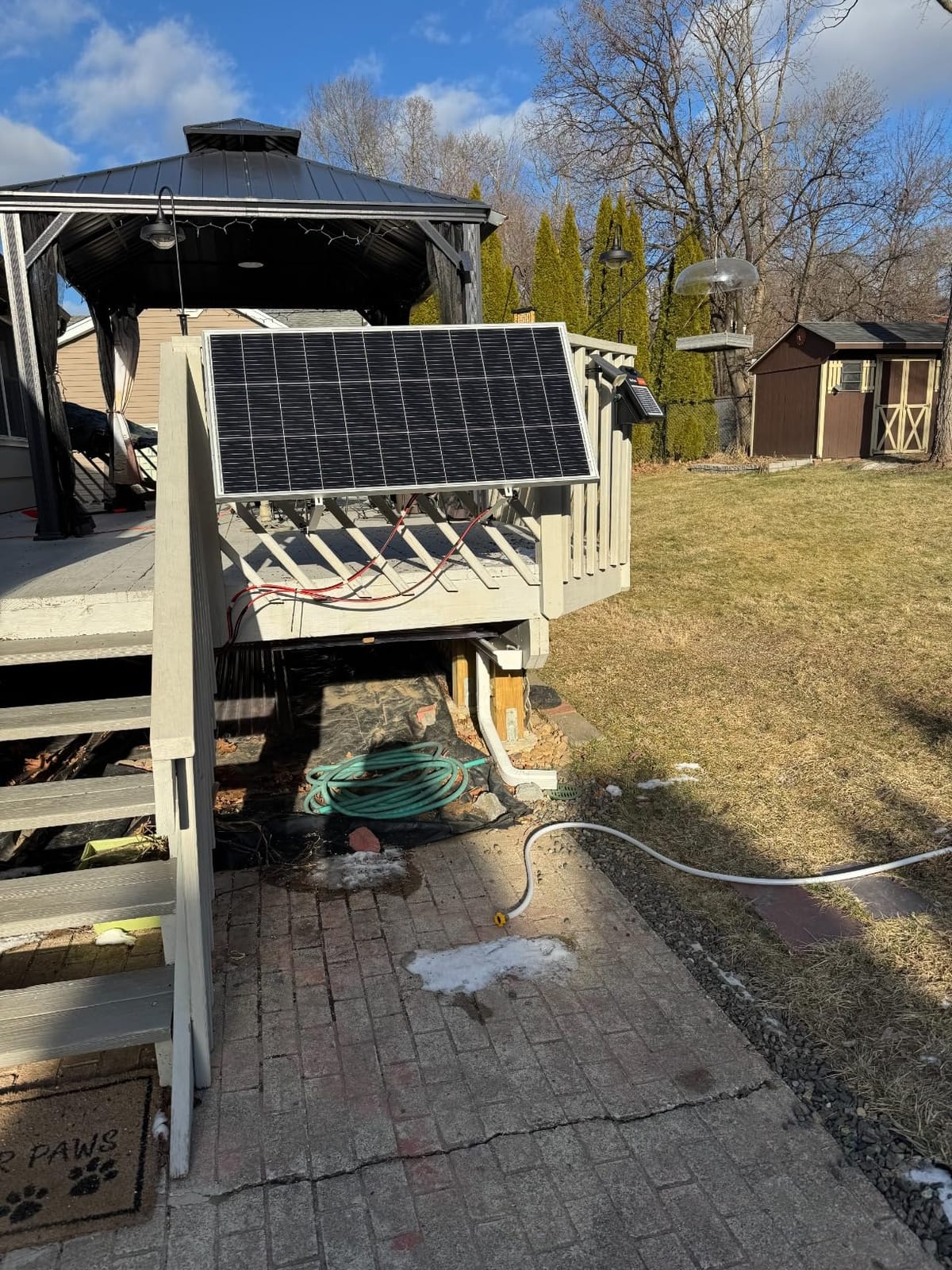
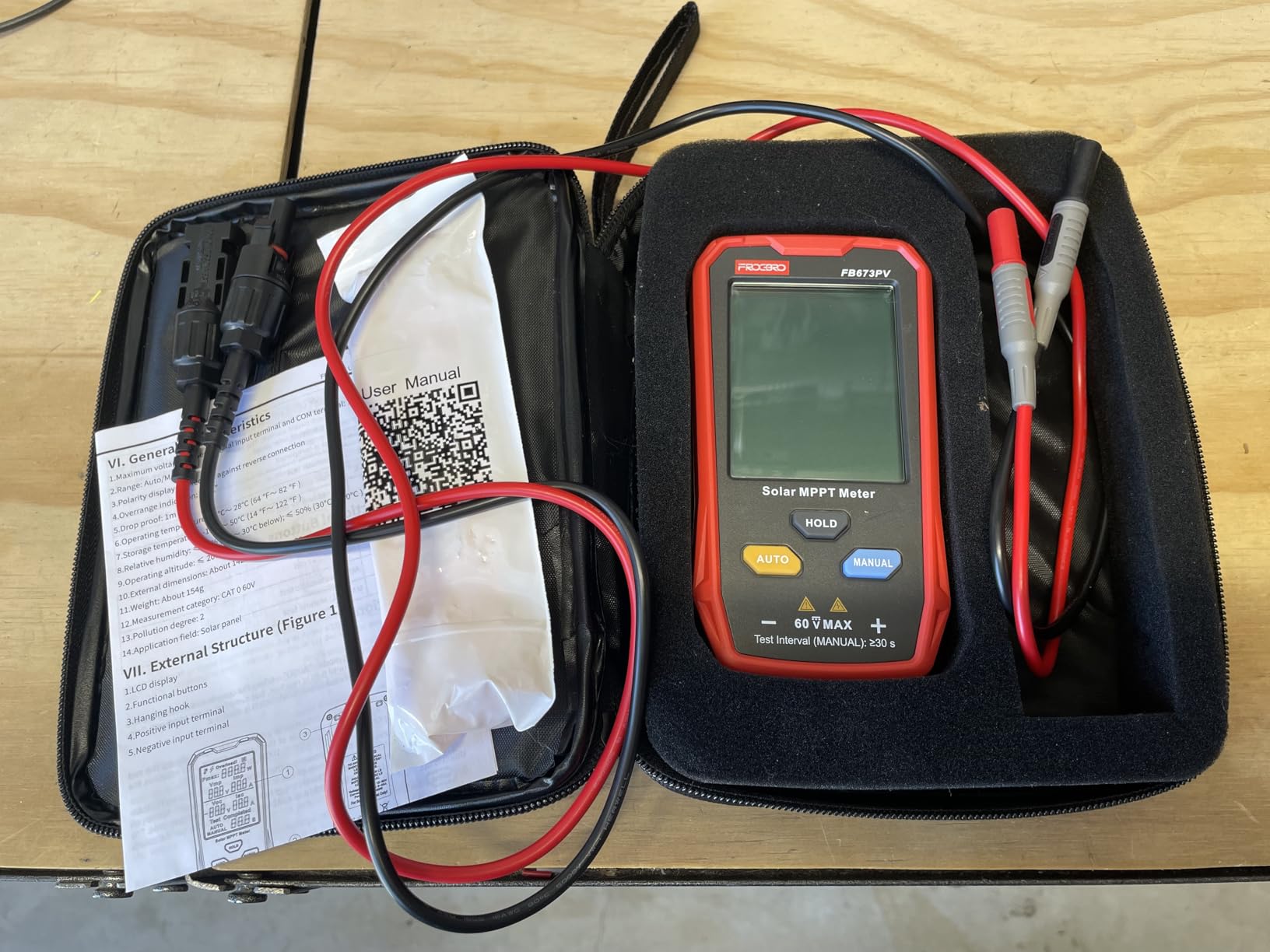
At roughly 156 grams the FROGBRO FB673PV is less than half the weight of most of its competitors, and for rooftop work that difference is felt after the twentieth panel. It is the same basic architecture as the 1600W FROGBRO, battery-free with simultaneous Pmax, Voc and Isc, but trimmed to an 800W and 60V envelope.
Reviews put it at 4.2 across 43 reviews, with owners specifically praising the large screen and the low weight. The complaints are all about capacity rather than quality, which tells you what kind of panel to buy it for.
Everything that makes the design work is still here. It draws power from the connected panel, shows all essential values on a single screen, carries a large LCD readable in bright sun, and includes MC4 cables and a connector wrench. Over-voltage, over-temperature, over-current and over-rated power warnings round out the protection set.
For anyone testing portable, foldable or small fixed panels, this is the meter that stays in the pocket rather than the van. The lighter the tool, the more likely it is to actually be carried up a ladder, and that is the whole game when the job is checking twenty modules rather than one.
It is worth being straightforward that the 800W and 60V ceiling is the trade. It is the lowest capacity in the roundup alongside the VQP, and it excludes most modern high-power residential modules. Buy it for small panels, not for an array of 400W and up.
What it is good for
Anyone carrying a tester up a ladder repeatedly, or working on portable, foldable, RV and marine panels. Battery-free storage means it is always ready, and the single-screen layout means fewer dial errors under time pressure.
Within its 800W class it is the best of the value, and the included wrench removes a common stop on site.
What it is bad for
Larger panels, and series-connected strings, which it cannot measure at all. If your modules are modern residential units rather than small portable panels, this is the wrong class of instrument.
Its 12 percent one-star share is the weakest distribution across the three FROGBRO units here, and the 4.2 average on 43 reviews is not a settled number. The 1-to-4 star spread with nothing at 3 suggests some buyers had a fundamentally different expectation, most likely around capacity.
10. elejoy 1800W: 120V and 60A Ceiling
ELEJOY 1800W Solar Panel Tester MPPT Photovoltaic Multimeter Watt
1800W and 120V and 60A
Handles two panels in series
Backlit clear LCD
Panel powered
Pros
- Handles both individual panels and two connected in series
- Identified a physically failed 360W panel on a 6kW array
- Panel powered so there is nothing to charge
- Sturdy carrying case and assorted test attachments
- Backlit screen at a light 12.8 ounces
Cons
- One reviewer reported Pmax readings near double the panel rating
- That same report described slow support after a defect claim
- Lowest average rating here at 4.1 with 14 percent one-star
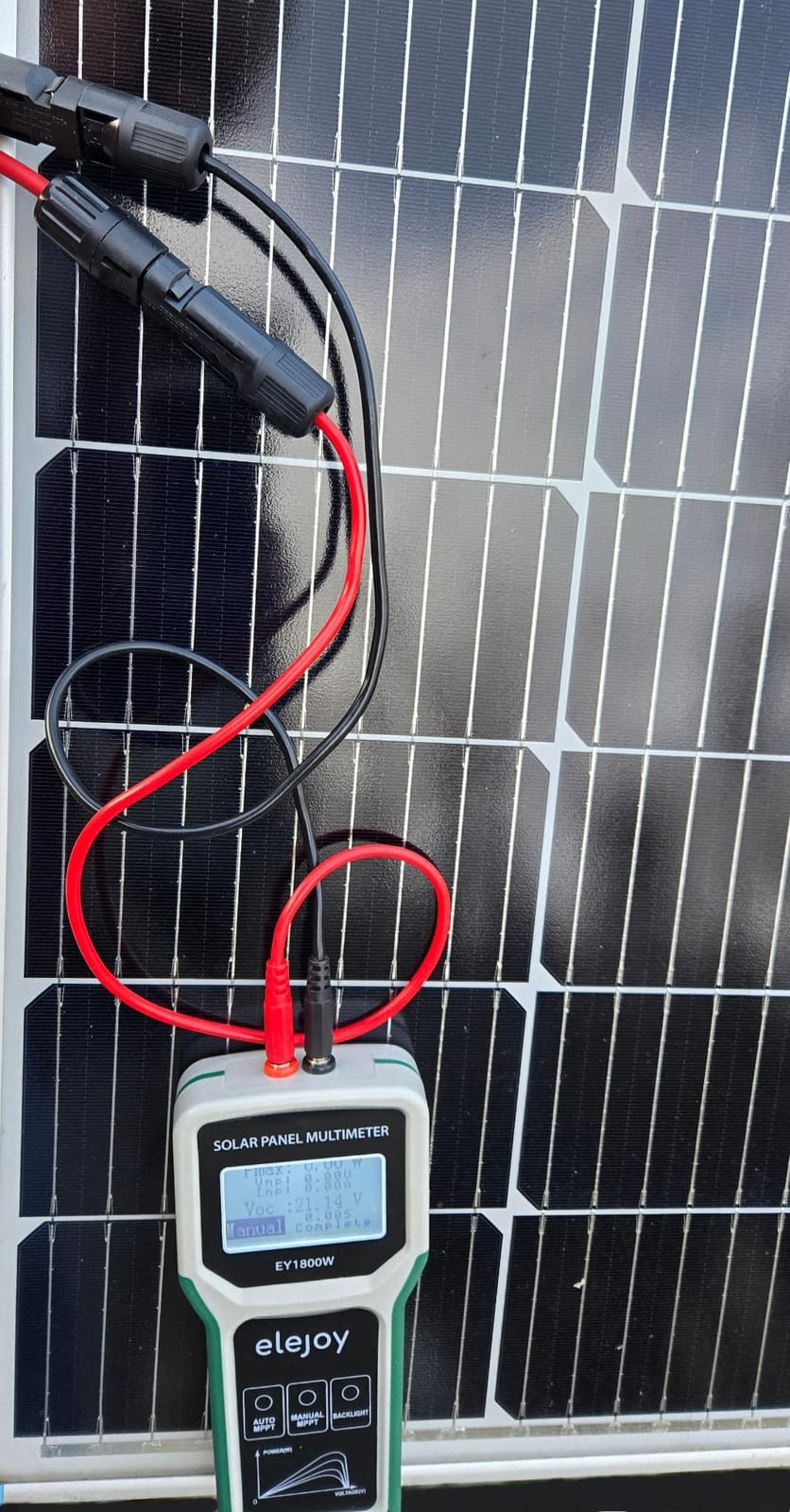
Series capability is what separates this unit from most of the field. With a 120V ceiling and 60A current capability, the elejoy can test a single panel or a pair of panels in series, which means you can check a two-module section of a string without reconnecting anything. Most dedicated PV testers in this roundup are parallel-only, so this covers a real gap in the testing workflow.
It holds a 4.1 average across 38 reviews, the lowest here, and the majority of owners report that it correctly flags failing panels in real installations. The rating spread is where the disagreement sits, not the core function.
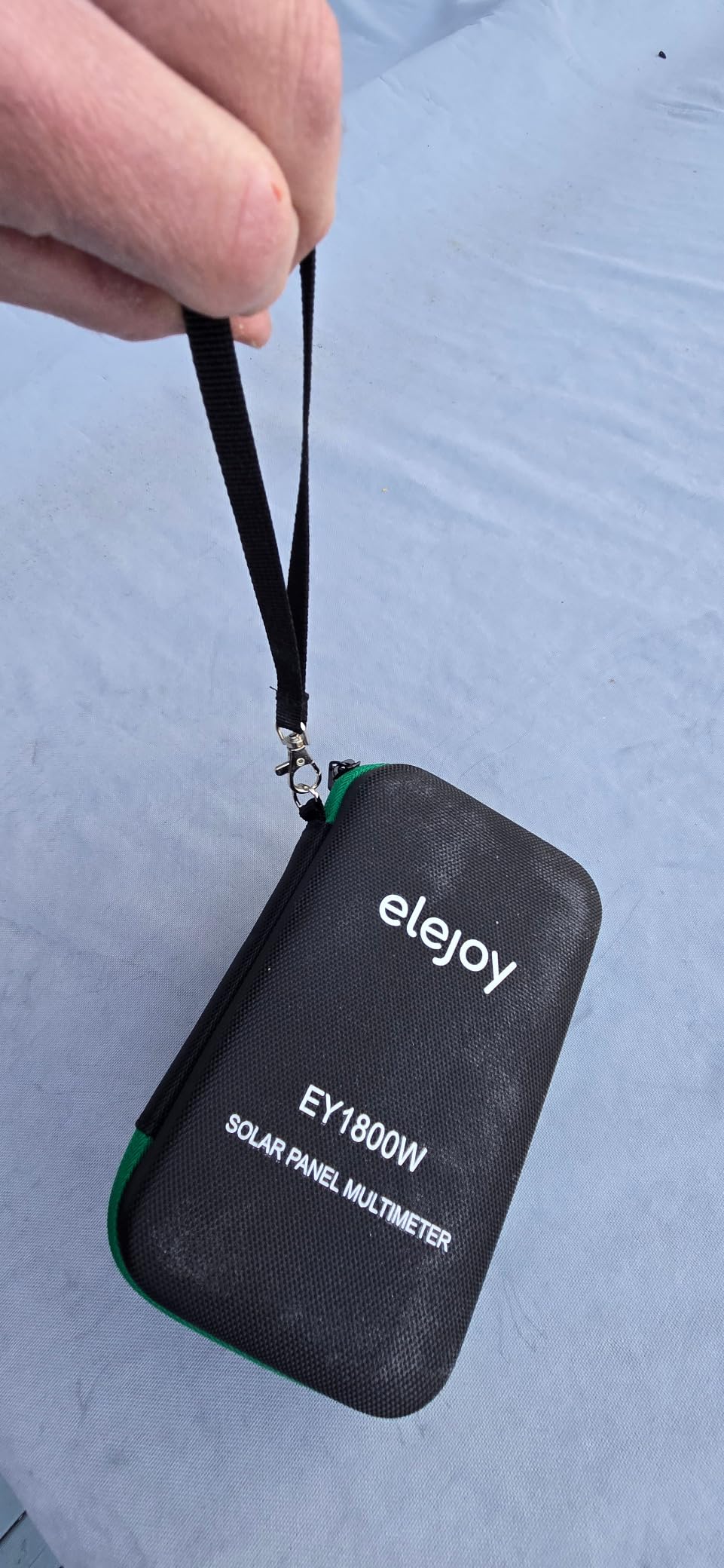
One owner reports using it to identify a physically failed 360W panel sitting on a 6kW array, which is exactly the scenario a meter like this exists for: a big installation where one module has quietly dragged its parallel string down, and a full teardown would be the only alternative. The backlit clear LCD is another plus, and at 12.8 ounces it stays comfortable in the hand on a roof.
It is panel-powered, so it needs no batteries, and the box includes MC4 connectors, alligator clips and an EVA toolkit for storage and field transport. The connection options mean you can handle both modern MC4 panels and older wired connections without hunting for an adapter.
We want to be direct about the weakness, because it is specific and documented. A detailed negative review reports Pmax readings coming back close to double the panel’s rated output, and describes slow, unresponsive support after a replacement request. That kind of report is worth taking seriously on a measurement instrument, and it is part of why this one sits at the bottom of our rating spread.
What it is good for
Two-panel series testing, which almost nothing else in this price bracket supports, and larger single panels at up to 1800W. The 120V and 60A envelope is genuinely useful for residential arrays, and the backlit display helps in conditions where other units here leave you guessing.
It has also proven effective in the field for fault isolation, which is the task that matters most.
What it is bad for
Accuracy confidence is the issue. A reported Pmax reading near double the rating is a serious claim about a measuring device, and the response to that report was slow, so we would not use it alone to make a warranty claim on a panel without cross-checking against a known-good reference.
At 4.1 stars with a 14 percent one-star share, it has the lowest average and the highest one-star share in this roundup. If you need certainty, the FROGBRO 1800W is the same measurement class with a stronger certification set.
11. FROGBRO 1800W: Series Strings up to 120V
FROGBRO 1800W Solar Panel Tester MPPT Photovoltaic Multimeter
1800W and 120V and 60A
Series strings to 120V
UL CE NIST RoHS listed
Panel powered
Pros
- Widest measurement envelope here at 1800W 120V and 60A
- Only unit rated for series-connected panels to 120V
- UL CE NIST and RoHS listed
- No batteries so it is always ready after storage
- MC4 and alligator cables plus an EVA case in the box
Cons
- 13 percent one-star reviews
- Second-smallest review base in the roundup
- Heavier at 460g than the other battery-free testers
This is the most capable unit in the roundup on paper and the best certified. Five watts to 1800W, 20V to 120V and up to 60A, with an upgraded dual voltage range that explicitly supports series-connected panels up to 120V. The certification list is where it separates itself: UL, CE, NIST and RoHS, a broader set than any other product here.
Its 4.2 average rests on just 35 reviews, the smallest base of any product here, and 13 percent of those are one-star. The specification is the strongest in the roundup; the owner feedback has simply not caught up with it yet.
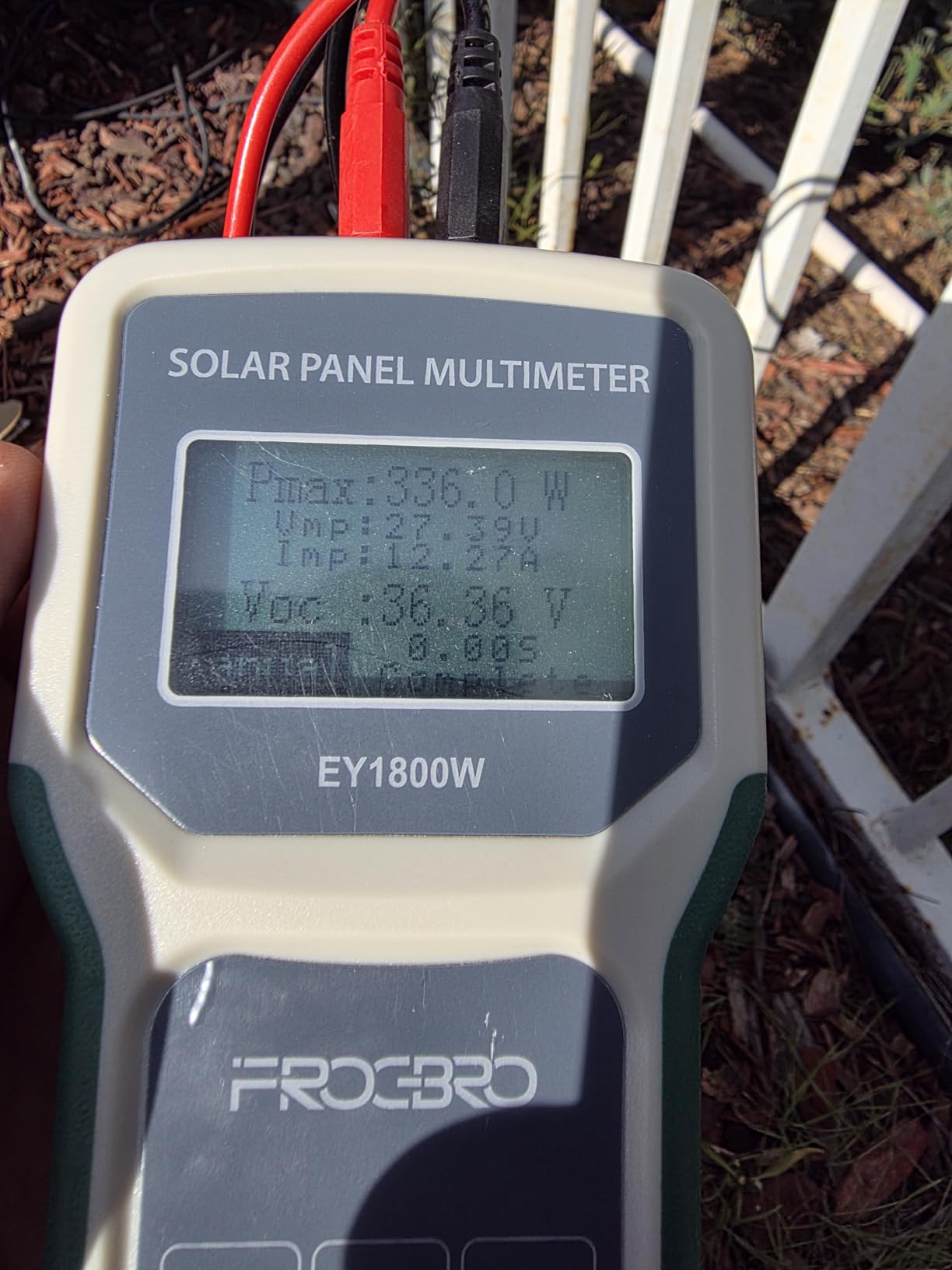
Series-string support is the practical headline. If your array is wired as a string rather than as parallel branches, almost every dedicated PV tester becomes decoration. This one will read that string, which makes it the only unit in the list that can handle both layouts as well as individual modules.
It is panel-powered with no battery to fail, has a large LCD readable in direct sun, and carries over-voltage, over-temperature, over-current and reverse-polarity protection. The box includes MC4 and alligator clip cables and a durable EVA case, and at 460 grams it is heavier than the other battery-free testers but still manageable for one-handed work.
The honest caveat is the evidence base. Thirty-five reviews is the smallest sample in the roundup, and a 13 percent one-star share is the second highest, so a 4.2 average is less firmly established here than a similar rating on a product with hundreds of reviews. What the specification claims is genuinely strong; what the owner feedback has actually proven is thinner than the spec sheet suggests.
What it is good for
Anyone working on series-connected strings, which is most professionally installed residential and commercial arrays. The 120V and 60A envelope is the widest in the roundup, and it covers the full measurement set you need for commissioning a section of string.
It is also the pick when certification is the deciding factor, since the UL, CE, NIST and RoHS markings are documented rather than implied.
What it is bad for
It is the heaviest of the battery-free units at 460 grams, which adds up over a long array walk, and it is not a light meter. Some of the protection thresholds are tighter than the 2000W-class testers in this list, so very large modules can trip them.
Thirty-five reviews is simply not much to go on, and the two negative-review clusters should be read as a caution about the sample rather than a verdict on the design.
12. VQP EY800W: Auto and Manual MPPT for Portable Panels
Solar Panel Tester/EY800W Solar Panel Meter/PV Testing Instrument Ultra Open Circuit Voltage Auto/Manual MPPT Clear LCD
Panels to 800W and 60V
Auto and manual MPPT
Voc readable in any mode
Panel powered
Pros
- Highest average rating in the roundup at 4.6 stars
- Auto MPPT refresh rate adapts to output so small panels update fast
- Full automatic Voc readable in any mode
- Panel powered so it survives long storage
- Suited to portable foldable car boat and roof panels
Cons
- Only 24 reviews the smallest base in the roundup
- 800W and 60V ceiling sits at the low end
- Heaviest unit here at 1.1 pounds
- Protections are tighter than the 2000W-class testers
The VQP EY800W earns the top rating in the roundup on a 4.6 average, and its distinguishing feature is the always-available Voc readout. Most dedicated testers make you switch modes to see open-circuit voltage; this one shows a full automatic Voc in any mode, which removes an entire class of measurement error when you are switching between a performance check and a voltage check on the same panel.
The auto MPPT mode adjusts its test interval to the power currently being produced, refreshing every 5 seconds at 100W and every 15 seconds at 300W. That sounds like trivia, but it means a small portable panel gives you a live number quickly instead of making you wait through a cycle sized for a much larger module. A manual MPPT mode is available when you want to hold a reading steady.
Owners like it specifically for portable, foldable, car, boat and rooftop panels, which is a coherent use case: these are panels that get moved, repositioned and tested in variable light, and a meter that adapts its refresh to a low output is the right instrument for that. It is panel-powered through two alligator clip cables, so there is no battery to go flat in a cupboard.
Protection covers 60V over-voltage, 60C over-temperature, 35A over-current, reverse connection and 800W over-rated power. Those limits are tighter than the 2000W-class testers here, which is the trade for the adaptive refresh behaviour.
What it is good for
Portable and foldable panels, and any small module where fast refresh on low output matters. The always-visible Voc readout is the feature experienced users single out most, and it makes the meter genuinely quicker to work with than mode-cycling alternatives.
At 4.6 with 82 percent five-star ratings and no 2-star reviews at all, the distribution is the cleanest here even though the sample is small.
What it is bad for
Twenty-four reviews is a very thin base for the highest-rated product in the list, so treat the 4.6 as encouraging rather than settled. The 800W and 60V ceiling is at the low end, and the protection thresholds cap usable panel size accordingly.
At 1.1 pounds it is the heaviest unit in this roundup despite being the smallest in capacity, which is an odd combination for anyone walking an array. It is a panel tester only, with no resistance or continuity mode for checking wiring.
How to Test a Solar Panel with a Multimeter
This is the procedure most people are actually searching for when they type “how to test a solar panel with a multimeter,” so here it is in full. Everything below assumes you are working on a disconnected module or a de-energised string, in daylight, with the meter set to DC. A PV module produces voltage as soon as light hits it, which is the single most important safety fact on this page: you cannot make a panel safe by switching the inverter off.
Measure open-circuit voltage first
Set the meter to DC voltage and connect the red probe to the positive lead and the black probe to the negative. This is Voc, the highest voltage the module will produce with no load attached. Write the number down, then compare it against the panel nameplate value, allowing for temperature.
Voc rises as cell temperature falls, which is why a reading taken on a cold morning can exceed the nameplate figure by a meaningful margin. This is normal, and it is one of the main reasons array designers use the cold-voltage correction when sizing inverter inputs.
Apply the temperature correction
Roughly speaking, a crystalline silicon module’s Voc drops by about 0.3% to 0.4% per degree Celsius above 25C. In reverse, a panel sitting at 5C in early morning can read several volts higher on a 40V module than its nameplate Voc. If your reading is below nameplate by more than a few percent on a hot day, that is a genuine concern, not a temperature artefact.
Measure short-circuit current with a clamp
This is the step people get wrong. To read Isc with a multimeter, you must break the circuit and put the meter in series, which on a live string in sunlight means exposed conductors. A Hall effect clamp meter wrapped around a single conductor gives you the same number with the circuit intact. This is exactly why the 40A and 400A DC ranges have been the recommended standard on Solar Panel Talk for over a decade: they resolve typical string currents without dropping you into the coarse 400A-only territory of a cheap clamp.
Put the clamp around one conductor, not the whole cable. Around a two-conductor cable the magnetic fields cancel and the meter reads close to zero, which sends people hunting for a fault that does not exist.
Compare against the healthy panels in the same string
Absolute numbers are hard to judge without irradiance data. Relative numbers are easy: measure Voc on every module in the string within a minute of each other under the same light. One module sitting noticeably low while its neighbours read normally is a fault signature. Rotate the meter between panels to rule out contact resistance at the probe tips, which mimics a weak module surprisingly well.
Reconnect only after the readings make sense
Before you land a string on an inverter, confirm the string Voc is below the inverter’s maximum DC input voltage. Overvoltage is the most common self-inflicted commissioning fault, and it happens most often in cold weather when Voc is at its highest. A meter that saves readings or a dedicated tester that logs 30 entries at a time makes this much easier to document.
If you want a walkthrough of the same procedure in video form, manufacturer pages for dedicated MPPT testers usually publish a short demonstration, and the general how-to videos in this niche are worth more than a manufacturer’s marketing reel because they show real panels in real light.
The 33% Rule: When a Reading Means a Fault
The 33% rule is the threshold installers use to decide whether a panel is underperforming badly enough to investigate. If one module in a matched set produces less than two-thirds of what its neighbours produce under the same conditions, the module is a suspect. It is a screening rule rather than a diagnosis, which is exactly what makes it useful: it tells you where to look without pretending to know why.
To apply it, measure Voc, or better still Pmax, on every module in the array within the same session. A healthy set clusters tightly. Shade, soiling and low cell temperature all push readings down, so read the whole string rather than judging one panel on its own.
One caution before you start pulling modules: a moving cloud crossing the array can move readings by a third in seconds. If a panel fails the 33% test, wait for steady light and re-measure before you accept the result. Forum regulars have made the same point for years, and it is the reason the clamp option is worth having, so you can watch a reading settle rather than guess at it.
Our guide to digital multimeters for electronics work covers the measurement modes that help most when you are testing charge controllers and battery banks rather than modules.
What Actually Matters in a Meter for PV Work
Choosing between these twelve is easier once you stop reading feature lists and start ranking the four things that change your answer. Here is the order we would use, and the reasoning behind each one.
1. DC safety category, matched to your string voltage
CAT III 600V is the residential floor and covers the great majority of homeowner and small-installer work. CAT III 1000V and CAT IV 600V, as on the ZIBOO testers, give more headroom for larger residential strings. CAT IV 1000V and 1500V DC territory is a different world, and one that utility-scale commissioning requires.
A higher CAT rating than you need costs little; a lower one is a genuine hazard. The point of the category system is that transient overvoltage on a PV string can be several times the nominal DC voltage, which is exactly the condition these ratings are designed for.
2. A DC current range that resolves your string
This is the point installers on Solar Panel Talk have made for more than a decade, and it is still the most neglected specification. A single residential panel might produce around 9A of Isc, and a whole string several times that, which puts it well past the 10A range of a typical hobbyist meter.
The 40A and 400A DC ranges are the practical sweet spot. Too low and you cannot read the string at all; too high and the resolution collapses to a digit or two, so a real difference between panels becomes invisible. This is also the argument for owning a clamp meter alongside a DMM rather than choosing between them.
3. True RMS, or an honest reason not to need it
True RMS matters most for AC, where average-responding meters misread on non-sinusoidal loads. PV output is DC, and a good DC measurement is a good DC measurement. But the general meters in this roundup all implement True RMS, and the cost of having it is effectively zero, so there is no reason to give it up.
Where it does pay off is inverter output, where modern grid-tie inverters produce a switching waveform that an average-responding meter will misread. If you test the AC side, True RMS is not optional.
4. Pmax and IV curve capability, if you are screening modules
Voc alone is a weak performance signal. A shaded, soiled and slightly degraded module can present a perfectly respectable Voc while producing far less power than it should. Pmax, the maximum power point, is the number that actually reflects what a panel is doing, and nine of the meters here exist purely to report it.
The same applies to MPPT and IV curve data. A curve tracer tells you the shape of the performance curve, and a distorted knee is a signature of shading, mismatched current or a failing bypass diode that a single number will never reveal.
On accuracy, and why cheap meters fail
The most valuable thing we can tell you here is not about any particular model. It is that meter accuracy is the one specification you cannot verify from a listing page, and the documented failure cases are worse than most people expect. On Solar Panel Talk, a reader reported a low-cost meter reading 12.2V on a battery at rest when the true value was 12.0V, a 0.2V error that is enough to damage a battery if you size a charge controller from it. After moving to a professional reference meter, the same user reported eliminating that error entirely.
The wider forum consensus, repeated across r/Tools threads, is that Fluke is treated as the reference standard and that no other brand is mentioned nearly as often. The practical version of that advice: verify any new meter against a known-good source before you trust it on an array. Our pick for panels and 12V systems is the AstroAI we rate as editor’s choice, and our pick for string current is the KAIWEETS clamp. For a home lab or bench reference, our guide to the best digital multimeters for home labs goes into calibration and accuracy in more detail.
If you are choosing panels rather than meters, our pick of the solar panel kits for cabins and tiny homes covers the small systems where a lightweight tester like the FROGBRO FB673PV is the right instrument.
Frequently Asked Questions
Can I use a multimeter to test my solar panels?
Yes. A multimeter is the cheapest way to confirm a panel is producing power. Set it to DC voltage and probe across the positive and negative leads to read open-circuit voltage, then compare against the nameplate value with a temperature correction in mind. For current, use a Hall effect clamp around a single conductor rather than breaking the circuit, because a live PV string stays energised in daylight.
What is the best multimeter for solar systems?
A True-RMS digital multimeter rated CAT III 600V or higher, with a 40A and 400A DC current range for string current, data hold and a backlit display for outdoor readings. For module-level diagnostics an MPPT solar tester that reports Voc, Isc and Pmax together is faster and safer than probing a live string by hand.
How do I test for a bad solar panel?
Measure Voc or Pmax on every module in the string within the same session under the same light. One module reading noticeably below its neighbours is a fault signature. Then apply the 33% rule: anything producing less than two-thirds of its matched neighbours fails the screening threshold. Always re-measure in steady light, because a passing cloud can move readings by a third in seconds.
What is the 33% rule in solar panels?
It is a screening threshold, not a diagnosis. If one module in a matched set produces less than two-thirds of what its neighbours produce under the same conditions, it is flagged for investigation. Measure the whole string in the same session so shade, soiling and cell temperature affect every reading equally.
Do I need a True RMS meter for DC solar measurement?
Not strictly. PV output is DC, and a competent DC measurement is a competent DC measurement regardless of RMS handling. True RMS matters where average-responding meters genuinely misread, which is AC, especially the switching waveform a modern grid-tie inverter puts out. Since True RMS meters are now standard at every price level, there is no reason to give it up.
What voltage should a 12V solar panel read?
So a typical 36-cell panel sold as a nominal 12V unit reads around 18 to 21V, while a 60-cell panel sold as a nominal 24V unit reads closer to 36 to 42V. Voc rises as cell temperature falls, so a cold morning reading can exceed nameplate by several volts without any fault present.
Which multimeter brand is considered the best for high quality?
Fluke is the most frequently cited professional reference standard across electrical forums, and is the brand other meters are typically cross-checked against. Klein, Extech, KAIWEETS and AstroAI cover the mid-range and DIY end with solid accuracy. For solar specifically, the deciding factor is usually the safety category and current range rather than the badge on the case.
Should I buy a dedicated solar panel tester instead of a multimeter?
Buy both if you can. A general True-RMS DMM covers Voc, resistance, continuity, diode testing, batteries and inverters, while a dedicated MPPT tester reports Pmax, Vmp and Voc together without a series break. The tester is faster for screening panels on arrival, and the DMM is the only one that can check the wiring, the fuse and the charge controller.
Best Multimeters for Solar Panel Testing in 2026
The best multimeters for solar panel testing come down to what you are measuring. If you are commissioning a residential array, working on batteries and inverters, and want one tool that covers everything, the AstroAI AST-6000-D is our editor’s choice, with a 1000V DC ceiling, True RMS on both AC and DC, and a 20k+ review history backing the accuracy claims.
If string current is your main problem, the KAIWEETS HT206D clamp is the instrument to buy, because measuring current without breaking a live circuit is worth more than any other single feature on this list. For module screening where Pmax matters, the ZIBOO FT-1000W gives you the solar-specific readout with the strongest safety rating here, and the FROGBRO 1800W covers series strings up to 120V with the best-documented certification.
Our single strongest piece of advice is the one that costs nothing. Verify any meter against a known-good reference before you trust it on an array, because a two-tenth-volt error on a resting battery is enough to size a charge controller wrong. Whichever meter you choose in 2026, measure every module in the string in the same session, apply the 33% rule, and re-check anything that fails in steady light before you pull panels off a roof.