
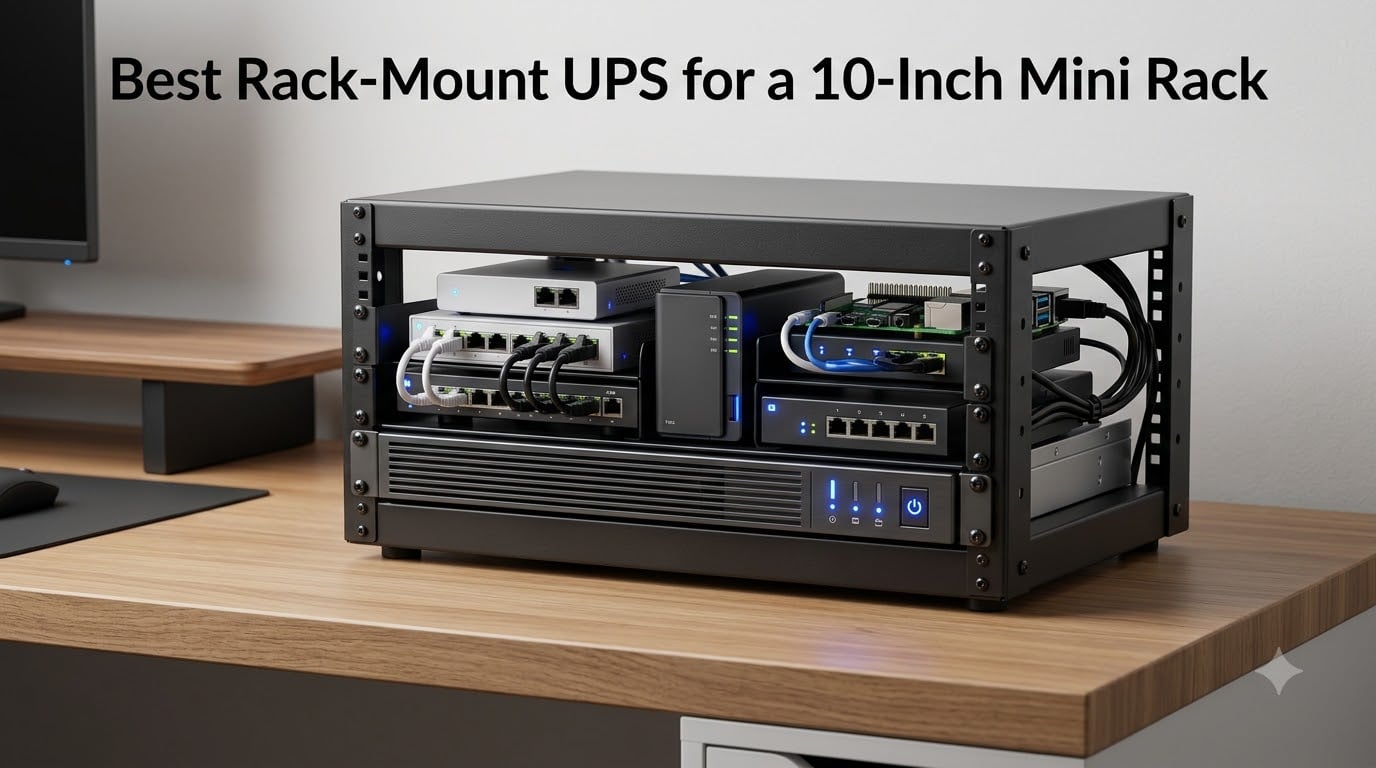
Finding the best rack-mount UPS for a 10-inch mini rack is harder than it should be. Almost every rackmount UPS on the market is built for a 19-inch rack, and the few compact units that exist come with trade-offs in depth, runtime, or waveform quality. I ran into this exact wall when I built my first mini rack, and I have spent months comparing every unit that actually has a chance of fitting.
The core problem is width. A 10-inch mini rack like the DeskPi RackMate or a generic 10.5-inch network enclosure leaves you with roughly 10 inches of usable rail space, while standard 1U and 2U UPS units are 17 to 17.5 inches wide. That forces a decision: buy a narrow 1U unit and mount it on a shelf, squeeze a full-size unit sideways, or accept a 19-inch rack altogether. Forum threads across r/homelab and r/minilab are full of people stuck at this exact decision point.
In this guide, I cover eight UPS units that real mini rack owners actually use in 2026, from 500VA 1U units that fit a shallow 10-inch enclosure to short-depth 2U models that pack 1500VA and more. For each one, I look at the real dimensions, the waveform type, runtime behavior, noise, and how well it plays with shutdown tools like NUT and apcupsd. I also break out the fitment math in a buying guide, because depth and weight matter as much as VA when your rack sits on a desk.
Table of Contents
Top 3 Picks for a 10-Inch Mini Rack UPS in 2026
These three cover the needs of most mini rack builds. My editor’s choice is the CyberPower CP500PFCRM1U because it is one of the only true 1U units with pure sine wave output, which matters if you run any Active PFC power supplies. For value, the CyberPower OR500LCDRM1U costs less, has a huge review base, and is only 9.25 inches deep. On a tight budget, the Eaton Tripp Lite SMART500RT1U gets you a genuine 1U rackmount UPS with real monitoring ports for under two hundred dollars.

A quick note on fitment before the comparison table: measure your rail-to-rail width first. Some 10-inch racks have removable side brackets that swallow almost an inch on each side, which changes which of these units can sit flush. I learned that the hard way with a shelf that was advertised as 10 inches but gave me barely 9.5 inches of clearance.
Best Rack-Mount UPS for a 10-Inch Mini Rack in October
Here is the full lineup side by side. Every unit below is one I would consider for a small rack build, sorted roughly from compact 1U options up to short-depth 2U powerhouses. Depths listed are the chassis depth, which is the number that decides whether a unit fits a shallow mini rack.
| Product | Specs | Action |
|---|---|---|
| CyberPower CP500PFCRM1U |
|
Check Latest Price |
 CyberPower OR500LCDRM1U CyberPower OR500LCDRM1U |
|
Check Latest Price |
 CyberPower CP1500PFCRM2U CyberPower CP1500PFCRM2U |
|
Check Latest Price |
 Eaton Tripp Lite SMART1500LCD Eaton Tripp Lite SMART1500LCD |
|
Check Latest Price |
 CyberPower CP2000PFCRM2U CyberPower CP2000PFCRM2U |
|
Check Latest Price |
 APC Smart-UPS SMC1500-2UC APC Smart-UPS SMC1500-2UC |
|
Check Latest Price |
 CyberPower OR700LCDRM1U CyberPower OR700LCDRM1U |
|
Check Latest Price |
| Eaton Tripp Lite SMART500RT1U |
|
Check Latest Price |
1. CyberPower CP500PFCRM1U – Pure Sine Wave in a True 1U Shell
CyberPower CP500PFCRM1U PFC Sinewave UPS Battery Backup and Surge Protector
500VA/300W
Pure sine wave
1U rackmount
6 outlets
AVR
3 year warranty
Pros
- Pure sine wave output for Active PFC power supplies
- True 1U rackmount form factor
- 3 year warranty including batteries
- 300000 dollar Connected Equipment Guarantee
- Multifunction LCD panel
Cons
- Only 2 minutes runtime at full load
- Remote management requires optional RMCARD205 card
This is the unit I recommend most often for mini racks, and the reason is simple: it is a genuine 1U rackmount UPS with pure sine wave output. Almost nothing else at this size offers that combination. If your rack runs anything with an Active PFC power supply, like a modern mini PC or a compact server, simulated sine wave units can cause shutdowns the moment they switch to battery. The CP500PFCRM1U sidesteps that entirely.
In practice, the 500VA/300W capacity covers a typical network stack easily. I have seen setups running a modem, router, a small switch, and a Raspberry Pi or NUC on this unit with room to spare. The LCD panel is genuinely useful, showing estimated runtime in minutes, load level, and battery health without needing to open a web interface. AVR also cleans up minor voltage fluctuations without tapping the battery, which extends battery life if your mains power is imperfect.
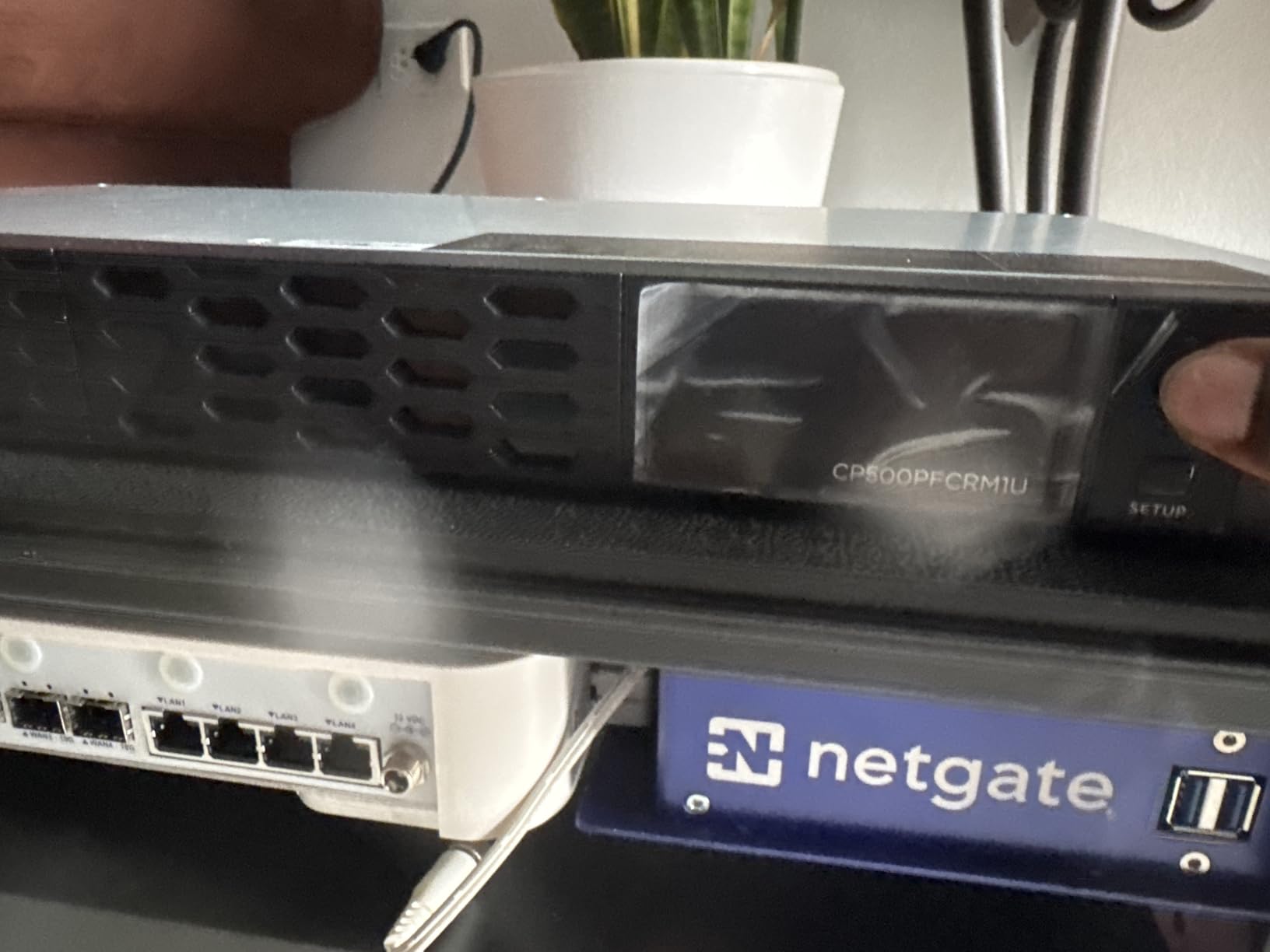
The chassis is 17 inches wide and 17 inches deep, which means it will not slide into a 10-inch rack on its own rails. In practice, mini rack owners mount it on a shelf or use the front brackets with a rear support, and the 18-pound weight is manageable for that. The 2-minute runtime figure you see quoted is at full 300W load. At a realistic 100 to 150W network load, you are looking at 10 to 20 minutes, which is plenty for a graceful shutdown or riding out a short blip.
The downsides are real but predictable. Network monitoring requires the optional RMCARD205 card, which adds meaningful cost. And with only 24 reviews so far, this is a newer unit with a shorter track record than the OR-series veterans below. The 4.6 average rating and Home Assistant compatibility reports from early users are encouraging signs.
Who should buy it
This is the pick if you run Active PFC equipment in your mini rack and want clean battery power without moving up to a 2U unit. It suits homelab builders who monitor locally via USB and do not need a network management card.
Who should skip it
Skip it if you need long runtime at high load, since 300W capacity runs out fast with a server in the mix. Also pass if remote network monitoring is a hard requirement and the RMCARD205 cost pushes you over budget.
2. CyberPower OR500LCDRM1U – Best Value 1U for Shallow Racks
CyberPower OR500LCDRM1U Smart App LCD UPS Battery Backup and Surge Protector, 500VA/300W, 6 Outlets, AVR, 1U Rackmount, UL Certified
500VA/300W
Simulated sine
1U rackmount
9.25 inch deep
6 outlets
AVR
Pros
- Great value for homelab and small setups
- Native CyberPower deb packages for Linux monitoring
- Compact 1U design only 9.25 inches deep
- Excellent LCD display
- 3 year warranty and 300000 dollar equipment guarantee
Cons
- Simulated sine wave output not pure sine wave
- Remote management requires optional RMCARD205 card
- Network option not included at this price
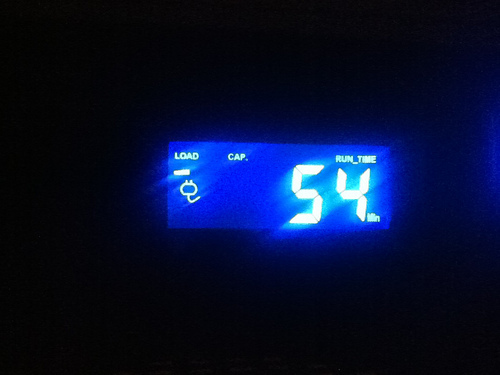
The OR500LCDRM1U is the unit I see most often in real mini rack builds, and the 839 reviews with a 4.5 average explain why. It hits a sweet spot of price, size, and reliability that has kept it relevant for years. At 9.25 inches deep, it is one of the shallowest rackmount UPS units available, which matters enormously in compact enclosures where rear clearance is tight.
My favorite detail is Linux support. CyberPower provides native .deb packages for its monitoring software, and the unit works cleanly with NUT for most users. In a homelab context, that means you can script automatic shutdowns of your server the moment mains power drops, without fighting drivers. The LCD is excellent for the price, showing runtime estimates, load, and battery condition at a glance.
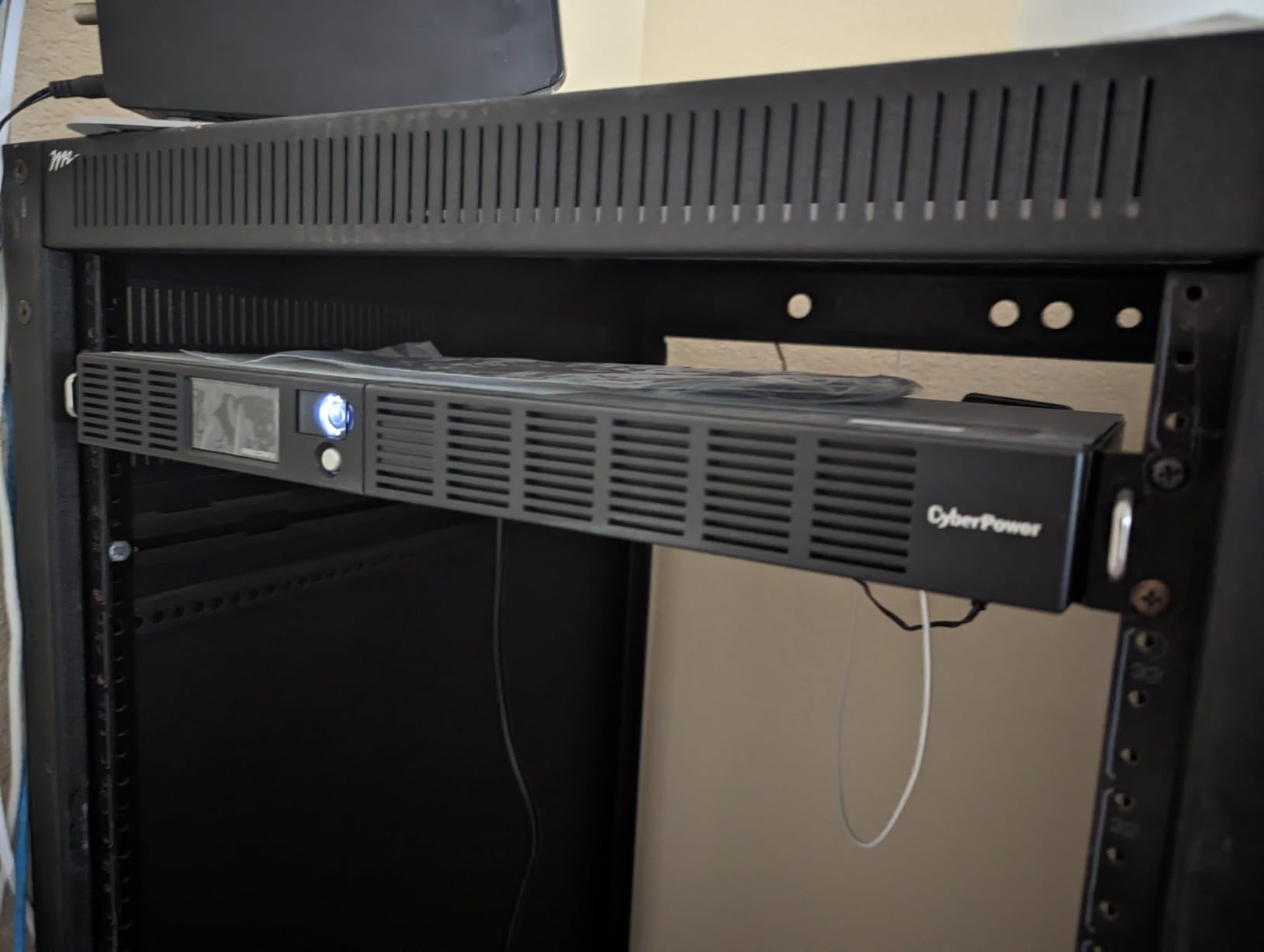
Technically, this is a line-interactive UPS with AVR and a simulated sine wave output on battery. For network gear, a NAS with a standard power supply, and most non-PFC loads, simulated sine wave is a non-issue. Where it bites is with Active PFC server power supplies, which can refuse to run on a stepped approximation of a sine wave. If your rack contains one of those, move up to the CP500PFCRM1U or a 2U pure sine unit.
Four of the six NEMA 5-15R outlets are battery backed and surge protected, while the other two are surge only, which is a sensible split for a network shelf where the modem and router get battery and accessories do not. The 3-year warranty includes the battery, and the connected equipment guarantee covers up to 300,000 dollars.
Who should buy it
Buy this if you want a proven, shallow 1U UPS for network gear and Linux-based monitoring on a budget. It is the safest default choice in this entire roundup for a first mini rack build.
Who should skip it
Pass if you run Active PFC power supplies that demand pure sine wave, or if you need SNMP monitoring out of the box rather than through an optional card.
3. CyberPower CP1500PFCRM2U – Short-Depth 2U Powerhouse
CyberPower CP1500PFCRM2U PFC Sinewave UPS Battery Backup
1500VA/1000W
Pure sine wave
2U short depth
8 outlets
Color LCD
Hot-swap battery
Pros
- Pure sine wave output PFC friendly
- Short depth 2U design at 10.5 inches
- Color LCD display with detailed information
- About 1 hour runtime for typical SMB racks
- Hot-swappable batteries for easy maintenance
Cons
- Only 3.1 minutes runtime at full load
- Heavy at 27 pounds so bottom-mount recommended
- Some units may not mount flush with rack rails
When your power needs outgrow 500VA, the CP1500PFCRM2U is the unit I point people toward, and the short 10.5-inch depth is the headline feature. Most 1500VA rackmount units are 16 or more inches deep, which rules them out for shallow enclosures entirely. CyberPower engineered this one specifically for compact racks, wall mounts, and network cabinets.
I ran the numbers on a friend’s setup: a NAS pulling 85W, a mini PC at 35W, and network gear at 25W totaled about 145W, roughly 15 percent load. At that level, the runtime stretches past an hour, which matches what owners report in reviews. One user mentioned running cameras and internet gear for over an hour during an outage. The pure sine wave output means Active PFC supplies run without complaint, and hot-swappable batteries let you replace cells without powering down.
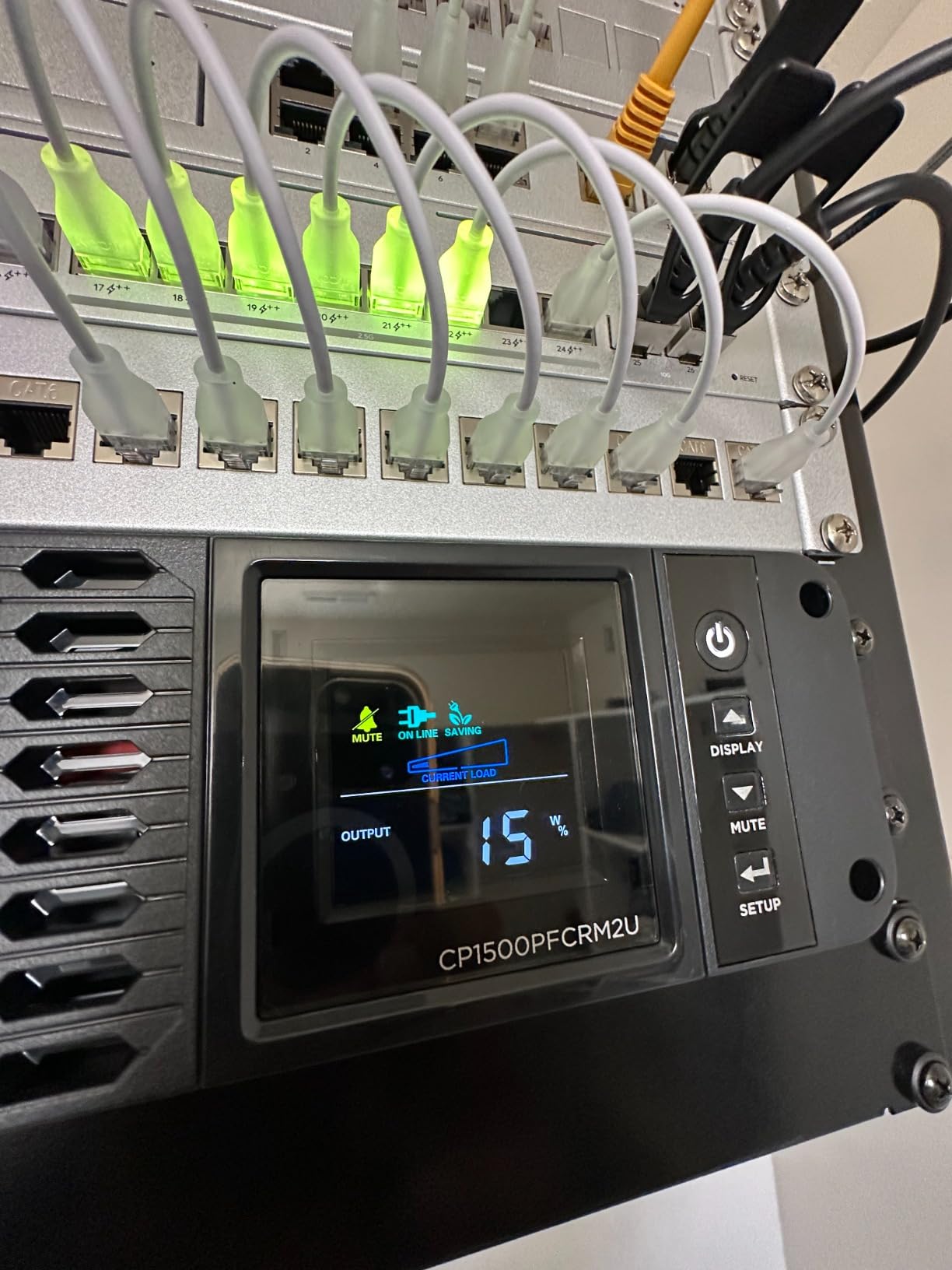
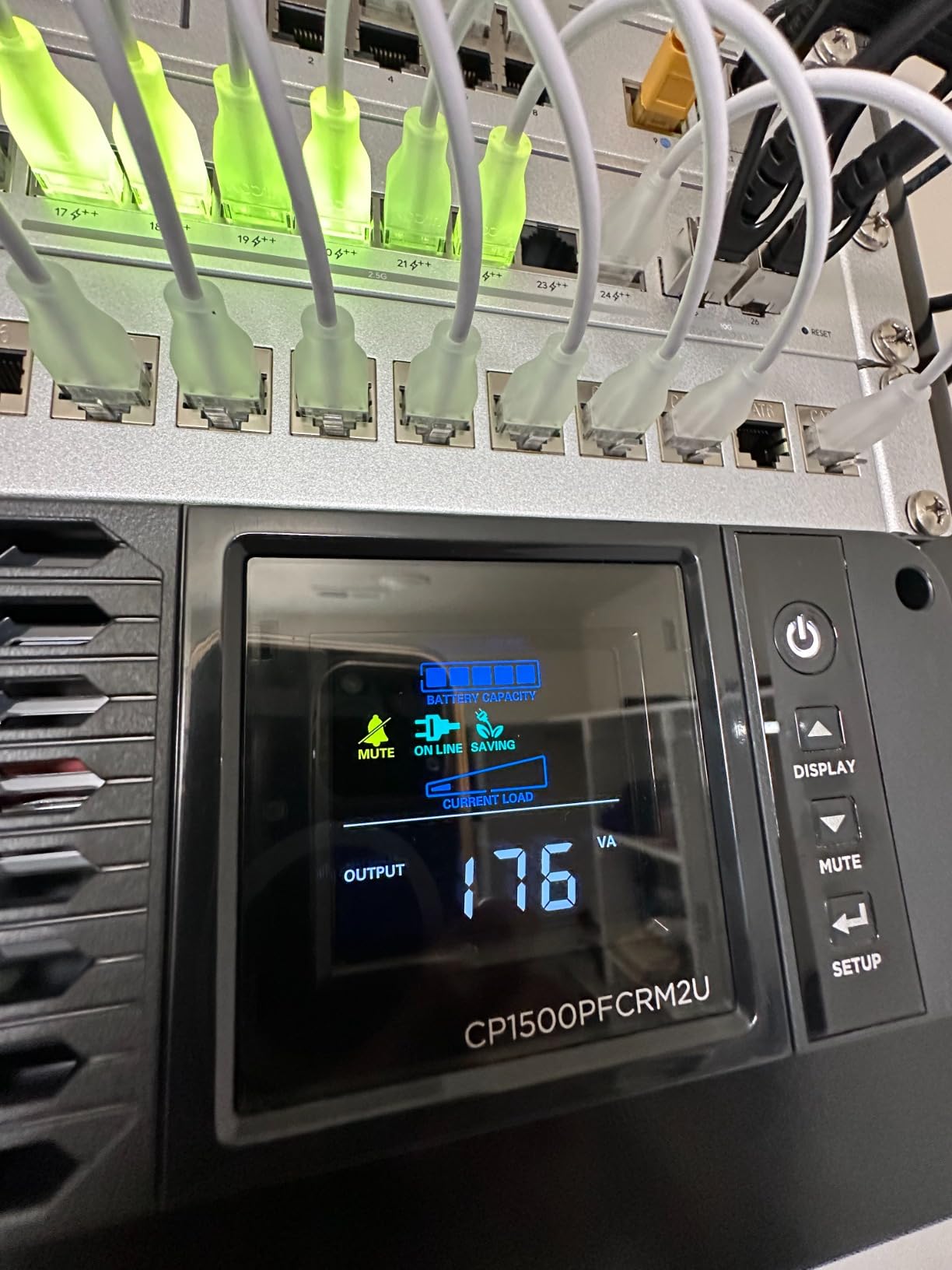
The 8 NEMA 5-15R outlets are all battery backed and surge protected, with a 1500 joule surge rating. The color LCD is a step up from monochrome panels, displaying input voltage, load wattage, and estimated runtime clearly. AVR handles brownouts and overvoltages from 75V up without touching the battery, and the GreenPower UPS design keeps efficiency reasonable.
The caveats are mostly physical. At 26.8 pounds, this is a heavy brick, and the universal consensus is to bottom-mount it in a rack rather than balance it mid-stack. The 4.2 rating across 447 reviews reflects some fitment grumbles, including units that do not sit perfectly flush with certain rails. The full-load runtime of about 3 minutes is also worth remembering: this unit is built for graceful shutdowns and moderate loads, not sustained max-wattage operation.
Who should buy it
This is the right pick for a growing homelab with a NAS, a server, or several PFC power supplies that need pure sine wave power and real runtime. The short depth makes it one of the few 1500VA units that works in compact enclosures.
Who should skip it
Skip it if your rack only powers a modem, router, and switch, since 1000W of capacity is wasted headroom there. Also avoid it if your enclosure cannot handle a 27-pound unit or lacks 2U plus depth clearance.
4. Eaton Tripp Lite SMART1500LCD – The Proven Workhorse
Eaton Tripp Lite SMART1500LCD 1500VA 2U Rack Mount UPS 900W Battery Backup
1500VA/900W
2U or tower
8 outlets
AVR
User-replaceable battery
RJ45 surge
Pros
- Rock-solid reliability for network and server gear
- Versatile 2U rackmount or tower configuration
- User-replaceable batteries
- Useful LCD monitoring screen
- 3 year warranty with 250000 dollar insurance
Cons
- Fan runs constantly even on utility power
- Modified sine wave on battery not pure sine
- Heavy at 29 pounds
- Some software setup challenges reported
With 1,782 reviews, the SMART1500LCD is the most battle-tested unit in this roundup. Eaton owns Tripp Lite now, and this line has been an IT closet staple for well over a decade. People buy it for the same reason they buy rack screws in bulk: it works, it lasts, and replacement batteries will be available for years.
The specs are solid for the price: 1500VA/900W, eight NEMA 5-15R outlets, AVR across a wide 75V to 147V window, and a rotatable LCD that reads correctly whether you rack it or stand it as a tower. That tower conversion is a genuine plus for mini rack owners, since you can shelf it vertically beside the rack if 2U of space is too precious to spend. An RJ45 port adds dataline surge protection for your ethernet runs.
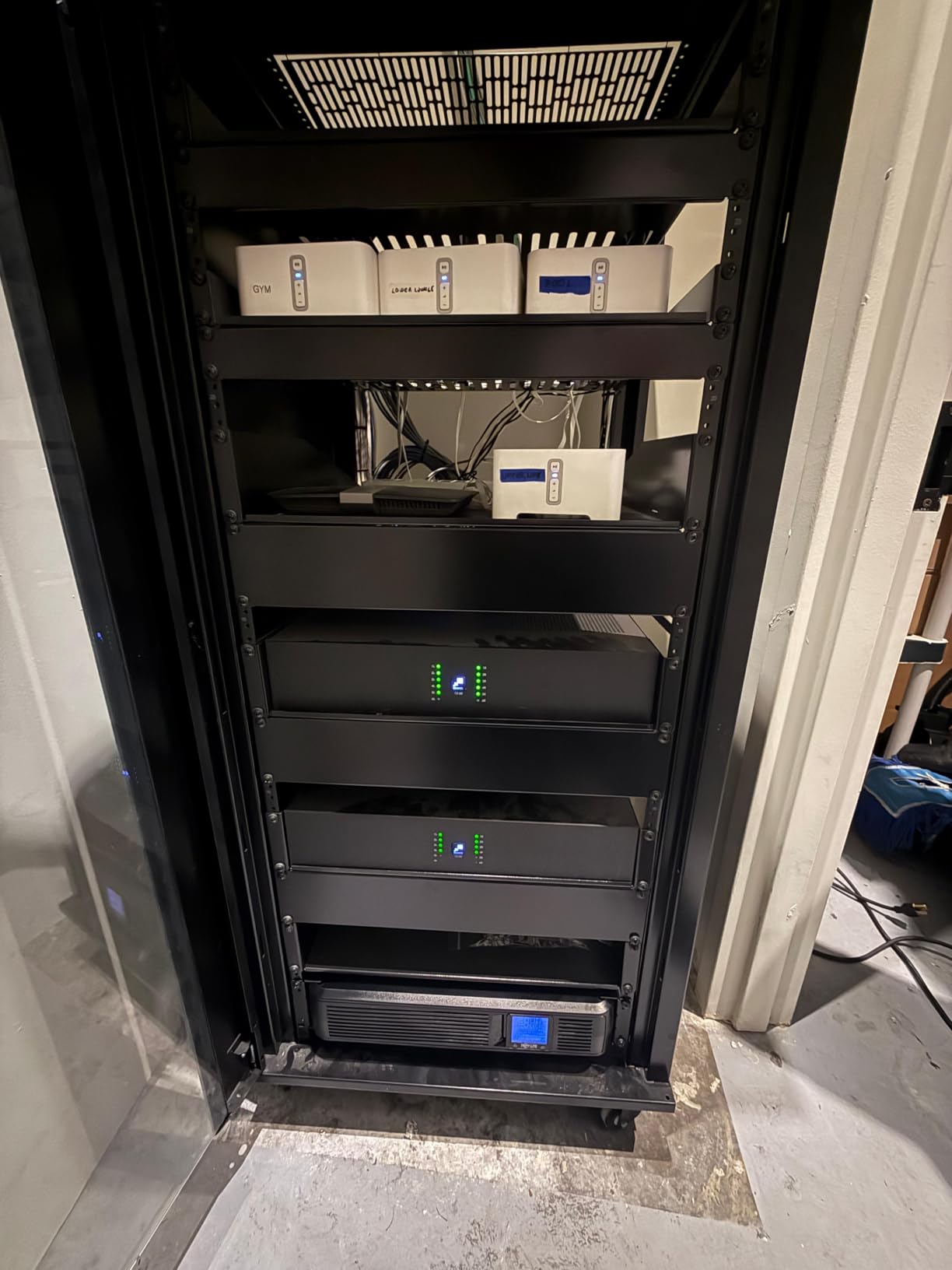
Two complaints dominate the reviews, and both are legitimate. First, the fan runs constantly, even on utility power, which makes this a poor choice for a quiet desk-side rack. Forum users consistently flag fan noise as a mini rack dealbreaker, and this is the loudest regular offender here. Second, the output on battery is modified sine wave, so Active PFC supplies may not cooperate during an outage.
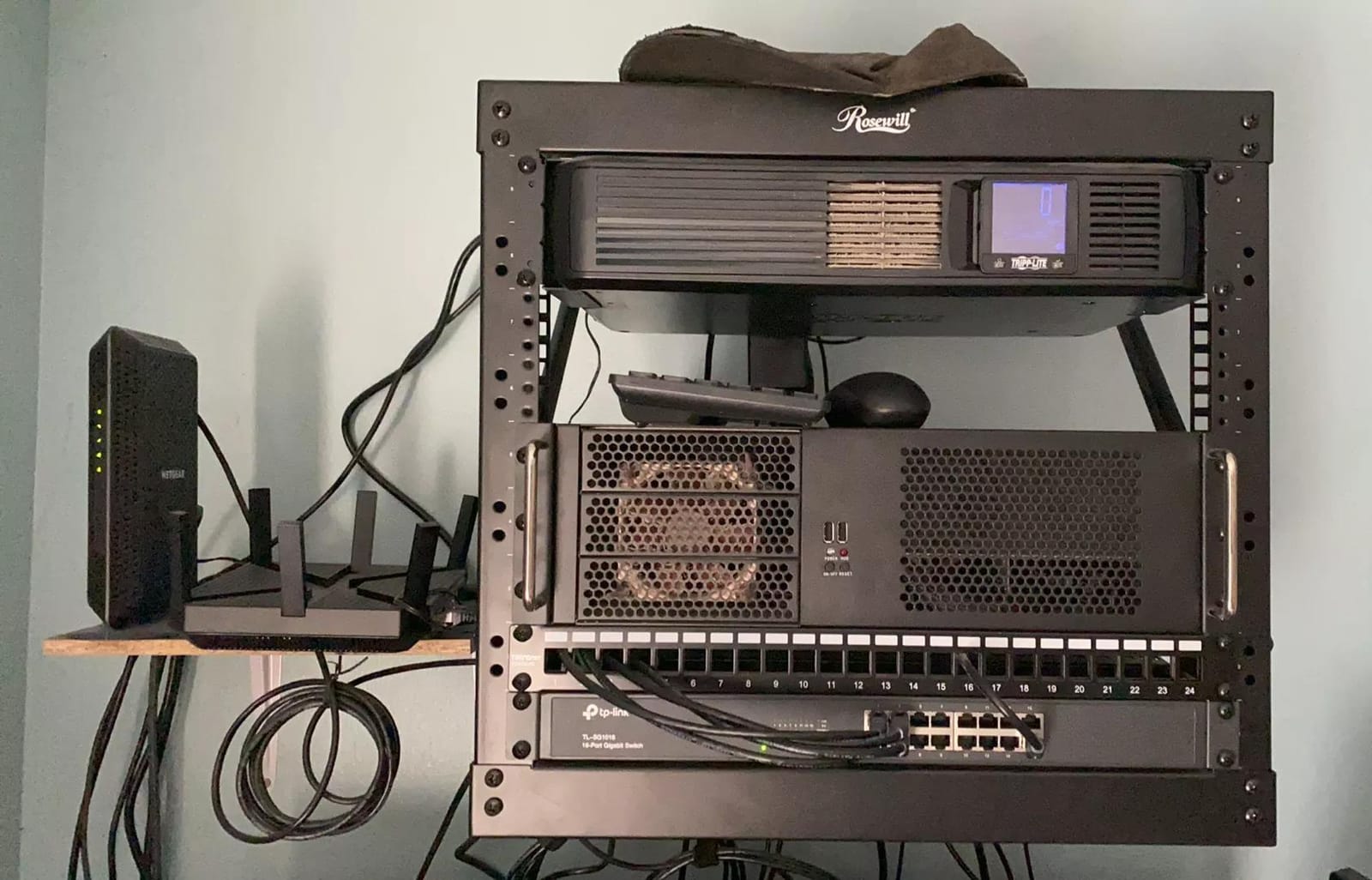
Batteries are user-replaceable and recharge in about 4.5 hours, faster than the 8 hours several CyberPower units need. The 3-year warranty comes with 250,000 dollars of connected equipment insurance. At 10.5 inches deep, fitment in a shallow enclosure is workable, though the 29-pound weight demands sturdy support.
Who should buy it
Buy it if you want maximum field-proven reliability for network and server gear and plan to keep the unit for a decade, swapping batteries as needed. It is also smart if you might convert between rack and tower use.
Who should skip it
Skip it for bedroom or office-adjacent racks where constant fan noise will bother you. Also pass if your gear includes Active PFC power supplies that require pure sine wave on battery.
5. CyberPower CP2000PFCRM2U – Maximum Capacity, Short Depth
CyberPower CP2000PFCRM2U PFC Sinewave UPS Battery Backup
2000VA/1200W
Pure sine wave
2U short depth
8 NEMA 5-20R outlets
Color LCD
UL 508
Pros
- Pure sine wave output for PFC power supplies
- Short depth 2U rackmount design
- Excellent runtime ran cameras and internet for over an hour
- Color LCD display
- 500000 dollar Connected Equipment Guarantee
Cons
- Requires 20 amp circuit with NEMA 5-20P plug
- Front of case protrudes past rack rails
- More expensive than CP1500 with similar features
The CP2000PFCRM2U is the big brother of my top 2U pick, pushing 2000VA/1200W in the same 10.8-inch-deep chassis. If the CP1500 is for a growing homelab, this one is for a homelab that grew. The pure sine wave output and hot battery capacity mean multiple servers, a NAS, cameras, and network gear can all ride through an outage together.
Runtime is the standout. One reviewer reported running cameras and internet equipment for over an hour, which tracks with the math at moderate loads. With 1200W of headroom, you can attach a genuinely serious stack without hitting the ceiling. The color LCD and AVR round out a spec sheet that mirrors the CP1500 in most respects.
The critical catch is the plug. This unit uses a NEMA 5-20P input, which means it requires a 20-amp circuit and will not physically fit a standard 15-amp household outlet. Several buyers have learned this after delivery. Before you consider this UPS, check whether your rack location has a 20A circuit, because an adapter defeats the entire purpose and creates a safety issue.
Fitment notes from owners mention that the front of the case can protrude past rack rails, worth knowing if your enclosure has a door or flush front panel. At 28.7 pounds, treat it like the CP1500 in terms of mounting. The 31 reviews are few but strongly positive at 4.6, with the 500,000-dollar equipment guarantee backing everything up.
Who should buy it
Buy this if you have a 20-amp circuit available and a power-hungry rack that genuinely needs 1200W of battery-backed capacity. It is the strongest short-depth option here for multi-server homelabs.
Who should skip it
Skip it without hesitation if you only have standard 15-amp outlets, since the 5-20P plug makes it unusable there. It is also overkill, and overpriced, for a pure network gear rack.
6. APC Smart-UPS SMC1500-2UC – Quiet Premium Pick
APC Smart-UPS 1500VA/900W Rackmount UPS, Line Interactive, SMC1500-2UC
1500VA/900W
Pure sine wave
2U rackmount
SmartConnect monitoring
6 outlets
Energy Star
Pros
- Supports apcupsd and NUT over USB
- Quiet operation
- Good battery life at low load
- APC SmartConnect remote monitoring
- 150000 dollar equipment protection policy
Cons
- Heavy unit so install battery after rack mounting
- 19.5 inch depth may be too deep for some racks
- Not the most user friendly interface
APC has a reputation for building the most reliable UPS units in the business, and the SMC1500-2UC is why that reputation persists. Across homelab forums, the consensus I keep reading is that APC is considered more reliable while CyberPower offers better value. If your rack protects equipment you genuinely cannot afford to lose, that reliability premium is what you are paying for here.
The features that matter to mini rack owners are quiet operation and monitoring. Where the Eaton unit above runs its fan constantly, this APC runs quietly enough for an office or bedroom-adjacent setup. SmartConnect gives you cloud-based remote monitoring with automatic notifications over ethernet, no optional card purchase required, which is a real advantage at this price tier. It also speaks fluently to apcupsd and NUT over USB for Linux-based shutdown automation.
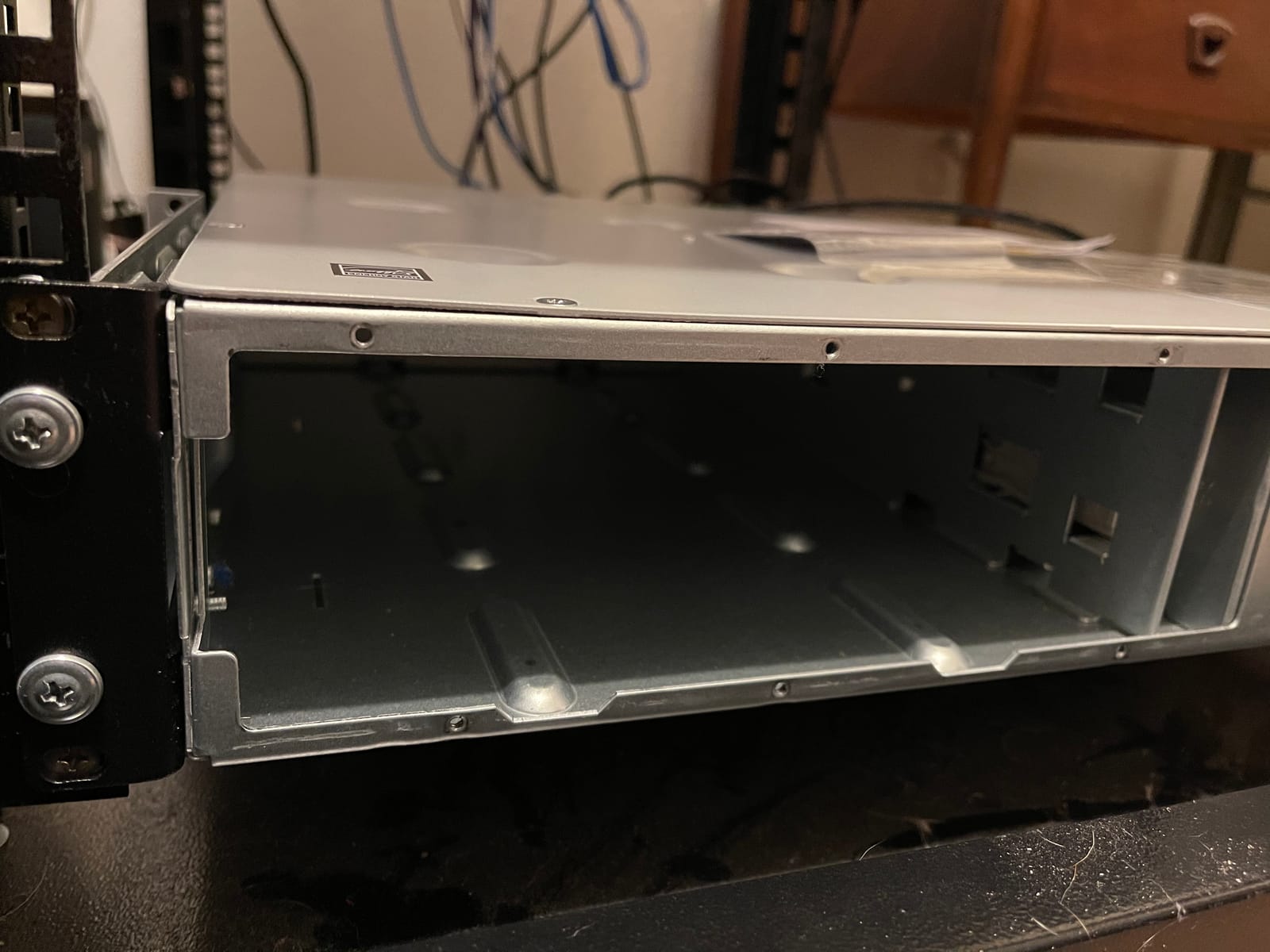
Output is pure sine wave at 1500VA/900W across six NEMA 5-15R outlets, with line-interactive AVR and Energy Star certification. Users report excellent battery behavior at low loads of 30 to 35 percent, which is exactly where a typical homelab sits. The 3-year warranty covers repair or replacement, with 2 years on the battery, plus a 150,000-dollar protection policy.
The dealbreaker for true mini racks is depth: 19.5 inches. That will not fit most 10-inch shallow enclosures, so this unit realistically belongs in a deeper rack, a closet, or beside a mini rack as a standalone tower. The weight, around 56 pounds with batteries, also means you should rack it first and install batteries after, as the manual suggests.
Who should buy it
Buy it if reliability and quiet operation outrank price for your setup, and if you have the depth for it in a deeper rack or as a tower next to a mini rack. Linux users will love the apcupsd and NUT support.
Who should skip it
Skip it for shallow 10-inch enclosures, since 19.5 inches of depth rules it out. Also pass if budget is the leading factor, because the CP1500PFCRM2U covers similar loads for considerably less.
7. CyberPower OR700LCDRM1U – NUT-Friendly 1U Middle Ground
CyberPower OR700LCDRM1U Smart App LCD UPS Battery Backup
700VA/400W
1U rackmount
6 outlets
LCD panel
AVR
Energy Star
USB monitoring
Pros
- Simple setup on Linux with NUT support
- Multifunction LCD panel shows runtime and battery status
- 4 battery backup plus 2 surge outlets
- AVR corrects minor fluctuations
- Can disable beeping via menu
- 3 year warranty including batteries
Cons
- Simulated sine wave output not pure sine
- Not suitable for Active PFC server power supplies
- Some users report battery degradation after 2 years
- Runtime limited at higher loads
The OR700LCDRM1U splits the difference between the 500VA and 700VA CyberPower units, adding a little headroom for racks with a few more devices. At 700VA/400W with 416 reviews averaging 4.5, it has the track record of the OR500 with 33 percent more capacity. The chassis matches its sibling at 9.25 inches deep, keeping it among the shallowest 1U options made.
What earns it a dedicated spot here is how well it integrates with Linux. Setup with NUT over USB is reportedly simple, and the LCD panel surfaces runtime, load, and battery status without any software at all. A small but beloved detail: you can disable the audible beeping through the menu, which matters when the rack lives in a quiet room and the power blips at 3 a.m.
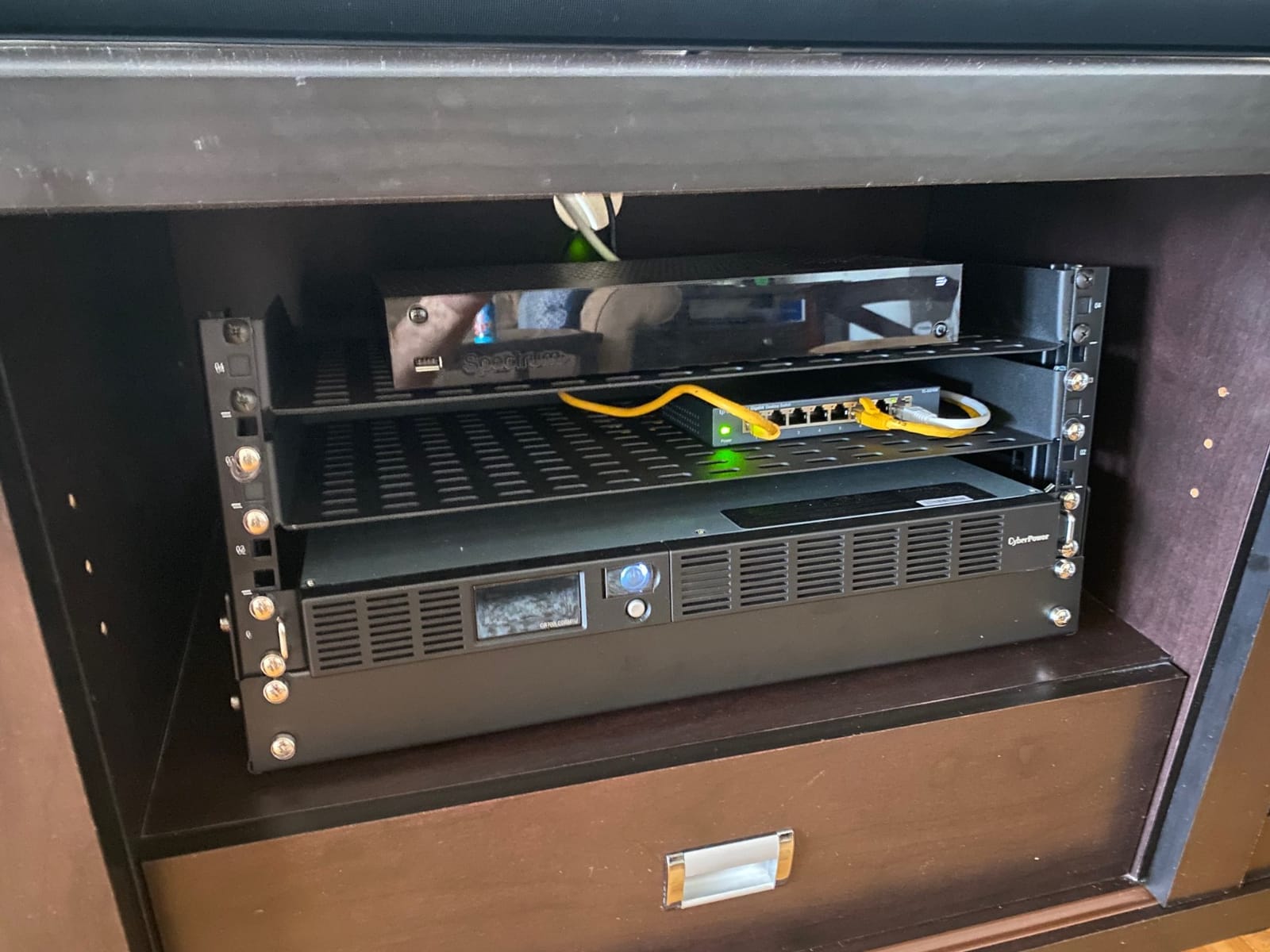
Four outlets are battery backed with surge protection, two are surge only, and the surge rating is 1150 joules. AVR handles minor fluctuations without draining the battery, and the unit carries both Energy Star certification and the 3-year warranty with a 300,000-dollar equipment guarantee.
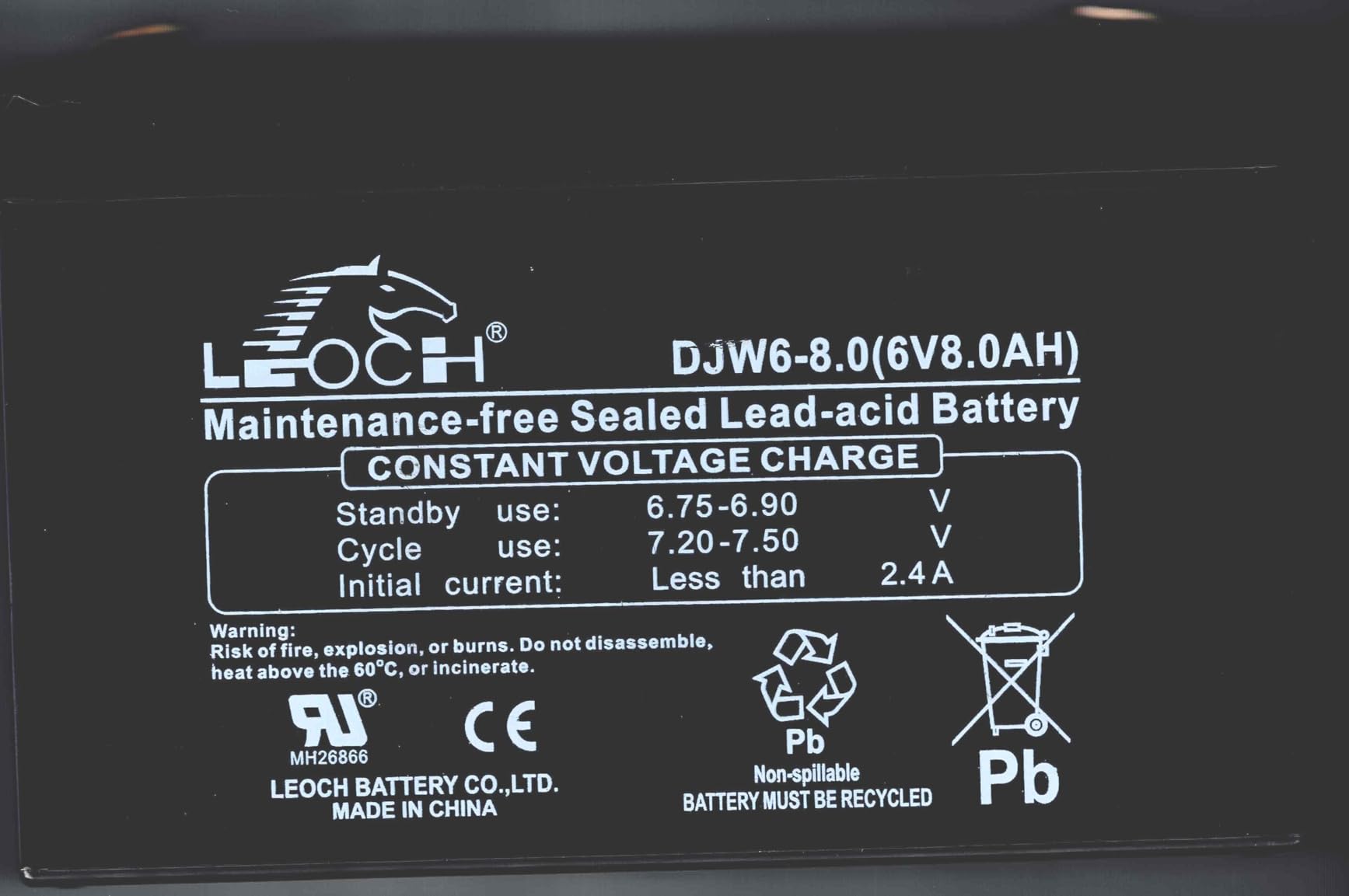
The limitations mirror the OR500. Simulated sine wave output means Active PFC server power supplies are off the menu, and some long-term owners report battery degradation after about two years, earlier than the stated 3-year battery life. Budgeting for a replacement battery around that mark is prudent. Runtime at higher loads is also thin, so keep the stack light if you want meaningful minutes on battery.
Who should buy it
Buy it if you liked the sound of the OR500 but want extra wattage headroom for a slightly bigger network stack. It is a natural fit for Linux homelabs that monitor through NUT.
Who should skip it
Skip it if you need pure sine wave output for PFC supplies, or if you want a battery that reliably lasts the full warranty period without early degradation risk.
8. Eaton Tripp Lite SMART500RT1U – Budget 1U Starter
Eaton Tripp Lite SMART500RT1U SmartPro 500VA 1U Rack Mount UPS 300W AVR
500VA/300W
1U rack or tower
11.8 inch depth
6 UPS outlets plus 1 surge
AVR
PowerAlert software
Pros
- Compact 1U design with 11.8 inch depth
- Supports USB RS232 EPO and optional SNMP card
- 6 UPS backed outlets plus 1 surge only
- PowerAlert software included
- Watchdog support for OS and hard reboot restart
- Converts to tower mount
Cons
- Battery alarm is extremely loud at 120 decibel when battery fails
- Battery not truly hot-swappable
- Short runtime at full load at 3.2 minutes
- Battery must ship ground if replacement needed
The SMART500RT1U is the cheapest genuine 1U rackmount UPS worth buying. At 500VA/300W with an installed depth of 11.8 inches, it fits shallow racks that turn away deeper units, and it converts to a tower if you decide to pull it from the rack later. For a first mini rack build on a strict budget, it covers the fundamentals.
The feature set is surprisingly complete for the price. You get USB and RS232 monitoring ports, EPO support, and an optional SNMP slot for network management later. PowerAlert software handles unattended shutdowns, and a watchdog feature can reboot a hung OS or device automatically, which is a nice touch for remotely located gear. AVR corrects brownouts without touching the battery reserve.
Outlet layout is generous: six UPS-backed NEMA 5-15R outlets plus a seventh surge-only outlet, the most battery-backed outlets of any 1U in this guide. The 2-year warranty extends to 3 years with registration, shorter than CyberPower’s 3-year standard, which is part of the budget trade.
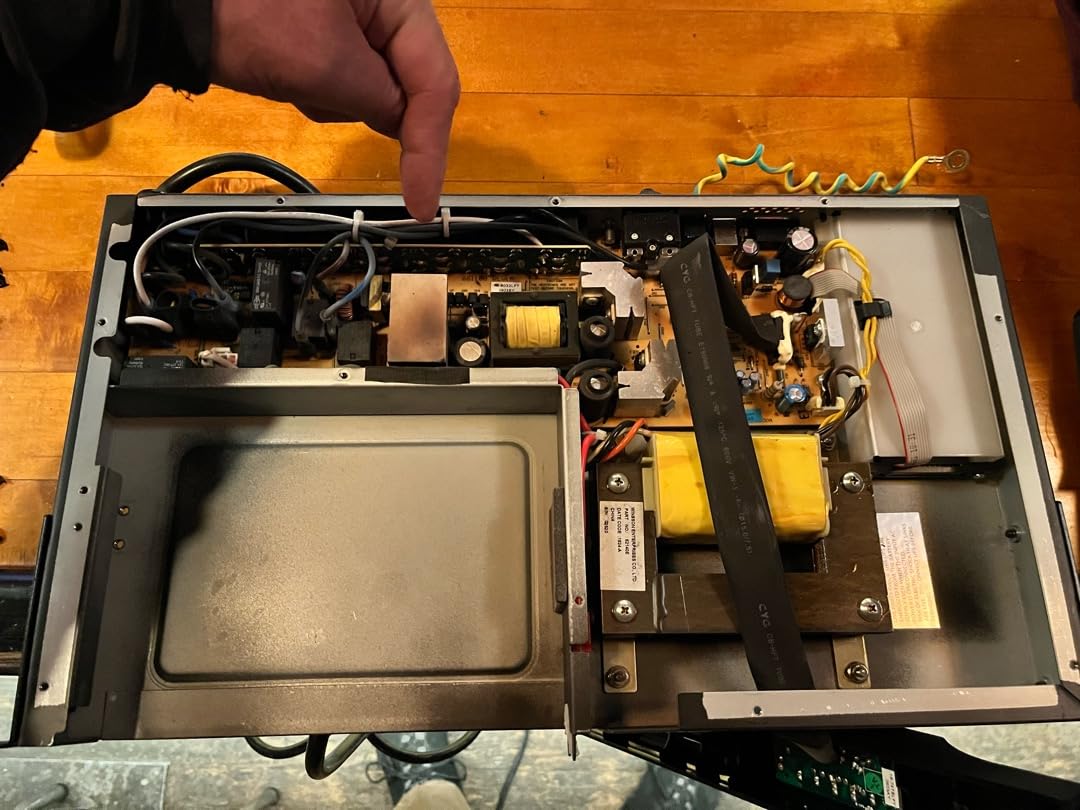
The rough edges are documented and worth heeding. When the battery fails, the alarm hits 120 decibels and it is startling. The battery is also not truly hot-swappable, so a replacement means powering down your stack. And replacement batteries must ship ground, which slows the repair. With 172 reviews at 4.3, most owners accept these quirks at this price.
Who should buy it
Buy it if you want the cheapest reliable way to put battery backup inside a 1U rack slot, with real monitoring ports and room to add SNMP later. Great for a starter network rack.
Who should skip it
Skip it if a loud failure alarm or downtime during battery swaps is unacceptable, or if you want pure sine wave and hot-swappable batteries. Spending more on the OR500 or CP500 solves both.
How to Choose a Rack-Mount UPS for a 10-Inch Mini Rack?
Choosing a mini rack UPS comes down to five questions: does it fit, is the waveform right, is the capacity sufficient, is it quiet enough, and will your shutdown software talk to it. Here is how I work through each one.
Physical fit: width, depth, and weight
Width is the defining constraint of a 10-inch rack. Standard rackmount UPS chassis are 17 to 17.5 inches wide, designed for 19-inch racks, so they cannot mount directly on 10-inch rails. The practical solutions are a rack shelf that supports the unit, side mounting with brackets, or a deeper enclosure. Measure rail-to-rail clearance before ordering anything.
Depth is the second gate. Mini racks typically offer 12 to 18 inches of depth, and forum threads are full of buyers who discovered their UPS was too deep after unboxing. The shallowest units here are the CyberPower OR-series at 9.25 inches, followed by the SMART500RT1U at 11.8 inches and the CP1500PFCRM2U at 10.5. The APC SMC1500-2UC at 19.5 inches will not fit most mini racks at all.
Weight matters more than people expect. These units run 18 to 29 pounds, and a top-heavy mini rack on a desk can tip. Bottom-mount the heavy 2U units, and check your rack’s rated load before committing.
VA and wattage: how to size correctly
Sizing a UPS is straightforward. First, add up the wattage of everything that will be battery backed: a modem and router might draw 30W combined, a NAS 50 to 90W, a mini PC 25 to 40W, a small switch 10 to 30W. Second, add 25 to 50 percent headroom so the UPS is not running at its ceiling, since runtime at low load is far better and the unit runs cooler. Third, check the watt rating, not just VA, because the watt figure is the real limit. A 500VA/300W unit maxes out at 300W regardless of the VA number.
As a rule of thumb: network gear only, 500VA is enough. A NAS plus mini PC, look at 700VA. Add a server or PFC power supplies and 1500VA short-depth is the right tier. Multiple servers means 2000VA, assuming you have a 20-amp circuit.
Waveform: pure sine vs simulated sine
This is the spec most buyers regret ignoring. On battery, a UPS either outputs a pure sine wave, identical in shape to wall power, or a simulated, stepped approximation of one. Network gear, routers, modems, and standard power supplies do not care. Power supplies with Active PFC, which includes most modern servers and many mini PCs, can shut down or behave erratically on simulated sine wave.
My guidance: if anything in your rack has an Active PFC supply, buy pure sine wave. In this lineup that means the CP500PFCRM1U, the CP1500PFCRM2U, the CP2000PFCRM2U, or the APC SMC1500-2UC. If you are only protecting network gear, simulated sine units like the OR500 and OR700 save real money with no downside.
Runtime expectations
Published runtime at full load is misleading, because almost nobody runs a UPS at full load. A unit rated for 2 or 3 minutes at full load can deliver 10 to 20 times that at 10 to 20 percent load. A 1500VA unit at 150W of load will often run an hour or more, which matches what owners report in reviews.
Decide what runtime is actually for. For a homelab, the goal is usually not to keep working through an outage, it is to ride out a 30-second blip and gracefully shut down if it lasts longer. That reframing lets you buy less UPS than you think. If you genuinely need hours of uptime, a UPS is the wrong tool and a generator or portable power station is the answer.
Noise and placement
Fan noise is the most under-discided factor in mini rack UPS buying, and forum users complain about it constantly. The Eaton SMART1500LCD runs its fan continuously, even on wall power, and several reviewers call it too loud for a quiet room. The APC SMC1500-2UC is noted for quiet operation, and fanless-style 1U units like the CyberPower OR-series are effectively silent on utility power.
Think about alarms too. The SMART500RT1U emits a 120-decibel alarm when the battery fails, while the OR700LCDRM1U lets you disable beeping from the menu. If your rack lives in a bedroom, office, or shared space, these details decide whether you end up unplugging the thing.
Monitoring and shutdown software
For Linux homelab users, NUT, the Network UPS Tools project, and apcupsd are the standard way to trigger automatic shutdowns. Compatibility here is patchy and undocumented, which is why I flagged it for every unit. CyberPower OR-series units work with NUT over USB and CyberPower ships native .deb packages. The APC SMC1500-2UC is well supported by both apcupsd and NUT. Eaton’s PowerAlert software works but has a steeper setup curve according to reviews.
Decide early whether USB monitoring to a local server is enough, or whether you need network-based monitoring with remote notifications. Network management usually means an optional card on CyberPower units, while APC’s SmartConnect includes it standard on the SMC1500-2UC.
Warranty and battery chemistry
CyberPower’s 3-year warranty covers batteries, which is genuinely valuable since replacement batteries cost a meaningful fraction of the unit. APC splits its coverage: 3 years on the unit but only 2 on the battery. Eaton’s SMART500 starts at 2 years, extendable to 3 with registration.
Every unit here uses sealed lead-acid batteries, which last 3 to 5 years and degrade faster in hot enclosures. Lithium-ion rack UPS units are emerging with 2 to 3 times the lifespan and lighter weight, and the Vertiv Liebert PowerUPS 100 lithium model comes up in mini rack discussions, but availability and price keep them niche for now. Expect lithium options to widen in the next couple of years.
Frequently Asked Questions
What is the best rack mounted UPS?
For a 10-inch mini rack, the CyberPower CP500PFCRM1U is the best overall pick thanks to pure sine wave output in a true 1U chassis. The CyberPower OR500LCDRM1U is the best value for network gear, and the CyberPower CP1500PFCRM2U is the top short-depth choice when you need 1500VA of capacity.
What fits in a 10 inch rack?
Most 10-inch racks accept equipment up to about 10 inches wide and 12 to 18 inches deep, so standard 19-inch rackmount UPS units will not fit on the rails. Workable options include shallow 1U units like the CyberPower OR500LCDRM1U at 9.25 inches deep, desktop UPS units mounted sideways or on a shelf, and short-depth 2U units like the CP1500PFCRM2U at 10.5 inches.
How long will a 1500VA UPS last?
At full load, a 1500VA UPS typically runs only 2 to 4 minutes. At 50 percent load expect roughly 10 to 15 minutes, and at 15 to 20 percent load, which is where most homelabs sit, runtime can exceed an hour. Owners of the CP1500PFCRM2U report running network and camera gear for over an hour during outages.
How to size UPS for server rack?
Add up the wattage of all battery-backed equipment, then add 25 to 50 percent headroom, and match that number to the UPS watt rating rather than its VA rating. For example, a 150W network stack and mini PC fits comfortably in a 500VA/300W unit, while adding a server or NAS points you to a 1500VA/900W or larger model.
Which rack mount UPS is the most reliable?
APC has the strongest reliability reputation among homelab users, with the SMC1500-2UC rated 4.6 across 214 reviews, and Eaton Tripp Lite’s SMART1500LCD has a long service record across 1,782 reviews. CyberPower is considered the better value, offering similar protection with a 3-year warranty that includes batteries.
Final Verdict
Picking the best rack-mount UPS for a 10-inch mini rack in 2026 comes down to your load and your waveform needs. For most builders, the CyberPower CP500PFCRM1U is the top choice because pure sine wave in a true 1U chassis is rare and valuable. Budget-conscious network racks are perfectly served by the CyberPower OR500LCDRM1U or the Eaton Tripp Lite SMART500RT1U, while power-hungry homelabs should move up to the short-depth CP1500PFCRM2U.
Before you click buy, measure your rack’s width, depth, and weight capacity, then check whether any of your power supplies need pure sine wave. Those two checks prevent nearly every fitment regret documented in homelab forums. Whichever unit you choose, pair it with NUT or apcupsd shutdown automation so an outage becomes a clean shutdown instead of corrupted storage.