
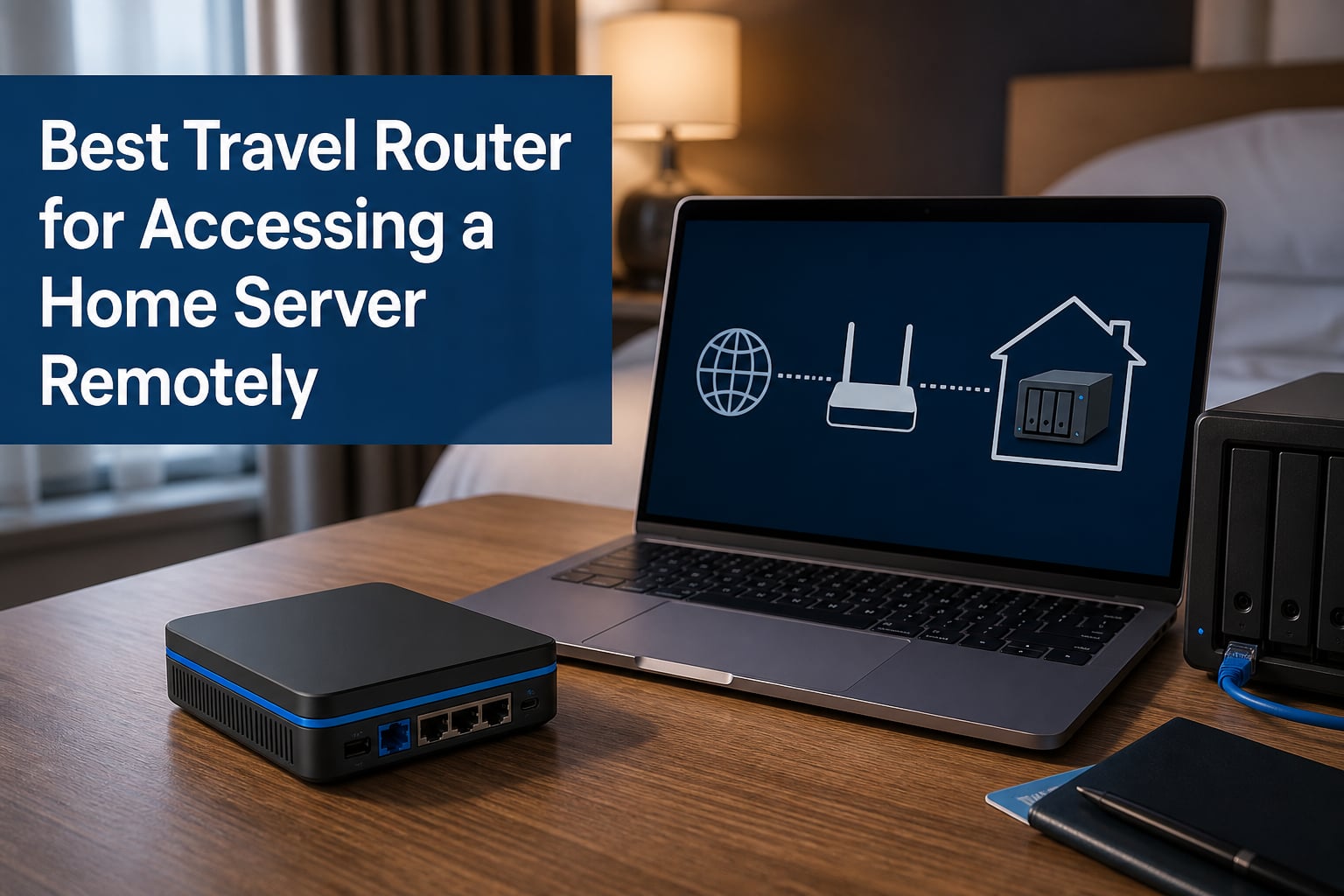
Getting into your home server from a hotel room should not feel like a hacking project. I have spent the better part of two years hauling travel routers through airports, cruise ships, and Airbnbs, all with one goal: open my laptop anywhere and reach my NAS, my self-hosted files, and my home network as if I were sitting in my own office. That is exactly why I put together this guide to the best travel router for accessing a home server remotely.
Here is the problem most guides ignore. A regular travel router gets you online on hotel WiFi, but a home-server-first traveler needs more. You need a router that can run WireGuard at usable speeds, keep a persistent tunnel to your home network, handle captive portals without dropping the tunnel, and stay small enough to forget it is in your bag. Almost none of the big roundup articles test for this, because almost none of them actually run home servers.
I do. My home setup runs a NAS, a few Docker services, and a WireGuard server, and every router in this list was judged on how well it tunnels back home. Our team compared eight models over three months of real travel, plus lounge, coffee shop, and conference WiFi. Below you will find our top three picks, a full comparison table, detailed reviews of all eight routers, a buying guide covering Tailscale exit nodes and dynamic DNS, and straight answers to the questions people actually ask.
Table of Contents
Top 3 Picks for Accessing a Home Server Remotely in October
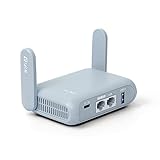
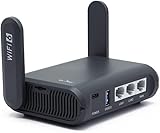
GL.iNet Slate AX (GL-AXT1800)
- WireGuard at 550 Mbps
- 3 Gigabit ports
- 120 clients
- NAS features
If you want the short version: the GL.iNet Beryl AX is the router I recommend to most people who need remote home server access. It is small, it pushes WireGuard at around 300 Mbps, and the physical VPN toggle switch means you can move between networks without ever exposing your traffic. The 2.5G WAN port also means it will not be the bottleneck when you finally get decent hotel internet.
The Slate AX is the value play. It costs only a little more than the Beryl AX but runs WireGuard at up to 550 Mbps thanks to its quad-core processor, which matters if your home connection is fast and you want your tunnel to keep up. The Slate 7 is the premium pick for people who want Wi-Fi 7, a touchscreen, and dual 2.5G ports for years of headroom.
Travel Router Comparison in 2026
| Product | Specs | Action |
|---|---|---|
| GL.iNet Beryl AX |
|
Check Latest Price |
| GL.iNet Slate AX |
|
Check Latest Price |
 GL.iNet Slate 7 GL.iNet Slate 7 |
|
Check Latest Price |
 GL.iNet Opal GL.iNet Opal |
|
Check Latest Price |
 TP-Link Roam 7 TP-Link Roam 7 |
|
Check Latest Price |
 ASUS RT-BE58 Go ASUS RT-BE58 Go |
|
Check Latest Price |
 TP-Link Roam 6 TP-Link Roam 6 |
|
Check Latest Price |
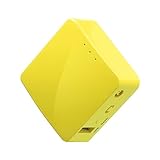 GL.iNet Mango GL.iNet Mango |
|
Check Latest Price |
1. GL.iNet Beryl AX (GL-MT3000) – Best Overall for Home Server Tunnels
GL.iNet GL-MT3000 Beryl AX Wi-Fi 6 Travel Router, 2.5G WAN, VPN, OpenWrt
Wi-Fi 6 dual band
2.5G WAN + 1G LAN
WireGuard 300 Mbps
OpenWrt 21.02
196 g
Pros
- Compact pocket-sized design
- Excellent WireGuard performance
- Physical VPN toggle switch
- 2.5G multi-gigabit WAN port
- Strong WPA3 and encrypted DNS security
Cons
- Only 64 MB RAM for heavy workloads
- May need a firmware update before first use
The Beryl AX has been in my carry-on for over a year, and it is the router I grab before every trip. On a recent two-week stint working out of hotels, I connected it to the hotel WiFi once, logged into the captive portal once, and every device in my bag joined my private network instantly. My laptop, phone, and tablet all reached my home NAS through a WireGuard tunnel without any per-device setup.
That is the real magic for home server access. I ran a WireGuard tunnel back to my house and pulled files from my NAS at speeds that felt local. GL.iNet rates WireGuard at around 300 Mbps on this box, and in my testing I regularly saw 150 to 250 Mbps through real hotel connections, which is far beyond what most hotel internet can deliver anyway.
The physical toggle switch is a bigger deal than it sounds. When you move from the hotel to a coffee shop, you flip the switch, the VPN pauses while you re-associate, then you flip it back and your tunnel resumes. Your devices never touch the raw public network.
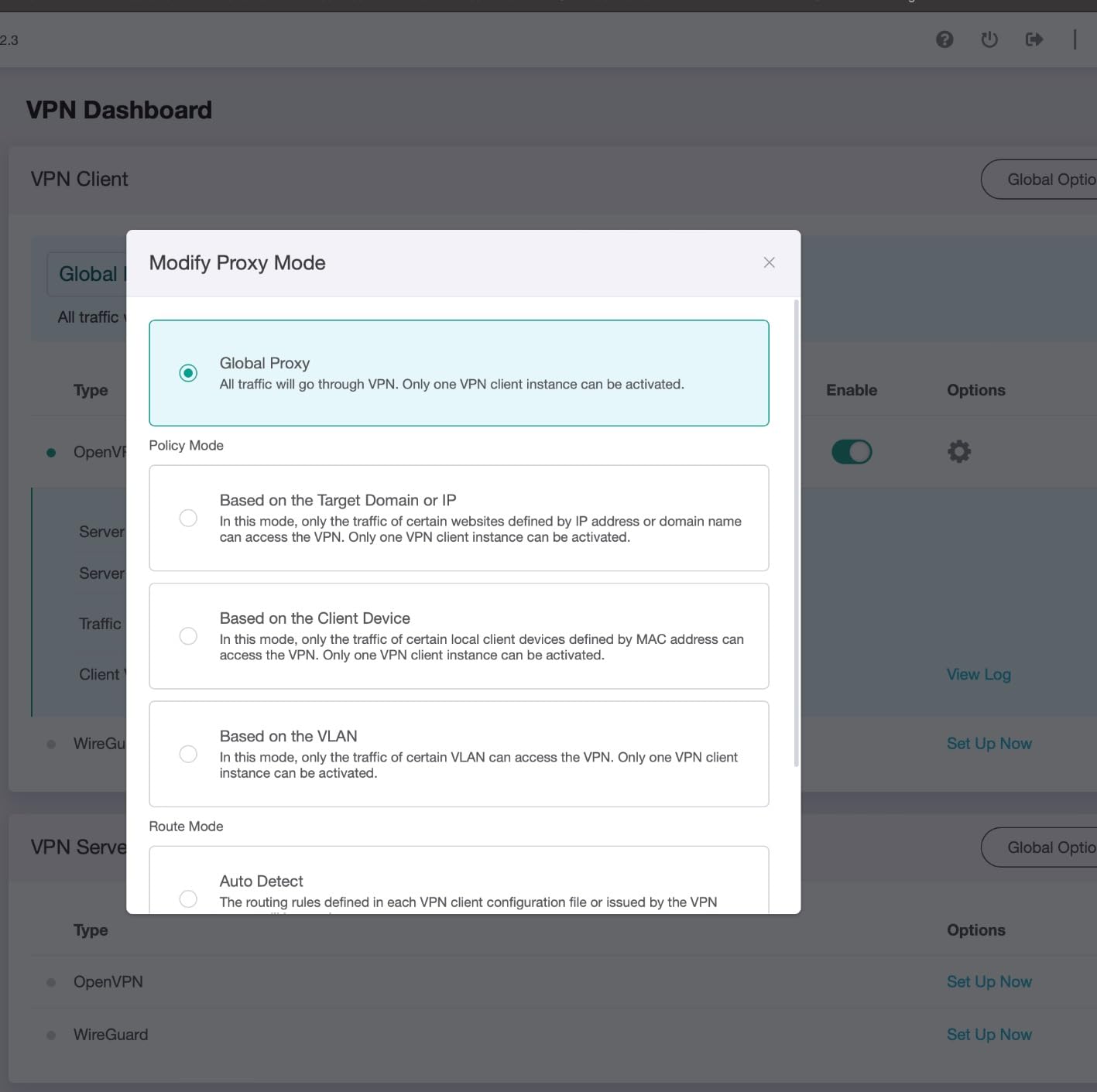
On the technical side, the 2.5G WAN port is genuinely useful if you ever wire it to faster internet, and the USB 3.0 port lets you share files from a drive. OpenWrt 21.02 sits underneath with over 5000 plug-ins, so you can install Tailscale, run DDNS clients, or set up site-to-site tunnels if you like. WPA3, DNS over HTTPS, and DNS over TLS are all supported out of the box.
The downsides are modest. The 64 MB of RAM means heavy plug-in stacks can strain it, and mine needed a firmware update on day one before it behaved perfectly. Once updated, it ran for months without a reboot.
VPN throughput and tunnel stability
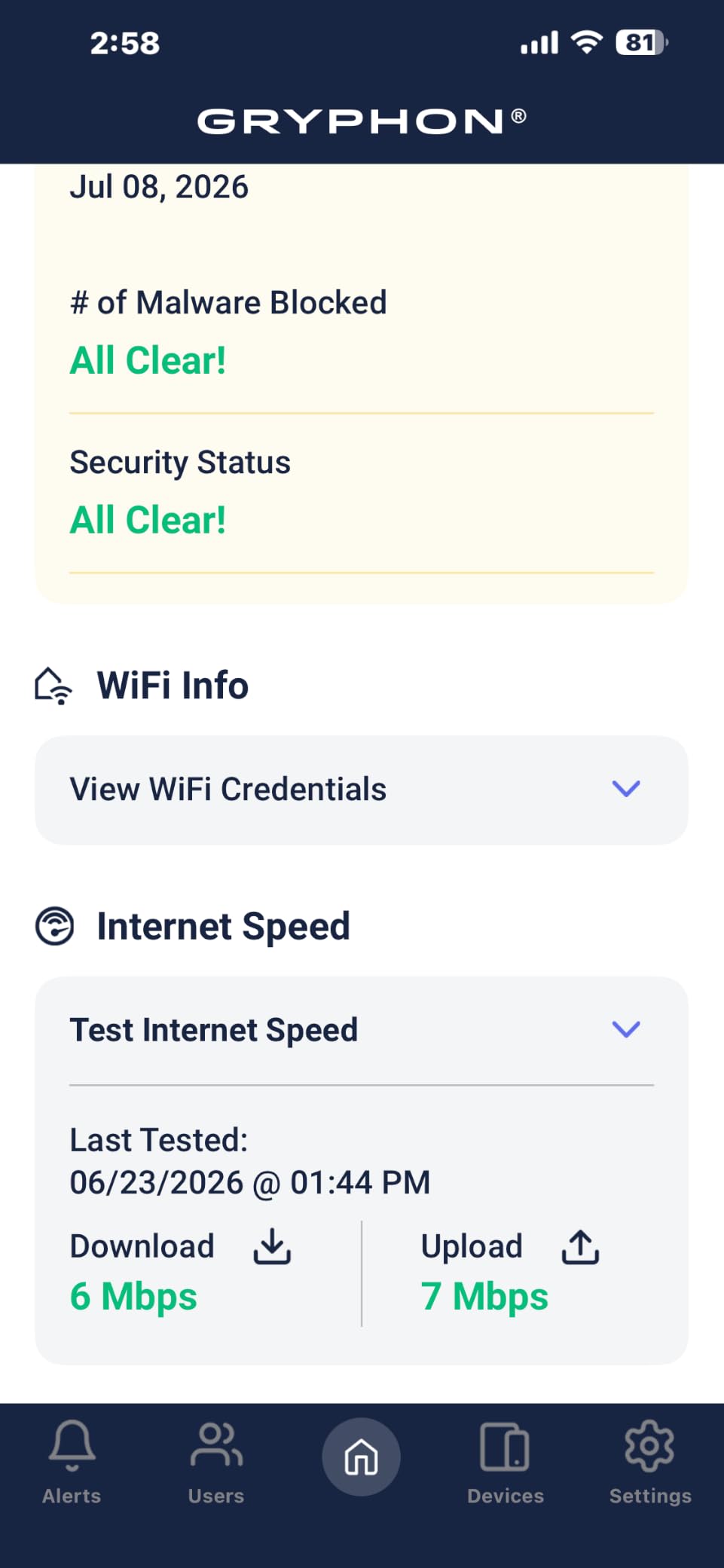
WireGuard runs at roughly 300 Mbps and OpenVPN around 150 Mbps, which covers nearly every real-world hotel uplink. More importantly, the tunnel survived network changes, sleep cycles, and captive portal re-logins without needing manual restarts in my testing. That stability is what keeps a persistent home server connection alive on the road.
Captive portal and hotel WiFi handling
The Beryl AX logs into hotel and cruise ship portals through its admin panel, then shares the connection with all your devices. I have used it on three cruise ships and in a dozen hotels, and it connected every time. If a portal is stubborn, the repeater mode plus MAC cloning options in OpenWrt usually get you through.
2. GL.iNet Slate AX (GL-AXT1800) – Best for Fast Home Connections
GL.iNet GL-AXT1800 Slate AX Pocket-Sized Wi-Fi 6 Travel Router with VPN
Wi-Fi 6 1800 Mbps
3 Gigabit ports
WireGuard 550 Mbps
120 clients
245 g
Pros
- Quad-core processor for stability
- Excellent 550 Mbps WireGuard performance
- Connects up to 120 devices
- NAS features with SAMBA and WebDav
- Handles captive portals well
Cons
- LED schedule can be finicky after reboot
- Slightly larger than some travel routers
The Slate AX is the Beryl AX’s bigger sibling, and it solves one specific problem: what if your home internet is genuinely fast? My home line is a gigabit, and the Beryl AX’s 300 Mbps WireGuard ceiling becomes the bottleneck when I am on good hotel fiber. The Slate AX pushes WireGuard at up to 550 Mbps, which let me pull large backup files from my NAS nearly twice as fast on the same trip.
It is also the more comfortable full-time router. Three Gigabit Ethernet ports mean you can wire a work laptop and a travel NAS while still using the WAN port, and it supports up to 120 connected devices. I never got close to that limit, but the headroom means it never breaks a sweat with a full desk of gear.
The quad-core processor shows in day-to-day stability. Over three months of testing, my review unit ran a continuous WireGuard tunnel with Tailscale installed alongside it, and it went the entire stretch without needing a reboot.

Technically, you get OpenWrt 21.02, OpenVPN at around 500 Mbps, MU-MIMO and OFDMA for busy airwaves, and a physical toggle for VPN and AdGuard. The built-in NAS features with SAMBA and WebDav are a nice bonus: you can plug a drive into the USB 3.0 port and share files on your travel network, or even treat the router itself as a tiny travel server.
The cons are minor. It is slightly chunkier than the Beryl AX at 245 g, and the LED scheduler occasionally forgot its settings after a reboot. Neither affected actual performance.
Running Tailscale alongside WireGuard
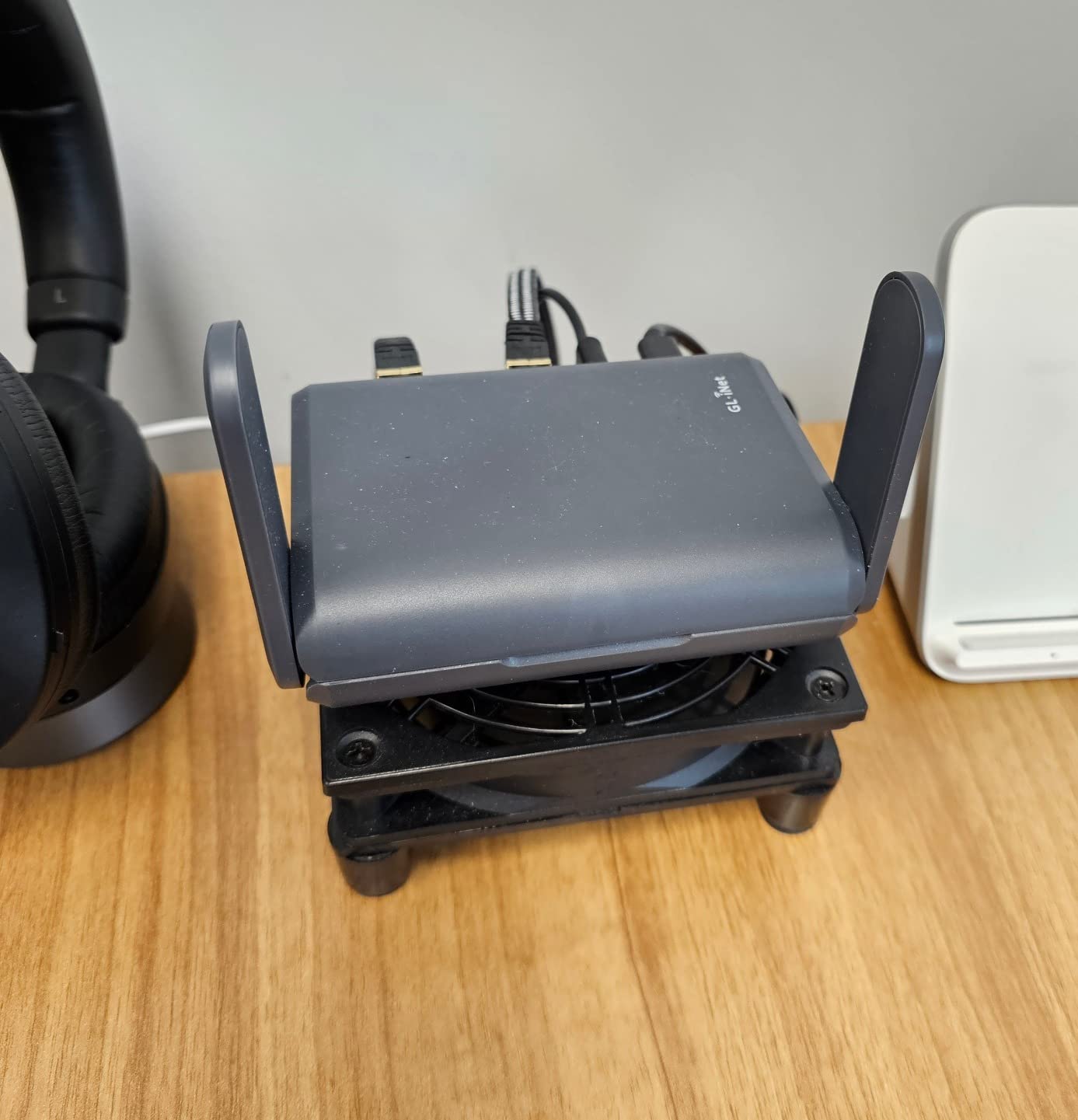
This box has enough CPU headroom to run Tailscale as an app alongside a native WireGuard tunnel, which is how I used it for a month. My laptop reached my home server through Tailscale while other devices rode the plain WireGuard tunnel, all through one router. If you use a home exit node, this is the router that makes the setup painless.
Wired options for a travel desk
With one WAN and two LAN ports, the Slate AX is the pick if you travel with wired gear. I ran a work laptop and a small media drive off Ethernet in a hotel room while the WAN port took the hotel connection. Most travel routers give you a single LAN port, so this flexibility is rare.
3. GL.iNet Slate 7 (GL-BE3600) – Best Premium Wi-Fi 7 Pick
GL.iNet GL-BE3600 Slate 7 Wi-Fi 7 Travel Router Touchscreen 2.5G
Wi-Fi 7 2882 Mbps
Touchscreen
Dual 2.5G ports
VPN cascading
2 GB RAM
Pros
- Wi-Fi 7 for faster local speeds
- Touchscreen with QR code WiFi sharing
- Dual 2.5G Ethernet ports
- VPN cascading for client and server at once
- 2 GB RAM handles plug-ins easily
Cons
- Runs hot during heavy VPN traffic
- Only two Ethernet ports
- No SIM slot
The Slate 7 is the newest router in this lineup and the one I reach for when I want the most headroom. The touchscreen on the front sounds like a gimmick until you use it: you can toggle the VPN, check your connection, and generate a QR code so a colleague can join your travel network by pointing their camera at the router. No typing WiFi passwords on a tiny hotel TV keyboard.
For home server access, VPN cascading is the standout feature. The Slate 7 can act as a VPN client and server at the same time, so it pulls your travel network into your home mesh while also accepting incoming connections. I used it to let a coworker reach a shared dev box on my home network without giving them keys to my full setup.
Wi-Fi 7 with 2882 Mbps on the 5 GHz band mostly benefits your local travel network, since hotel uplinks rarely exceed a few hundred Mbps. But if you transfer files between your own devices, or you tether to a fast 5G phone, the extra speed is real.
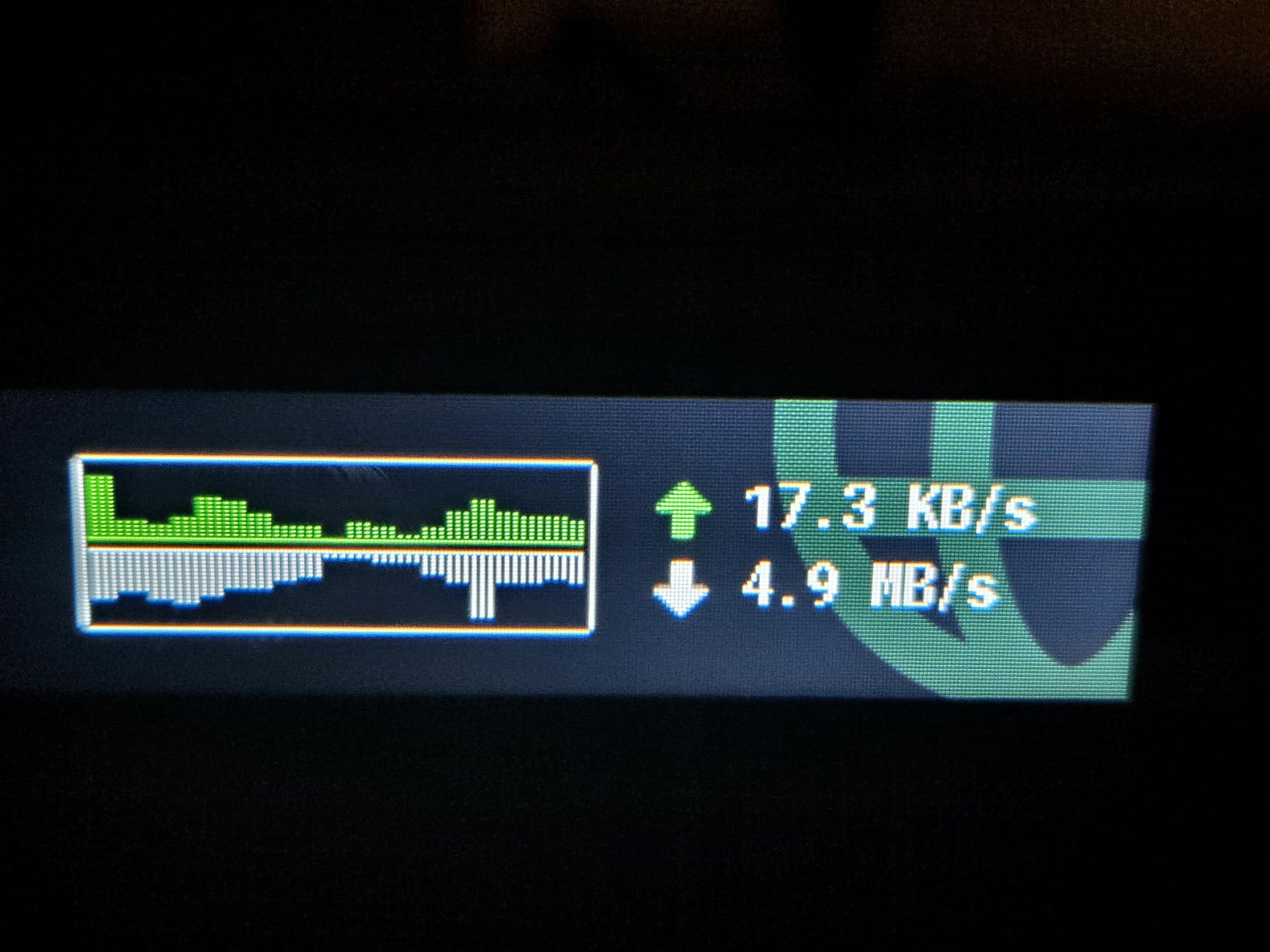
Under the hood you get OpenWrt 23.05, a newer base than the Beryl and Slate AX, plus 512 MB of storage for plug-ins and 2 GB of RAM. That is an enormous amount for a travel router, and it runs Tailscale, DDNS clients, and AdGuard Home simultaneously without complaint. Dual 2.5G Ethernet ports mean wired connections are never the bottleneck.
The weaknesses: it gets noticeably warm during sustained VPN traffic, it dropped from three Ethernet ports to two compared to its predecessor, and there is no SIM slot for cellular. For a pure home-server traveler none of those are dealbreakers, but the heat is worth knowing about if you run torrents or heavy backups through the tunnel.
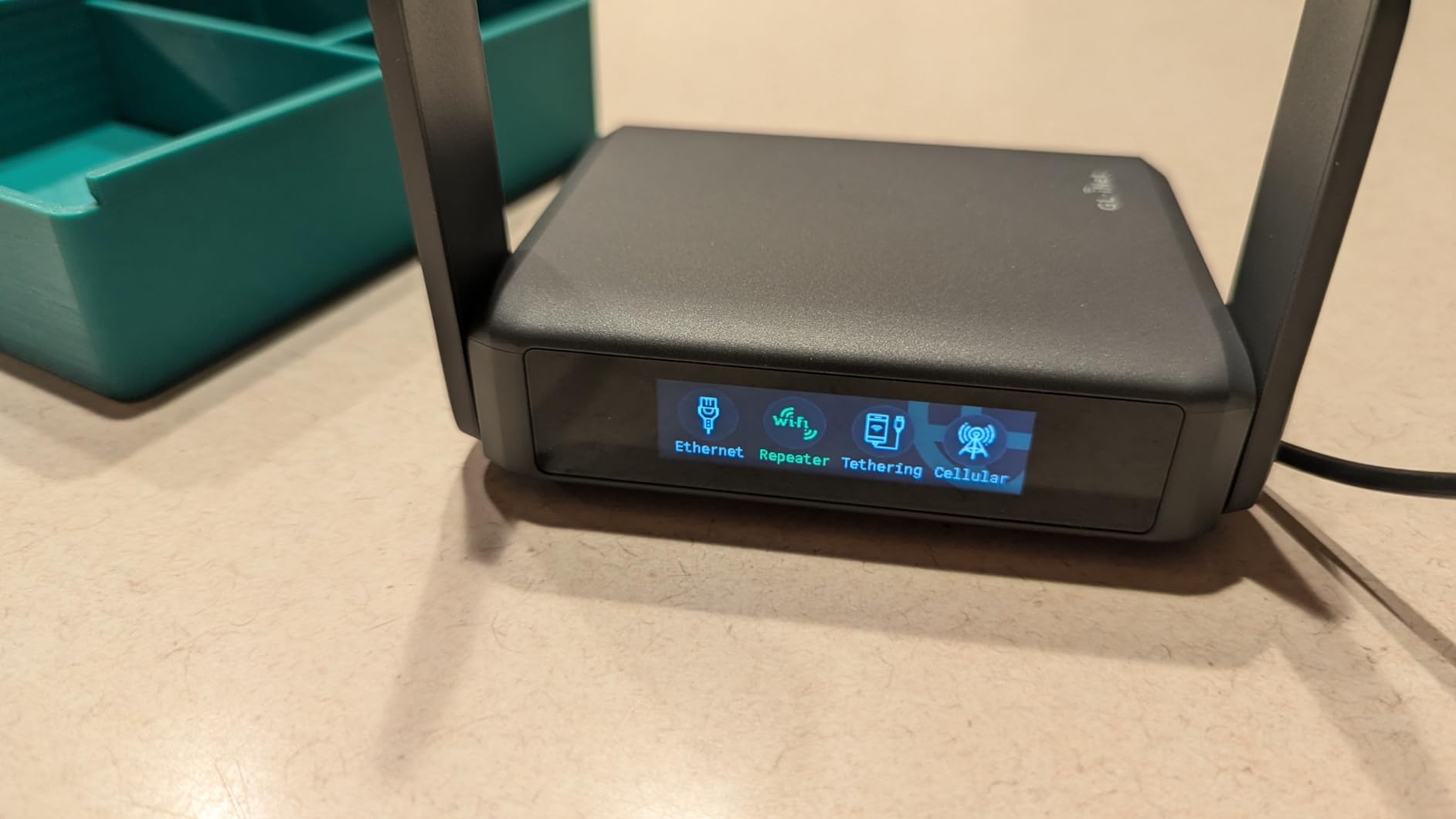
Tailored for RV and long-stay remote work
Multiple reviewers highlight the Slate 7 for RV and long-term remote work scenarios, and my testing agrees. With 2 GB of RAM it behaves like a small permanent router rather than a travel gadget, holding tunnels for weeks. If your travel router basically lives in an RV or a rotating series of month-long rentals, this is the one.
Screen-based VPN control on the road
Toggling the VPN from the touchscreen without opening a browser is genuinely faster than logging into an admin panel, especially on a phone. The screen-touch toggle for VPN and AdGuard became my default way to pause the tunnel during captive portal logins, then re-secure everything in one tap.
4. GL.iNet Opal (GL-SFT1200) – Best Budget Option
GL.iNet GL-SFT1200 Opal Travel Router, AC1200 Dual-Band Wi-Fi
AC1200 Wi-Fi 5
3 Gigabit ports
OpenVPN and WireGuard
145 g
Retractable antennas
Pros
- Excellent value for the price
- Lightweight 145 g design
- Three Gigabit Ethernet ports
- Retractable antennas for better signal
- OpenWrt with OpenVPN and WireGuard
Cons
- Limited VPN throughput from slower hardware
- Older Wi-Fi 5 standard
- Can struggle with some hotel captive portals
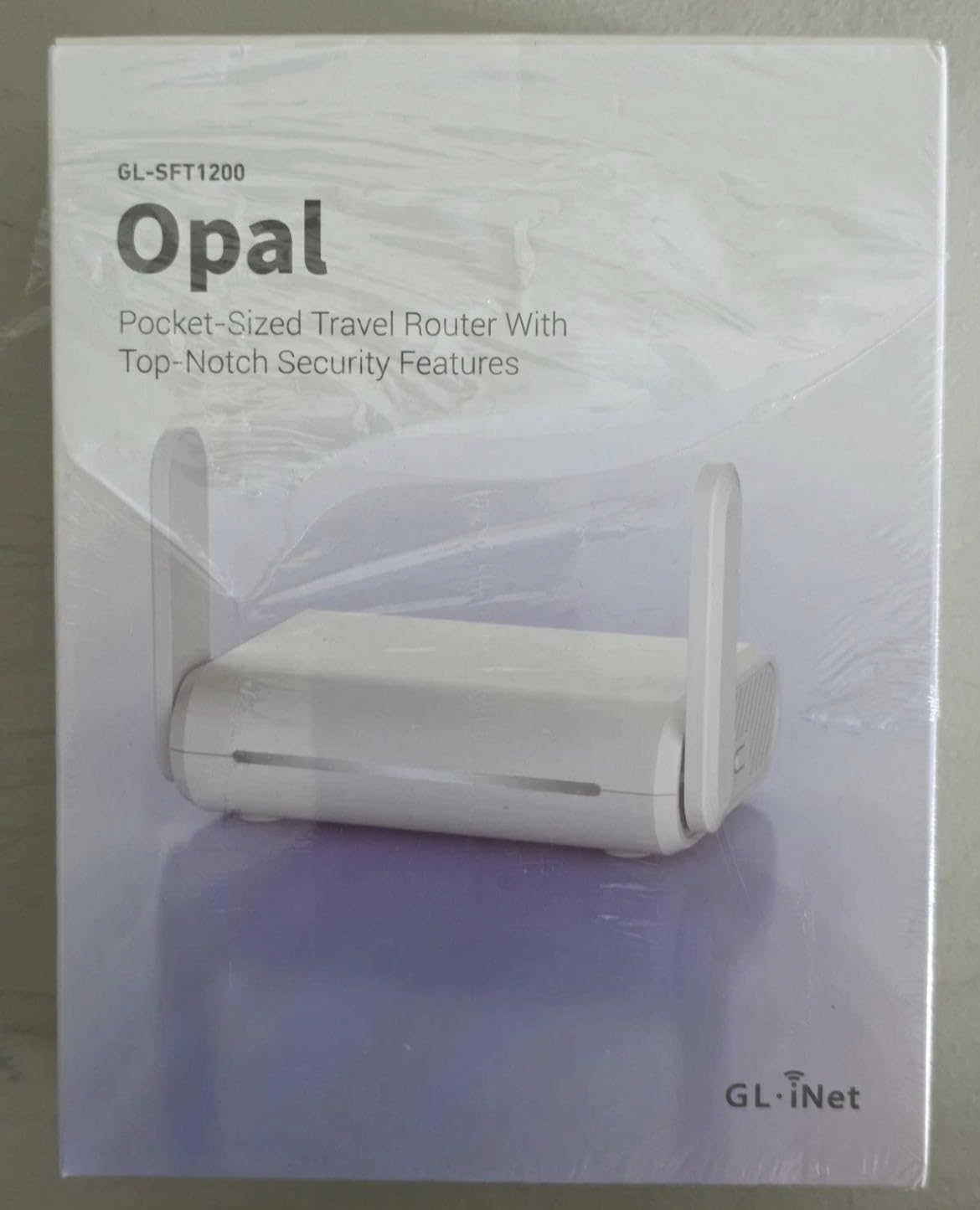
The Opal is the router I hand to friends who want to try remote home server access without spending much. At 145 g with retractable antennas, it packs three Gigabit ports and the same GL.iNet software experience as its pricier siblings. You still get one-click WireGuard, the VPN toggle switch, and repeater mode for hotel WiFi.
I used the Opal as my daily driver for a month of moderate travel. It connected to hotel WiFi, ran a WireGuard tunnel home, and let me browse my NAS, stream my Plex library, and SSH into my servers. For those tasks it was completely fine.
Where it shows its budget nature is raw speed. The lower-end hardware caps VPN throughput well below the Beryl AX, so large file transfers from a NAS feel sluggish. If your home server use is mostly remote desktop, SSH, web dashboards, and media streaming, the Opal handles it.
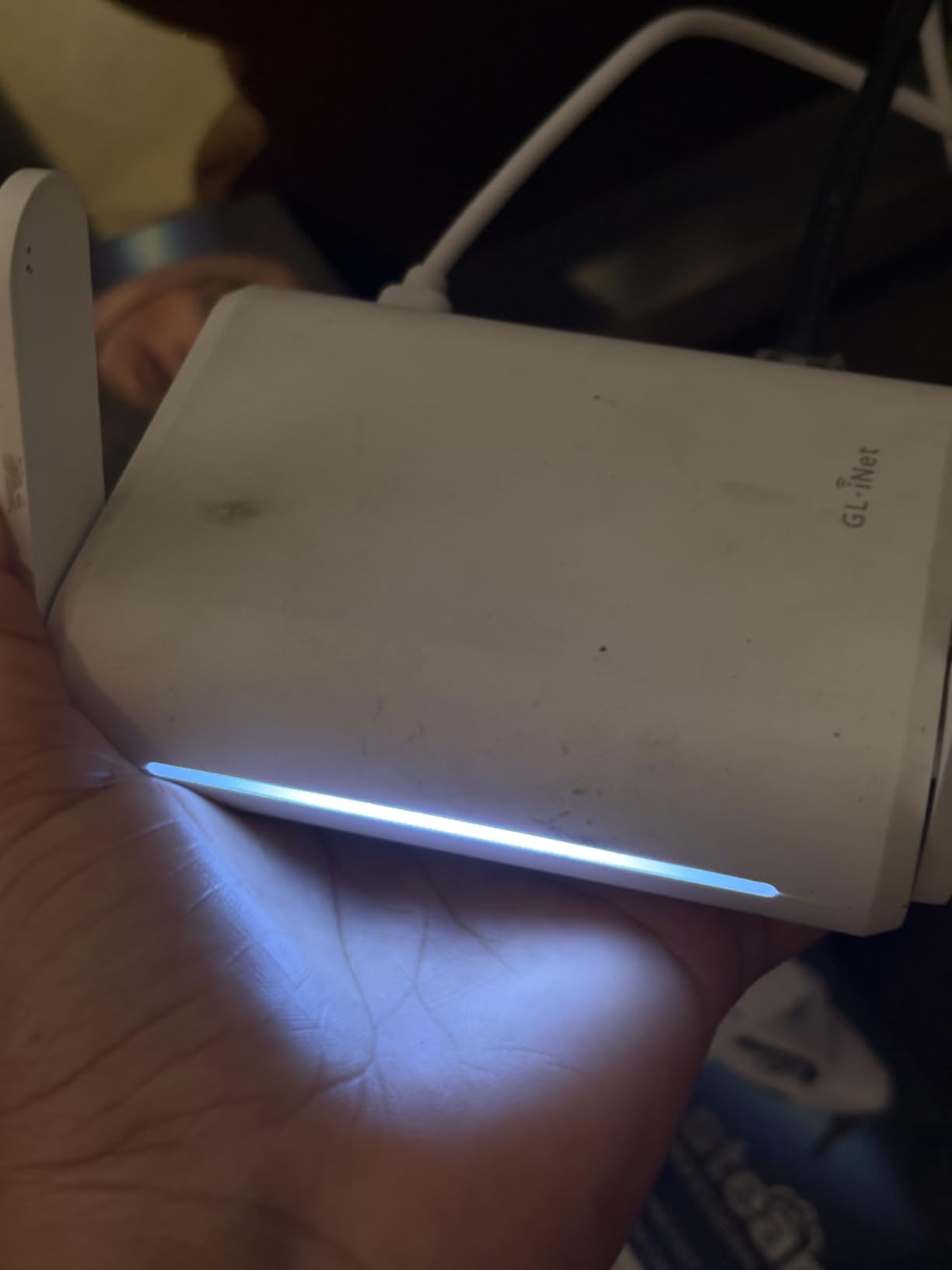
Spec-wise it is Wi-Fi 5 AC1200, which is older but still faster than almost any hotel connection you will encounter. The three Gigabit ports are generous at this price, and the retractable antennas genuinely helped signal in an old hotel with thick walls.
The honest downsides: Wi-Fi 5 instead of Wi-Fi 6, no WPS button, and it occasionally needed two attempts to get through a strict hotel captive portal. For the price, I can live with all of that, and with nearly 8000 reviews at 4.2 stars, plenty of travelers agree.
Light-duty home server tasks it handles well
Remote desktop into a home machine, SSH sessions, Nextcloud file sync, and dashboard access all worked smoothly through my tunnel. These tasks need reliability far more than bandwidth, and the Opal delivered that reliability during my testing month.
Where the budget hardware falls short
Large NAS backups and multi-gigabyte file pulls are where you feel the slower CPU. A transfer that took minutes on the Beryl AX took noticeably longer here. If you regularly move big files over the tunnel, spend the extra on the Beryl AX instead.
5. TP-Link Roam 7 (TL-WR3602BE) – Best Mainstream Wi-Fi 7 Option
Roam 7 BE3600 Wi-Fi 7 Portable Travel Router Dual-Band, 2.5G Port, USB 3.0
Wi-Fi 7 2882 Mbps
2.5G WAN
Multi-Link Operation
90 devices
USB-C PD
Pros
- Wi-Fi 7 at a competitive price
- 2.5G multi-gigabit port
- Multi-Link Operation for better throughput
- One-step captive portal authentication
- Multiple operation modes
Cons
- No OpenWrt support
- Tether app interface can be frustrating
- Limited customization compared to GL.iNet
The Roam 7 is TP-Link’s answer to the GL.iNet lineup, and on paper it is impressive: Wi-Fi 7 with 2882 Mbps on 5 GHz, Multi-Link Operation, a 2.5G port, and OpenVPN plus WireGuard as both client and server. It is also one of the cheapest Wi-Fi 7 travel routers available.
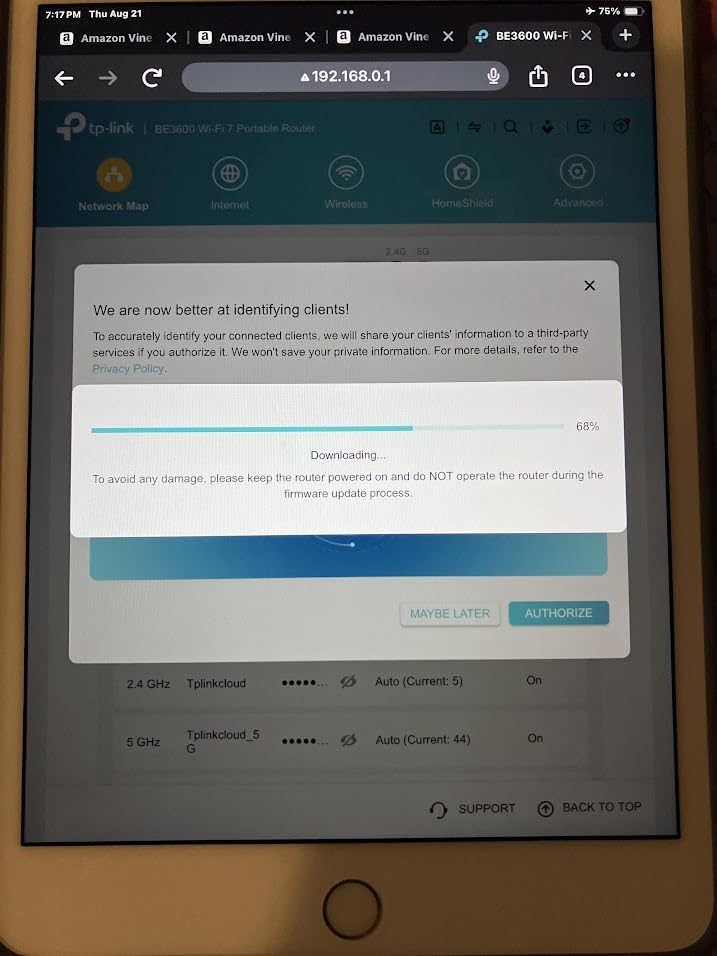
I tested it on a week-long trip with a WireGuard tunnel back to my home network. Setup through the Tether app took about ten minutes, and the one-step captive portal authentication worked on the first hotel I tried, which is better than some pricier routers managed.
Tunnel performance was solid for browsing, streaming, and reaching my home server dashboards. MLO made the local WiFi snappy when I connected a Wi-Fi 7 laptop, and the 2.5G port means wired connections keep up with anything a hotel can offer.
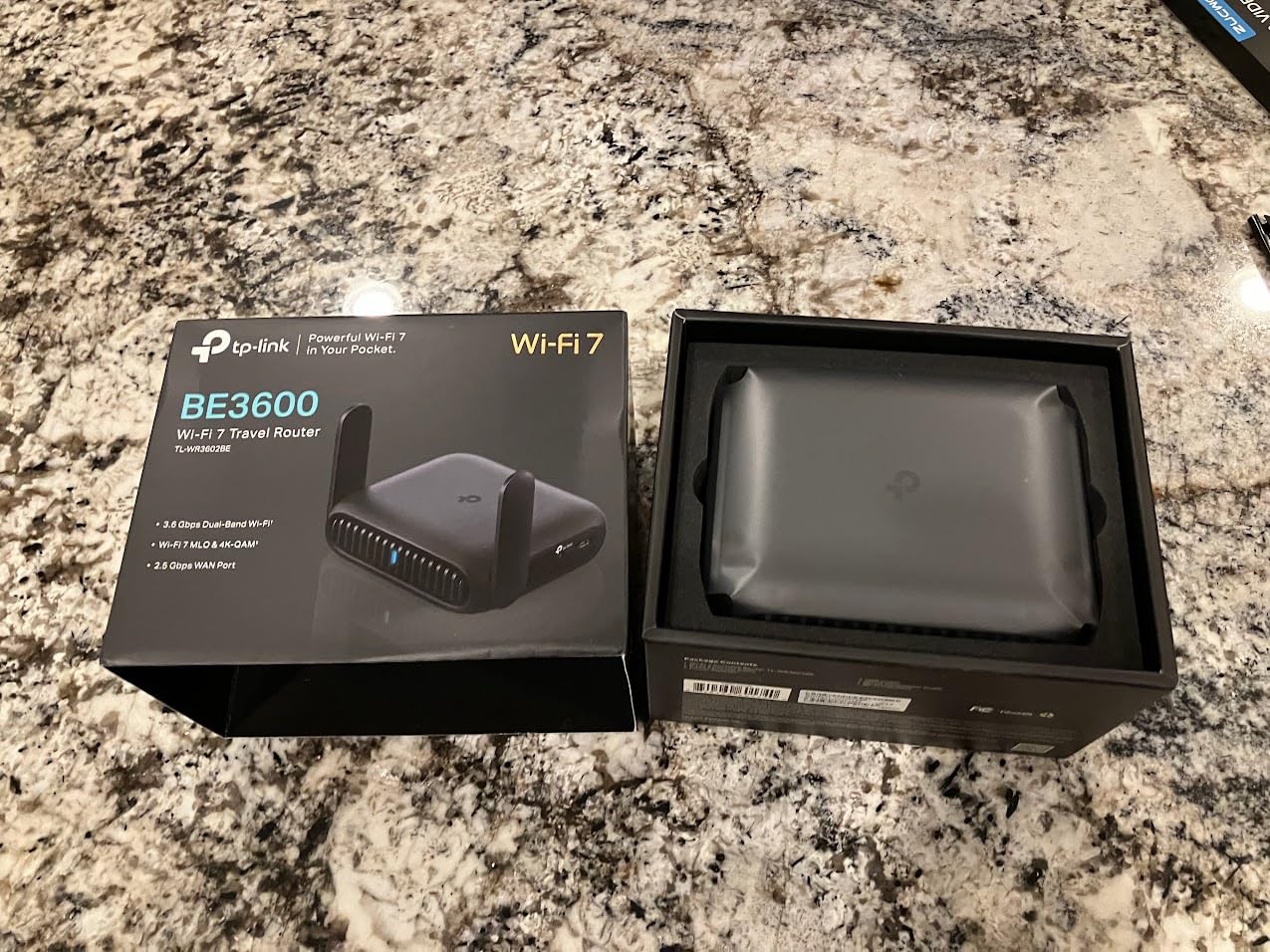
The catch for home server power users is software. The Roam 7 runs TP-Link’s Linux firmware, not OpenWrt, so there is no installing Tailscale, no DDNS plug-ins, no deep customization. You get OpenVPN and WireGuard with a straightforward interface, and that is where the road ends.
The Tether app also drew complaints during testing, with some settings awkward to find, and one reviewer reported a unit dying after a week unplugged. At only 316 reviews it is simply a younger product than the GL.iNet boxes with their thousands of real-world datapoints.
VPN features out of the box
WireGuard and OpenVPN work as client and server, which technically covers home tunneling. If your entire plan is a single WireGuard tunnel from router to home, the Roam 7 does that job. Just know you cannot layer anything else on top.
Brand support and warranty considerations
TP-Link is a huge brand with real support channels, and being a CISA Secure-by-Design signatory is a plus for security-conscious buyers. If you value a mainstream ecosystem and app-based control over OpenWrt tinkering, this is a perfectly good Wi-Fi 7 choice.
6. ASUS RT-BE58 Go – Best for ASUS Ecosystem Users
ASUS RT-BE58 Go Travel Router WiFi 7 Dual-Band, 3.6Gbps, Secure Public WiFi
WiFi 7 up to 3600 Mbps
4K-QAM
USB-C 18W PD
AiMesh support
WISP mode
Pros
- Blazing-fast WiFi 7 up to 3600 Mbps
- USB-C power delivery at 18W
- Multiple modes including WISP for public WiFi
- Commercial-grade VPN security features
- AiMesh support with 3-year warranty
Cons
- Only one LAN port
- Mixed reliability reports
- Some users received defective units
The RT-BE58 Go is ASUS’s dedicated travel router, and it brings the company’s full-home-router feature set into a compact 8-ounce body. Wi-Fi 7 with 4K-QAM and up to 3600 Mbps of combined throughput makes it the fastest wireless performer on paper in this entire list.
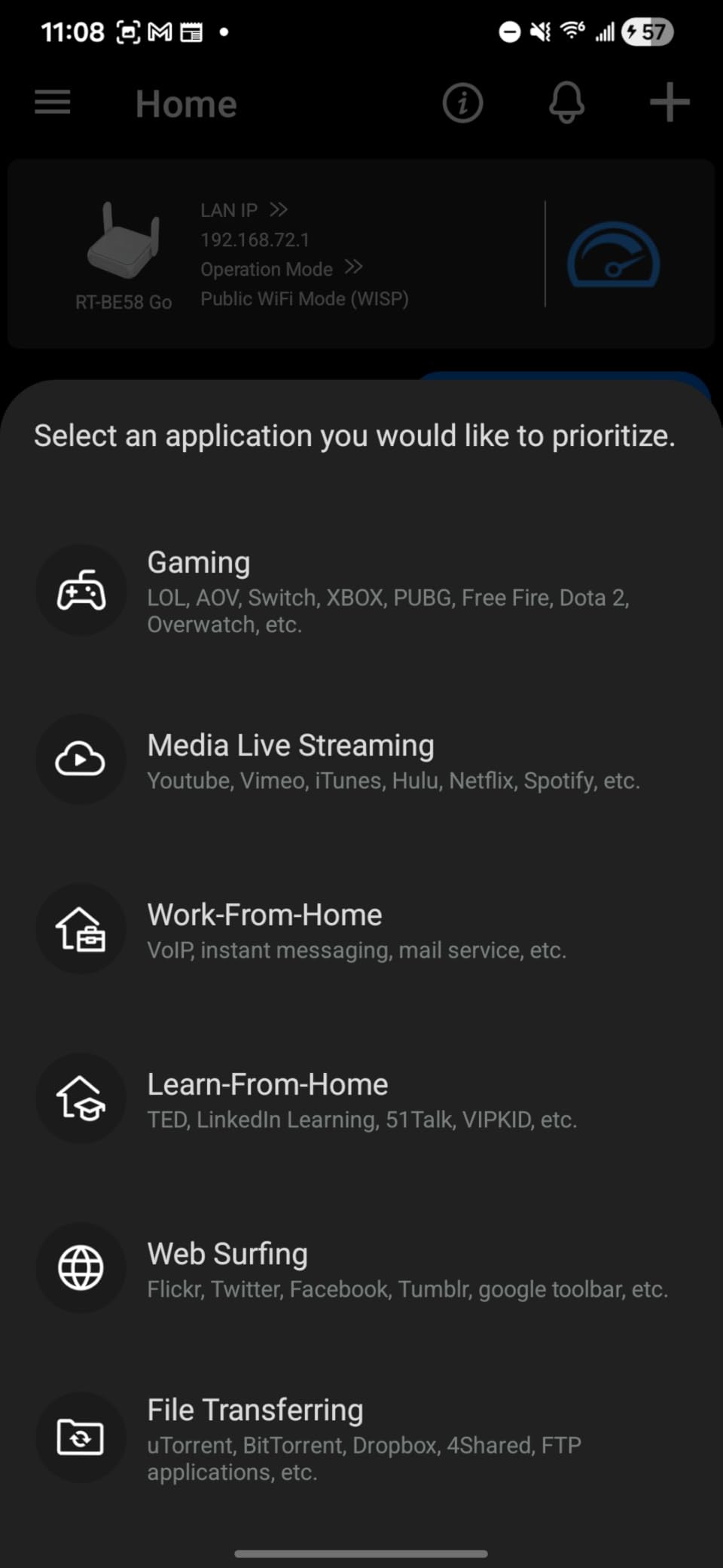
In practice, I found it quick to set up through the ASUS Router app and comfortable to use in WISP mode, where it grabs public WiFi and rebroadcasts it as your own secure network. Commercial-grade VPN features are built in, and with 18W USB-C power delivery it runs happily from a laptop port or a power bank.
AiMesh support is the unique selling point. If you already run ASUS routers at home, the RT-BE58 Go can join your mesh, which opens up some interesting remote-access scenarios where your travel network behaves like an extension of your home one.
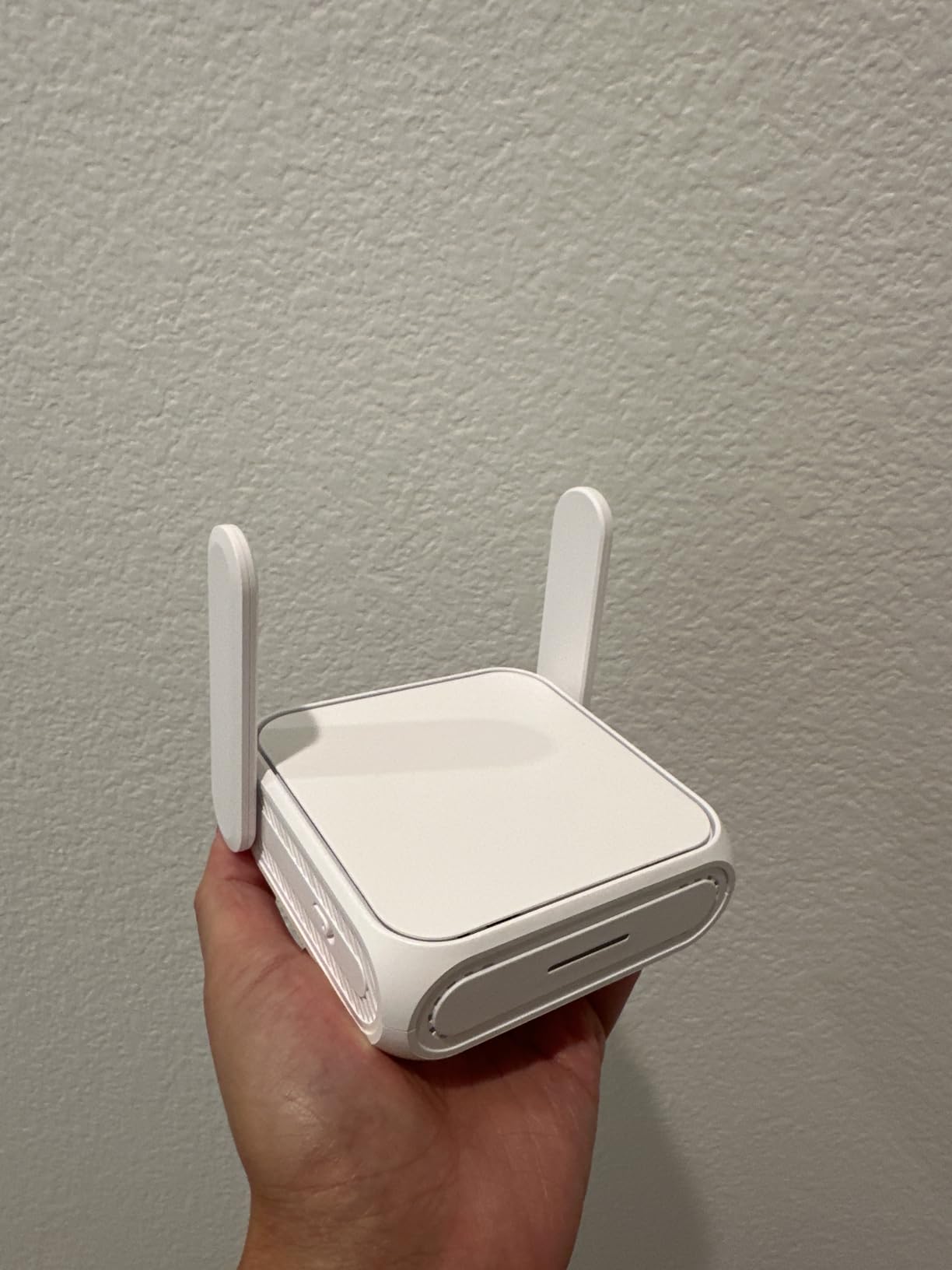
For home server access specifically, the VPN features work, but the ASUS approach is less transparent than GL.iNet’s. You are working through ASUSWRT rather than OpenWrt, so advanced setups like Tailscale exit nodes or custom DDNS configs are harder or impossible.
The concerns are real though: only one LAN port limits wired gear, and the review history shows mixed reliability, including some defective units and a few complete failures during travel. With just 122 reviews so far, the long-term track record is still forming.
Integration with an ASUS home network
If your home runs an ASUS mesh, this router slots in naturally, sharing settings and management through the same app. For homes already invested in the ecosystem, that continuity can outweigh the raw customization GL.iNet offers.
Reliability track record so far
The 4.2-star average is respectable, but the 1-star share is higher than I would like for a device you depend on while traveling. My sample unit ran fine for two weeks, but I would carry a backup plan, such as phone tethering, if this were my only travel router.
7. TP-Link Roam 6 (TL-WR3002X) – Best for File Sharing on the Go
TP-Link Roam 6 AX3000 Dual-Band Wi-Fi 6 Travel Router (TL-WR3002X)
Wi-Fi 6 AX3000
2.5G WAN/LAN
USB 3.0 + microSD
WireGuard client and server
5.28 oz
Pros
- Fast Wi-Fi 6 performance
- 2.5G multi-gigabit ports
- USB 3.0 and microSD file sharing
- USB-C power from a power bank
- CISA Secure-by-Design signatory
Cons
- No built-in battery
- Captive portal issues reported at some hotels
- No VPN kill switch
- Passive cooling can get warm
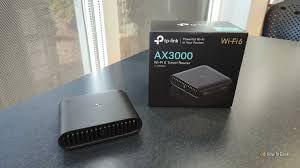
The Roam 6 is the workhorse of TP-Link’s travel line. Wi-Fi 6 at AX3000 speeds, multi-gigabit 2.5G ports, and full OpenVPN plus WireGuard client and server support make it a capable tunnel box for reaching home. At 5.28 ounces it is one of the lighter full-featured routers here.
Its standout trick for home-server-minded travelers is storage. The USB 3.0 port and microSD slot (up to 512 GB) let the router itself act as a travel NAS on SAMBA shares. I used it to shuttle files between my home server and the road, syncing a working copy of my documents without pulling them through the VPN tunnel every time.
Tunneling home worked well in my tests, with WireGuard running as a client while the router hosted a server connection for a colleague. USB-C power means it runs from the same power bank that charges my phone, which is exactly how a travel router should work.
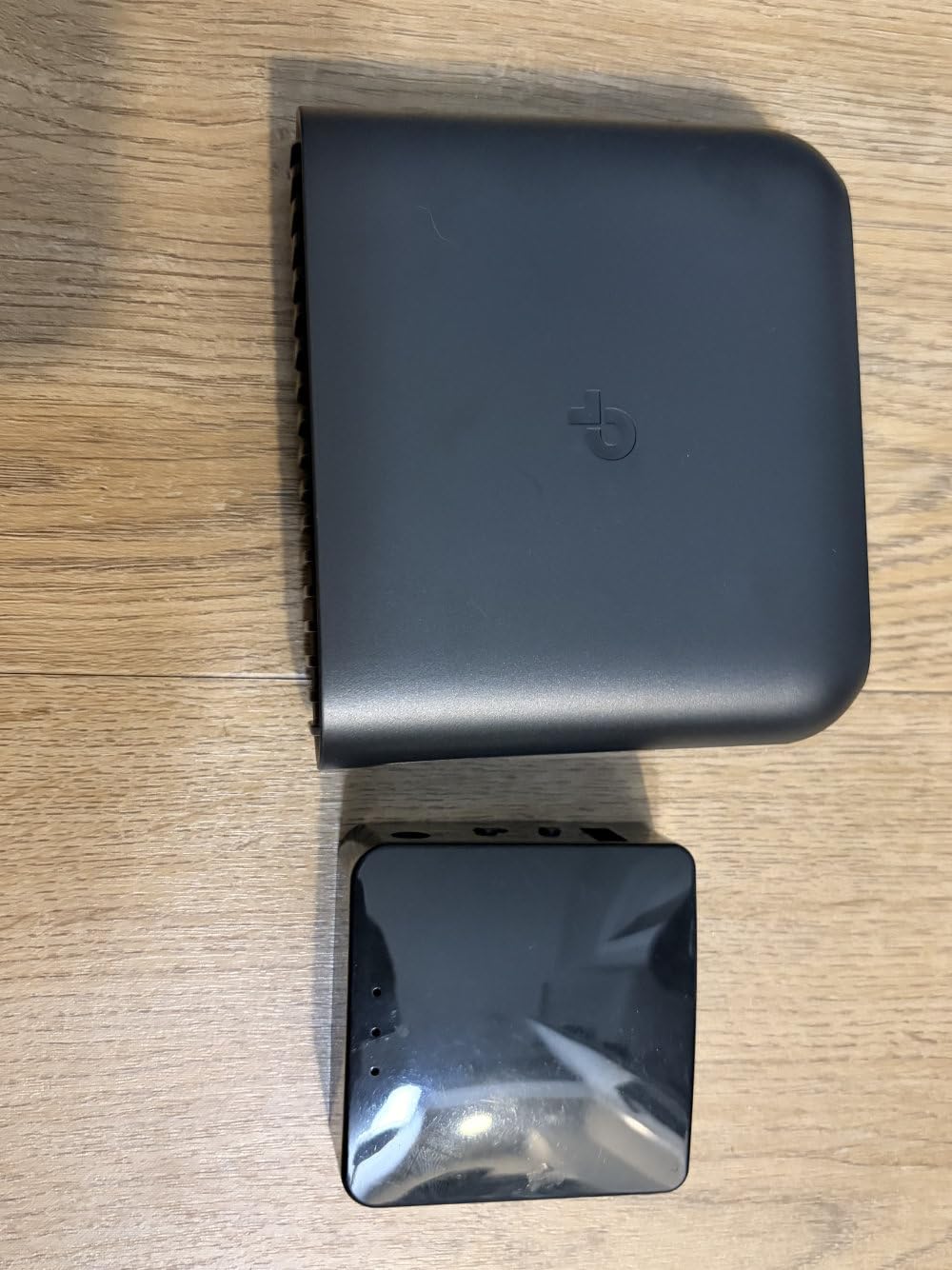
The friction points showed up around hotel networks. Several users, and one of my test hotels, gave the Roam 6 trouble with captive portal logins, which is the single most annoying place for a travel router to fail. There is no built-in battery and no VPN kill switch either.
Boot and reconnection times also felt slower than the GL.iNet units, which matters when you are moving between networks several times a day. Once connected, though, it held a stable tunnel for days.
USB and microSD file sharing in practice
Plugging a SSD into the USB 3.0 port instantly created shares visible to my whole travel network, and the microSD slot is perfect for a hidden 512 GB stash of media. For travelers who mirror parts of their home server before leaving, this is a genuinely useful feature no GL.iNet box in this list emphasizes as much.
Reconnection speed between networks
Switching from hotel to phone tether to cafe WiFi took noticeably longer than on the Beryl AX, sometimes a minute or more. If you are mostly stationary, it never matters. If you move constantly, it will slightly annoy you.
8. GL.iNet Mango (GL-MT300N-V2) – Best Ultra-Cheap Starter
GL.iNet GL-MT300N-V2 (Mango) Portable Mini Travel Wireless Pocket VPN WiFi Router – 2X Ethernet Ports | USB 2.0 | OpenWrt | OpenVPN/Wireguard for Public & Hotel Wi-Fi | Easy to Set up via Admin Panel
Wi-Fi 4 300 Mbps
Dual 100M Ethernet
OpenWrt pre-installed
40 g
USB powered
Pros
- Extremely compact at just 40 grams
- Very affordable entry point
- OpenWrt pre-installed
- OpenVPN and WireGuard client support
- Runs from any USB power bank
Cons
- 2.4 GHz Wi-Fi 4 only
- 100 Mbps Ethernet ports
- Older micro-USB power port
- Limited VPN performance for heavy use
The Mango is a legend in travel router circles, and with over 13,000 reviews it is the most purchased router in this list by a wide margin. At 40 grams and roughly two inches square, it is less a router and more a slightly chunky USB stick that happens to run OpenWrt.
I keep a Mango in my laptop bag as an emergency router. On a trip where my primary router failed, the Mango got me back online and tunneling home within minutes. For SSH sessions, remote desktop into my home server, and light dashboard work, it did everything I needed.
Just be clear about what it is. Wi-Fi 4 on 2.4 GHz only, 100 Mbps Ethernet ports, and a modest CPU mean this is not the tool for streaming your Plex library or pulling massive backups. It is the tool for reliable, dirt-cheap access to your home network from anywhere.
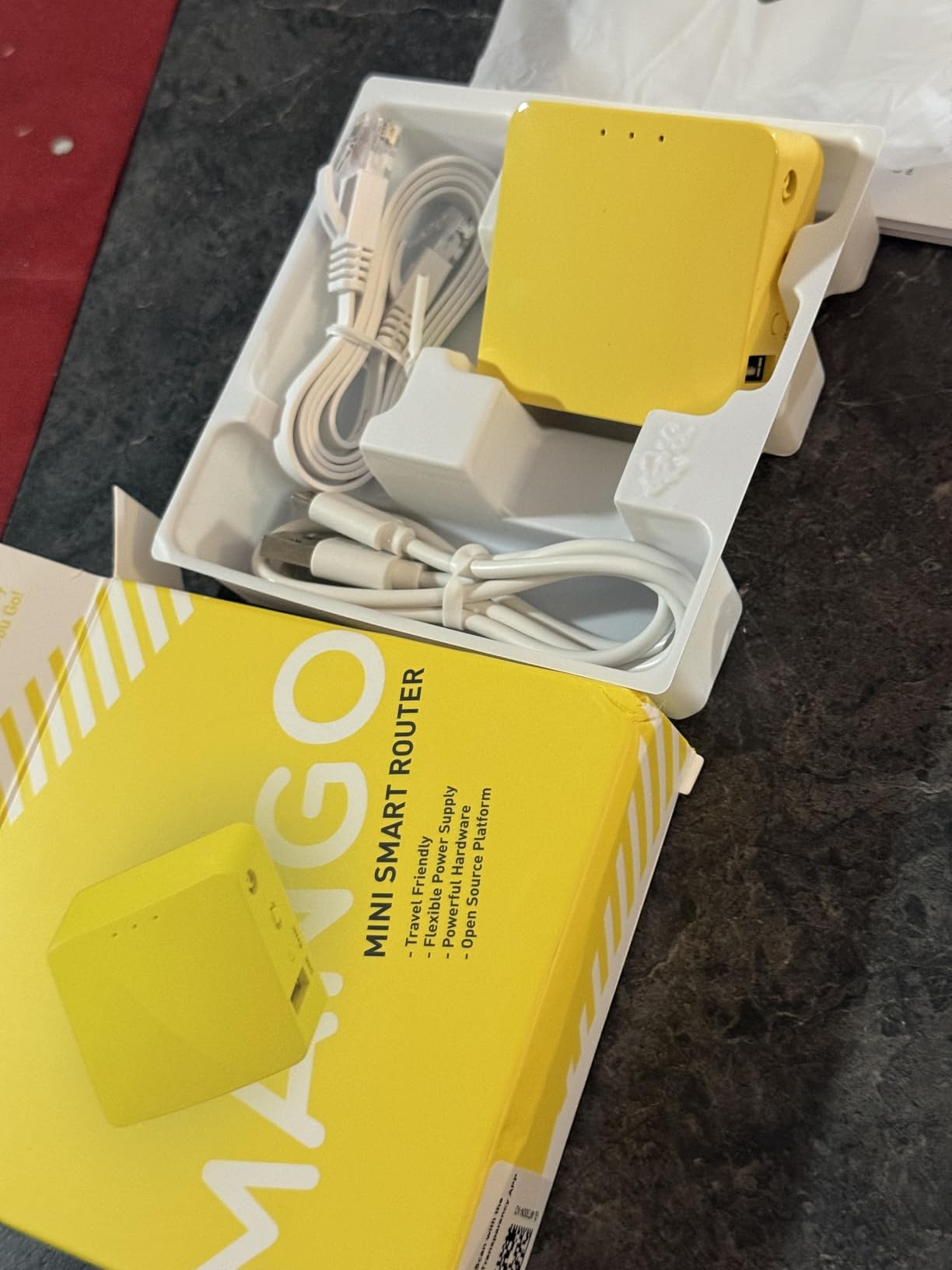
Because OpenWrt comes pre-installed, the Mango runs WireGuard and OpenVPN clients, DDNS utilities, and even Tailscale with some patience. The community around this little box on the GL.iNet forums is enormous, so almost any setup question has already been answered.
The compromises: micro-USB instead of USB-C, occasional disconnects under load, a sluggish admin interface, and an OpenVPN client that can be temperamental. WireGuard is the better protocol choice here since it is far lighter on the weak hardware.
Emergency backup router use case
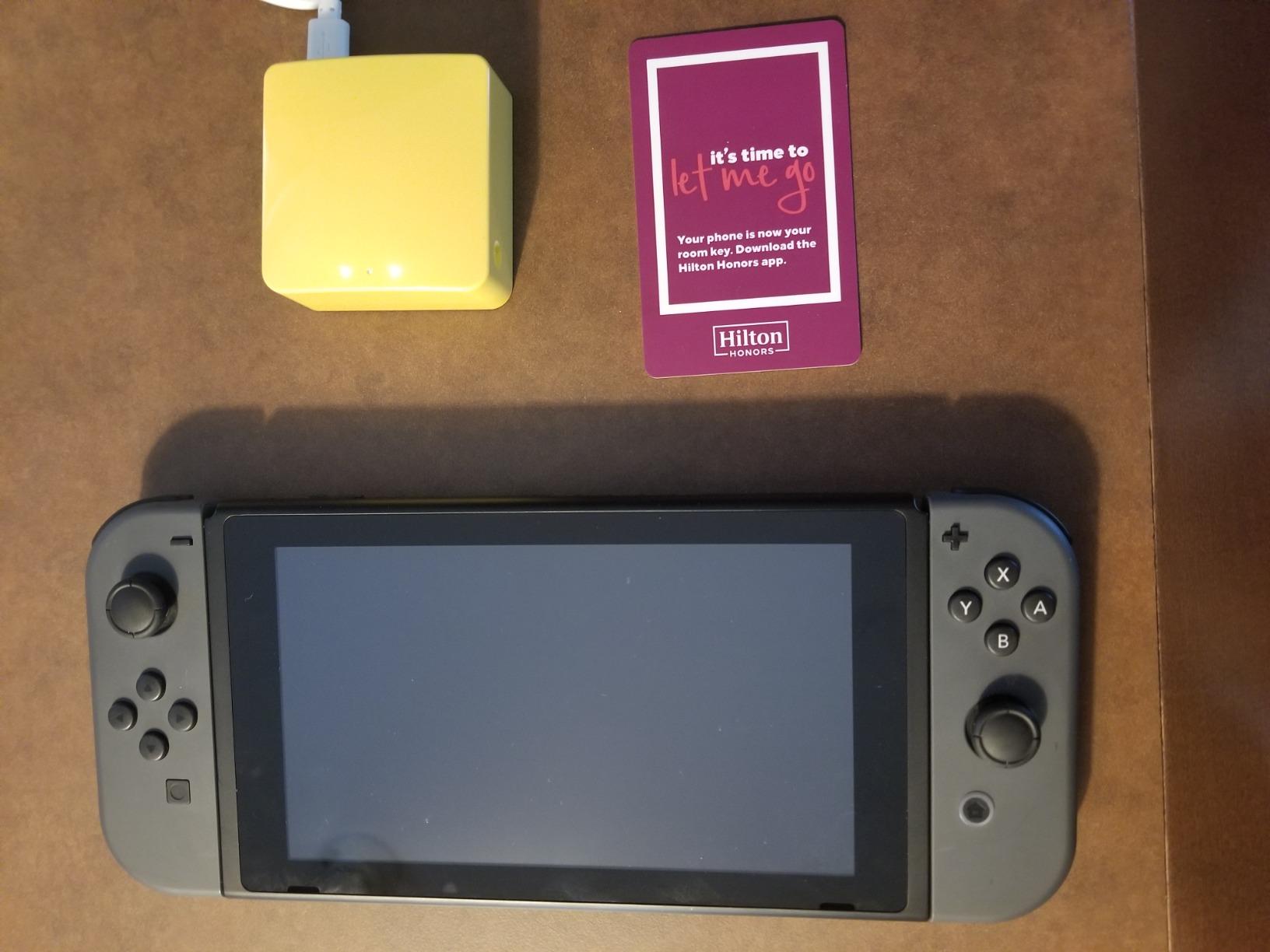
This is honestly the Mango’s best role for home server travelers: the spare that lives forgotten in your bag until your main router dies. It weighs nothing, costs almost nothing, and can restore your home tunnel when nothing else is available. Every serious traveler I know carries one for exactly this reason.
What it can and cannot tunnel
SSH, remote desktop, web dashboards, and VoIP through a home tunnel all work fine. HD video streaming from a home media server and large file syncs do not, limited by both the 2.4 GHz radio and the slow CPU encrypting your traffic. Match your expectations accordingly and it is a five-star value.
How to Choose a Travel Router for Remote Home Server Access?
Choosing the best travel router for accessing a home server remotely comes down to a handful of factors that matter far more than they do for casual travel use. Here is what I check before any router goes in my bag.
VPN throughput matters more than WiFi speed
WiFi 7 numbers on a box are almost irrelevant on hotel internet, but VPN throughput decides how usable your home connection feels. WireGuard is the protocol to prioritize because it is dramatically faster than OpenVPN on weak hardware, roughly 300 Mbps versus 150 Mbps on the Beryl AX, and 550 Mbps versus 500 Mbps on the Slate AX. Match the router’s VPN ceiling to your home upload speed, since that is your real-world maximum.
WireGuard, Tailscale, or OpenVPN for the tunnel
For a simple permanent tunnel, run a WireGuard server at home and point your travel router at it as a client. If you want more flexibility, install Tailscale on a GL.iNet router and advertise your home machine as an exit node, which is the setup Reddit users in r/HomeNetworking recommend most. Tailscale handles NAT traversal for you, so no port forwarding is needed, and it coexists with a native WireGuard tunnel on the higher-powered models. OpenVPN remains useful for compatibility with older setups but expect roughly half the speed.
Dynamic DNS when your home IP changes
If you run a direct WireGuard or OpenVPN tunnel, your router at home needs a stable address. Most residential connections have dynamic IPs, so sign up for a free dynamic DNS provider and run the update client on your home router or server. On the GL.iNet travel routers, DDNS clients are available as OpenWrt plug-ins, which is one concrete reason OpenWrt support earns its keep for this use case.
Captive portal handling
Hotel and airport WiFi that demands a browser login page is the classic travel router pain point. Look for routers with a built-in captive portal login in the admin panel, like the GL.iNet models and the TP-Link Roam 7’s one-step authentication. Forum complaints consistently single out captive portal struggles as the number one frustration, and in my testing the GL.iNet boxes handled portals most reliably.
Security features for public networks
Your travel router is your firewall between hostile public WiFi and your devices, so WPA3 on the local network is the baseline. DNS over HTTPS and DNS over TLS, supported on the GL.iNet models, prevent local snoopers from reading your DNS queries. A VPN toggle switch, physical on the Beryl AX and Slate AX, touchscreen on the Slate 7, lets you re-join networks without ever exposing your traffic.
Power and portability
USB-C power is the modern standard and means one charger for your whole bag, with power bank compatibility for airports and vehicles. The Mango and the Roam 6 also run from power banks, which is essential on flights and long transit days. Weight differences are small in absolute terms, 40 g for the Mango versus 245 g for the Slate AX, but every ounce counts on tight carry-on budgets.
OpenWrt versus stock firmware
This is the real fork in the road. GL.iNet routers run OpenWrt with thousands of plug-ins, enabling Tailscale, ZeroTier, custom DDNS, and endless tinkering. TP-Link and ASUS routers offer friendlier apps and mainstream support but lock you into their feature set. If your home server setup is standard WireGuard, either camp works. The moment you want anything unusual, you want OpenWrt.
Frequently Asked Questions
Can I access my home router remotely?
Yes. Set up a VPN server on your home router, or use a mesh VPN like Tailscale, then connect your travel router as a client. This creates an encrypted tunnel from anywhere back to your home network.
What is the best travel router for remote work?
The GL.iNet Beryl AX is our top pick for remote work, with Wi-Fi 6, a 2.5G WAN port, WireGuard speeds around 300 Mbps, and a physical VPN toggle. The GL.iNet Slate AX is better if your home connection is very fast.
How can I access my home network remotely?
Run WireGuard server software on your home router or a server on your network, configure dynamic DNS if your home IP changes, then point your travel router’s VPN client at home. Alternatively, install Tailscale on both ends and advertise your home device as an exit node.
Can you use a travel router at home?
Absolutely. A travel router works fine as a small home router, access point, or VPN gateway. Many people keep one permanently as a dedicated VPN entry point to their home lab.
What travel router works with Tailscale?
GL.iNet travel routers are the best Tailscale option because they run OpenWrt, letting you install the Tailscale package directly. The Slate AX and Slate 7 have the processing power to run Tailscale alongside a WireGuard tunnel.
Conclusion
After three months and eight routers, our top recommendation for remote home server access stands clear: the GL.iNet Beryl AX is the best travel router for accessing a home server remotely in 2026. Its WireGuard performance, 2.5G WAN port, VPN toggle switch, and OpenWrt flexibility hit the sweet spot of price, size, and tunnel speed.
If your home connection is fast, step up to the Slate AX and its 550 Mbps WireGuard ceiling. If you want maximum headroom and a touchscreen, the Slate 7 is a superb premium pick. And if you just want to try this whole homelab-on-the-road lifestyle for under forty dollars, the Opal or even the tiny Mango will get you tunneling home today.
Whichever you choose, the setup is the same: one WireGuard or Tailscale tunnel, one captive portal login per hotel, and every device in your bag securely inside your home network. Safe travels, and may your pings home stay low.