
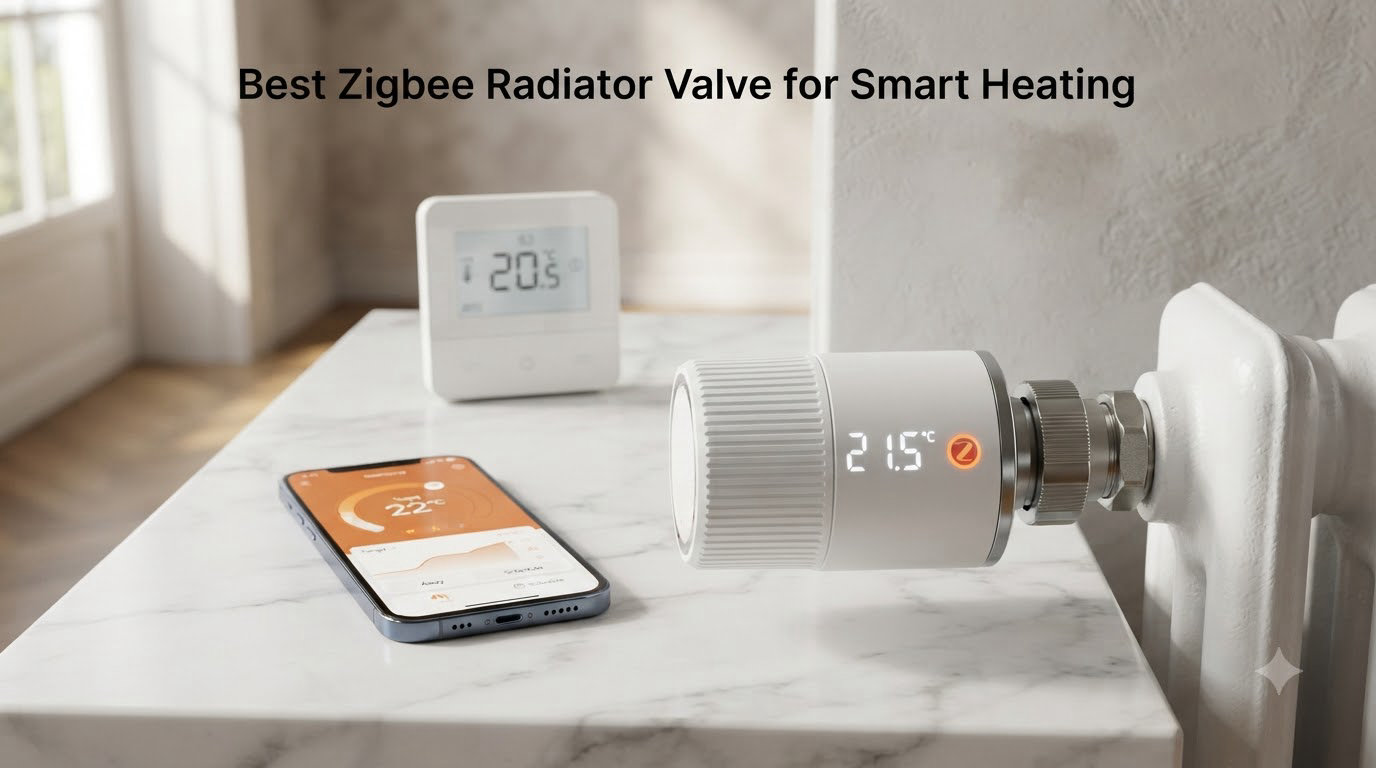
If you are looking for the best Zigbee radiator valve for smart heating, the main decision is not simply which valve has the largest display. It is which device fits your radiator bodies, works with your preferred hub, reports its state clearly, and keeps regulating heat when your internet connection disappears.
A Zigbee TRV replaces a manual or ordinary thermostatic radiator valve. It measures temperature, receives a target setpoint over a Zigbee mesh, and moves an internal actuator to open or close the radiator.
That gives you room-by-room heating without replacing the boiler, underfloor manifold, or every radiator at once. I also value local control: a coordinator such as Home Assistant with ZHA or Zigbee2MQTT can run schedules, automations, presence rules, and temperature histories without sending every command through a vendor cloud.
Our comparison covers eight products with very different levels of evidence behind them. Danfoss is the established choice for older European valve bodies, while the Shelly kit uses Bluetooth from valve to gateway and then joins your network through its gateway. The other models mostly sit in the Tuya or app-driven value tier, where app names and exposed Zigbee clusters can matter more than the hardware price.
Before buying, check the thread, measure the existing valve, and confirm whether adapters are included. A valve that cannot mount cleanly is not a smart purchase, however polished its interface looks.
Table of Contents
Top 3 Picks for Best Zigbee Radiator Valve for Smart Heating in 2026

The Danfoss Ally is my pick for a radiator-first installation because its adapter set and M30 orientation are familiar in European systems. SENCKIT makes more sense when a Tuya hub is already part of your home and you want schedules plus voice support. Aurikall is the low-cost feature pick, but its lack of reviews means I would treat it as a monitored experiment rather than a settled long-term choice.
Best Zigbee Radiator Valve for Smart Heating in September
| Product | Specs | Action |
|---|---|---|
 Danfoss Ally Radiator Thermostat Danfoss Ally Radiator Thermostat |
|
Check Latest Price |
 Shelly Blu TRV & Blu Gateway Gen3 Shelly Blu TRV & Blu Gateway Gen3 |
|
Check Latest Price |
 SENCKIT Tuya Zigbee TRV SENCKIT Tuya Zigbee TRV |
|
Check Latest Price |
 ngnsky NGN-mg-1600 ngnsky NGN-mg-1600 |
|
Check Latest Price |
 ngnsky ZTRV-mg-1600 ngnsky ZTRV-mg-1600 |
|
Check Latest Price |
| Aurikall Rotatable-Screen TRV |
|
Check Latest Price |
 HLFuBynox Tuya TRV HLFuBynox Tuya TRV |
|
Check Latest Price |
 AVATTO TRV07 AVATTO TRV07 |
|
Check Latest Price |
My ranking weighs evidence of long-term use, integration depth, adapter coverage, and diagnostic feedback more heavily than headline features. The first three options are the safest starting points, while the five remaining products are best suited to a Tuya-led system or a buyer willing to accept a newer product record.
1. Danfoss Ally Radiator Thermostat – M30 fit and dependable Zigbee control
Danfoss Ally Radiator Thermostat. Ally, White, IP20, 90 øC, 5 -, W125786971 (Ally, White, IP20, 90 øC, 5-35 øC, 0-40 øC, -20-65 øC)
Zigbee 3.0
M30 adapters
2 AA batteries
LCD touch control
Pros
- Reliable local control
- Quiet operation
- Strong EU fit
- OTA updates
Cons
- No M28 adapter
- Documentation can be unclear
The Danfoss Ally is the most convincing product in this list for an existing European radiator system. It runs on two AA batteries, uses Zigbee connectivity, and has a compact LCD with touch control; the supplied review data also identifies multiple adapters, quiet operation, and OTA update support.
With Home Assistant, I pair it through Zigbee2MQTT when I want predictable entities and direct control over setpoint, measured temperature, battery state, and valve position. The Ally can operate without a Danfoss bridge, so the device is not dependent on the vendor cloud for every schedule.
Its biggest installation trap is compatibility. The product is described as M30-focused and does not include an M28 adapter in the supplied package, so an older or unusual radiator may need a separately sourced adapter. That is a small extra step, but it is exactly the kind of detail that separates a successful retrofit from a return.
For whom it is good
I would choose the Ally for a homeowner with common M30 or included Danfoss adapter bodies, especially when Home Assistant, ZHA, or Zigbee2MQTT is already running. Its 194 reviews and 4.3 rating are the strongest evidence set in this group, and the quiet actuator is welcome in bedrooms.
It also suits someone who values local operation and firmware updates more than a colorful app. The device has a clear role in a multi-room heating system: measure, adjust, and report without requiring a proprietary bridge.
For whom it is bad
I would not pick it for a valve body that needs M28 hardware unless you already own the correct adapter. I would also test rechargeable cells if that is your normal battery plan, because the supplied review data flags the battery indicator as less reliable with rechargeables.
Finally, the documentation is not the clearest onboarding material. If you want a guided wizard that explains every Zigbee cluster, another product may feel friendlier even if its long-term evidence is thinner.
2. Shelly Blu TRV & Blu Gateway Gen3 – Bluetooth valve with a Zigbee bridge
Shelly Blu TRV & Blu Gateway Gen3, Bluetooth-Operated Smart Thermostatic Valve, Smart Thermostatic Radiator Valve, Temperature Control, Home Automation, Compatible with Alexa, Google, Home Assistant
Bluetooth TRV
USB gateway
2 AA batteries
Home Assistant
Pros
- Precise control
- Boost mode
- Scheduling
- Three-year warranty
Cons
- Gateway must stay powered
- Some Alexa reports
The Shelly Blu TRV is not a direct Zigbee radiator valve in the same sense as the Danfoss. The valve itself is Bluetooth-operated, and the included Blu Gateway Gen3 provides the bridge into the Shelly ecosystem and Home Assistant. That architecture is useful when you want a small valve with a broad set of Shelly automations.
The supplied specifications list precise temperature control of ±0.1°C, Boost Mode, smart scheduling, external sensor support, and a three-year warranty. The trade-off is infrastructure: the gateway is a continuously powered USB device, so a clean outlet location and reliable power supply matter.
I would place this in a room where Shelly devices already exist or where Bluetooth placement gives better coverage than a battery-only Zigbee endpoint. The 4.0 rating and 110 reviews provide a more useful reliability signal than the unrated products later in this roundup.
For whom it is good
This kit fits a Shelly household. It is also a good fit for someone who values boost heating, external room sensors, and a warranty over the simplest possible radio path.
Home Assistant users can treat the gateway as a managed part of the system rather than a mystery bridge. I would still confirm the exact Bluetooth coverage at the radiator before committing the wall location.
For whom it is bad
I would avoid it in a holiday home or cabinet where the gateway cannot remain powered. Some users report rattling noise, and Alexa integration is described as unreliable in the supplied feedback.
It is also less suitable for a buyer who specifically wants every radiator to be a native Zigbee mesh node. The valve may fit the Shelly workflow, but the product data names Bluetooth as its operating connection.
3. SENCKIT Tuya Zigbee TRV – feature-rich budget option
Smart Thermostat Radiator Valve: Programmable Thermostatic Valve, Zigbee Thermostat for Temperature Adjustment, App Control, Tuya Zigbee Hub Required, Compatible with Alexa, Google Home (White)
Tuya Zigbee
2 AA batteries
LCD
5°C to 45°C
Pros
- Window and eco modes
- Weekly schedules
- Voice control
- Child lock
Cons
- App integration reports
- German manual not included
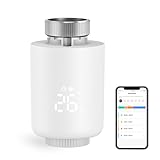
The SENCKIT is the strongest value-oriented Tuya choice in this set. It uses Zigbee, includes two AA batteries, has an LCD, and exposes a useful range of schedules and modes: vacation, comfort, window, automatic, manual, and energy saving.
At a basic level, I like the breadth of the feature list. Alexa and Google voice control are convenient for a household that already uses those assistants, while the five-to-six period weekly schedule is enough to split a normal weekday routine.
The review record is mixed: 22 reviews and a 3.6 rating point to decent value but also SmartLife integration problems for some users. I would pair it with a Tuya Zigbee hub and use Home Assistant through a supported bridge only after checking the local entity names and error reports.
For whom it is good
I would recommend SENCKIT to a buyer who already runs Tuya or Smart Life and wants a conventional feature set without buying the most established name in the category. The LCD, child lock, window mode, and scheduling make it practical for a first smart-heating install.
It can also work well in a rented property where plumbing changes are out of the question. Fit still needs to be checked at the valve body, because no software feature compensates for an incompatible thread.
For whom it is bad
I would not make this the foundation of a large, critical heating system without testing the integration first. The low review count and app-related complaints make a small pilot room the sensible rollout.
The German manual omission is a friction point for European buyers. If precise automations and rich diagnostics are the reason you want a Zigbee thermostat, the cheaper hardware may cost you time later.
4. ngnsky NGN-mg-1600 – Zigbee 3.0 with long history storage
Zigbee Smart Heating Thermostatic Radiator Valve, Mobile App Remote Control,Temperature Adjustment,LED Digital Display,ZigBee Hub Require.(EU/UK)
Zigbee 3.0
LED display
App control
2 AA batteries
Pros
- Six-month history
- Group control
- Anti-calcification
- Window function
Cons
- No customer reviews
- Less established support
The ngnsky NGN-mg-1600 advertises Zigbee 3.0, an LED display, app control, and a large feature bundle for a value-priced radiator valve. Its six-month historical data claim is notable if you want to compare room temperatures over a full heating season.
I read those claims as useful promises, not proven outcomes. The product has no customer reviews in the analyzed data, so I would validate the exposed sensors, setpoint control, battery reporting, and error reporting in one room before buying a set for the house.
The included feature set covers schedules, group control, antifreeze, window opening, anti-calcification, and child lock. That is a lot of functionality, but a longer feature list does not replace a reliable Zigbee interview or a clear adapter list.
For whom it is good
I would consider it for a low-cost experiment in a home that already has a compatible Zigbee hub and a flexible app workflow. The six-month history could be helpful for energy audits, provided the app exposes the data you expect.
It may also suit a user who wants group control rather than individual room logic. I would start with one valve because there is no review history to calibrate expectations around noise, drift, or battery drain.
For whom it is bad
I would not choose it for a property where a failed valve could leave a room cold or create a service call. The unknown brand and missing review record make support quality a genuine question.
It is also a poor match for someone who wants an established HA profile on day one. Ask for the exact model identifier, supported clusters, and adapter compatibility before installation.
5. ngnsky ZTRV-mg-1600 – basic hub-powered heating control
Zigbee Smart Thermostatic Radiator Valve, Mobile App Remote Control,Temperature Adjustment,LCD Digital Display,ZigBee Hub Require.
Zigbee hub required
App control
2 AA batteries
Low-battery alarm
Pros
- Straightforward controls
- Voice support
- Heating and AC use
- Low-battery alert
Cons
- No reviews
- Slower stated delivery
The ZTRV-mg-1600 is the more basic ngnsky option. It is a black, app-controlled Zigbee valve with temperature adjustment, voice-control support, and a low-battery alarm, and the product data says it can be used for heating and air conditioning.
I see this as a sensible entry device when the priority is simple setpoint control rather than advanced reporting. Its two-AA power format keeps the valve independent of mains wiring, and the low-battery alert is more useful than silent depletion.
Like the related NGN-mg-1600, it has no analyzed customer reviews. The product data also indicates delivery can take four to five days, so I would not let that uncertainty decide an urgent heating repair.
For whom it is good
I would pick it for a budget room zone that already has a working Tuya Zigbee hub. The limited feature list can be an advantage when you only need reliable opening, closing, and a setpoint.
It is also a reasonable candidate for testing whether a generic Tuya device works with your coordinator. I would label the device carefully in Home Assistant so a later firmware change does not leave you guessing which valve is which.
For whom it is bad
I would avoid a whole-home rollout because there is no review base to support assumptions about actuator life or battery consumption. The slow delivery note adds another reason to keep a manual valve or spare plan.
Its AC use claim is less relevant to a conventional hydronic radiator, and a buyer should not infer that a furnace-specific integration is guaranteed. Confirm the heating control path in the app and your hub before purchase.
6. Aurikall Rotatable-Screen TRV – schedules and valve protection
Smart Thermostatic Radiator Valve with Rotatable Screen, Programmable Schedule, Wireless Zigbee Control for Home Heating
Rotatable display
Zigbee control
5°C to 35°C
Weekly schedule
Pros
- Decalcification cycle
- Four daily periods
- Rotatable screen
- Wireless control
Cons
- No customer reviews
- 90-day warranty
Aurikall focuses on practical radiator details: a rotatable screen, knob-based adjustment from 5°C to 35°C, and a weekly schedule with up to four periods per day. It also says the valve runs an automatic decalcification cycle every Monday at noon.
That maintenance cycle is a thoughtful inclusion because a stuck radiator valve is often more annoying than a slow app. I would still treat the claim as a specification until a full heating season confirms the actuator and schedule behavior.
The analyzed product is new and has no reviews. Its 90-day manufacturer warranty is worth noticing; I would photograph the installation, test the pin travel, and check the local entity readings before trusting it in a room that matters.
For whom it is good
I would choose Aurikall for a budget installation where the display orientation and scheduled decalcification matter more than a long product history. Four periods per day cover a simple home, office, or shop routine.
It is also a good first test valve for a user learning how Zigbee mesh placement affects battery endpoints. Buy one, place it in a representative room, and expand only after the radio and adapter checks pass.
For whom it is bad
I would not select it for a bedroom where quiet operation is essential, because the available feedback does not establish a noise profile. I also would not assume that a 90-day warranty covers long-term valve wear or cloud changes.
For a larger property, the lack of reviews makes consistency between units uncertain. A known brand may cost more initially, but it gives you a much larger body of user experience to draw on.
7. HLFuBynox Tuya TRV – quiet control for light schedules
HLFuBynox Smart Thermostatic Radiator Valve Zigbee Programmable Temperature Control with App Control for Home Heating
Tuya Zigbee
5°C to 45°C
Under 25 dB
Child lock
Pros
- Quiet operation
- Custom schedules
- Child safety lock
- Simple installation
Cons
- No customer reviews
- New brand
The HLFuBynox is another Tuya-oriented valve, with a black body, app control, custom schedules, a child lock, and a stated operating noise level below 25 decibels. Its temperature range is listed as 5°C to 45°C.
Quiet operation is the detail I would test first. A valve that clicks loudly every time it adjusts can be more distracting than a slightly slower response, especially in a study or nursery.
There are no analyzed reviews, so I would not call it reliable based on the specification sheet. I would check whether the local Zigbee integration reports battery level, local temperature, setpoint, and actuator position rather than only an online app state.
For whom it is good
I would consider it for a room where low noise and a simple schedule are the main requirements. The Tuya app and child lock are convenient if your household already uses that ecosystem.
It can fit a staged upgrade: install one unit, observe the mesh, then add more. I would keep a manual fallback in rooms that cannot tolerate a control failure.
For whom it is bad
I would not use it as the only thermostat in a vulnerable person’s room or a poorly insulated property until it has survived a season. The new-brand status and missing review count make that caution sensible rather than alarmist.
If you need calibration, diagnostics, or heat-pump-specific logic, I would choose a better-documented device. A wide setpoint range does not tell you how accurately the sensor tracks room temperature.
8. AVATTO TRV07 – direct Tuya Zigbee 3.0 valve
Avatto Smart Thermostat Radiator Valve TRV07 Zigbee 3.0 TUYA
TRV07 model
Zigbee 3.0
Tuya compatible
Pros
- Native Zigbee 3.0
- Simple model identity
- Tuya ecosystem
Cons
- No reviews
- Limited feature details
The AVATTO TRV07 is the least documented product here. The product record identifies the TRV07 model, Zigbee 3.0, and Tuya compatibility, but it does not provide a rich feature list, battery specification, adapter list, or customer review evidence.
I would buy this only after checking the exact package contents and supported Zigbee clusters. “Tuya compatible” can mean a smooth app pairing or a device that exposes just enough information for a basic automation, and those are not the same thing.
The available stock note says only one unit remains, which adds pressure but is not a reason to skip fit testing. I would confirm the thread and pin position before removing the existing valve.
For whom it is good
I would choose it for a small Tuya experiment when the exact model is already known to work with your hub. A simple TRV07 can be enough for one room and a limited schedule.
It is also suitable for a buyer who wants Zigbee 3.0 without paying for a larger ecosystem bundle. I would still maintain a separate temperature sensor if accurate room control is important.
For whom it is bad
I would avoid it for a large installation because the lack of reviews and specifications makes long-term planning difficult. There is not enough information here to promise quiet operation, battery life, adapter coverage, or useful error reporting.
If you need a dependable bedroom or nursery control, the Danfoss Ally is the stronger evidence-based choice. AVATTO is better treated as a low-cost trial than a system standard.
Buying Guide: How to Choose the Right Zigbee TRV?
Confirm your radiator connection before comparing apps
A smart radiator valve must match the physical valve body, thread, and actuator pin. Many European systems use M30 x 1.5 connections, but Danfoss RA, RAV, and RAVL bodies use different adapters; the supplied Danfoss review data specifically notes that an M28 adapter is not included.
Turn off the heating, remove the existing head, and inspect the body rather than trusting a product photo. Check whether the TRV package includes the right adapter, and keep the old head until the new valve has completed its first movement cycle.
Older valves can also be stiff. A TRV cannot repair a seized body, and forcing the motor can produce inaccurate readings or an actuator that never seats correctly.
Choose the hub path that matches your smart home
Home Assistant works well with Zigbee TRVs through ZHA or Zigbee2MQTT, but the coordinator and exposed clusters determine how much information you receive. I look for setpoint, measured temperature, battery voltage or percentage, local schedule state, and valve position before trusting a device with automations.
Tuya devices are attractive when a Tuya hub and Smart Life app are already present. SENCKIT, ngnsky, HLFuBynox, and AVATTO should be tested against the exact app and hub version you use because some generic devices have limited error reporting.
Danfoss Ally is the cleaner local-control option in this list, while Shelly uses a Bluetooth valve and a powered gateway. That extra gateway can be a benefit in a Shelly installation, but it is a dependency rather than a detail to ignore.
Calibrate the temperature instead of trusting the first reading
TRV sensors sit close to a warm radiator, so a measured temperature can run above the room air temperature. Forum users commonly report this issue, and the useful remedy is an offset rather than repeatedly changing the setpoint.
Place a reliable room thermometer or Home Assistant temperature sensor away from the radiator, let the system settle, and compare the two readings. Adjust the TRV offset gradually, often in the range of minus 2°C to minus 4°C when the physical placement explains the difference; the exact offset belongs to your room, not a universal rule.
Keep the radiator valve body and room sensor out of direct sun, draughts, curtains, and exterior walls. A clean comparison gives you a more stable automation and prevents a warm-metal reading from making the room feel colder than it is.
Plan the mesh around battery-powered end devices
Zigbee uses the 2.4 GHz IEEE 802.15.4 band and a mesh structure, but a battery TRV is normally an end device. It needs a coordinator and, where necessary, router devices such as mains-powered smart-home nodes to reach rooms with thick walls.
Masonry construction can make placement more important than nominal range. I check the network map after adding a valve, place the coordinator centrally, and add a mains-powered router only when signal quality remains poor.
A strong mesh can also improve command delivery and local response. It does not guarantee cloud-free behavior, so confirm that your chosen hub can operate without the vendor’s internet service.
Budget for batteries, maintenance, and failure recovery
Most products in this comparison use two AA batteries, but the analyzed specifications do not provide a reliable field battery-life figure for every model. Battery consumption depends on wake-ups, actuator travel, Zigbee reporting, and whether you use local schedules or frequent app changes.
Use a consistent cell policy, check battery reports in your hub, and replace cells before a cold snap. Keep manual valves on unrenovated rooms during a staged rollout, because a failed TRV should not turn one faulty accessory into an emergency.
Valve condition matters too. Decalcification cycles, quiet movement, and OTA support help, but none makes up for a radiator body that has not moved freely in years.
Use schedules and presence rules to improve room-by-room control
A useful schedule gives occupied rooms a comfort setpoint, lowers unused rooms, and includes an antifreeze floor. Start with two or three periods rather than a complicated timetable, then compare temperature history with comfort complaints.
Presence-based automations can lower the setpoint when everyone leaves and restore it before arrival. I prefer gradual changes and a short confirmation window so a temporary exit does not make the heating oscillate.
Open-window detection is useful when it reports a real temperature drop, but a radiator-mounted sensor can overstate room warmth. Use a separate window or room sensor when your home has strong solar gain or cold exterior walls.
Be careful with boilers, heat pumps, and underfloor systems
TRVs regulate the radiator, not the heat source. With a boiler, short cycling or simultaneous room demand still needs a safe control strategy; with a heat pump, avoid rapid room setpoint changes that encourage unnecessary compressor starts.
For underfloor heating, use a compatible manifold actuator and a controller designed for the system. A Zigbee radiator valve is not a substitute for a dry-contact relay, pump control, or heat-pump-specific thermostat.
If the system has a common flow temperature, room-level TRVs can overconstrain the loop. I would ask the installer or check the system design before using a TRV to close a radiator that must remain open for hydraulic balance.
Compare value by evidence, not by the number of modes
Window mode, child lock, boost, schedules, and voice control are useful only when the valve remains mounted, reports its state, and reacts at the right time. Danfoss earns its place through a larger review base, while the budget models offer more functions on paper with little independent history.
I would pay more for dependable mounting, useful diagnostics, quiet movement, and a known Home Assistant path. I would save money on a basic valve only for a room where comfort is not critical and the user accepts a more active troubleshooting role.
Frequently Asked Questions
Which is the best smart radiator valve?
For most European radiator systems in this comparison, the Danfoss Ally is the best evidence-based choice because it has a 4.3 rating, 194 reviews, quiet operation, local Zigbee control, and a familiar adapter approach. Choose SENCKIT for a budget Tuya setup, or Aurikall when the lower-cost feature set is more important than long-term review history.
Is it worth getting smart radiator valves?
Yes, when you have multiple rooms with different schedules or want Home Assistant automations without replacing the heat source. The benefit comes from room-by-room control, presence rules, local scheduling, and better temperature history, not from replacing every radiator indiscriminately.
What is the best smart thermostat for controlling radiator heat?
For Home Assistant, the Danfoss Ally is the strongest native Zigbee choice here because it can work without a Danfoss bridge and is supported by Zigbee2MQTT. Shelly Blu TRV is a good alternative when the rest of the home already uses Shelly, but its valve connects by Bluetooth through a powered gateway.
How accurate is Sonoff TRV temperature control?
The analyzed product data does not include a Sonoff TRV entry, so I cannot claim a measured temperature accuracy for it. For any TRV, compare the built-in reading with a room thermometer and apply an offset if the valve sits too close to a warm radiator.
Do smart radiator valves work with any radiator?
No. Check the thread, valve-body type, actuator pin, and available adapters first. M30 x 1.5 is common in Europe, while Danfoss RA, RAV, and RAVL bodies may need specific adapters; a generic Tuya listing does not guarantee compatibility with an older body.
How long do Zigbee TRV batteries last?
Battery life varies by model, report interval, actuator travel, and whether schedules run locally or commands arrive frequently. Most products here use two AA batteries, but the analyzed data does not provide a dependable real-world figure for every model, so check the hub’s battery report and plan cell replacement before winter.
Conclusion
The best Zigbee radiator valve for smart heating is the one that fits the radiator, integrates with your hub, and gives you useful local feedback. Danfoss Ally is my evidence-based choice for a dependable European installation; Shelly Blu TRV is the sensible Shelly-specific alternative; SENCKIT is the feature-rich value option for a Tuya household.
I would avoid buying a full set of the unrated models before testing one valve in a representative room. Check the thread and adapter, pair it through ZHA or Zigbee2MQTT, calibrate against a room thermometer, and let the mesh prove itself through a heating season. That measured start gives you smart control without turning a small radiator upgrade into a winter emergency.