
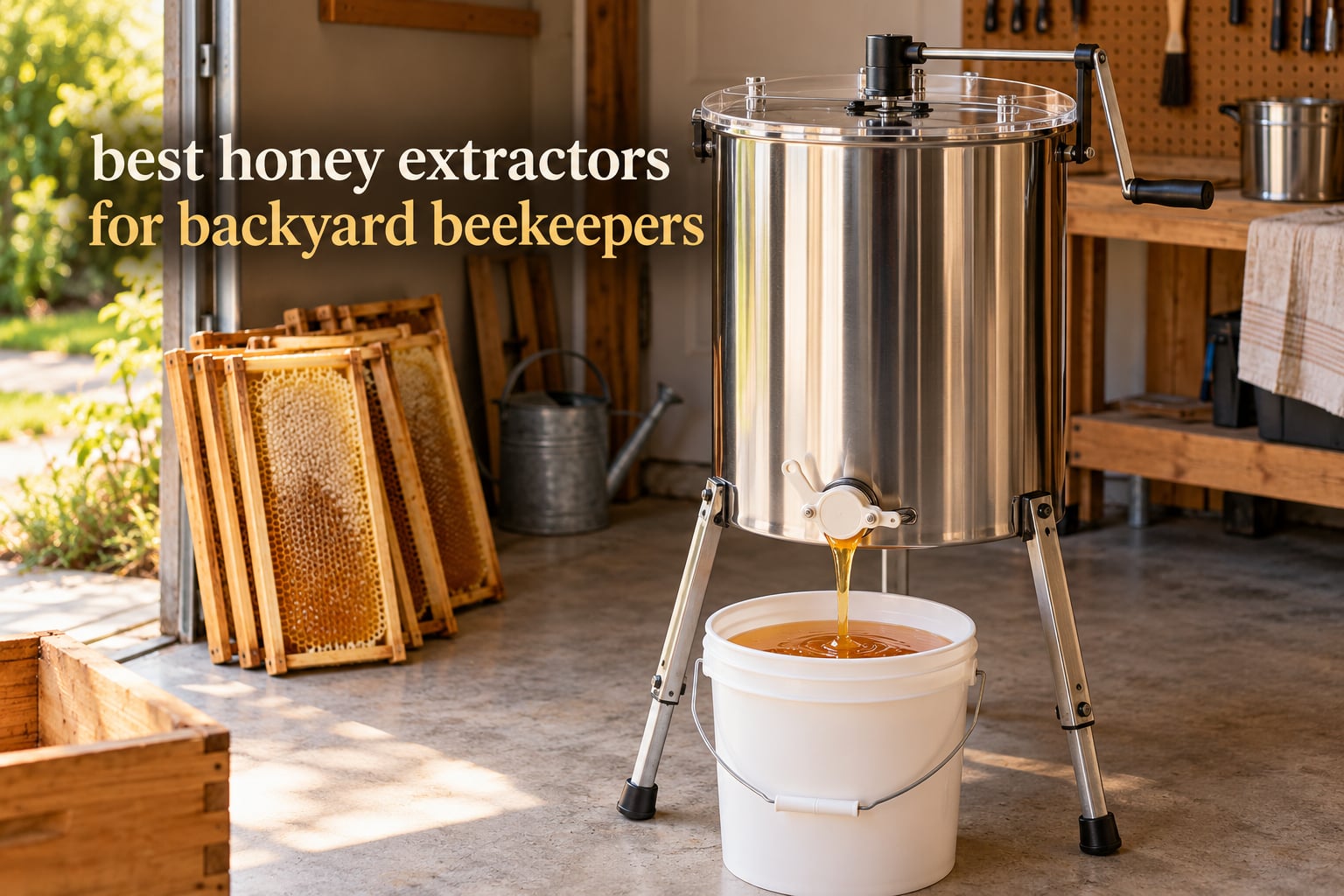
A honey extractor is a drum or barrel that spins uncapped honeycomb frames so centrifugal force slings the honey out of the cells and down to a honey gate at the bottom, leaving the comb intact for the bees to refill. You uncap the frames, load them into a basket inside the drum, and spin slowly first, then faster. Honey flies out to the drum wall, runs down, and drains into your container.
That matters more than it sounds. Crush-and-drain methods destroy the comb, which means your bees rebuild it from scratch and burn weeks of honey doing it. Extraction is also the single biggest time investment in a backyard harvest, so the machine you pick decides how painful your one or two harvest days a year actually feel.
This guide covers the best honey extractors for backyard beekeepers running roughly 1 to 10 colonies and harvesting up to about 20 supers. We compared eight manual and electric drums across frame capacity, drum material, drive type and the specific failure points owners keep reporting. Commercial 18-frame motorized units are out of scope for this list. If you are still working out what a harvest looks like end to end, our backyard monitoring picks help you track conditions through the season.
We kept the scope tight on purpose. Most roundups drift toward bee-farm equipment. Everything here is sized for hives you can walk around in your own yard.
Table of Contents
Top 3 Picks for Best Honey Extractors for Backyard Beekeepers in October

VEVOR 2 Frame Manual Extractor
- 2-frame manual drum
- Fits shallow medium deep
- Food-grade stainless steel
- Adjustable-height stand

VIVO Electric 8 Frame Rack
- Quiet 120V AC motor
- 8 medium or 4 deep frames
- Elevated honey gate
- Clear viewing lid

VEVOR 2/4 Frame Electric
- 140W motor with speed control
- 2 deep plus 2 medium frames
- Clear lid with safety auto-stop
- Bolt-down legs
All 8 Best Honey Extractors for Backyard Beekeepers in 2026
Here is the full lineup side by side. Frame capacity is the number that decides how many load cycles your harvest needs.
| Product | Specs | Action |
|---|---|---|
| VEVOR 2 Frame Manual Honey Extractor |
|
Check Latest Price |
| VIVO Electric Honey Extractor 8 Frame Rack |
|
Check Latest Price |
| VEVOR 2/4 Frame Electric Honey Extractor |
|
Check Latest Price |
 Hardin Professional 2 Frame Manual Extractor Hardin Professional 2 Frame Manual Extractor |
|
Check Latest Price |
 HE3MAN 3 Frame Manual Honey Extractor HE3MAN 3 Frame Manual Honey Extractor |
|
Check Latest Price |
 TRINFREE Electric Plus PMSM Extractor TRINFREE Electric Plus PMSM Extractor |
|
Check Latest Price |
 TRINFREE 6 Frame Manual Extractor TRINFREE 6 Frame Manual Extractor |
|
Check Latest Price |
 Little Giant 2 Frame Honey Extractor Little Giant 2 Frame Honey Extractor |
|
Check Latest Price |
1. VEVOR 2 Frame Manual Honey Extractor – Best Overall for Backyard Hives
VEVOR Honey Extractor, 2 Frame Manual Honey Extractor with Transparent Lid, Stainless Steel Honeycomb Drum Spinner with Height Adjustable Stand,Honeycomb Extraction Centrifuge Equipment for Beekeeping
2-frame manual drum
Fits shallow, medium and deep frames
21.2 lb
Adjustable stand 11.81 to 14.96 in
Pros
- Most reviewed unit in this roundup at 882 reviews
- Handles 2-10 hive operations comfortably
- Enclosed metal gears keep honey out of the drivetrain
- Seamless stainless barrel rinses clean in minutes
Cons
- Legs described as flimsy and unit vibrates unless anchored
- Plastic honey gate threads pop off when tightened
This is the unit I come back to for anyone keeping a handful of hives behind a house. The drum is food-grade stainless steel, and the seamless barrel design means there are no seams for honey to creep out of during a long spin. It holds two frames and takes shallow, medium and deep frames without swapping anything.
Assembly took me under five minutes with the included gloves and a single hex key. Owners report the gear ratio delivers good drum speed without a huge cranking effort, which is the whole reason a 2-frame manual does not feel punishing. It suits small operations of 2 to 10 hives, and for that range it is the most validated machine here with 882 reviews behind it.
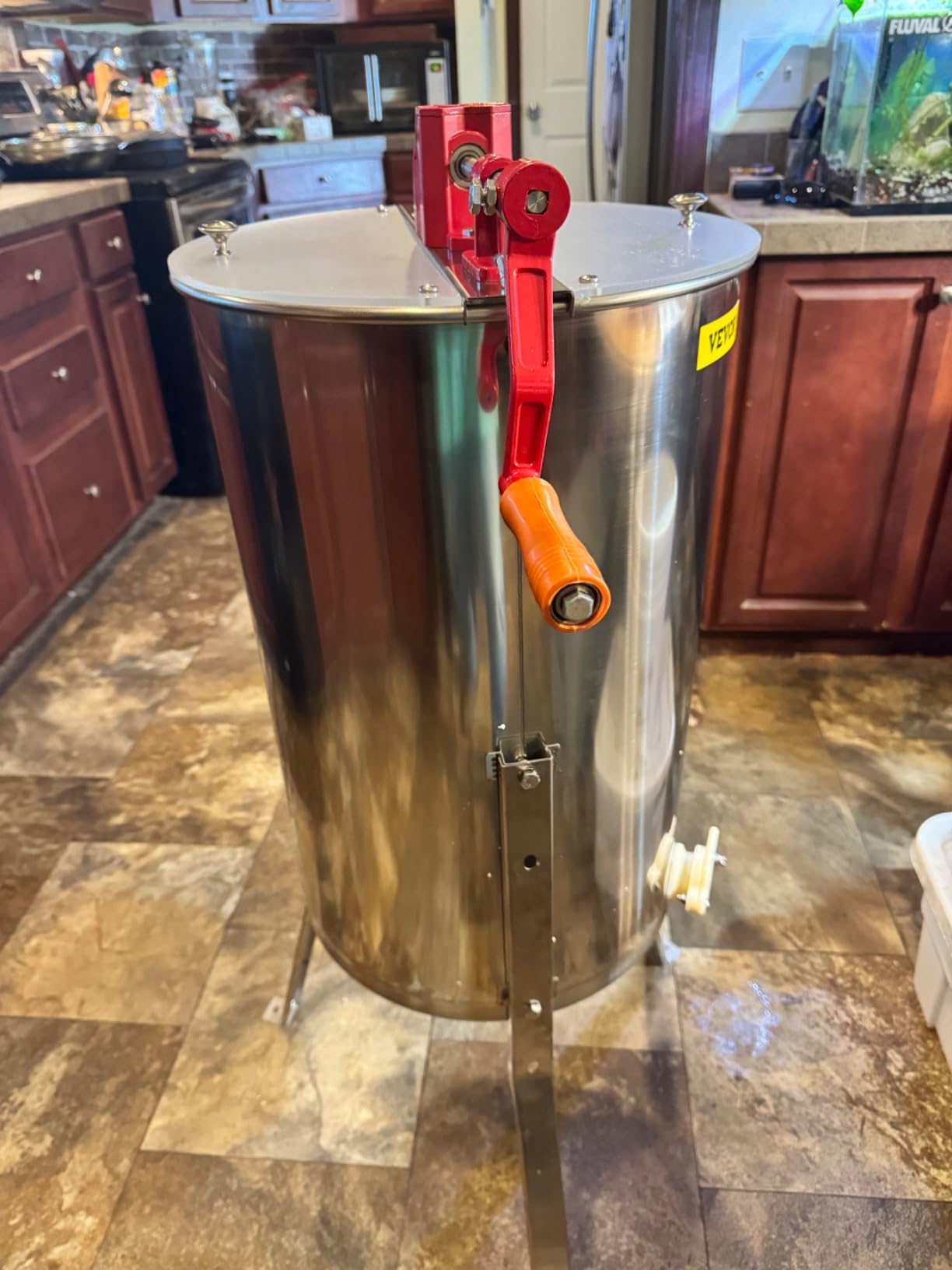
The catch is that nearly every owner anchors it. It vibrates noticeably during a spin, especially with an unbalanced load, and the triangular legs are described as flimsy enough that one owner reported a leg breaking at the foot. Bolting it to a sheet of plywood on a level surface solves both problems. The plastic honey gate is the other recurring weak point; threads pop off when tightened and plenty of owners replace it after the first season.
Sharp edges on the metal legs during assembly catch a few people out, which is why gloves ship in the box. Deep and brood frames also fit the slots very tightly, so check your frame dimensions before you commit. Cranking gets tiring past 20 frames, which is the point at which most of these owners step up to something electric.

What you get right for a first harvest
The adjustable-height three-leg stand moves between 11.81 and 14.96 inches, so you can set the honey gate at a comfortable height over a bucket without a riser. The transparent acrylic lid means you can watch the spin without stopping, which is genuinely useful for a first-timer who wants to see honey leaving the comb.
Because it needs no electricity, you can run it in a garage, a shed or out on the patio without hunting for an outlet. That flexibility is the reason this unit keeps outselling shinier-looking alternatives for very small apiaries.
Where it falls short
It is a two-frame machine. A colony that produced four or five full supers means a lot of load cycles, and each one takes two flips on a tangential unit. Plan the afternoon around that, and it stops being an issue.
Budget for a gate replacement and for anchoring hardware. Once you add those two things, this is the most dependable starter extractor in the roundup for anyone who keeps bees for honey rather than as a hobby project. On the forums, hand-crank VEVOR units are the recurring answer when beginners ask what to buy first.
2. VIVO Electric 8 Frame Rack – Best Electric for 4 to 10 Colonies
VIVO Electric Honey Extractor 8 Frame Rack, BEE-V004E
Quiet 120V AC motor
8 medium or 4 deep frames
18.5 x 25.5 in stainless drum
35.3 lb, 49.5 in tall
Pros
- Takes the physical effort out of extraction entirely
- Gate elevated 17.2 in clears a 5-gallon bucket
- Gate sits near the lowest point so most honey drains without tipping
- One drum handles both 8 medium and 4 deep frames
Cons
- Most expensive unit in this roundup
- 49.5 in tall footprint needs ceiling clearance and a firm floor
This is the one that changes a harvest day. The quiet 120V AC motor removes cranking entirely, which for anyone with real arm fatigue after the first season is the deciding feature. It is also the best-reviewed electric option here at 4.4 out of 5 across 718 reviews.
The drum is 18.5 inches across and 25.5 inches tall, and it runs two configurations: up to 8 small or medium frames, or up to 4 large deep frames in the same basket. That flexibility means it grows with you if you switch from mediums to deeps in later years. The clear plastic lid lets you monitor the spin without opening it.
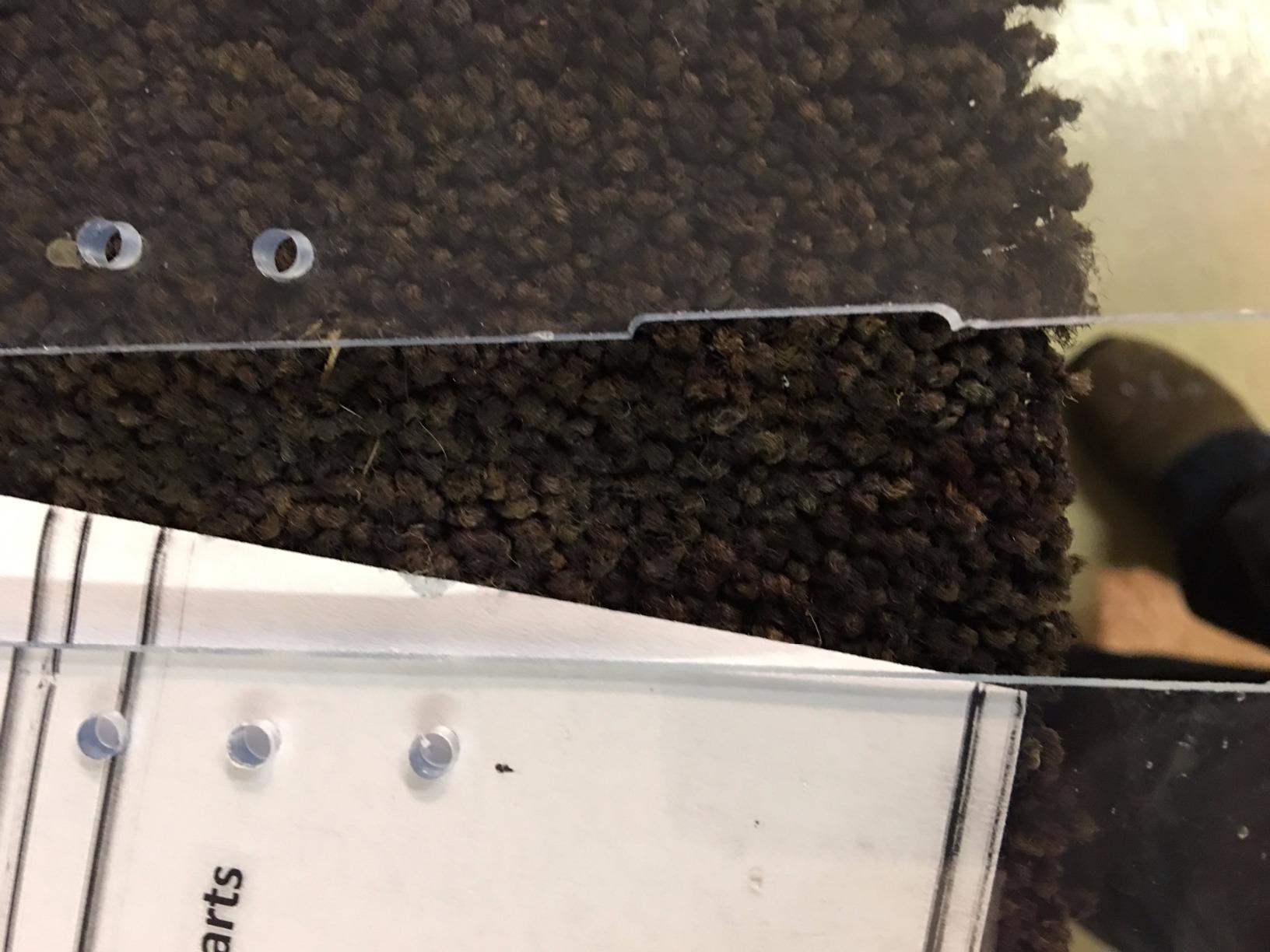
The elevated honey gate is the detail I appreciate most. It sits 17.2 inches off the floor, which leaves genuine room for a standard 5-gallon bucket underneath, and the opening itself rests only half an inch above the barrel bottom. That means you get most of the honey out without tipping the drum forward, which is a real time saver when you have eight frames to drain.
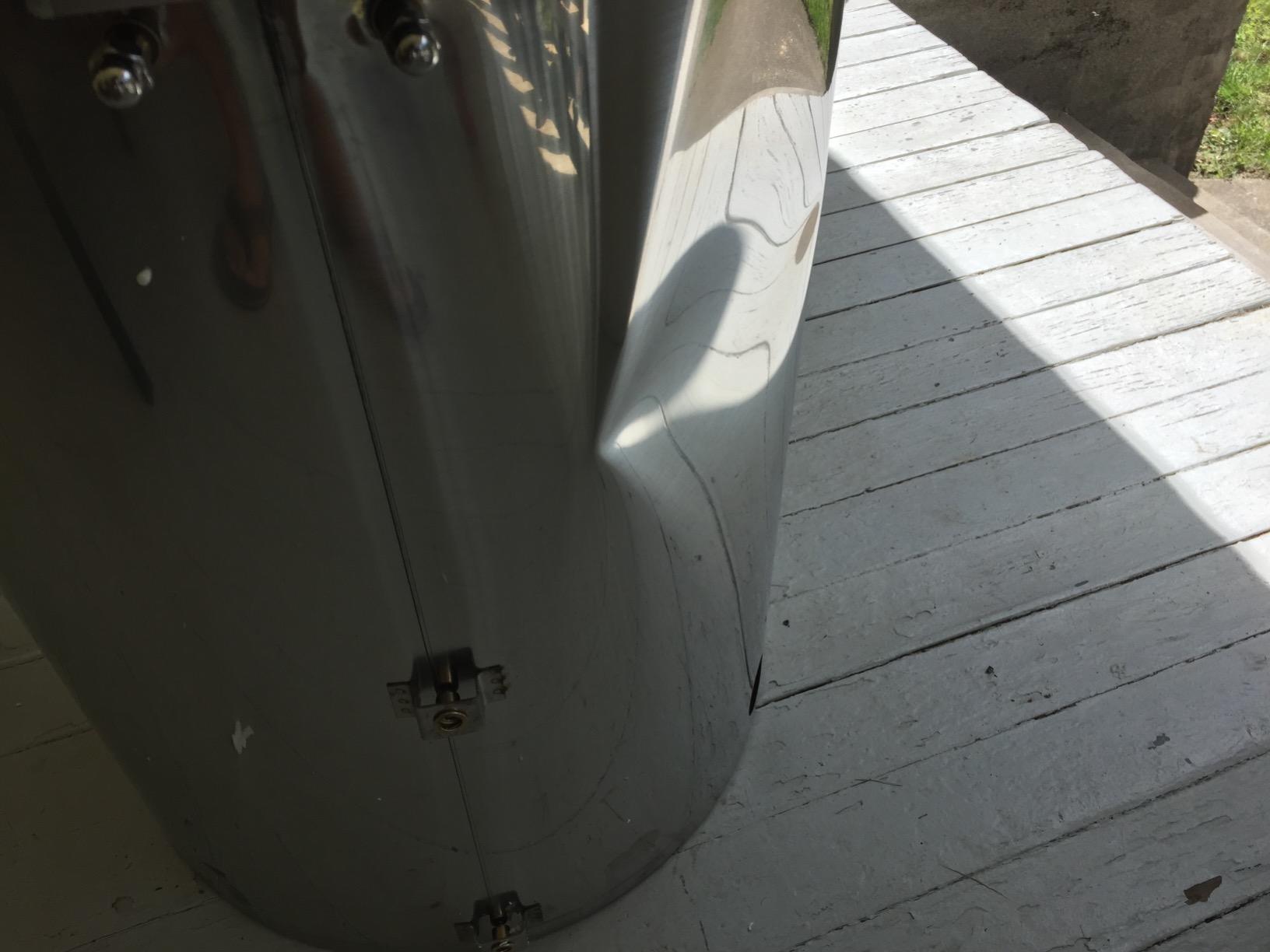
The trade-offs are physical rather than mechanical. At 49.5 inches tall, this needs a garage with real headroom and a floor that will not flex, and it is the heaviest kind of commitment in terms of footprint. The enclosed gears and tall drum also make cleaning the frame basket more involved than on an open manual unit. Buyers running bigger harvests wish it held more than four deeps at once.
What you get right if your harvest grows
Eight frames of medium capacity per load is the sweet spot for someone running four to ten colonies. You finish a load, drain it into a bucket, swap frames, and start again. The stainless drum and clear lid clean down easily with warm water once the honey is off.
It comes with warranty cover from a recognised beekeeping equipment maker, which matters more than it sounds. Warranty and replacement parts availability are the factors hobbyists consistently call out as the real regret triggers, and an electric motor is the component most likely to need one.
Where it falls short
This is the most expensive unit in the roundup, and for someone with two hives and one super a year that money is hard to justify. Start smaller and upgrade later if your colony count climbs.
Noise is low but not silent, so if you extract in the evening near a neighbour’s bedroom wall, check with them first. The tall footprint also dictates where in the garage it can live permanently.
3. VEVOR 2/4 Frame Electric Extractor – Best Small Electric With Speed Control
VEVOR 2/4 Frame Electric Honey Extractor with Adjustable Stand
140W motor to 1300 rpm
Holds 2 deep plus 2 medium
30.6 lb
Height adjustable 39.3 to 42.5 in
Pros
- Quiet motor with true variable speed control
- Auto-stop when the clear lid is opened mid-spin
- Bolt-down legs on a sheet of plywood dampen shaking
- Polished stainless drum cleans easily
Cons
- Shakes with a full 4-frame load unless anchored
- Drain is not at the lowest point so the last honey needs leaning
This is the compact electric option for someone who wants a motor but does not have garage headroom for a tall drum. It holds 2 deep frames plus 2 medium or shallow frames, and the drum is polished rust-resistant stainless with a bottom gasket seal that owners report does not leak.
The 140W motor adjusts up to 1300 rpm, and that ramp-up control matters more than it sounds. You can bring the drum up slowly, which cuts the wobble that plagues fixed-speed units. The clear lid has an automatic shutoff if you open it during extraction, a safety feature reviewers single out as a genuine purchase factor.
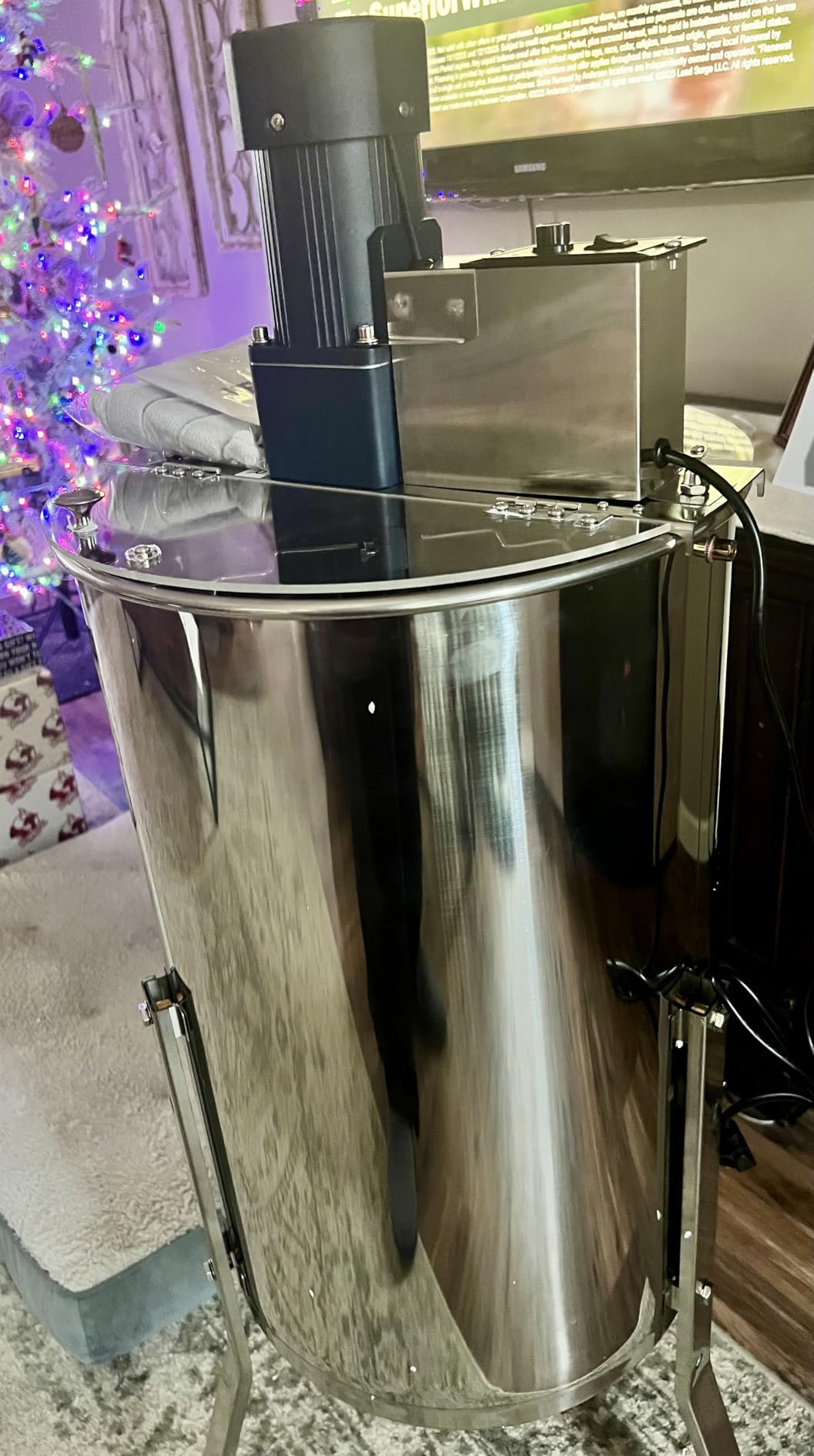
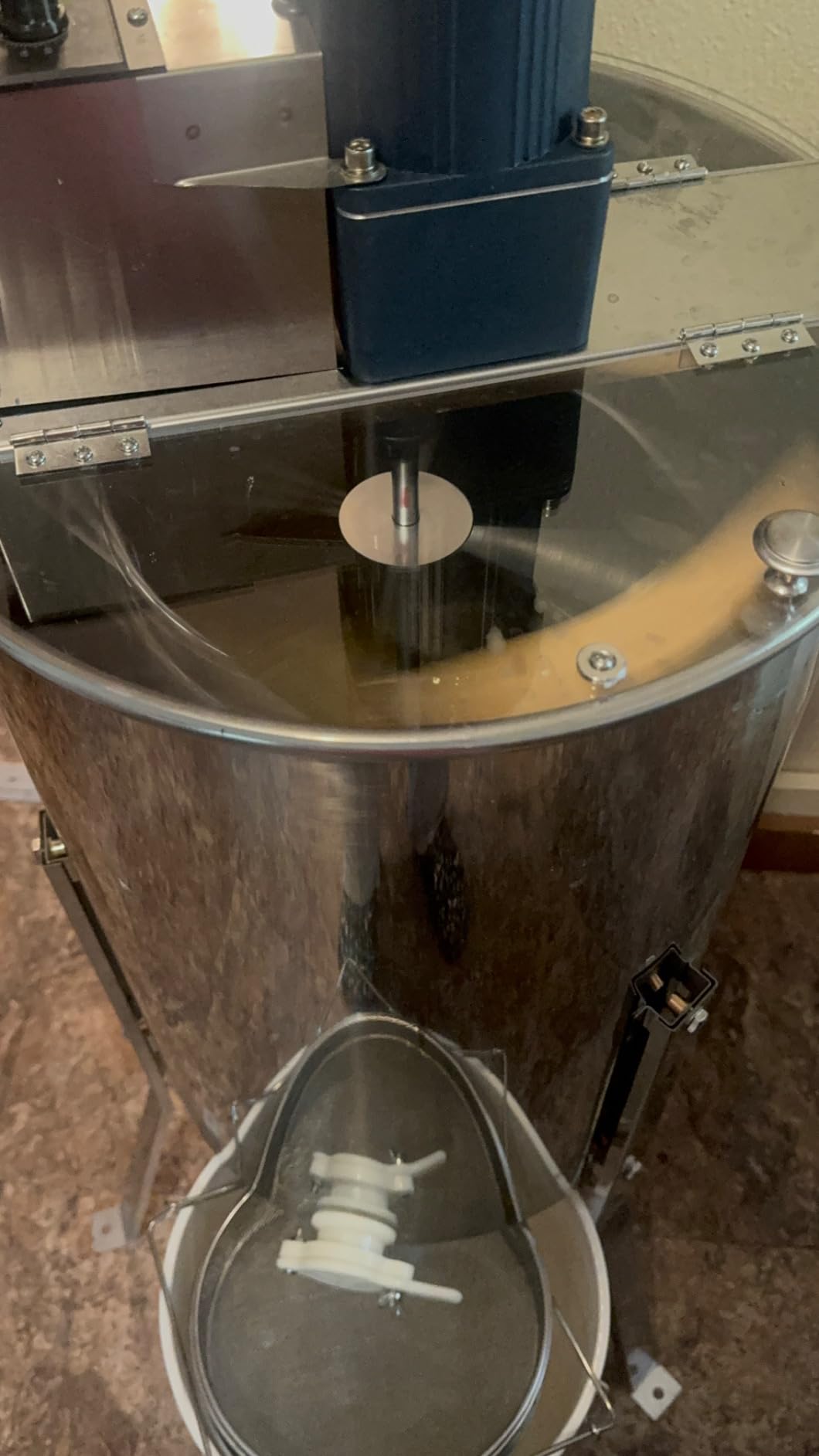
At 4.1 out of 5 across 609 reviews, this is the most polarised unit in the set. The distribution is lopsided: 65 percent five-star but a 12 percent one-star share, the highest complaint tail of any pick here. Recurring grievances are vibration with four loaded frames, drain placement that forces you to tip the drum for the last of the honey, and a frame basket that is difficult to pull out for cleaning.
There are practical frictions too. The height range of 39.3 to 42.5 inches is short enough that a 5-gallon bucket needs a riser under it, and the small screws holding the top doors shake loose and want retightening. One detailed negative review documents a motor failure and an unsatisfying warranty resolution, and one reviewer reports it does not actually hold four medium frames as advertised.
What you get right with a small footprint
The bolt-down legs are the standout here. Owners run the unit at speed, then bolt it to a piece of plywood, which turns a wobbling machine into a steady one. If you have ever chased a vibrating manual drum across a garage floor, that single design decision is worth a lot.
One owner switched from a 5-gallon to a 3.5-gallon bucket simply because it fits underneath more easily, which tells you how much the drain geometry shapes your workflow. Assembly is straightforward and cleanup is quick.
Where it falls short
Capacity is the honest limitation. Two deep plus two medium frames means a big harvest is many cycles, and with the drain above the lowest point you will be leaning the drum at the end of each load to get the last honey.
Given the motor failure and warranty reports, this is the pick I would scrutinise most carefully before buying. Check the review tail for your specific batch, and keep the bolts tight every season.
4. Hardin Professional 2 Frame Manual Extractor – Best Heavy-Gauge Starter Unit
GOODLAND BEE SUPPLY Hardin Professional 2 Frame Manual Honey Extractor, Metallic
16 gauge stainless tank
2-frame manual tangential
Sealed gear bearings
Clear Plexiglass top
Pros
- Thickest stainless sheet metal among the 2-frame manual units
- Sealed bearings run quietly and keep honey out of the gears
- No electronics to fail
- Stand included
Cons
- Listed item weight looks inconsistent with a full steel tank and stand
- Basic design with no speed control or powered drive
This is the tank-durability pick. The drum is 16 gauge stainless steel, which is the thickest sheet metal on any two-frame manual unit in this roundup, and the gear construction uses sealed bearings. For a beekeeper who plans to keep the same machine for a decade, gauge is the number that predicts survival.
The simple hand-crank design has no electronics to fail and no power cord to run, and the clear Plexiglas top lets you watch extraction without stopping the spin. It is a 2-frame tangential extractor, which is the classic hobbyist layout.
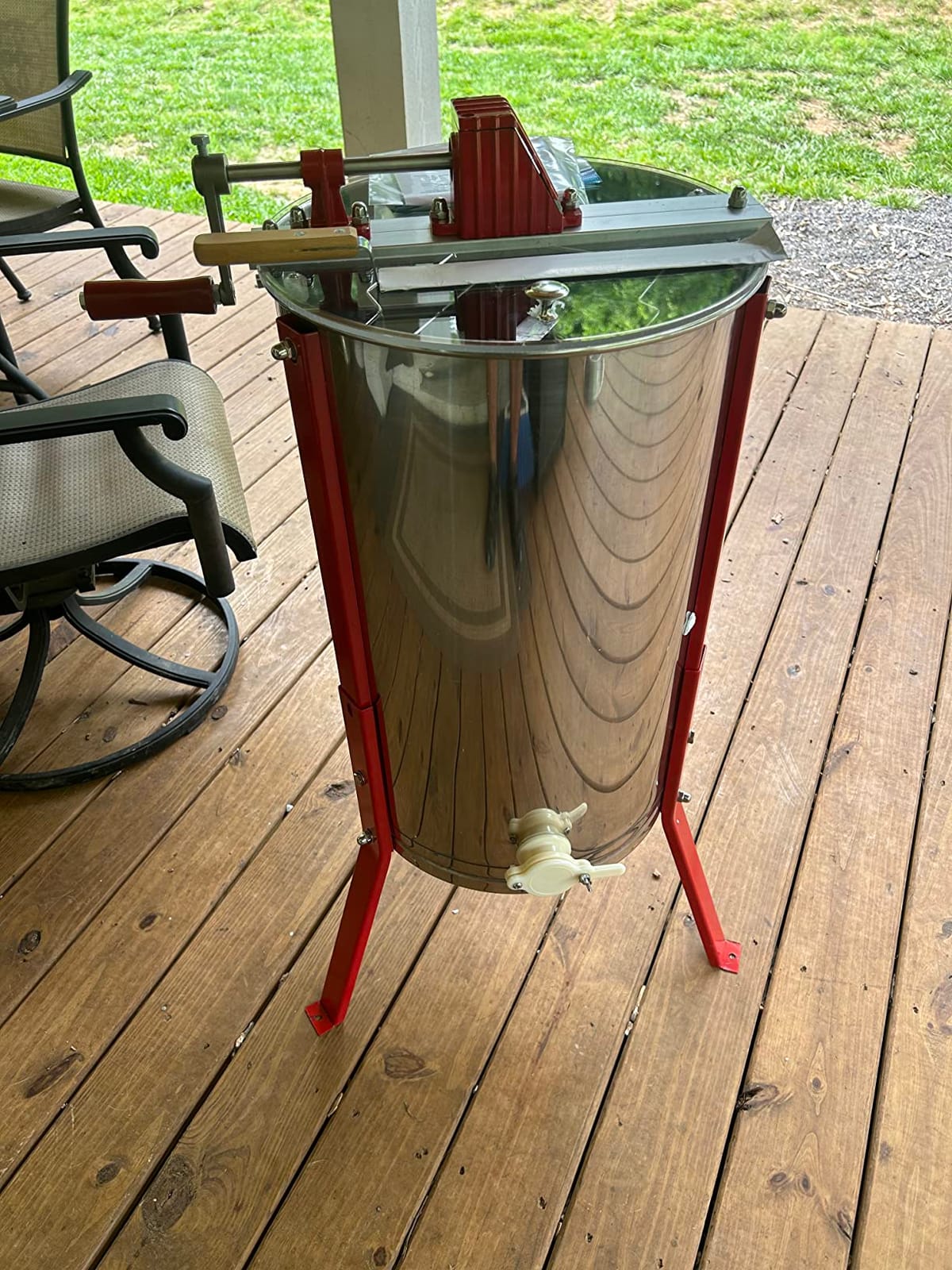
It carries a 4.0 rating across 183 reviews, and the distribution is flatter than the VEVOR units at 52 percent five-star with a 12 percent two-star share. Buyers value the stainless construction and the sealed bearings rather than capacity or convenience. It is sold under the GoodLand Bee Supply name, a long-standing beekeeping supplier, which matters if you want replacement parts to exist in five years.
The listed item weight of 16 ounces is plainly inconsistent with a full stainless tank on a stand, so treat the specs with some scepticism there. Setup also depends on what is actually in the box, since the leg and stand are described as optional rather than universal. And the basic design means no speed control at all, so the extraction pace is entirely set by your arm.

What you get right long term
Sealed bearings are the quiet hero here. They keep honey out of the drivetrain and they wear slowly, which is why this unit holds a steady 4.0 rather than sliding as the season count climbs. No motor means no electrical parts to fail, and no outlet within reach.
If you are buying once and keeping the machine for the next decade, the 16 gauge tank is the reason to look past the higher review counts elsewhere in this list.
Where it falls short
Two frames is two frames. If your colonies are strong and you are pulling five or more supers, you will spend a long afternoon flipping comb. The Plexiglass top also scratches more readily than an acrylic one, so clean it gently.
Confirm the stand is in the box before you order, because setup height affects how comfortably you can work. Nothing about this unit is fast, and that is precisely the point for someone who extracts once or twice a season.
5. HE3MAN 3 Frame Manual Extractor – Best Manual Fit for 5 to 10 Hives
GOODLAND BEE SUPPLY HE3MAN 3 Frame Beekeeping 304 Stainless Steel Drum Honey Extractor With Stand – Manual
3-frame manual drum
22-gauge food-grade stainless
26 lb
Approx. 15 x 24 x 15 in
Pros
- Three-frame batches cut load cycles versus 2-frame units
- Works with deep
- medium or shallow frames with no conversion
- No electricity required
- Included three-piece stand raises the drum to working height
Cons
- Thinner 22-gauge steel is less rigid over time
- Gear system needs periodic maintenance to stay smooth
Capacity is the reason this one exists. A three-frame batch cuts your load cycles by a third against a 2-frame unit, and it does so while staying a pure hand-crank machine with no electricity requirement. For someone running five to ten hives and pulling medium supers, that is the sweet spot without crossing into electric money.
The drum holds deep, medium or shallow frames in each batch, so you are not juggling equipment when you change super size. The clear plexiglass lid contains honey and lets you monitor the spin, and the three-piece metal leg set raises the drum to a working height rather than leaving you crouching over a bucket on the ground.
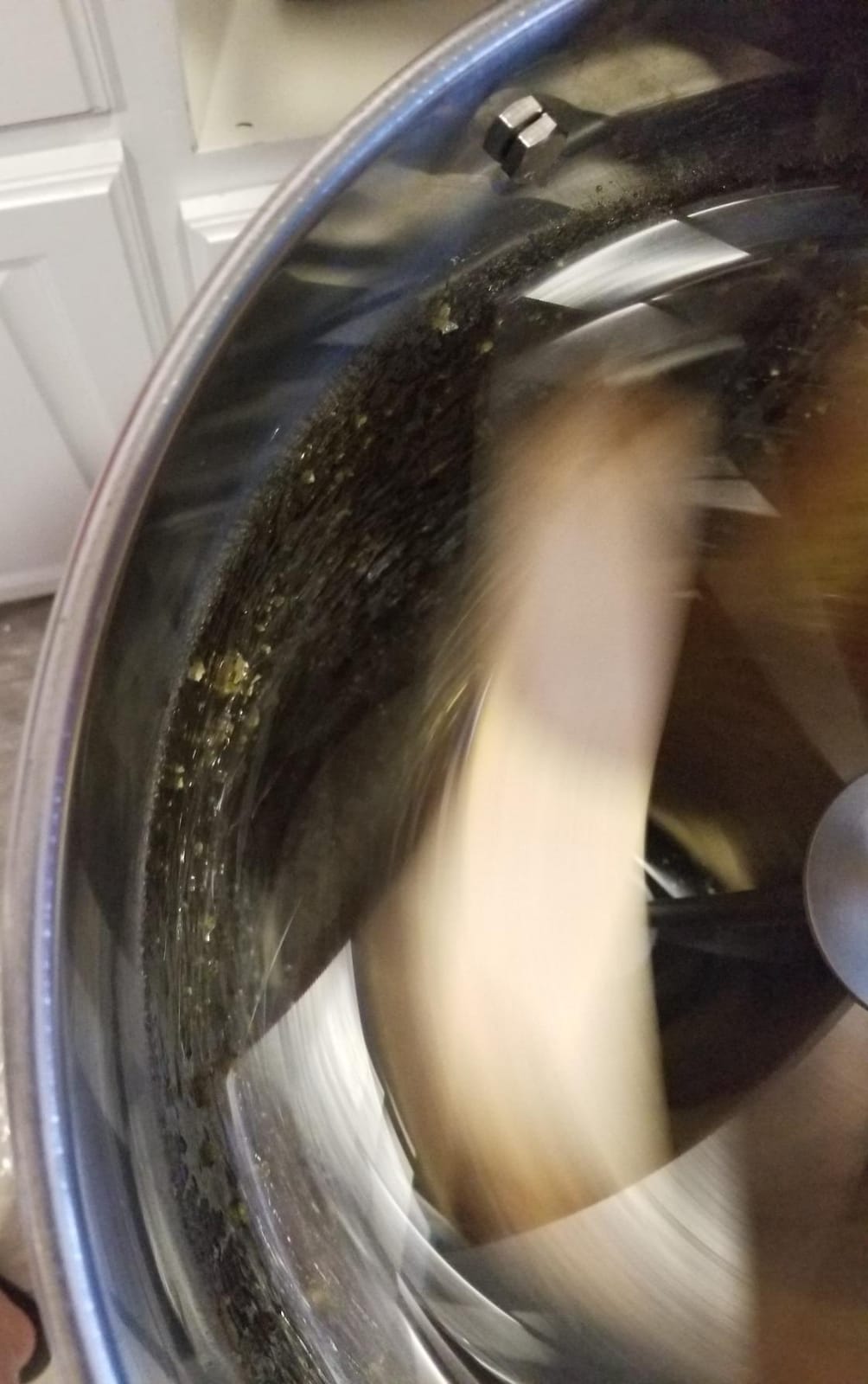
It holds a 4.0 rating across 137 reviews with the most even spread in this roundup: 50 percent five-star, 17 percent three-star and only 5 percent one-star, with no harsh outliers. The stainless drum rinses clean with warm water and mild soap, and the sealed bearings and steel gears are designed to reduce internal wear across repeated harvests.
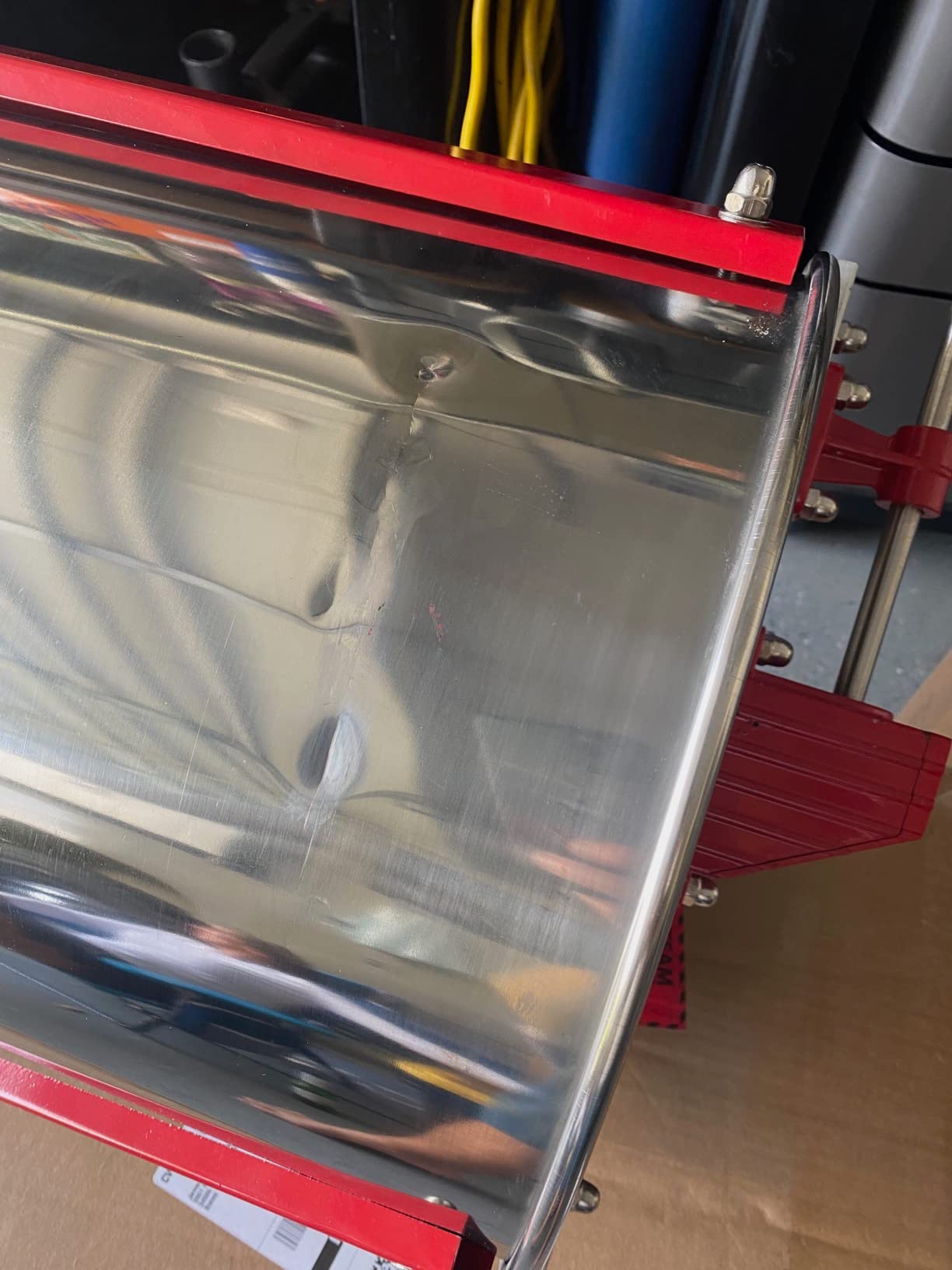
The reservation is gauge. At 22 gauge this is the thinnest steel in the roundup, so over years it is less rigid than the Hardin and the Little Giant. The leg stand also offers less height adjustment than some rivals, and the low-friction gear system still wants periodic maintenance to stay smooth. Full three-frame loads will tire your arms regardless of the gearing.
What you get right with 5 to 10 hives
Matching a three-frame basket to a medium super is the whole trick. Three frames fit one super, you spin, drain, and go back for the next super. That clean one-to-one mapping is why this size keeps showing up as the recommendation for small backyard apiaries that have outgrown a 2-frame drum.
It is also the easiest unit here to place. At roughly 15 by 24 by 15 inches and 26 pounds, it moves between a garage, a shed and a patio table without any disassembly.
Where it falls short
Thin sheet metal is hard to un-ring. If you plan to keep this machine well past five seasons, step up to a heavier gauge rather than buying twice.
And be realistic about the afternoon. Three frames per cycle is a 50 percent increase in cranking per load versus a two-frame unit, so pace yourself across a multi-hive harvest. Budget a few minutes of maintenance on the gears each year and it will hold up.
6. TRINFREE Electric Plus PMSM Extractor – Most Frames per Load
TRINFREE Electric Honey Extractor Plus with PMSM Motor, Dual Tangential/Radial Drum Spinner Fits 4 Deep/8 Medium Radial/Up to 12 Medium Hybrid Frames for Farm Beekeeping Honey Harvest
PMSM permanent magnet motor
4 deep, 8 medium or 12 medium
37.6 lb
Food-grade stainless
Pros
- Holds up to 12 medium frames in one load
- Dual tangential and radial drum lets you switch loading styles
- Full-length support legs run through the drum to resist shaking
- Height-adjustable ground-anchorable legs align to a 5-gallon bucket
Cons
- Newest listing in the set with only 43 reviews
- Heaviest unit here at 37.6 lb
- Through-drum leg design is harder to reach when cleaning
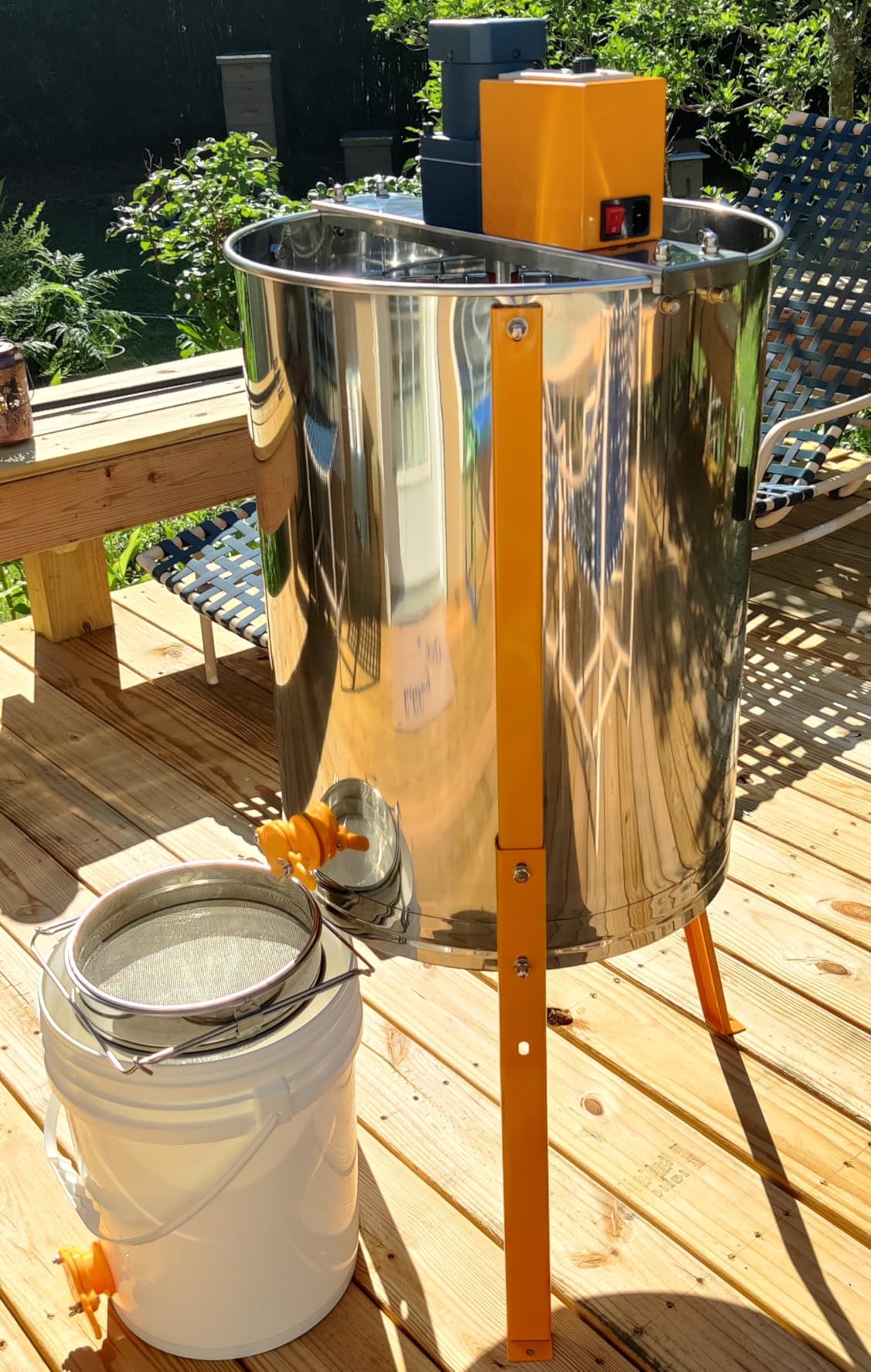
Capacity is the headline. This drum takes 4 deep frames, 8 medium frames in a radial layout, or up to 12 medium frames in a hybrid tangential and radial load. For a backyard beekeeper whose apiary has grown into a dozen supers, that is fewer cycles than anything else in the list.
The dual tangential and radial geometry is genuinely useful because you change loading style by frame size rather than owning two machines. The drum is food-grade stainless throughout, and the transparent acrylic lid, leak-proof honey gate and reinforced internal frame are all built around keeping the machine serviceable.
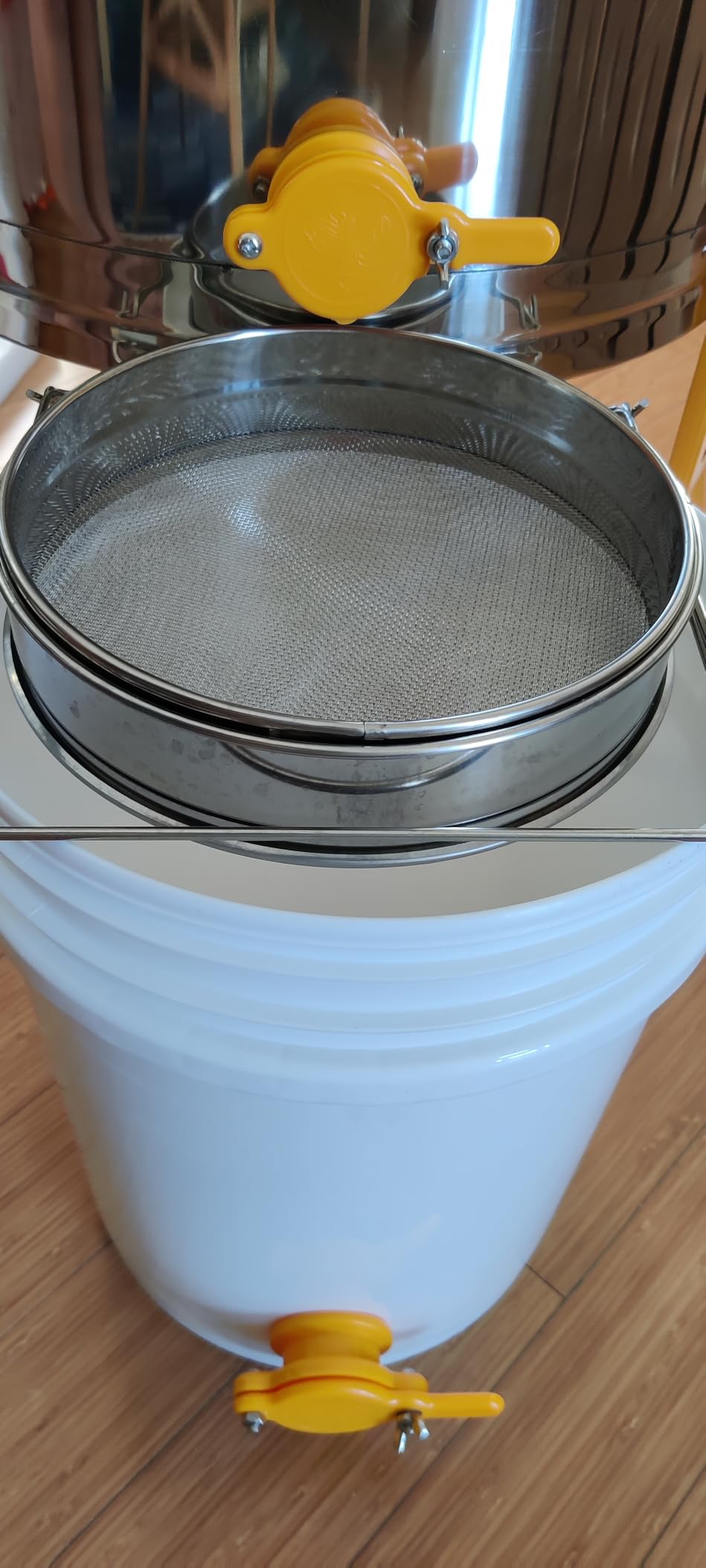
The PMSM permanent magnet synchronous motor spins smoothly and quietly with strong performance, and the full-length support legs extend through the entire drum. That through-drum design is the vibration answer: instead of four legs under a barrel, the support runs the full height, which is why owners report the shaking stays controlled even at speed. The height-adjustable legs can be anchored to the ground and align with a standard 5-gallon bucket.
Here is the honest caveat. It holds 4.5 out of 5 with 72 percent five-star and nothing below three stars except a single review, but that is 43 reviews on a listing that first became available earlier in 2026. The highest rating here and the smallest sample here are the same product. At 37.6 pounds it is also the heaviest unit in the roundup, which makes repositioning it solo harder, and the through-drum leg design is awkward to reach when you wash the frame area.
What you get right with a big yard harvest
Twelve medium frames in one load changes the maths on a harvest day. Fewer loads mean less uncapping, fewer basket swaps and less time standing over a bucket, which is exactly the time cost that pushes people toward electric in the first place.
Being able to anchor the legs to the ground is a real quality-of-life feature in a backyard where concrete is uneven. And the leak-proof gate means you are not chasing drips into your bucket at the end of every load.
Where it falls short
Unproven durability is the headline risk. A 43-review listing with no ratings below three stars tells you the early owners are happy, not that the drivetrain survives a decade. Buy replacement parts confidence, not just the machine.
Fewer independent buyers have verified the frame sizes in practice, so check your actual super dimensions before ordering. If you are not extracting a dozen frames in one sitting, this capacity is headroom you are paying for and not using, and overbuying early is the most common regret hobbyists report.
7. TRINFREE 6 Frame Manual Extractor – Best Manual Capacity Per Load
TRINFREE 6 Frames Manual Honey Extractor, Basic Stainless Steel Drum Spinner with Clear Lid, Fits 2 Deep and 4 Medium Frames for Beginner Beekeeping Honey Harvest
Fits 2 deep and 4 medium frames
Food-grade stainless drum
26.6 lb
Transparent acrylic lid
Pros
- Six frames of manual capacity is unusual at this drive type
- Nano-precision gear system runs smoothly and quietly
- Through-drum support legs limit shaking at speed
- Height-adjustable legs align with a standard 5-gallon bucket
Cons
- Smallest review base in the roundup at 26
- Manual cranking still tires arms on a full six-frame load
- Brand is new to beekeeping equipment
This is the highest-rated product in the roundup at 4.7 out of 5, with 82 percent five-star and nothing below three stars. It is also the smallest sample at 26 reviews on a listing that went live earlier in 2026, so read that pair of numbers together rather than picking one.
What it does is unusual. A pure hand-crank machine that fits 2 deep and 4 medium frames per load gives you six frames of capacity without a motor, which normally means six frames of cranking. The self-developed nano-precision gear system is what makes that tolerable, running smoothly and quietly and cutting the effort per turn.
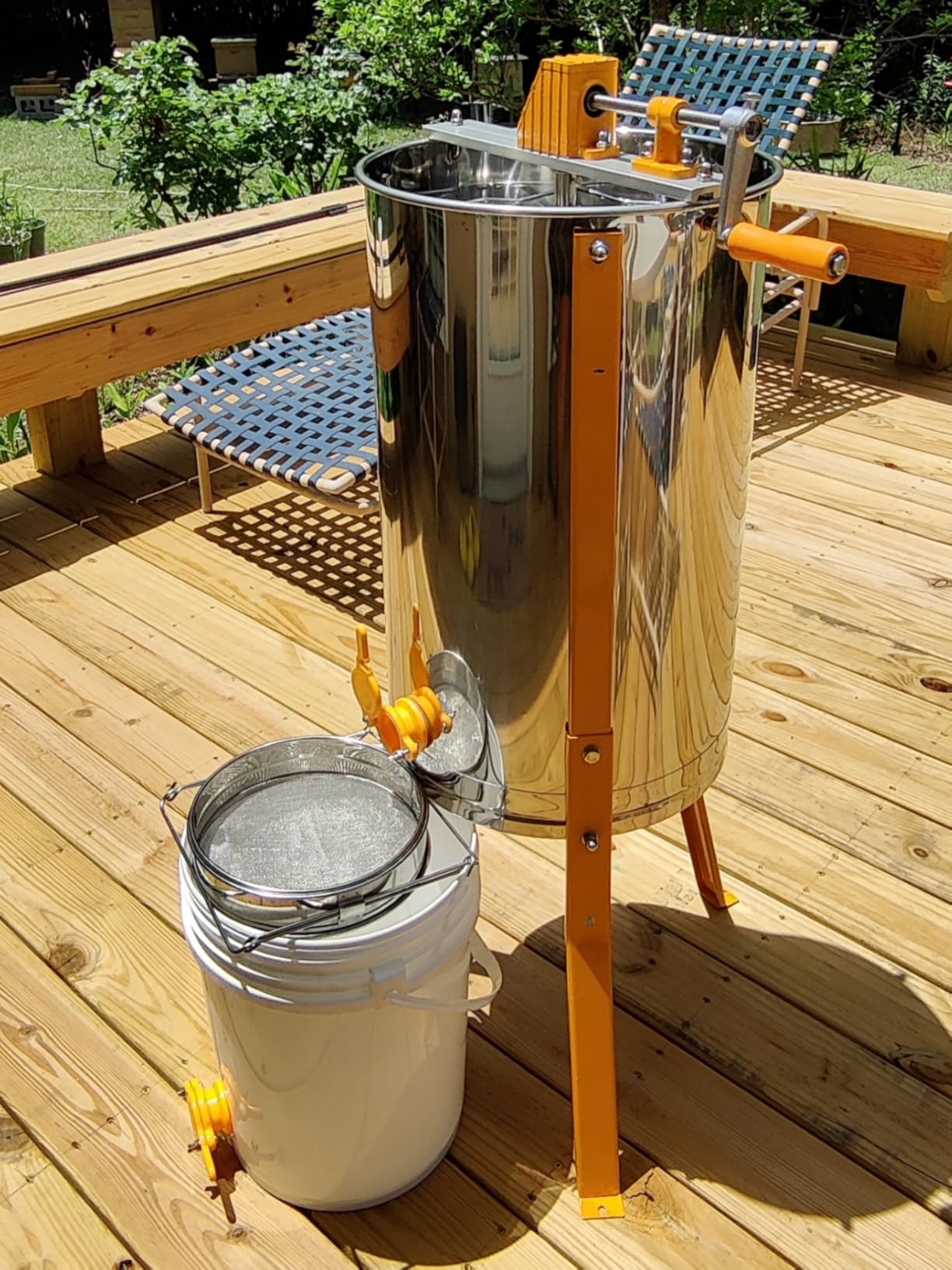
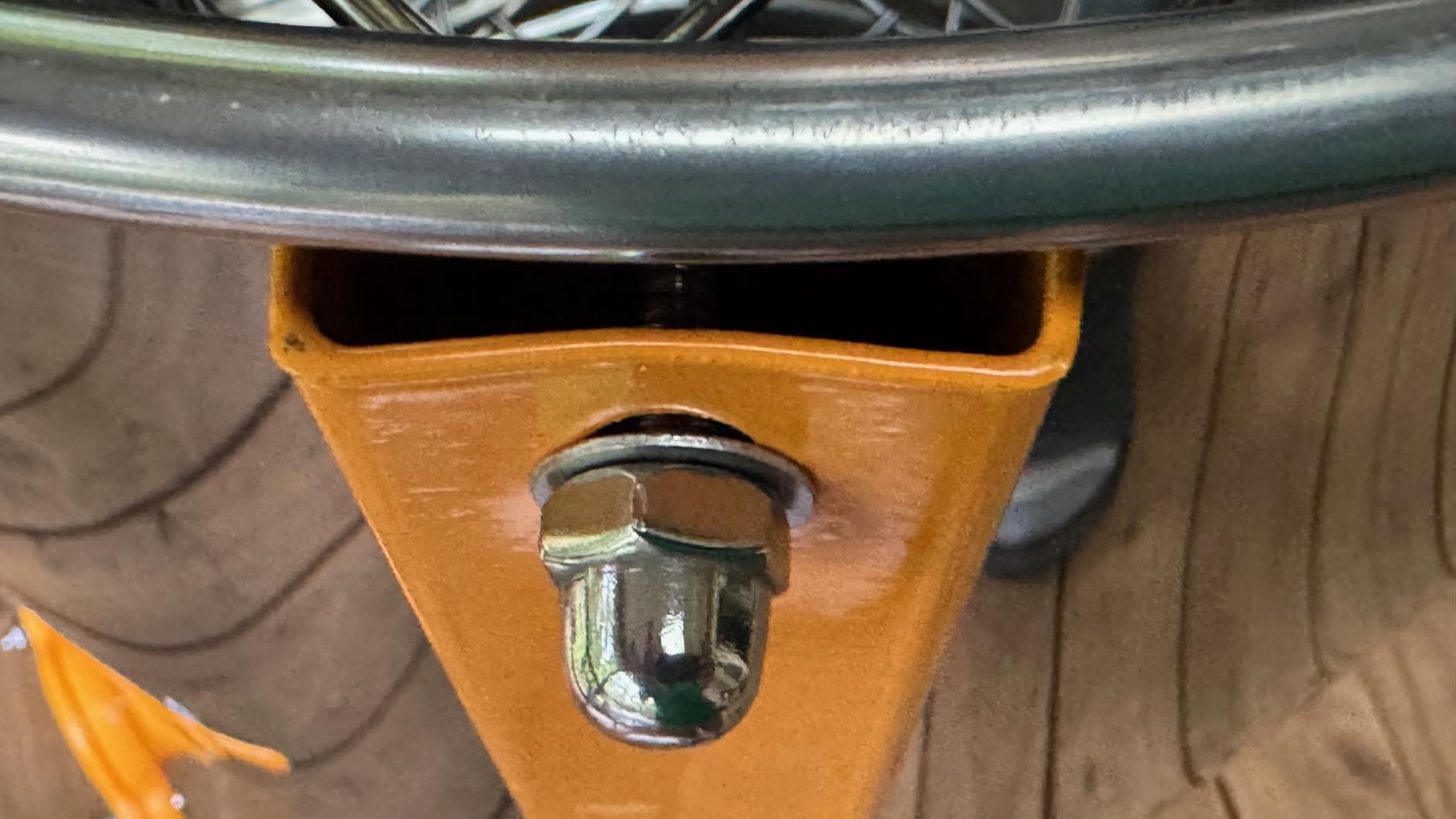
The through-drum support legs are the same vibration answer as the electric version in this line, extending through the entire drum to keep the barrel steady at speed. The height-adjustable legs can be anchored to the ground and are designed to line up with a standard 5-gallon bucket, so collection stays clean. The drum is food-grade stainless with a transparent acrylic lid for real-time monitoring.
Be clear-eyed about the limits. Six frames is a genuinely heavy manual load and the gearing only reduces fatigue, it does not remove it. A hand-crank drive means no speed control, so the extraction pace is entirely yours. And a brand new to beekeeping equipment has no long service record, which is exactly the trust signal experienced hobbyists weight heaviest when deciding whether parts will exist in ten years.
What you get right without an outlet
No electricity means no outlet, no extension lead across the yard and no noise complaint. You can extract in a shed, a garage or a covered patio at whatever hour suits the weather, which is a genuine freedom if your apiary sits away from your house.
Six frames also maps cleanly onto a medium super harvest. Two deep plus four medium is a realistic load from a small backyard operation, so you finish a super in one cycle rather than three.
Where it falls short
Twenty-six reviews is not a track record. The rating is encouraging and the sample is thin, and buying on a 4.7 from 26 owners is a different kind of bet than buying on a 4.3 from 882.
Full six-frame loads will tire your arms, so pace a multi-hive harvest across more than one session. If your harvest is consistently more than about a dozen frames, a small electric unit will save you more time than it costs.
8. Little Giant 2 Frame Extractor – Best All-In-One Kit
Little Giant® 2-Frame Honey Extractor for Beekeeping | Hand-Crank Manual Honey Extractor Equipment | Stainless Steel | Beekeeping Supplies
2-frame manual tangential
18/10 stainless steel construction
24 lb
Fits deep or medium frames
Pros
- Complete kit with crank
- honey gate
- cover and height-adjustable legs
- 18/10 stainless steel from a heritage US manufacturer
- Tangential geometry suits both deep and medium frames
- Zero 1-star reviews across its rating history
Cons
- Highest outlay of any 2-frame manual unit here
- Requires initial assembly before first use
- Only 30 reviews relative to its price
This is the pick for someone who wants to open one box and start extracting. The kit includes the hand crank, honey gate, cover and height-adjustable legs, so nothing has to be sourced separately. The body is 18/10 stainless steel from Miller Manufacturing, a long-running US maker, and comprehensive instructions are included for the initial assembly.
Geometry is tangential, and the pot fits two deep or medium frames at a time. It carries a 4.4 rating with 67 percent five-star and, notably, no 1-star reviews at all across its history, which is rare in this category.
The value-for-capacity tradeoff is the whole story. This is the most expensive 2-frame manual unit in the roundup, and you are paying for material gauge, brand backing and the completeness of the kit rather than for size. It holds the fewest frames, which means the most load cycles for a given harvest, and at 30 inches tall it needs more vertical space than the compact 2-frame units.
Only 30 reviews across that history, so long-term ownership is lightly documented relative to what it costs. Some initial assembly is required before first use, which is a small afternoon of work rather than a dealbreaker.
What you get right in the box
Everything you need arrives together, and that genuinely matters for a first-time buyer. There is no sourcing a separate stand, no hunting for a compatible honey gate and no wondering whether the cover is included. Legs are height-adjustable, so you set the drain over your bucket on day one.
Zero 1-star reviews is a meaningful signal in a category where durability complaints dominate. The 18/10 stainless body is the kind of construction that ages well in a damp shed.
Where it falls short
Two frames is the smallest basket here, so a 12-frame harvest means six load cycles and twelve flips. Budget the afternoon accordingly, or pair it with a bigger unit in year two.
The narrow review base means less long-term evidence than the heavily reviewed picks. If your operation is heading past five hives quickly, a 3-frame or 6-frame manual will scale with you better, and our backyard setup guide covers the rest of the extraction-day kit you will need either way.
How to Choose a Honey Extractor for Your Hive Count
Start with the number of frames you expect to pull on a single harvest day, not the number of hives. A strong colony in a good year can give you four or five full supers. Multiply that by your colony count and you have your real load demand, which is the only number that matters.
As a rough map: one to four colonies that harvest once a year are well served by a 2-frame manual unit. Five to ten colonies pushing medium supers point at a 3-frame or 6-frame manual. Past that, or if you pull heavy deep frames, an electric unit earns its cost through saved arms rather than through throughput.
Frame size compatibility is where people get caught out. An 8-frame rack and a 3-frame tangential basket are not interchangeable, and a drum balanced for deep frames will wobble badly if you load it with mediums. Check the stated frame dimensions against your actual supers before ordering, and never run an odd number of frames in a load, because the imbalance is what causes the violent shaking owners complain about.
Material is the second filter. Every unit in this roundup is stainless steel or food-grade stainless steel, so at this scale you are choosing gauge rather than plastic versus metal. 16 gauge stainless like the Hardin and 18/10 like the Little Giant will outlast 22 gauge steel like the HE3MAN many times over.
Last, check the drivetrain support. The units with full-length legs running through the drum, like both TRINFREE models, stay markedly steadier at speed than units with legs that stop at the rim. If you have a concrete floor, ask whether the legs can be bolted or anchored down.
Radial vs. Tangential Extractors: Which One Do You Want?
Tangential extractors seat frames with one face of the comb parallel to the drum wall, which means you extract one side of each frame and have to flip and run the cycle again. Radial extractors point the top bar of the frame toward the axis, so centrifugal force pulls honey from both sides of the comb in a single spin.
Radial is faster because it halves the number of cycles, and it is the better choice once you are extracting dozens of frames. Every unit in this roundup except the dual-mode TRINFREE is tangential, because at 1 to 10 colonies the trade is worth making. You trade a longer afternoon for a machine that costs less, takes less space and has no motor to fail.
There is a middle path. The TRINFREE Electric Plus uses a dual tangential and radial drum spinner, so you choose the loading style by frame size rather than owning two machines. If you are certain your apiary is heading past a dozen frames per harvest, that flexibility is the argument for it.
Manual vs. Electric Extractors: Which Is Better for a Backyard Apiary?
A manual crank extractor is cheaper, quieter, needs no outlet and has almost nothing to break. An electric unit removes the cranking entirely, which is the difference between a pleasant afternoon and a sore-arm evening once you are past a dozen frames.
For one to four colonies, manual wins on every practical axis. A 2-frame unit like the VEVOR or the Hardin handles a small harvest in a reasonable time, and forum consensus keeps pointing beginners toward hand-crank units for exactly that reason.
For five to ten colonies with heavy yields, electric earns its cost through labour saved rather than capacity. Both VEVOR and VIVO electric units here remove the arm fatigue that pushes people to upgrade after a first season. The trade is a power cord within reach, a taller footprint, a motor that can fail, and a higher up-front cost.
A middle route exists for many hobbyists: buy a manual unit now and add a conversion motor later. The 3-frame and 6-frame manual drums are the ones worth converting, because a small tangential unit is the most common first purchase and the most common second-year regret.
Should You Buy, Rent, or Borrow an Extractor?
Borrow first if you can. A local beekeeping association or a mentor with a spare tangential unit will cover your entire first harvest for free, and that first extraction is when you learn what you actually need rather than what you think you need.
Rent is the right call if you expect one or two hives and one good year. Many associations and equipment rental businesses offer extractors by the weekend, which suits a harvest that happens once a season.
Buy when you are pulling more than a dozen frames a year, when borrowing is no longer convenient, or when you want control over your own schedule. Just buy to your current hive count, not to the number you plan to have in three years. Overbuying early is the most common regret hobbyists report, and an eight-frame electric sitting in a garage for three seasons helps nobody. Our backyard barbecue guide covers the other seasonal equipment that earns its keep in a yard.
Setting Up a Backyard Extraction Station
Work in a garage, shed or covered area rather than out in the open apiary. Open-air extraction draws every bee in the neighbourhood to your honey, and a cloud of foragers around a bucket is how people end up stung repeatedly on their own harvest day.
You need three pieces beyond the extractor: an uncapping tool, a food-grade settling tank with a double sieve, and a floor you can wash. Warm comb extracts far better than cold, so pull supers a day or two ahead and store them indoors at room temperature.
Load an even number of frames, always balanced across from each other. Start the spin slowly, ramp up, drain, then flip and repeat on a tangential unit. Do not rush the ramp-up; that is the single biggest cause of comb blowout and foundation damage.
For the no-electricity case, manual units sidestep the problem entirely. For the no-outlet case, a garden solar bank and a small inverter will run any of the electric picks here, but the simpler answer is to extract in a room where a socket already exists.
Clean the drum the same day. Warm water and mild soap on a stainless drum is enough, and letting honey sit in the basket overnight is how wax moths find equipment before they find your frames.
Frequently Asked Questions
What is the best type of honey extractor for beekeepers?
For 1 to 10 backyard colonies, a tangential manual drum is the right default. It costs less, needs no outlet and has nothing to fail, and it handles the load volumes a hobbyist apiary produces. Move to a radial or hybrid electric unit only when a single harvest exceeds roughly a dozen frames.
Which is better, manual or electric honey extractor?
Manual is better for one to four colonies because it is cheaper, silent and has no motor to fail. Electric is better for five to ten colonies with heavy yields because it removes the arm fatigue that comes with dozens of cranked cycles. Cranking, not throughput, is the deciding factor.
Which is better, radial or tangential honey extractor?
Radial extracts both sides of the comb in one spin, so it halves the number of cycles. Tangential extracts one side, so frames must be flipped and run again. Radial is faster but costs more and needs more space, which is why nearly every unit sold for backyard hive counts is tangential.
What is the best honey extractor for a beginner beekeeper?
A 2-frame manual tangential unit is the standard first purchase. It covers one to four colonies, assembles quickly, needs no power and is simple to learn. The VEVOR 2 Frame Manual in this roundup is the most reviewed option, while the Hardin offers heavier steel for buyers who want a longer-lived tank.
How long does it take to extract honey with an electric extractor?
A single load takes roughly 5 to 10 minutes including ramp-up and drain time. An 8-frame electric unit completes a load in one pass, while a 2 or 3-frame tangential manual unit needs a flip and a second pass, so a 12-frame harvest runs about six cycles. Full harvest time depends far more on how many supers you pulled than on the motor.
Do I need a honey extractor to harvest honey?
No, but crush-and-drain and scrape methods destroy the comb, which means your bees rebuild it from scratch and burn weeks of honey doing it. A single hive that harvests occasionally can gravity-drain or use a Flow-style frame instead, which makes a machine unnecessary for that case.
Which Honey Extractor Should a Backyard Beekeeper Buy in 2026?
If you keep one to four colonies, buy the VEVOR 2 Frame Manual. It is the most reviewed machine in this roundup, needs no electricity, takes any frame size, and costs the least to live with once you anchor the legs and replace the plastic honey gate.
If you are heading toward five to ten colonies with heavy yields, the VIVO Electric 8 Frame Rack removes the cranking and holds a full medium super per load. If your yard has no headroom for a tall drum, the VEVOR 2/4 Frame Electric gives you speed control and a lid safety shutoff in a compact footprint.
If you plan to keep the same machine for a decade, look at gauge before anything else, which points to the Hardin 16 gauge tank or the Little Giant 18/10 body. And if you are still on your first season, borrow one before you buy any of them. Whichever route you take, the best honey extractors for backyard beekeepers share the same three traits: steady legs, a gate that does not leak, and a drum that is easy to wash the same day you finish.